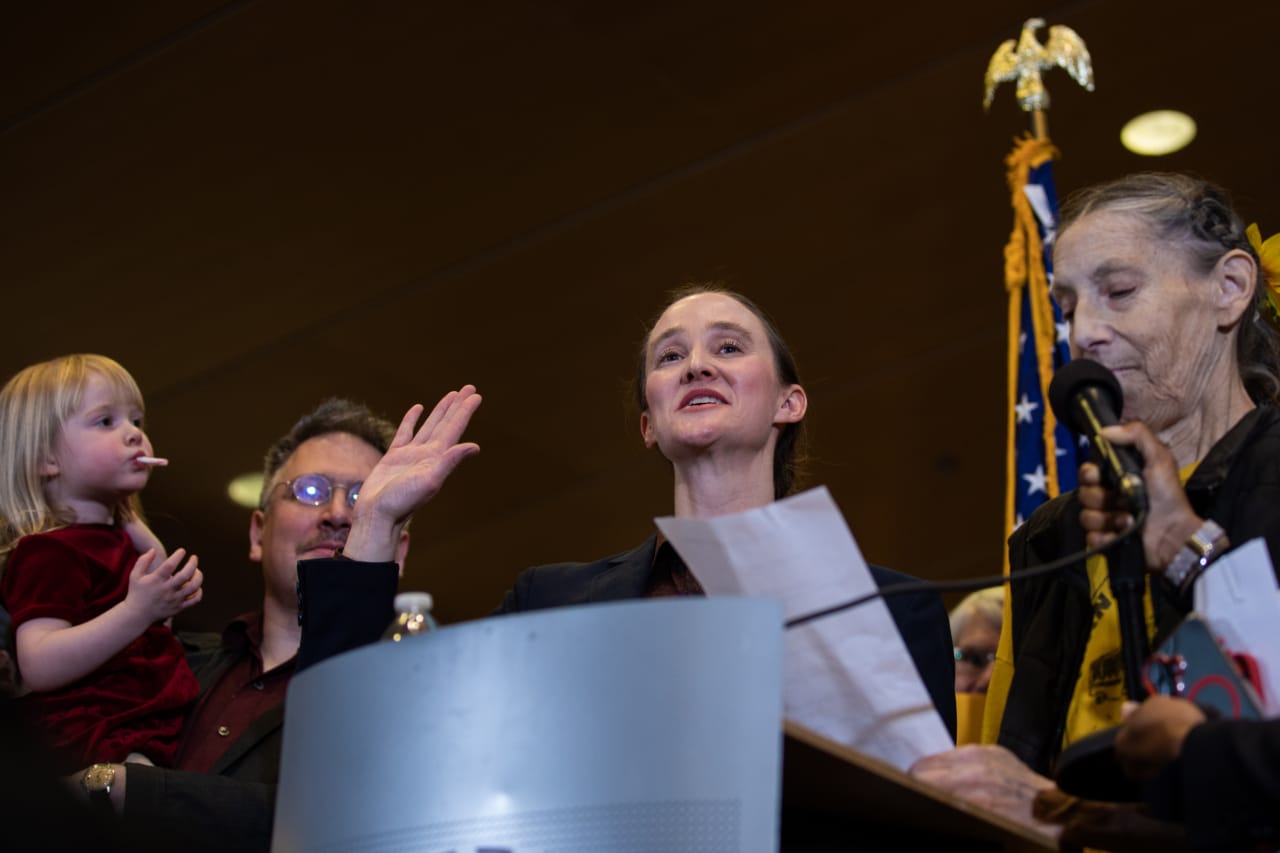
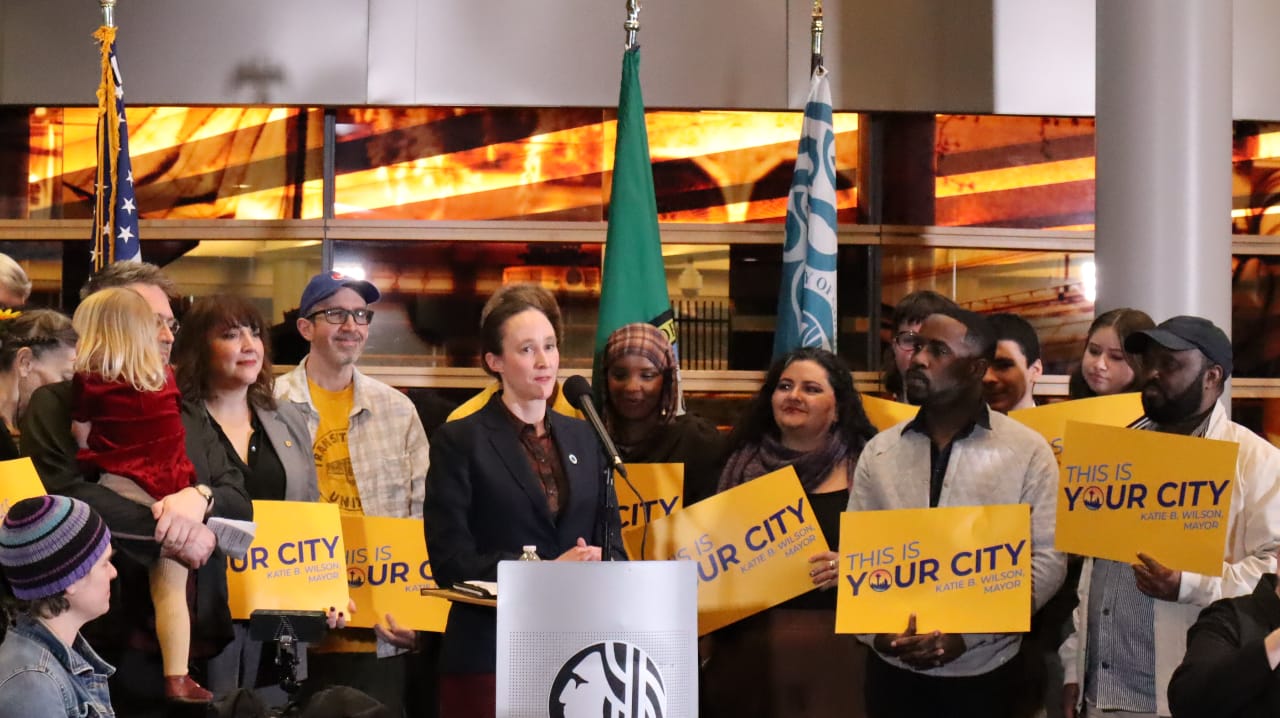
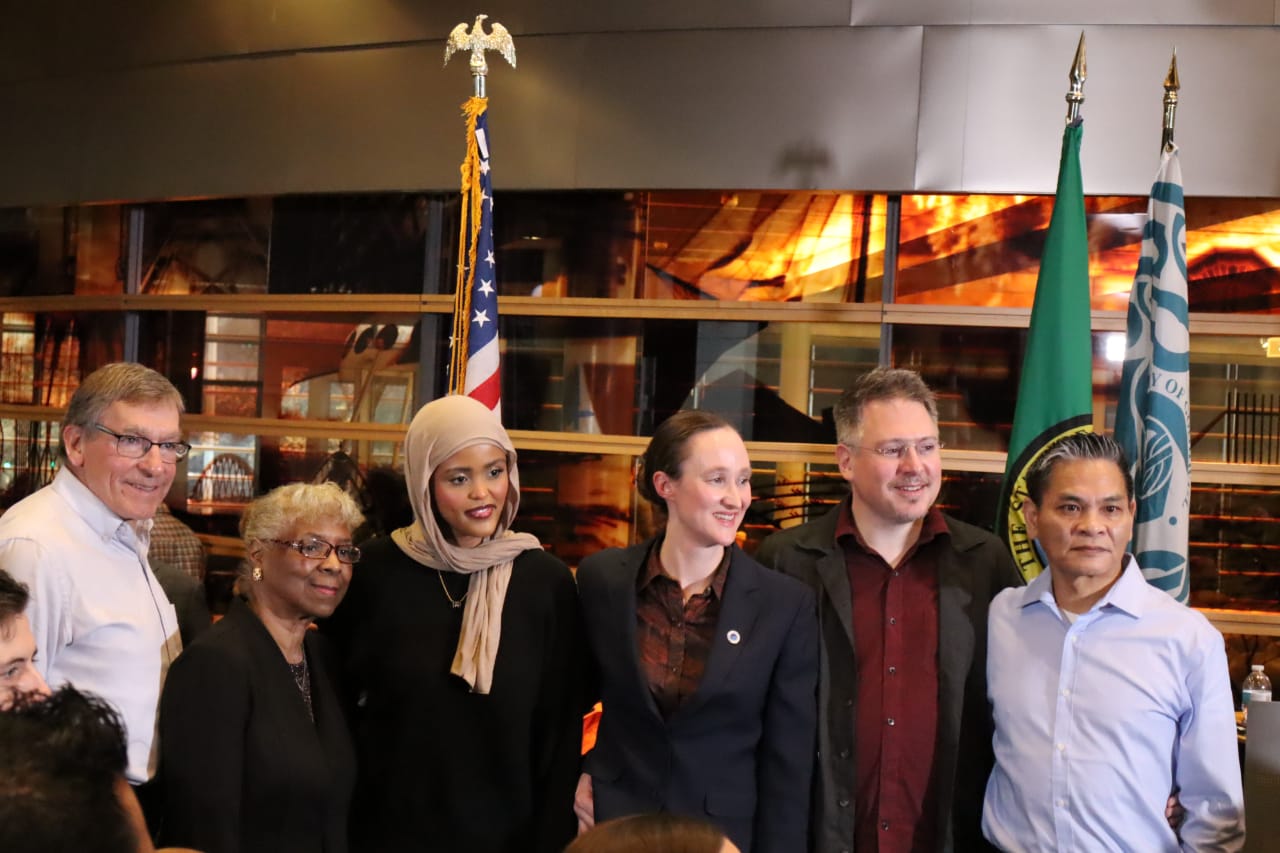
Surrounded by a crowd of supporters, onlookers, and elected officials, Katie Wilson ceremonially started her tenure as Seattle’s 58th mayor Friday morning, setting a clear tone around the issues of affordability and city livability. As the first millennial to lead Seattle city government, the packed City Hall event that was open to anyone walking by seemed to set a tone for an accessible administration that will be doing things differently than they’ve been done in the past.
Wilson had officially taken over the mayor’s office at midnight on New Year’s Day, after a hard-fought November election that saw her prevail over departing Mayor Bruce Harrell by just over 2,100 votes. She takes office as the first mayor elected by Seattle’s progressive coalition since Mike McGinn in 2009, and she faces significant pressure to deliver on her campaign promises.
The new mayor has pledged to add 4,000 new shelter beds in an attempt to make a dent in the city’s homelessness crisis, and to end counterproductive sweeps that just end up moving encampments from place to place. As a Capitol Hill transit rider, Wilson has also pledged to override the Seattle Department of Transportation and paint a red bus lane along Denny Way for the Route 8, freeing the infamously delayed bus from traffic congestion.
In remarks that set the tone for the next four years, Wilson painted a bold vision for a city government that was more trustworthy, and responsive to the needs of its citizens. Those remarks carried forward her campaign-long theme of addressing Seattle’s affordability woes, but the vision she fleshed out Friday went further than campaign themes.
During her transition into elected office, Wilson has been explicit about seeing herself as an urbanist mayor. In an appearance on the Seattle Nice podcast in November, she referenced her past columns in The Urbanist, and laid out an intense interest in making it easier for Seattleites to get around without a car, and in increasing urban amenities like parks and open streets.
Though the word “urbanism” didn’t appear in her speech Friday, Wilson outlined an explicitly urbanist vision: a city that makes room for residents to have creative pursuits, to take family time, and to do volunteer work, all elements of city living that get squeezed by income inequality and housing unaffordability.
Drawing a direct contrast with Bruce Harrell’s consistent references to his “One Seattle” slogan, Wilson painted a picture of many Seattles — and a current reality that doesn’t value all of those residents equally.
“The thing about cities is that there is never just one story to be told about them,” Wilson said, referencing both the city’s profitable industries that foster innovation and jobs, but also its creative industries that are often not seen as economic engines: “innovation from below.”
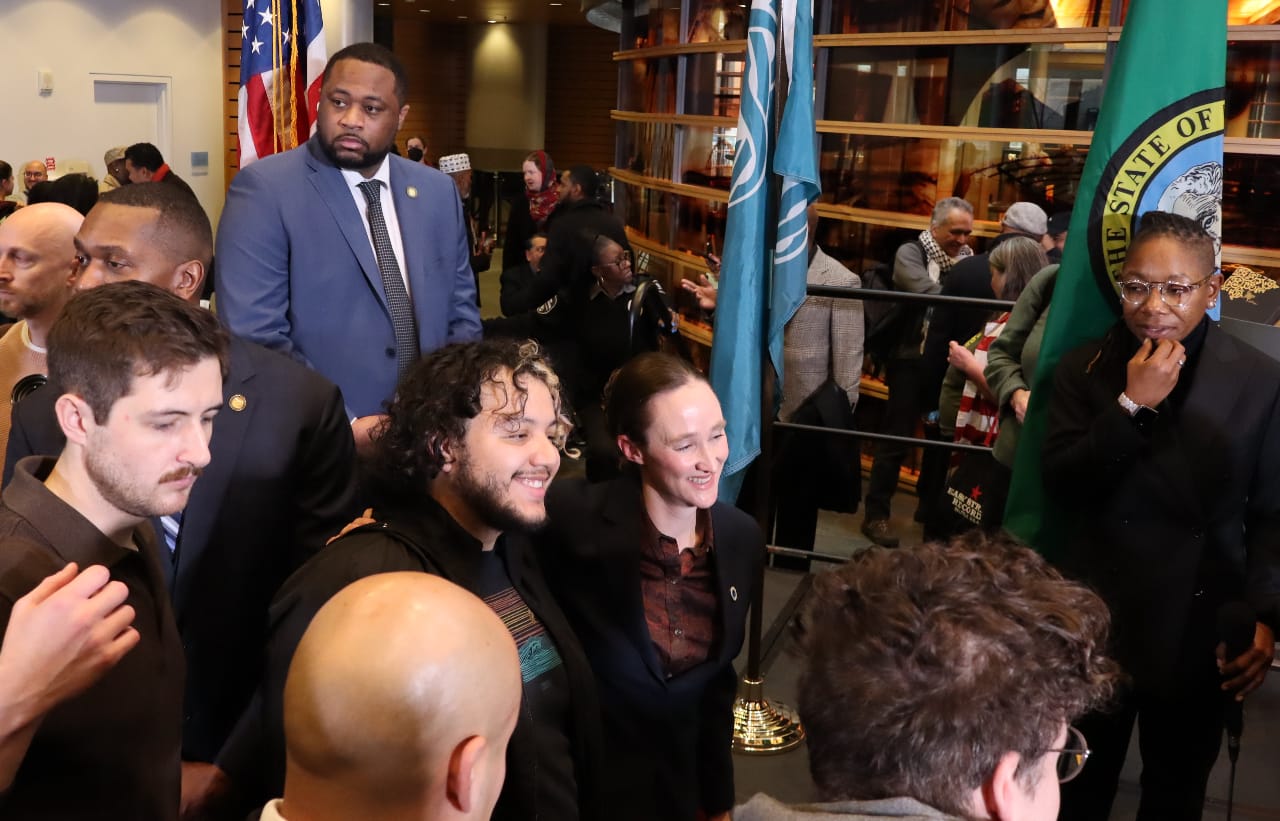
“No one pays you to try to change the way power flows through the city, to change who has a voice in shaping our city’s future and its politics,” Wilson said. “And these kinds of innovation from below are something that I am afraid we are at risk of losing because it is so, so hard to afford to live in this city. So when we fight for affordable housing and child care, it is not just about solving the math problem of how to make your household’s revenue exceed its expenses. And when we talk about shaping our transportation system in our neighborhoods, it’s not just about making people’s commute safer or shorter or less polluting. It’s about opening up the time and the space where life happens, where people can breathe and experience and create, where we can be full human beings, and not just means to an end.”
To mark the occasion of taking office, Wilson was joined by several longtime community advocates: public health services advocate Ifrah Abshir, former Economic Opportunity Institute executive director John Burbank, Nickelsville organizer Jarvis Capucion, and longtime South End and Central District advocate Cynthia Green.
After those four speeches, the mayor’s oath of office was administered by longtime Transit Riders Union volunteer Pauline Van Senus, known as Seattle’s “Transit Fairy” — who volunteers her time to clean up King County Metro bus stops in the name of neighborhood beautification and a better experience for riders. The guest list served as a clear reminder that Wilson wouldn’t be shedding her organizing mindset at the door of City Hall.
Green, the namesake behind the Cynthia A. Green Family Center in Skyway, portrayed Wilson’s election as an earthquake in the larger context of Seattle’s political history.
“When I say this moment matters, I say it with the weight of a long memory,” Green said. “Today we swear in a mayor, a mayor who did not come from the loudest rooms or the richest donors, but from the long work of organizing, listening and standing with people who are usually told to wait their turn.”
In the weeks since the election, Wilson has made it clear that she’s no stranger to City Hall, despite what was said about her during the campaign. Her transition team leaders and initial slate of senior leadership appointments so far have brought a mix of outside agitator energy and insider experience, and she’s made it clear that she knows enough about being mayor to chart her own path. In a break with the past three mayors, Wilson has chosen to only have one deputy mayor in Brian Surratt, a former director of the Office of Economic Development. In lieu of a stable of deputy mayors, Wilson has created a Director of Departments position and hired Jen Chan, a former Deputy Executive Director at the Seattle Housing Authority.
Though the city’s political establishment will likely spend the next four years painting her election as a fluke, with a close margin falling well short of a mandate, Wilson clearly has the mindset and the experience to make headway on the ambitious vision that she laid out in her speech this week.
“Today is more than a celebration for our mayor, it is a victory for the people who refuse to disappear from this city,” Green said. “Seattle does not belong only to the powerful or to the ones with wealth collected. It also belongs to the people who love it, labor in it, and believe in it. This is our city.”