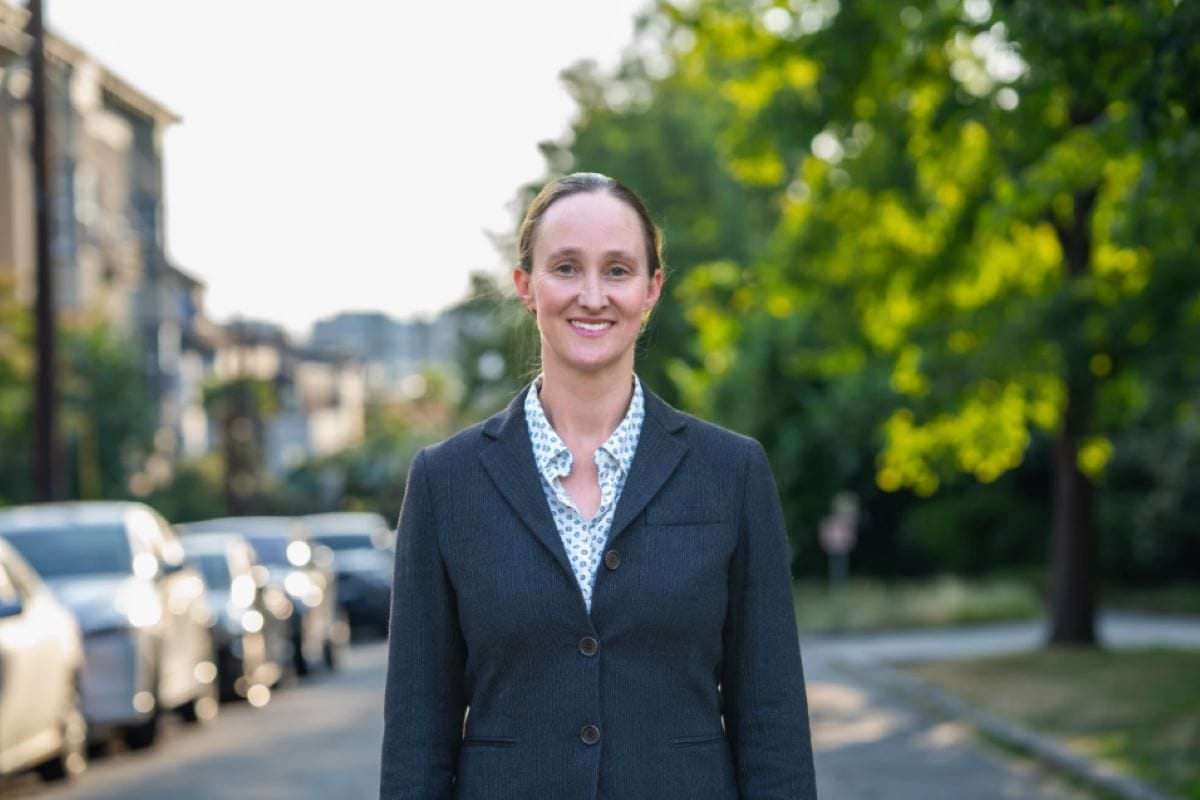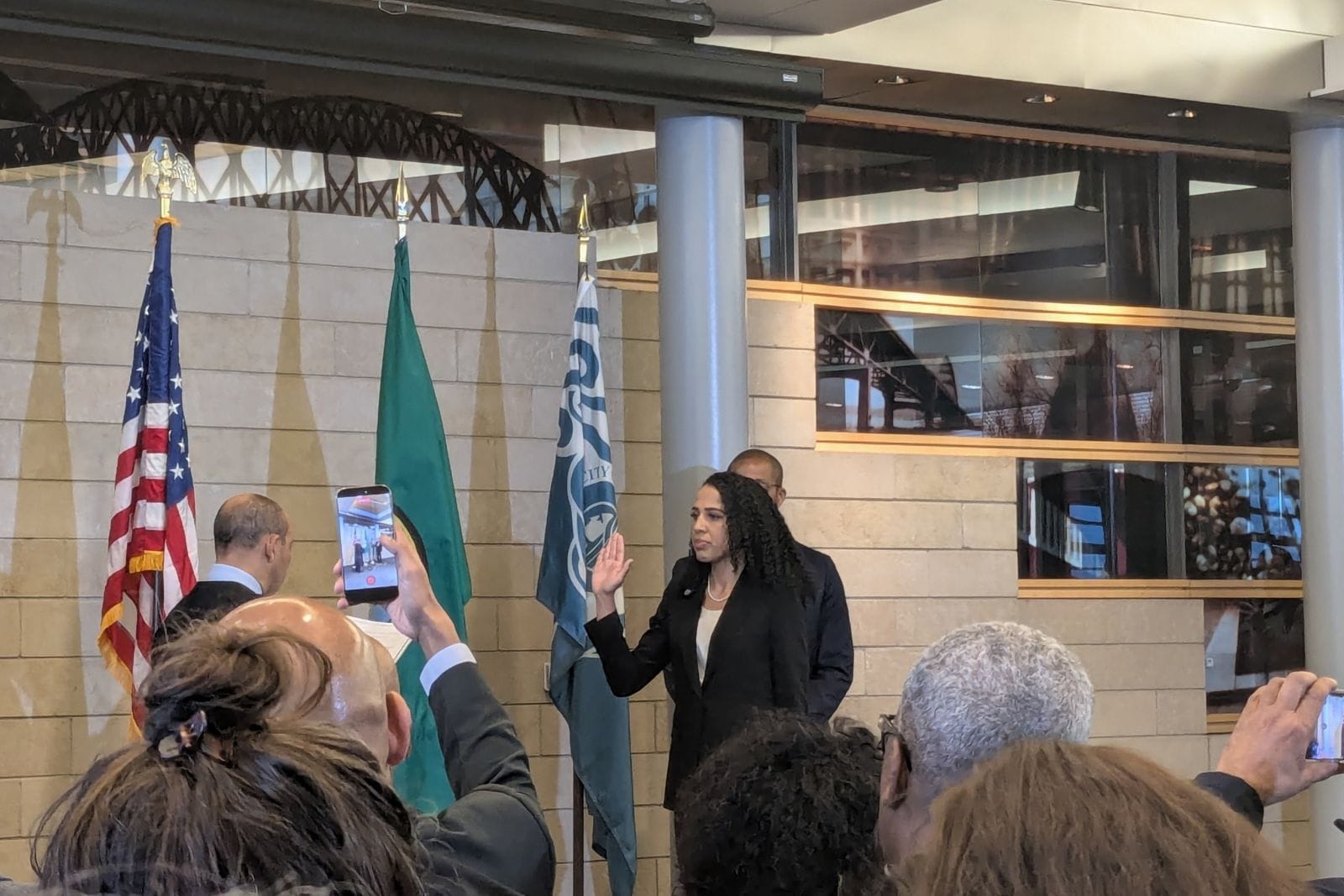
At a well-attended ceremony on Monday, Erika Evans was sworn in as the newest Seattle City Attorney. Evans won in a resounding victory over Republican incumbent Ann Davison, receiving over 66% of the vote.
Evans is the first Black person to be elected to this role, as well as the first woman of color.
In a discordant note, right-wing media attacks against Evans began before the ceremony had even been conducted, with a concerted effort to brand her as soft on crime already underway from the Seattle Police Officers Guild and right-leaning media sources.
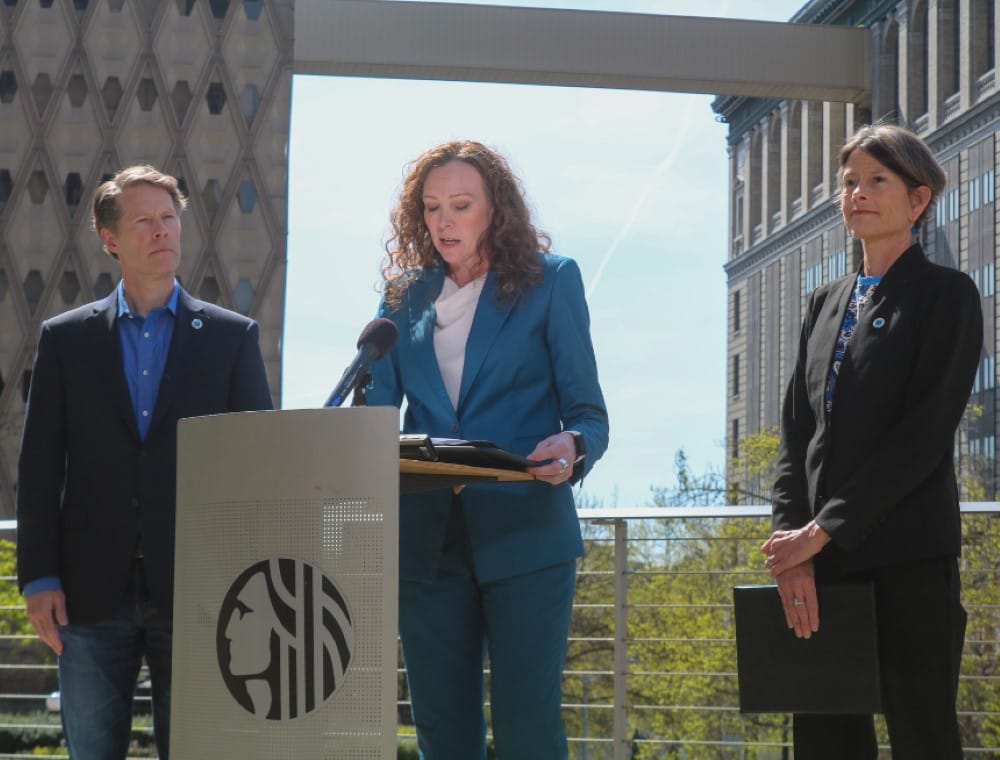
Evans was sworn in by U.S. Federal District Court Judge Richard Jones after remarks by former Washington State Supreme Court Justice Mary Yu, whom Evans called a mentor, University of Washington student and campaign worker Towa Nakano-Harris, and Washington State Attorney General Nick Brown.
“My purpose, my North Star, is serving others,” Evans said in a speech following her swearing-in. “Service to others is something that has always guided me. Dr Martin Luther King Jr, said that life’s most urgent and persistent question is: what are you doing for others? This has guided me in my life and in my career in public service.”
Evans’s speech culminated in a standing ovation and the audience singing to mark her birthday. Many notable local elected officials attended the event, including Seattle Mayor Katie Wilson, King County Executive Girmay Zahilay (and his daughter), former Seattle Mayor Jenny Durkan, and most of the Seattle City Council. Seattle Police Department (SPD) Chief Shon Barnes was also present and served on Evans’s transition team.
Evans ran as a progressive Democrat, pledging to follow evidence-based policies and stand up against the overreach of the Trump administration. Evans spoke strongly against her predecessor’s tough-on-crime policies, especially the Stay Out of Drug Area (SODA) and Stay Out of Area of Prostitution (SOAP) zones, policies that Evans said are racist and ineffective.
Known as the city’s top lawyer, the Seattle City Attorney defends and initiates lawsuits on behalf of the City, advises elected officials such as the mayor and the city council, and enforces city regulations, including labor laws and tenant protections.
In a criminal capacity, the City Attorney only handles low-level misdemeanors, the most serious of which are driving under the influence (DUI) and domestic violence cases. Other misdemeanors handled by the City Attorney’s Office include shoplifting, trespassing, disorderly conduct, vandalism, and as of the fall of 2023, simple drug possession and public drug use.
Meanwhile, the King County Prosecuting Attorney’s Office handles all felonies, which include charges such as murder, rape, robbery, aggravated assault, arson, and drug trafficking.
Brown spoke about a time in the past when he advised Evans against taking a career opportunity, which later led to her being free to run for office.
“There was going to be a future opportunity to lead, to shine, and see what she could become,” Brown said. “I did not know it would be serving as the City Attorney for the City of Seattle, but I knew that she had the skill set and the character to do something bold and visionary that would have an impact on more people.”
Assuming office at a time of legal challenges
Evans assumes the office of the Seattle City Attorney at a challenging time, between a slew of lawsuits from current and former members of the Seattle Police Department (SPD), a new mayor who’s interested in passing more progressive revenue and pushing for a bolder vision for the City’s comp plan, and an erratic United States president who has spent the last year regularly trying to withhold federal funding and threatening to send a more active U.S. Immigration and Customs Enforcement (ICE) presence and/or the National Guard to Seattle.
“You step into the role at a time when the challenges facing our cities across the nation are complex, ever changing,” said Yu during her speech. “But with those challenges come opportunities, opportunities to strengthen trust, to uphold transparency, and to ensure that every voice in our community is heard and respected. I am confident that your leadership will help guide us towards solutions that reflect the values that we hear.”
As she stressed on the campaign trail and in an interview with The Urbanist following her victory, Evans reiterated her pledge to be proactive in protecting the city from federal overreach, whatever form that might take.
Evans also has the opportunity to shape the city through her legal interpretations and level of risk aversion.
During a discussion of council amendments to the Seattle Comprehensive Plan last fall, councilmembers used legal advice given to them by the City Attorney’s Office as a reason to oppose the addition of several neighborhood centers that had been included in the planning department’s original growth plan before then-Mayor Bruce Harrell’s team intervened. If Evans were to take a more pro-active approach than Davison, one obstacle or excuse for council action for adding density to the comp plan would be removed from the table.
On the criminal side, Evans plans to focus strongly on DUI and domestic violence cases, which she has said are not being filed quickly enough.
Now that she’s in office, Evans plans to determine the methodology Davison was using in her High Utilizer Initiative, which focused on a list of people who frequently cycle through the City Attorney’s Office because of low-level violations. Many of these people have been found to be homeless and suffering from substance use disorder and/or behavioral health disorders, and some of them aren’t competent to stand trial.
Evans will be working with King County Prosecutor Leesa Manion to ensure the City and County are aligned in their methodology for who belongs on such a list.
“[The High Utilizers] definitely need our attention and focus because we need to be making sure we’re being good stewards for the whole city and for people that need help, or providing the right help in treatment and services and for public safety,” Evans told The Urbanist. “I see it all weaving together.”
Evans is also full steam ahead on implementing her reimagined community court, which she sees as a key component to breaking the cycle of people committing misdemeanors. Evans told The Urbanist she has already met with the Seattle Municipal Court, who are very excited about the idea of a new community court.
Immediate right-wing attack
The Seattle Police Officers Guild (SPOG) did not wait for Evans to settle into office before going on the attack.
The night before Evans’s swearing in ceremony, SPOG published a social media post making the inaccurate claim that SPD would no longer be arresting people for open drug use. SPOG president Mike Solan signed the post, which specifically attacked the City’s Let Everyone Advance with Dignity (LEAD) diversion program, identifying its ideology as “meeting people where they are who are in the throes of addiction.”
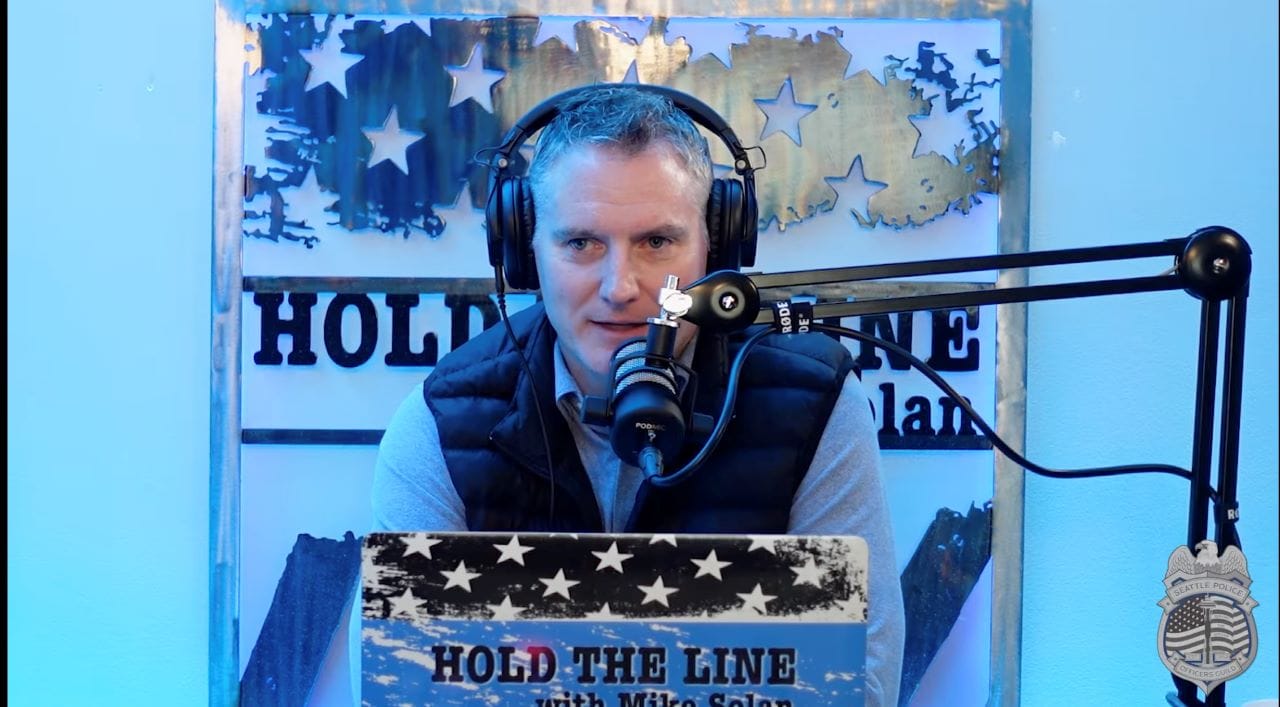
“Most cops know that the LEAD program supports this ideology and they don’t want to refer cases,” Solan wrote. “It is a waste of time. We’ve all seen how our streets can be filled with death, decay, blight and crime when ideology like this infects our city.”
This post appears to have been inspired by a memo issued by Evans last week and a department-wide email Barnes sent to SPD in response.
In her memo, Evans states that all arrests for drug possession and public drug use should be referred for review to a team within her office, who will determine whether each case is suitable for referral to LEAD. Evans confirmed with The Urbanist that the cases will not be directly referred to LEAD without review.
In his email, Barnes appears to misinterpret that guidance: “Effective immediately, all charges related to drug possession and/or drug use will be diverted from prosecution to the LEAD program.”
This statement isn’t strictly correct, since cases with those charges will be sent to an internal team within the City Attorney’s Office to determine whether a LEAD referral will be made.
On Monday, SPD released a statement saying “SPD has not changed its policy around public drug use and SPD will continue to enforce Seattle’s laws” and “Seattle Police officers will continue to make arrests for drug-related charges if they have probable cause.”
This clarifying statement from SPD did not prevent Seattle City Councilmembers Bob Kettle and Maritza Rivera from making statements of their own. Kettle recognized the misunderstanding that had taken place and expressed a wish for continued improvement, but Rivera said she found the news “concerning” and expressed a fear that Seattle might “go backwards.”

When asked for her response to SPOG’s statement, Evans referenced her experience as a federal prosecutor working on fentanyl drug trafficking cases.
“To say that we shouldn’t be aggressive in our approach to help get folks connected to treatment to stop this extremely addictive drug is really out of touch,” Evans said. “Jail isn’t the solution. It’s not a treatment facility. I have prosecuted folks that have smuggled fentanyl into our jails, and so it’s very clear that that is not the place for people that are dealing with substance use disorder to get any meaningful recovery.”
Evans cited the failure of Davison’s approach to the fentanyl crisis, talking about kids and teenagers she’s seen on the streets addicted to fentanyl.
“You have to provide the right response so people are not back out on the streets using [drugs],” Evans said. “That’s what we all want at the end of the day. And we’re going to be smart and evidence-based in our approach to accomplish that, and not just say things that sound tough, but actually in substance, are failed.”
Moving forward
This SPOG offensive against diversion services is likely to be just the beginning as Evans joins fellow progressives Wilson and Councilmembers Dionne Foster, Alexis Mercedes Rinck, and Eddie Lin in beginning new terms of office.
Solan announced at the end of the year that he’ll be stepping down from the SPOG presidency in a month, but he has already endorsed a possible successor: Kent Loux, whose campaign video says that he served on SPOG’s board and the contract negotiations team.
Kent Loux, Mike Solan's hand-picked successor to lead SPOG, is somehow an even bigger dope, but he's a "proven fighter with miles left in the tank," according to his campaign video:
— DivestSPD (@divestspd.bsky.social) January 7, 2026 at 9:06 AM
[image or embed]
The video utilizes bombastic music and images of flashing patrol lights, a pack of wolves, and Mixed Martial Arts (MMA) battle ropes and a riled-up boxer.
“Make no mistake: Seattle’s politics have veered sharply left, unleashing a storm that threatens to dismantle everything we’ve built brick by brick,” Loux says in a voiceover. “SPOG is staring down its most brutal years yet—a relentless assault on our unity, our resources, and our resolve.”
During the voiceover, the video alternates between photos of Wilson, Foster, and Rinck.
It's the 5th anniversary of Jan 6 & Mike Solan is stepping down. Good time to share an excerpt from Capt. Robert Brown's journal. On 1/6, Solan's chosen successor, Kent Loux, told a roomful of cops that the 2020 elections were "'clearly stolen" and needed to be "set right."
— DivestSPD (@divestspd.bsky.social) January 6, 2026 at 1:05 PM
[image or embed]
Regardless of the results of the SPOG presidential election and right-wing propaganda efforts, Evans has expressed her readiness to fight for Seattle’s values.
During her swearing-in speech, Evans referenced her grandfather, Olympian and two-time gold medal winner Lee Evans. Lee Evans wore a black beret and raised his fist while accepting one of his Olympic medals in 1968 as part of the Black Power movement, embracing what his granddaughter Evans referred to as a sacrifice and risk to make things better for others.
“I’m approaching this with eyes wide open that the road ahead will not be easy,” Evans said. “I think about what my grandfather did at the Olympic Games, how it was met with outrage, but it stood the test of time, and it was on the right side of history. And now we are in a moment where young leaders like Towa will look back and ask what the leaders in this moment were doing to be on the right side of history. And we are going to do that work right now.”