

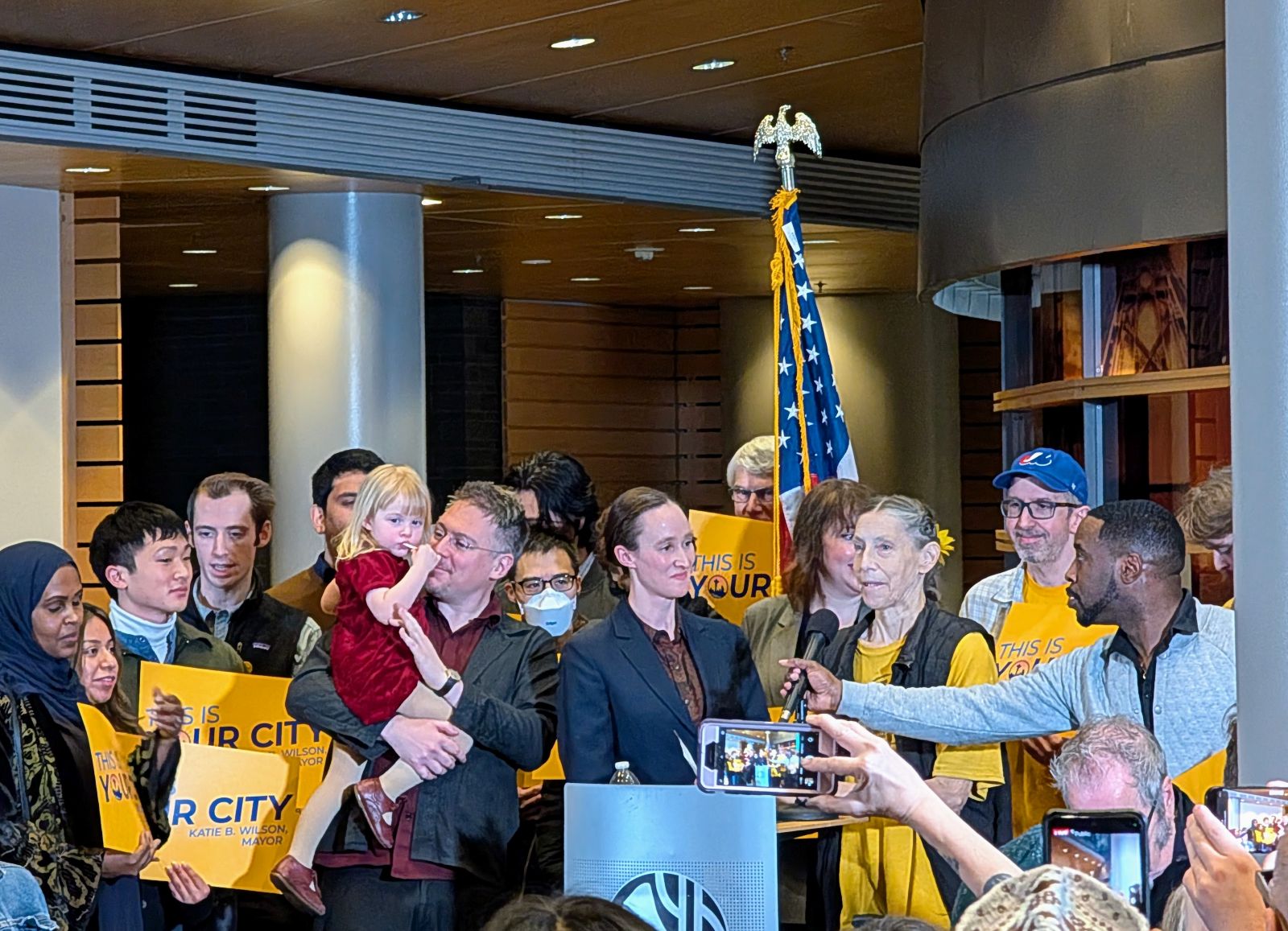
The Urbanist’s Ryan Packer, Amy Sundberg, and Doug Trumm kick off the new year by breaking down Seattle Mayor Katie Wilson’s inauguration ceremony and Washington Governor Bob Ferguson’s budget proposal, which included deep cuts to public education and a raid of Climate Commitment Act funds, while also queuing up a millionaires income tax for 2029. To round out the podcast episode, we also made a few new year predictions and flagged some big stories to watch in 2026.
This episode of The Urbanist Podcast was edited by yours truly. Episodes also air on KVRU 105.7 FM radio Thursdays at 4pm, on a once every two weeks cadence, give or take. Thank you to Crystal Fincher and Shannon Cheng of KVRU for their assistance producing our podcast.
Podcast Transcript:
Ryan: Welcome to The Urbanist Podcast, a show touching on the biggest headlines at The Urbanist, and also offering a deeper look from the reporters breaking the stories. We’re an independent reader publication, covering Seattle metropolitan region since 2014. We do advocacy journalism for better cities.
You can find us at theurbanist.org. My name is Ryan Packer. I’m a contributing editor here at The Urbanist. With me is the rest of our newsroom, publisher, Doug Trumm.
Doug: Hey, Ryan. Happy New Year. Good to be here.
Ryan: Happy New Year, Doug. And we also got reporter Amy Sundburg.
Amy: Hello there. Great to be here at the beginning of 2026.
Ryan: Great to have you here. Glad we’re all back together for a fresh brand new year. Every couple weeks, The [00:01:00] Urbanist podcast recaps the biggest headlines happening around the region.
Right now everyone’s talking about the new mayor of Seattle, Katie Wilson, who was sworn in Friday, January 2nd when we’re recording this, a few hours after that.
So, that’s what we’re really excited to chat about, and dig in on, on all the speeches and the signals that the new mayoral administration is, is sending out so far.
Amy, you watched the speech. What were your takeaways?
Amy: I was really excited to see the, the changeover of power. It was a lengthy ceremony with a lot of different speeches, which I actually liked because I liked to hear the different perspectives. It was really interesting who the new administration chose to speak.
Ryan: One thing I thought was notable was that they held the event at the first floor of City Hall. Anybody who wanted to come in could come in. It was open to everybody. It seemed like a very clear signal that they’re [00:02:00] trying to make an accessible administration that’s not press invite only to your speeches.
You know, everyone can stop by and listen to directly what the mayor wants to say. And she explicitly said that if it’s your first time at City Hall, then she wants you to come back and advocate for things.
Doug: Yeah, that definitely seemed like she was emphasizing that both that openness and like practicality. I was near a guy who I thought he was gonna start heckling her, but luckily he lost interest. Because obviously that’s the downside of that approach is you can’t control the crowd.
But nothing, as far as any people trying to disrupt the speech. So it relatively went off without a hitch.
Amy: I think too, it really jived well with her message during the campaign. And I know, right when she won, when they had finished counting enough votes that it was really clear that, that Katie Wilson would be our next mayor. She did have a very small press event, which I attended, and it was in a really tiny space, so it was very limited and [00:03:00] brief.
It was very short, and I think that stressed some people out, that they weren’t invited and that they weren’t allowed to go. So I thought it was really good that for her big formal inauguration, it was completely the opposite.
Doug: Yeah, and her election was close as you alluded to. She won by a little over 2100 votes. So the speech kind of tried to reiterate that she’d be the mayor for everyone. On the flip side of things, her speakers were largely from the grassroots advocacy world.
So I think she was trying to be a break from the traditional big time players only approach to city government. That was very much Bruce Harrell and Jenny Durkan. While being the mayor for everyone, but really trying to get more working class people, everyday people, more of the downtrodden people represented in the room.
Ryan: Yeah, a lot of those speakers that led up to this direct swearing in were callbacks to her prior [00:04:00] advocacy. You know, we had Ifrah Abshir, who was a former high schooler at Rainier Beach High School when Katie Wilson was working with high schoolers to get free youth transit passes and a win that was ultimately taken statewide.
But the groundwork was laid when it was the Youth Transit pass work. These years later coming back to highlight her. And there was the organizer with Nickelsville, Jarvis Campucion, who went through a litany of all the advocacy that they had worked together on, with Nickelsville and the coalition to end homelessness and all the different iterations that were just still kind of spinning our wheels.
I think that was ultimately one of the hardest parts to listen to of the speeches because it was emphasizing the fact that we’ve not made very much progress on those issues. Which isn’t to say that the advocacy was a failure. I think it’s ultimately the failure of our policy systems to actually tackle the, [00:05:00] the crisis at the scale that we need.
But it was really emphasizing the need for a change of, of direction.
Doug: Yeah, and I thought Jarvis’s point that he hadn’t been invited to City Hall in 10 years and they declared a state of emergency just over 10 years ago. They declare the state of emergency to actually end homelessness. And, he talked about the moving of goalposts and just eventually just settling for a reduction, because they weren’t really getting it for a while.
It definitely felt like there’s new energy around actually doing big things like drawing down homelessness closer to functional zero. And, and I don’t think you can solve things like that without, bringing into people actually living that.
Maybe they don’t get to write every policy, but they should at least be in the room having input, that’s real input rather than just policies thrown at them.
Ryan: Yeah, and there was John Burbank who used to be the head of the Economic Opportunity Institute, , who also called back to Katie’s [00:06:00] roots, starting the Transit Riders Union and talking about how that came to be.
Doug: And Burbank’s a columnist with the urbanist occasionally, so it’s always good to see someone who puts their stuff out there with us out in the real world.
Ryan: that’s true. And obviously the current executive director at the Economic Opportunity Institute is Rian Watt, who serves on our board. So we were half close ties to that, to that organization. But I thought he did a great job of really painting Katie’s advocacy as, as grounded in community.
Amy: And he also has been a big proponent for a new progressive revenue of course, Wilson has worked really closely to pass the Jumpstart payroll tax that has really saved Seattle more than once since it’s been passed in terms of getting our budget to balance without a lot of very, very painful cuts.
And I felt like it was a signal of her continued interest in progressive revenue.
Ryan: Yeah, I think that was one of her big applause lines actually during her speech was that she campaigned on taxing the rich. People [00:07:00] really wanted to hear that in the crowd. Before we talk about her speech directly, I thought the most powerful speaker before that was Cynthia Green, who’s a long time eight decade resident of Seattle and advocate, has a a center named after her in Skyway.
But she was really, I think, really zooming out and showing what a big deal it is that someone who didn’t have the backing of money or the big business or the big political endorsements was able to, to become mayor. I think she was really really effective in painting what’s happening right now as a seismic shift in the direction of city government.
Doug: Definitely, and she alluded to the price that she paid to be an early endorser of Katie. Obviously there was a lot of pressure, especially in the African American community with a lot of the families who’ve been in Seattle a long time, having close ties to the Harrell family, if you get out and, and put your name out there for Katie, that, that rubbed people, some people the wrong way, but she [00:08:00] stood by what she did and, and ultimately was looking more at outcomes rather than just going with the pedigree or family ties.
Ryan: Uh, what did you think of Katie’s speech, Amy?
Amy: I thought it was quite powerful. And of course, I mean, I thought it was fascinating, right? I, I analyze these things for fun. So , one thing I noticed is that if you’ve gone to any of Bruce Harrell’s events over the past four years, you’ve heard about One Seattle. Probably a lot.
Doug: Too much.
Amy: Yeah, Katie Wilson explicitly said in her speech, there isn’t just one story for Seattle. And so I felt that I was very symbolic of the shift that she wants to bring to city government. I also think one of the lines that really seemed to resonate with the crowd was about bread and roses, about trying to get people what they need, but also that people deserve more than just what they need, right? That they deserve beauty, that [00:09:00] they deserve the arts, that they deserve fun time, that they deserve leisure, and that we need to value unpaid labor and unpaid pursuit, as well as the, you know, traditional paid labor.
Ryan: Yeah. You know, one word that wasn’t uttered in any of the speeches today was urbanist, but Katie painted a very clear picture of the type of city that she wants us to move toward. And to me it is an essentially urbanist vision. She talked about the need for more sustainable transportation, easier transportation, safer transportation, not a means to an end, but as, as a goal to get to a city where everybody has breathing room and a place to live and the ability to thrive.
And, you know, the same could be said, and she did say for housing affordability and the need to make housing more, more affordable. And so, income inequality is it’s killing [00:10:00] cities. And so when you’re talking about making a city that everyone has a place in, you’re painting an explicitly urbanist picture to me.
I thought it was incredible the way that she laid it out. Not with just saying I want abundant housing, but actually really making clear why we advocate for the things that we do.
Doug: Yeah, definitely. And, with the fact that she had Pauline Van Senus, who is better known as the “Transit Ferry”, actually swear her in. It’s a very unconventional choice you might say. Usually it’s like a judge or some, some high ranking official. But I think that was a really symbolic choice.
And this is someone who was a founding member of the Transit Riders Union, along with Katie Wilson and her husband, who was the mc for the event. So there’s a lot of Transit Riders, Union energy in the swearing in, and that was definitely a signal that we’re gonna care about transit, and affordable ways to get around for folks, safe ways to get around for folks.
That came up more than any speech I can think of on a swearing-in [00:11:00] day in Seattle. Both on the transportation and housing side, which are two of the hugest costs that people have to contemplate in Seattle, along with childcare, which is also been vocal about trying to address those costs.
So affordability, just pervading that.
Ryan: Yeah. And Pauline is someone who had to deal with being brutally attacked, a couple years ago on Third Avenue, cleaning up the bus stop that she does as a thankless task. But she, she got through that and. She’s back out there on the bus stops beautifying our city again. So that’s someone who understands the impact of public safety and obviously is someone who is very close with the mayor. But I thought that was also a another little subtle indication that Katie’s not, not blind to the idea of that public safety is a huge impact on all the other things that we, we talk about when we’re trying to advocate for a better city.
Amy: And all of these things feed into one another, [00:12:00] right? Like if you have more affordable housing, usually your public safety will improve, for example. So it’s good to be able to think of it as a holistic system and not just, you know, these very separate subject areas. I also really liked, I mean, to go back when she said we’re in danger of losing some of the things that make Seattle special. That really resonated with me personally, because before I lived here, I lived in the Bay Area in California I was born there, and I’ve been here almost 10 years now, but I was in the Bay Area for most of my life before that.
And, I was a writer, a science fiction fantasy writer . I saw firsthand people, my, my artistic peers and colleagues being priced out, having to leave the Bay Area, or they could only be in the Bay Area if they worked in tech or if they had a partner who worked in tech. And since I moved up here, the scene is very different, right?
And part of that is [00:13:00] because there are more people who are here who, who don’t have tech money, and they could just afford to be here. And I’ve been very worried about that changing , as prices get higher and higher and it’s harder to afford to live here. So it was really encouraging to me to, to hear some of the things I’ve been thinking about being said by Katie Wilson in her first official speech. Uh.
Ryan: A hundred percent. Yeah, I, I also found that to be very important and very moving. I totally agree with you, Amy. I’m pretty involved in the theater scene in the city and it’s night and day compared to what it was 10, 15 years ago in terms of the number of smaller independent theater companies that are able to, to put on productions.
I’ve seen, I’ve seen it happen before my eyes basically. The pandemic obviously was a big accelerator for a lot of those changes. But, the art scene is something that doesn’t get a lot of attention, and I’m really excited to see her [00:14:00] explicitly calling it out on day one.
Amy: I also really liked her focus on community and on organizing and encouraging people to keep coming to City Hall to stay involved. I feel like a lot of people these days feel disconnected. And there’s a real need to rebuild trust in what government can accomplish, especially given what’s happening in a federal level.
And I think clearly that is one of Wilson’s goals is to show people what local government is capable of doing and how it’s capable of making a better life for the folks that live here.
Doug: Yeah, she, she seemed to despite being an, unapologetic policy wonk, she shied away from some of the academic language around this. But she was really bouncing around the idea of how late stage capitalism is kind of soulless in many ways. And that we’re trying to create ways [00:15:00] to, to connect both, like you were mentioning, by organizing and then the art scene and the theater scene, and all sorts of creative acts like that.
And it definitely, I think, came across as refreshing to folks who are, who are feeling that, that we’re just not doing enough on those fronts. We’re not investing, we’re not focusing on the things that people actually moved to Seattle for. We’re a city with a famous music scene and a famous art scene in some ways.
So yeah, let’s actually embrace that rather than sort of letting get pushed to the side in favor of the shiny and the new and the techie.
Ryan: Ultimately I think the energy today was pretty incredible in terms of, I mean, this is the first mayor that we’ve elected from the progressive side of the city in 16 years. But I think the pressure is, is gonna be on the Wilson administration to, pretty quickly deliver. So obviously I [00:16:00] think the speech was very well crafted , and I think Katie knows that the, the policy is gonna be the, the thing that ultimately proves whether her administration’s gonna be judged as, as an effective one.
Well, we’ll be tracking the Wilson administration very closely here. Very excited to report that the Urbanists will be sitting down with Katie Wilson next week. So we’ll have takeaways from that, likely on a future podcast, but definitely on the site by mid-January, so check back for that.
I think we’re gonna switch gears and head to the statewide lens here and talk about, uh, the newly released budget that Governor Bob Ferguson. It’s his first budget proposal after taking office last January. And, there’s some interesting things to talk about when it comes to this package that he’s sending over to the legislature for their consideration. Amy, what were your high level takeaways from Ferguson’s Budget?
Amy: Yeah. He definitely had a difficult task in front of him. He had a [00:17:00] deficit to plug of over $2 billion. And he had pledged before releasing this budget proposal that he would not institute any new revenue or raise taxes in any way. What that means, practically speaking is that you’re gonna have to cut, right?
Like those are your two main choices. And that’s what he did in this budget. He cut about I think $800 million worth of investments that the state was making. And he also took about a billion dollars from the state’s rainy day fund, which is traditionally an emergency fund, right?
It’s for help for the state if there’s a recession or serious recession, if there’s a, some kind of emergency, like a pandemic or, you know, a lot of wildfires or, or something of that nature. Obviously we’re not in that kind of emergency right now, but he did choose to take about half of those rainy day funds to plug [00:18:00] this hole temporarily in his budget. One of the other interesting things that he did was reallocating the, the Climate Commitment Act funds, which I know you covered Ryan, so maybe you could say a little bit more about that.
Ryan: Yeah, so, this is money that is over and above what was collected and accounted for earlier this year, sort of the latest round of carbon auctions under the 2021 Climate Commitment Act, which is a cap invest program that puts a cap on emissions and charges polluters, to trade credits.
And so, it’s about 700 million. He is wanting to divert more than 500 million of that over into the working family’s tax credit. And that is explicitly something that’s allowed under state law, but lawmakers had held off on doing that. Instead, they were using general fund dollars to fund this tax credit.
And so what it [00:19:00] essentially means is that it’s a little bit of a, a spreadsheet trick because you’re able to not put any new money into new Climate Commitment Act programs and then use the rest of the budget to kind of stay balanced. And so, ultimately, that’s a lot of climate programs that won’t, won’t see new investment because we’re just choosing to kind of divert that money into something that was already funded.
And so obviously I think the Working Families tax credit is a great program. It’s one tool that’s making our tax system less, less regressive. It’s giving people money back on the sales taxes they already pay, but we have federal governments that that’s attacking climate action. So this is a lost opportunity to have a lot of really great investments in transit, clean energy, sustainable flood resilience is what I’m thinking about in terms of what we just had to go through in December.
Climate groups are not happy with that, [00:20:00] obviously. Unsurprisingly and are hoping for a different option.
Amy: Yeah, a hundred percent. And I think also wildfire mitigation, right, is another one that instantly springs to mind for me. It hasn’t been maybe quite as bad the last couple years, but it’s still an ever present danger here in Washington.
Ryan: Yeah. The thing that kind of made the Climate Commitment Act, money diversion a little bit, sting even more was this fact that he’s also proposing $3 billion in new bonds, for the state transportation budget just to go toward bridge preservation and highway maintenance as well as to purchase three new ferries.
The state transportation budget is already more than 11% debt service, which is actually more than the entire state ferry system and, and way more the double what the state spends every year on public transit. And so it’s more debt that the city that the state’s gonna have to pay down the line just to do [00:21:00] basic maintenance on its transportation system.
At the same time that we are cutting all these programs that we’re gonna pay for, like I said, transit and sustainable transportation boats.
Amy: Are you worried at all about how that will impact the long-term outlook for the state budget?
Ryan: I mean, yeah, especially for the transportation budget, especially because a lot of that’s relying on the 6 cent gas tax increase that we just approved earlier this year. Gas tax revenues are, are not expected to increase. They’re expected to decline as we switch to EVs, as cars get more fuel efficient.
And we do actually expect people to be driving less on a per capita basis. And so it’s not clear that there is another revenue source that’s gonna be able to kind of step in. And the legislature has talked for years about a road usage charge. I don’t see that happening until things get really dire.
So we’re taking out the credit card and that’s worrying. Especially [00:22:00] because like I said, these are, these are basic things. This is keeping highways repaved, which is the idea that you’re using debt for that is pretty alarming in terms of what it says about your priorities because, a big portion of the existing state highway budget is, is for new projects like highway expansions in Spokane, south King County, et cetera.
Amy: Right, right.
Doug: And those bonds just lock that money away. I mean, sometimes people forget how that works, but usually that means 10, 15, 20 years of money is just accounted for. You’re just making it, it more difficult. And obviously there’s a time and place for debt, but it doesn’t feel like repaving highways is the best use and definitely feels like a stretch and I wasn’t even sure you could bond for some of these things because usually you want to have collateral, but I guess you could still patch a road and treat it as collateral.
Ryan: Yeah. That’s a good point. It’s interesting to me how differently the idea of bonding [00:23:00] gets covered in the media compared to the idea of, say, increasing the gas tax. I feel like these are treated so differently. It’s just like utilizing existing revenues is like a phrase that’s comes up when you talk about bonding.
It’s like there’s a cost that’s gonna get paid for down the road. But I don’t think this is a foregone conclusion to issue bonds. You have to have a 60% vote in the legislature. I think that’s gonna be tough to get either every single Democrat and a few Republicans, or to get a bipartisan coalition to sign on the idea of, like I said, taking out the state credit card.
Doug: Yeah, and it’s not like Ferguson proved that he has strong relationships in the, uh, the legislature in the first year of his office. So it’s gonna be a tall order.
Ryan: Well, three was, three years ago, Jay Inslee proposed to do 4 billion in bonding to pay for housing, which was kind of a [00:24:00] moonshot proposal, that died a pretty swift death in the legislature. I think transportation bonds, it’s a little more wonky. There’s, there’s different sources of that. It’s not an exact apples to apples comparison, but I think, I think it’s still gonna be very, very tough.
Amy: The budget proposal also, well, as I said, it is balanced partially through cuts. So there are a lot of state programs being trimmed, delayed, cut. It sounded to me like many departments will have their budgets cut and then they’ll have to decide how to deal with that basically. Which is almost certain to lead to at least some layoffs.
So we won’t know until, until the departments make their decisions exactly what that’s gonna look like or how many people are going to be laid off as a result of this budget proposal should it go through. And another thing, well, a couple other areas [00:25:00] in which there are cuts that I found a bit concerning was education and healthcare, particularly education, which already received cuts in the budget that just passed this year during the legislative session now is looking like it’s gonna receive even more cuts, which obviously isn’t, isn’t good news for anybody who has students in their family is a student, has educators in their family. He’s calling for an additional 3% cut to the University of Washington and Washington State University, and a 1.5% cut to all the other regional universities, the community colleges, the technical colleges, all of that.
There also is are gonna be, uh, delay, I guess they’re capping how many people can sign up for the Working Connections Childcare Program. They’re eliminating some slots to the [00:26:00] Transitions to Kindergarten program, which is for four year olds who need some extra education or help before they go to kindergarten.
So there’s gonna be a lot of impacts. Oh, also they’re supposed to give additional money to school districts that can’t raise as much money as easily because they don’t have as high property values so that when they, when they have a property tax levy to fund education, it’s just not gonna bring in as many dollars.
And that is gonna be delayed or cut. So it’s gonna have some wide impacting consequences to the state’s education system, which I think a lot of people are worried about already.
Doug: Yeah. It’s not like their schools and universities are in this great fiscal shape either and definitely, one of those critics was state superintendent Chris Reykdal, who put out a statement that was highly critical. And he said, unfortunately, this budget proposal takes a austerity approach.
He goes [00:27:00] on to talk about how this should actually be a time when we’re working to go the other way and make our tax code more progressive, so that the people least able to pay aren’t shouldering the largest share of the burden. Obviously he, he pissed off his state superintendent with this idea, and it will strain budgets in the education system.
Ryan: Yeah, but, as dire as those cuts are, that was not really what the headlines about the budget proposal were focused on. Instead they were looking at Ferguson’s newfound support for a state income tax. What happened there, Doug?
Doug: Yeah, so this, this kind of came a little bit as a surprise just because Ferguson had spent so much effort in his first year in office saying, I don’t support new revenue. And there’s obviously a big caveat here. He said, I support the state income tax, but I don’t want to implement it until 2029 for reasons.
And, he did get into [00:28:00] those reasons. I’d being a little facetious , but, he gave a, that you would need time to set up the infrastructure to collect the tax. ’cause we don’t have income tax in our state. Only the federal income tax applies here. So, there’s something to that. It would, would take some time.
It wouldn’t take three years, but it would take a while to actually set up the infrastructure and collect the tax. But then the other reason he gave is he’s expecting both a legal challenge in the courts and potentially a write-in campaign from conservatives who’ve been very active in that front. Whether that’s Tim Eyman, or more likely now Brian Haywood, who ran a repeal effort for the Climate Commitment Act, which is a our cap and trade carbon tax. , So, they’re expecting the rich people to fight back, which I do think that’s true, but at the same time, it doesn’t necessarily, I don’t know why you would need to then concede that you’re not gonna even try to get money for three years.
And that ends up putting it, collecting money only in Ferguson’s second [00:29:00] term. So, yeah, this whole budget goes back to that whole approach of Ferguson not wanting to be the one to raise the new revenue. So he pushes it onto other people, whether that’s the legislature last year to come up with what avenues they did have without a push for a bigger new source , which ended up being like B&O tax and things like that, to patch the budget along with some cuts. Because Ferguson also didn’t get very specific about which areas he wanted to cut. So, it’s that same kind of chaotic approach where he’s not really leading per se, he’s just kind of setting a vague framework and hoping that the state legislature does their work for them.
But, at least it’s something in the fact that he supports the income tax now, which would only apply to millionaires, which is probably politically savvy approach. When it does go to ballot, likely if, if they’re able to collect enough signatures to try to repeal it.
Amy: Just to be clear about what this tax is that we’re talking about, it only applies to Washington residents who make more [00:30:00] than a million dollars a year. So it doesn’t apply to people who like have a house and they bought it and it was really cheap back in the day, and they’ve had it for 40 years, and now it is worth more than a million dollars.
That’s, that’s not what this tax is about, and I think that’s important to state upfront.
Ryan: It’s not a wealth tax.
Doug: And there’s also a proposal for a wealth tax, but that’s a whole, whole different thing, which Ferguson doesn’t support.
Amy: What it actually is is 9.9% on adjusted annual gross income of over a million dollars. So only the money over a million dollars. So it will apply to less than 0.1% of Washingtonians. So it’s very carefully and narrowly tailored to, to basically tax the rich.
Doug: Yeah. And yet, it somehow still collects was it over $3 billion a year they expect, if I’m recalling
correctly,
Amy: yeah. No, it’s a significant revenue source.
Doug: Yeah, that, that’s a very wealthy 0.1% of the Washington [00:31:00] state when you, when you figure it that way.
Amy: Yes. Yes. And, and you know, there’s questions. I think Ferguson has been very clear since the beginning of the year that he really doesn’t wanna rely on any new revenue that is at risk in any way. Right? So I think that’s the idea behind the 2029. That’s when we’ll collect this revenue because by then, like all those risks will have been worked through.
The flip side is you’ve, you’ve given up billions and billions of dollars of revenue in that time that if it does survive, the state could have had to invest in some of these programs. There’s also gonna be, of course, I’m sure this will shock nobody, a big debate as to what to spend any new revenue like this on.
And how much to spend on things like tax relief for small businesses or eliminating certain sales tax on certain items or bringing down the overall rate versus [00:32:00] investing more in things like education and in healthcare. And I bring up healthcare specifically because, the healthcare system in this country is, is in trouble, right?
It has been in trouble. I think the strain of the COVID pandemic in 2020 was really hard on it. And, now with federal level policy, we can expect things to be getting a lot worse fairly quickly.
Ryan: Yeah, I think that doesn’t get enough attention. We talk a lot about whether the tax system is directly regressive and whether we could make it less regressive, but we don’t really talk about the regressivity of massive cuts to the state budget that will have impacts on the ability for people to get healthcare for people to get education.
I think a lot about this in the context of the county’s budget, which is considerably constricted, and the governor has not supported the idea of letting the 1 [00:33:00] property tax cap, which is strangling county government, king County in particular, but also all counties across the state who are tasked with ensuring public health and, and keeping clinics open.
And those cuts that they have to make because we don’t want to raise revenue and in really any way at all are really hurting the most vulnerable.
Doug: Yeah, that was bizarre. The, that Ferguson would block that particular thing. ’cause usually officials are good at giving other levels of government permission to raise new revenue because they don’t have to personally take the heat. But he kind of fell on that grenade. And it was kind of unclear for what reason. Especially in a time of high inflation, that cap is particularly burdensome.
Amy: And counties in particular. I, I think people get confused about the difference between cities and counties in Washington state and counties in particular just have so few tools at [00:34:00] their disposal to try to collect or raise new revenue. So they do their best, but I often feel like their hands are kind of tied and in order to untie those hands, the state legislature needs to act. That that is the solution. That is, I think, the only solution.
Ryan: Yeah, king County can’t raise a jumpstart tax. They, they’re not allowed to do that. Shaun Scott has a bill this session to allow them to impose a B&O tax, which could be one tool in the toolbox, but it is, I think, misunderstood a lot in terms of even the ability to do things, to actually get out of the, the budget crunch that they’re in.
We will be watching the entire machinations of the budget, which are expected to take over the majority of the 60 day session. It starts in just 10 days on January 12th.
Doug: That’s a lot to get done in 60 days.
Ryan: yes, but stay tuned for future episodes as we chat about that. Here on the [00:35:00] Urbanist Podcast on KVRU 105.7. Let’s go into something a little lighter. Let’s talk about 2026. Expectations, predictions, things we’re watching. It’s gonna be a busy year for urbanism in Puget Sound. We’ve got a lot of city councils changing around, new mayor, Sound Transit is up to a lot of stuff. What, what are you tracking this year, Amy?
Amy: Well, surprising no one. I’m gonna be tracking a lot about public safety. We do have two new executives, in Seattle and in King County who are gonna have their own ideas about public safety. And I will say by public safety, I’m also talking about homelessness. Because those two just are so intertwined, at least in our region, that I, I think you can’t talk about one without the other.
So I’m gonna be watching that really carefully. As well as, surveillance, which I think was a big topic [00:36:00] in 2025, and I think it’s gonna continue to be a big topic in 2026, both here in Seattle and, but across, across the state as, as we’ve been seen, with license plate readers, for example.
And there is most likely going to be an important bill at the state legislature this session about those license plate readers. So that is one of the first things that I’m probably just gonna be really intensively watching, and talking with folks about because, I think not all the details have quite been ironed out on what’s gonna be in that bill, but it’s going to potentially really impact the future of surveillance in this state.
So it’s something I, I guess looking forward to covering. And, I mean, surveillance is kind of a grim topic, but it is interesting.
Ryan: Amy on, on the topic of homelessness, you know, I noticed Girmay Zahilay was at Katie Wilson’s swearing in today. I’m watching both of those [00:37:00] newly elected officials and what they’re gonna do with the King County Regional Homelessness Authority. Is that one thing that you’re tracking about what’s gonna happen with, with that organization?
Amy: Definitely, definitely. And I mean, it’s been painful to watch sometimes how, how the county and the city kind of struggle to work together and some of these intractable, seemingly intractable problems, I should say. I think they can be solved . are ones that happen on a regional level so they’re not just focused in the city of Seattle.
And homelessness is probably the best example of that. Gun violence is another example of that. And, some of the folks I’ve talked to have been disappointed, at the poor communication between the county and the city and their inability to, to coordinate and work together, which could be a game changer in terms of actually making some progress on some of these really important issues that I think everybody that lives here cares about a lot.
I think that will be something to watch is how much does it seem [00:38:00] like the county and the city of Seattle are on the same page this year? Does that shift at all? Or are they just gonna kind of continue fumbling around, and sometimes talking and working around one another?
Ryan: Yeah, I think in the past we’ve seen the county executive show up at city events when they have a direct interest, if it’s a King County Metro project. But I, I’m seeing something a little different here. I think Girmay and Katie Wilson are legitimately interested in, in working together.
Amy: Yeah. Yeah, that’s what I think as well. And I have been hearing, I think people are a little more hopeful about that. Obviously, we have to wait and see how it ends up panning out. But, this is a time of opportunity for both the county and the city. Even though, you know, both of them are having some budget issues, it’s still, there’s still opportunity to really improve things.
Doug: Yeah. And I wonder if just the sheer power of them being similar age. They both had their daughters along with them at that event, and I was kind of struck by Oh yeah, [00:39:00] these people are at a similar point. Um, obviously Girmay took a little bit different path than than Katie did since Katie’s a first time politician , at least as far as elected office goes. But yeah, I think they’ve made some signals. They made a social media video together, where they kind of seem like they had a good rapport and maybe that will get tested once they actually have to work on policy. But, hopeful that they can iron out some of those things because the regional homelessness authority, obviously some of the critics lately have been crowing that they’ve been right. Because they haven’t been able to solve some of those issues that they, they hoped that if they just formed an regional entity, some, some of the stuff will get fixed, but they haven’t come up with the major new revenue source. So Seattle continues to provide most of the money for that, and then King County chips in another chunk.
And, towards the end, former mayor Bruce Harrell was making a big deal about how the suburban cities had to chip in more. But that was the original fight at the beginning, whether or not they were going to get this off the ground. That was the [00:40:00] thing that people were saying then, and it’s still true now.
So it’s, it’s a sticky issue and hopefully they figure it out. But some of these things were predicted.
Amy: Well, and it continues to be an issue of great urgency. And again, I hate having to keep calling out the federal level of policy because it’s, it’s grim. But because of some of that policy that’s coming down from a federal level, that is gonna impact our homelessness numbers here in King County . So it’s likely to get worse in some ways. And so if we aren’t really being bold and making strides, we’re really gonna see that, in terms of the number of people who are homeless on our streets is gonna go up, right? And more people here are going to be really, really directly suffering, as a result of these federal policies.
So, it makes it even more important that leaders at a local level really step up and figure out what they can do [00:41:00] to at least ameliorate some of that damage.
Doug: Yeah. Some of these things have, like you said, have the potential to throw a huge number of people into homelessness ’cause people want to equate homelessness with like a moral failing. But we know that’s, that’s rarely true. And, kicking millions of people off of their healthcare that through the loss of public subsidies like that’s going to be a huge pressure on people’s budgets as well as these huge Housing and Urban Development department HUD cuts, that are gonna hit people’s pocketbooks.
And as far as how many people can get subsidized housing. So definitely a dangerous time. Need all the resources we can get. New revenue sources, everything.
Amy: But on a, on a happier note, since, since a lot of this is really heavy stuff, we have some important levees. That are coming up this next year.
Doug: Yeah, and here’s one of my predictions. The Seattle Transit Measure is up for renewal, [00:42:00] and this is a measure that provides about 39 million, if my memory serves, of funding per year. Originally it was intended to almost overwhelmingly all of it going towards supplementing our bus service, so you get more frequent service on major routes.
But over the course of the last two administrations, it sort of became a little bit of a grab bag. A good chunk of it ended up going towards, as Ryan reported, hiring planners to do Sound Transit 3 preparations. Which I guess that’s important, but not exactly what was originally sold to voters.
It also was funneled towards some transit security investments, and some street upgrades, which sort of makes sense, if they’re improving bus flow. But I think Katie Wilson’s approach and she’s someone who rides the bus a lot, not just the perfunctory, occasional ride to the stadiums or something.
I think she’s gonna leverage this money to truly improve the experience for most bus riders, [00:43:00] the service levels for most bus, bus riders. So I think it’ll be more reemphasized on, bus service and hopefully we’re able to get more, more bus frequency on some of our routes that that people are coming back to the bus. But to get back to our ridership level we had 2019, which we still haven’t reached in the pandemic and post pandemic era. It’s gonna take getting back to that frequency level because, you only can fit so many people on buses if they’re not coming , and people lose interest. So we know that that’s what drives people to actually ride the bus: fast, frequent, reliable bus service. And that’s something Katie’s thought about for a long time, so I’m optimistic.
Ryan: Yeah. Well, one thing that the sail transit measure is paying for right now is the operations of the Seattle Streetcar. And it’s a pretty big operating subsidy to make up for the lack of fare revenue, especially on the South Lake Union line. And so I think Katie Wilson’s administration’s gonna have some tough choices to make around [00:44:00] whether to continue using that funding source for that or put it toward broader transit.
It’s a pretty clear trade off in terms of keeping this one streetcar line in South Lake Union. I think First Hill Streetcar is a much higher ridership. It’s over a million people a year, but South Lake Union is, is only in the couple hundred thousands.
So, the question is, I think, gonna be put on her doorstep. Katie Wilson has hired Alex Hudson, who used to be the executive director at Transportation Choices Coalition and Commute Seattle to be her transportation advisor. It seems like that a big part of her portfolio is gonna be getting that, that levy ready for renewal.
I would expect to see a more intense focus, like you said, on, on transit frequency as well as making sure that the Orca cards that are paid for by the transit measure continue to be in there for low income people, people in public housing. But also what I’d [00:45:00] like to see from that is more direct accountability measures in terms of the improvements that we are making to our bus lines.
Actual metrics around if we’re gonna spend 5 million to upgrade a bus, we are actually saving, you know, 30 seconds a minute on every trip as opposed to just sprinkling improvements there and kinda hoping that they work .
Doug: yeah, Katie is someone who’s very, you know, she’s detail oriented. It’s not going to be something where she just only swoops in for the ribbon cutting. I don’t think that’s the kind of mayor we’re getting, at least, at least having known her for about a decade.
So hopefully that that’s not something that gets lost in the shuffle. And she’ll also have the Seattle Transportation Levy dollars, which are kind of open-ended, as we’ve reported at The Urbanist , which could have been a risk if you have someone with bad transportation values in office. But, now we have an opportunity to make that open-ended revenue source work for us.
So maybe that’s where she can find some of the money [00:46:00] for bus lanes and queue jumps and things like that, that make the bus go faster. And then you have those service hours to then make sure that those faster buses aren’t getting overcrowded..
Ryan: Yeah, it’s definitely something we’re gonna continue to watch. How Katie Wilson shapes the overall priorities that the Seattle Department of Transportation.
Amy: I also am very excited. Just a quick shout out to the library levy that’s coming up this year as well. I love libraries and also they’re very important third place, a place where people can come, they can get inside from the cold, from the heat, whatever’s going on. Access the internet, access all sorts of resources.
So, it’ll be good to see our libraries continuing to be funded, perhaps at, perhaps at a higher level than they are now. We shall see.
Doug: They’re wildly popular. W ell, and Ryan, I know you’ve been to every library, I think in the city and you’re working on the county. They’re just, they’re just spaces that are [00:47:00] really community beacons. And most of them are, are beloved. Um, so I think it’s something that you’ll probably see pass in, you know, 70, 80% range.
I, I think how we can wisely invest to, to keep getting more out of our libraries, whether it’s improving the existing ones or potentially thinking about a new library here or there. It’s something that I think Seattle voters would be happy to support.
Amy: Yeah, and I mean, I, it’s an opportunity to present a levy to the voters that maybe has a slightly more bold vision for libraries, which would be fun to see.
Ryan: Yeah, that’s gonna be a quick turnaround for a Katie Wilson administration. I think they need to start talking about that in April. But, yeah, definitely join you in the library fan club. I know with the last library levy in 2019, I remember an amendment from Mike O’Brien to add a little bit of money to keep the libraries open until 9:00 PM, on certain weekdays, which would’ve been huge.
Ultimately, the pandemic really put the kibosh on that. And they went back and said, would you [00:48:00] prefer us to do other things like keep libraries open on Fridays and stuff like that. So, but that was originally one of the promises in the last levy. I hope we can get to other cities, libraries are until nine, 10 o’clock at night.
And you know, people they don’t go to bed at 8:30. So. I, I did hear a rumor about potentially using the library levee to fund the Seattle Channel, which would be an interesting use of funding. It’s a little bit of a budget supplantation trick, I think ’cause they were previously funded by utility fees that are cable fees that are going down.
But could be a good use of resources. Obviously Seattle Channel their projects are very hand in glove with things the library works on.
Doug: Yeah, it seems like the basic infrastructure of the city and I can see an argument for it.
Amy: What else are you gonna be looking for this year, Ryan?
Ryan: One big thing I’m gonna be tracking is the implementation for the Comprehensive Plan. We just approved the comprehensive plan earlier [00:49:00] this December. But there’s gonna be a phase two and a phase three that are actually gonna look at changing zoning. Phase two is gonna be looking at neighborhood centers, places like Tangletown and Madrona and stuff like that to zone those areas to allow more apartment buildings.
I think those fights are gonna be contentious. We’re, we’re no longer haggling over the boundaries of those neighborhood centers, but we will be haggling over the exact zoning, whether it’s townhouse zoning or actual apartment zoning. But the other element is the transit-oriented development zoning.
The, the Bruce Harrell Comprehensive Plan proposed very narrow upzones along certain transit routes, but those were not actually directly included in the comp plan. So it’s gonna be a kind of a whole free for all in terms of there’s nothing checking council member from just wiping a zone that they don’t like off the map.
It’s [00:50:00] not in the comprehensive plan. So that’s gonna be an interesting fight. I think we’re gonna see neighborhoods like Queen Anne, Wallingford come out to oppose those zoning changes.
Doug: Yeah. And, advocates were frustrated that those transit corridor rezones weren’t wider. And I don’t know the extent they, they can completely reverse that, but, you know, maybe, maybe they could be having a two block or three block radius could be something that gets discussion rather than the Harrell administration settling into this one block radius, which is exactly what advocates said they didn’t want, because many of our transit routes are on very polluted, busy, dangerous arterials where people aren’t gonna really feel comfortable having like their kids play in the street or anything like that. And everyone, like single family homeowners, wants to be on a nice quiet street. But that’s something that we reserve largely for those owners, rather than renters.
Ryan: Agreed. I think the big limitation there in terms of especially, Katie Wilson wanting to make the plan more bold, is gonna [00:51:00] be not the comp plan, but the environmental review and whether it’s was studied previously. And so that’s gonna be the question of whether they’re gonna go back and be able to get that updated environmental review done in order to check the box and be able to move forward.
My sense is that it’ll probably be a future phase and not part of phase two.
Doug: Yeah. I guess depends if the new Seattle City Attorney takes a more bullish approach, because Ann Davison, our former Seattle City attorney, the last Republican in Seattle office, she just didn’t want to really risk going to court. And that might just be something that’s coming from staff. We’ll have to see. Or maybe, Erica Evans will be more willing to be like, well there’s maybe risk, but there’s high reward.
So, uh, I’m curious to see.
Amy: Yeah, I don’t really have a sense of which way she would go on something like that, so that will be interesting to watch.
Ryan: We will be tracking these topics and many more as the weeks unfold here in [00:52:00] 2026. We’re very excited to be rebooting this podcast and getting back into your ear holes. Um, I don’t know why I said that. Um,
Doug: oh, I like it.
Ryan: This has been The Urbanist Podcast on KVRU 105.7 fm. I coming to you about every two weeks right now as we get our full podcast schedule back into full rotation. So, all you crazy cats out there in radio land, this has been The Urbanist Podcast. I’m Ryan Packer.
Amy: I am Amy Sundburg.
Doug: And I’m Doug Trumm. Have a happy New Year. Hope that good things are in store. [00:53:00]

Doug Trumm is publisher of The Urbanist. An Urbanist writer since 2015, he dreams of pedestrian streets, bus lanes, and a mass-timber building spree to end our housing crisis. He graduated from the Evans School of Public Policy and Governance at the University of Washington in 2019. He lives in Seattle's Fremont neighborhood and loves to explore the city by foot and by bike.