

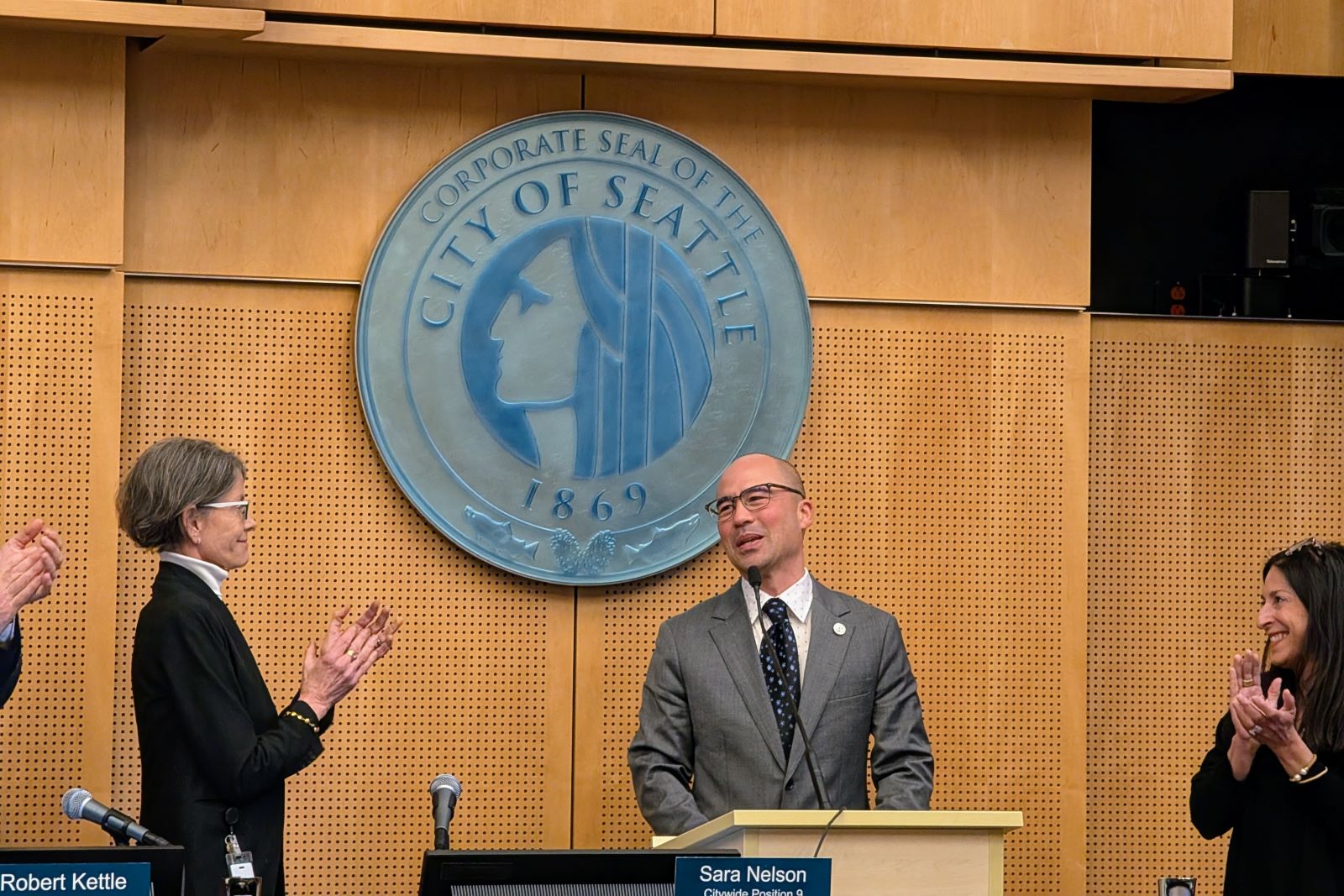
On Tuesday, Eddie Lin took office as Seattle’s newest city councilmember, pledging action to address the city’s affordability, homelessness, and community safety crises. Lin is fresh off a dominant performance in the recent election, winning 68% of the vote in Southeast Seattle’s District 2.
While Lin officially started in his new role last week, when King County’s election results were certified, Tuesday was the time for his first remarks as an elected official.
The new councilmember credited his focus on housing affordability and lifting up marginalized communities for his win over Adonis Ducksworth, who was a transportation policy advisor to Mayor Bruce Harrell.
“I think our message resonated strongly around housing affordability, around taxing wealthy corporations, around just being a strong voice and doing strong community engagement with District 2,” Lin told The Urbanist. “We are the most diverse district, and that means there’s a lot of barriers to representation.”
In a speech after taking the oath of office, Lin said many people in his district are struggling and need help, from the parents paying $3,000 per kid for childcare and struggling to afford the high cost of family-sized housing to people lacking housing altogether.
“I think about our unhoused neighbors, especially as winter approaches, who don’t have a roof or heat or safety or a bathroom to use, and I wonder how that’s possible in such a wealthy society, and how things have only gotten harder and worse 10 years after declaring a state of emergency for homelessness,” Lin said.
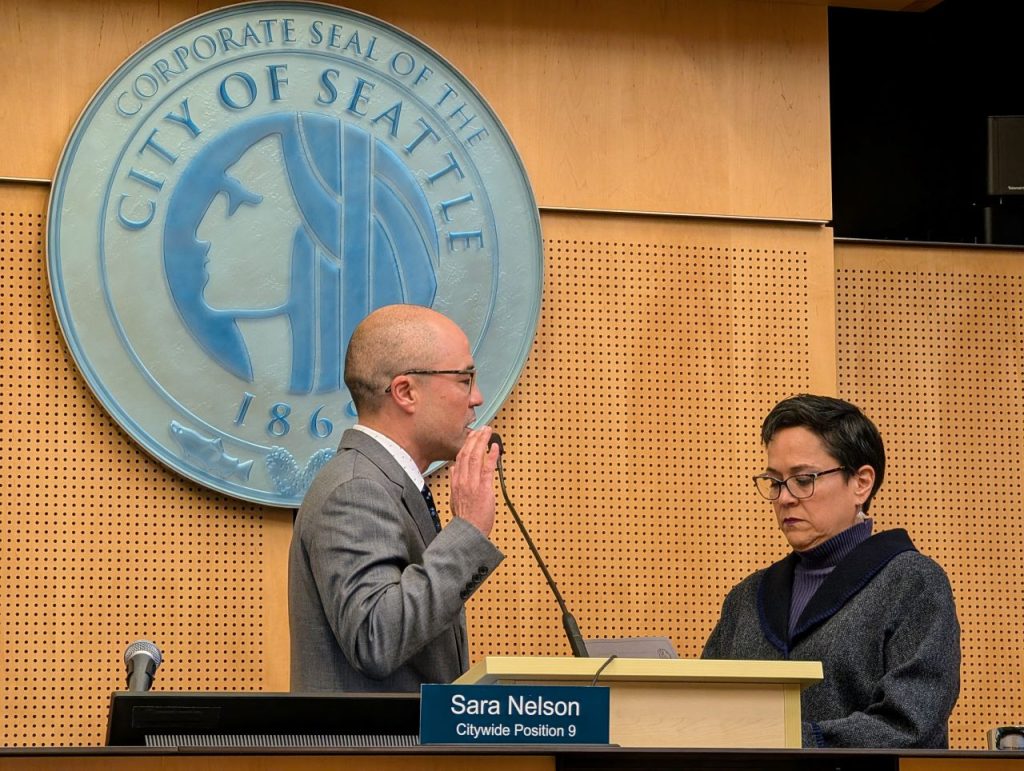
Lin embraced the goal of abundance in housing and community resources, and ultimately concluded his speech with a note of hope and collaborative spirit.
“When we have an abundance mindset and share our power and resources, we foster a community where we take care of others and they also take care of us,” Lin said. “And as I reflect on that world that we can foster, that world of abundance that happens when we come together as communion, it becomes crystal clear to me that I am not alone in this work, that we are not alone in this work, and that the resources and tools that we need, that our kids and elders need to flourish are right here in this room and all around us. It is us working together, growing together, talking and collaborating together.”
Lin noted the strong sense of belonging and community he has felt in Seattle. That stood in contrast to a childhood in Durham, North Carolina in the 1970s and 1980s, when he said he felt his Asian heritage as a source of shame and his biracial identity was only recently legalized and still controversial to many. He gave a shout to the many local Asian American leaders that blazed the trail for him.
“I think a bit about the shame and embarrassment I felt as a kid being Chinese and Taiwanese in a culture and society without strong Asian role models,” Lin said. “Versus the pride I feel now about my heritage, especially living here in Seattle, where we have such strong and rich Asian, American, Native Hawaiian, Pacific Islander history and culture and leaders, whether that’s folks like Wing Luke or Ruby Chow or David Della or Velma Veloria or Sharon Maeda in the crowd here today.”
In an interview with The Urbanist following the speech, Lin put a little bit of meat on those rhetorical bones, saying raising progressive revenue would be a top priority to ensure Seattle is funding enough housing and social services to meet the crisis. Lin vowed support for “anything we can do to rapidly expand shelter, tiny home villages” to get unhoused people inside. At his very first council briefing the day before, he noted a lack of references to progressive revenue in the city’s draft state legislative agenda for 2026, and suggested a potential amendment could be on deck.
Lin pledged to pursue broad solutions to increase community safety and “find creative, new ways to deal with public safety that are not just an enforcement approach.” He noted environmental design is too often overlooked, but that the City has experimented with traffic barriers near Aurora Avenue N to deter drive-by shootings.
When asked how he would vote on the proposed labor contract for the Seattle Police Officers Guild, which outgoing Mayor Bruce Harrell is seeking to get approved by Council before he leaves office, Lin said he was still making up his mind. Critics contend the contract offers a big pay raise that will strain the City budget while still failing to implement Seattle’s police accountability law approved in 2017 and hamstringing the City’s new civilian crisis responder department.
Clearing a path for an expansion of the civilian-run Community Assisted Response & Engagement (CARE) department was among Lin’s priorities, and he said he was happy to see the cap on civilian responders lifted — though the police contract adds new restrictions to the circumstances when the CARE team can respond without police co-response.
“The other top priority for me is accountability, greater civilian oversight,” Lin said “And I don’t think there was enough progress made on that front in this round. So, yeah, that’s going to be a tough one for me, but look forward to diving in and learning more.”
Shifting balance on council
Lin was sworn in earlier than other newly elected winners around the region because he is replacing an appointed councilmember. In those circumstances, state law stipulates the election winner take office as soon as election results are certified. The opening for D2 Council seat was set in motion by Tammy Morales’ resignation in January — even as she had nearly three years remaining on her term. Council voted to appoint Mark Solomon as a temporary replacement until the next election.
Lin will now serve the remainder of Morales’ term and face reelection in 2027.
Lin's message resonated across D2. His opponent Adonis Ducksworth only won a handful of precincts. This WA Community Alliance map shows precincts Lin won in green, with only a few orange beachheads for Ducksworth. www.theurbanist.org/2025/12/02/k…
— The Urbanist (@theurbanist.org) December 2, 2025 at 2:22 PM
[image or embed]
Morales cited mistreatment and ostracization by her colleagues as a major motivating factor for her resignation. Morales was often the lone progressive vote in 2024, after centrists picked up three seats in the 2023 election, seized control of Council, and installed Sara Nelson as Council President. However, Nelson lost her reelection bid by a wide margin, and progressive nonprofit leader Dionne Foster will take over her seat next month. In other words, Lin will have more allies than Morales did.
Working with Katie Wilson
Ahead of the primary, Lin endorsed Katie Wilson’s successful mayoral bid, noting similarities in their messages and plans around affordability and taxing the rich. (Both candidates were endorsed by The Urbanist Elections Committee, on which I serve.) Wilson won District 2 by 12 points despite the fact that Harrell lives in the district and used to represent it as councilmember.
“Affordability is a top issue for District 2,” Lin said. “People are getting pushed down to District 2 from other parts of the city because of affordability. And then people in district two are getting pushed further south, or getting pushed onto the streets. So, yeah, I do think we certainly feel it pretty acutely, the affordability crisis around child care, housing, groceries, utilities, property taxes.”
Lin's affordability and housing abundance message was a hallmark of his campaign from the beginning. His first interview with The Urbanist is here: www.theurbanist.org/2025/03/10/e…
— The Urbanist (@theurbanist.org) December 2, 2025 at 2:16 PM
[image or embed]
Lin pointed to road safety as another salient issue in Southeast Seattle, which is a major hotspot for deadly crashes and has fewer safe facilities for people walking, rolling, and biking.
“Her resume and her messaging around transportation, safety and transit, with MLK and Rainier being some of the two most dangerous roads, I think that resonated with folks,” Lin said. “Super excited to get to work with her and have a strong partner on floor seven.”
Lin said a recent vigil for victims of fatal car crashes held in his district was top of mind.
“As I think about community, I also think about another event I attended on Saturday, organized by the Rainier Ave Committee, a group that centers the voices of Black youth,” Lin said. “They held a vigil for victims of traffic violence on the corner of Othello and MLK. And I felt both a sense of sadness for the many lives lost traffic violence, and also hope, seeing the energy of our youth and advocating for a better future [so that] traffic violence and our addiction to vehicles as the primary mode of transportation can become a thing of the past.”
Doug Trumm is publisher of The Urbanist. An Urbanist writer since 2015, he dreams of pedestrian streets, bus lanes, and a mass-timber building spree to end our housing crisis. He graduated from the Evans School of Public Policy and Governance at the University of Washington in 2019. He lives in Seattle's Fremont neighborhood and loves to explore the city by foot and by bike.