

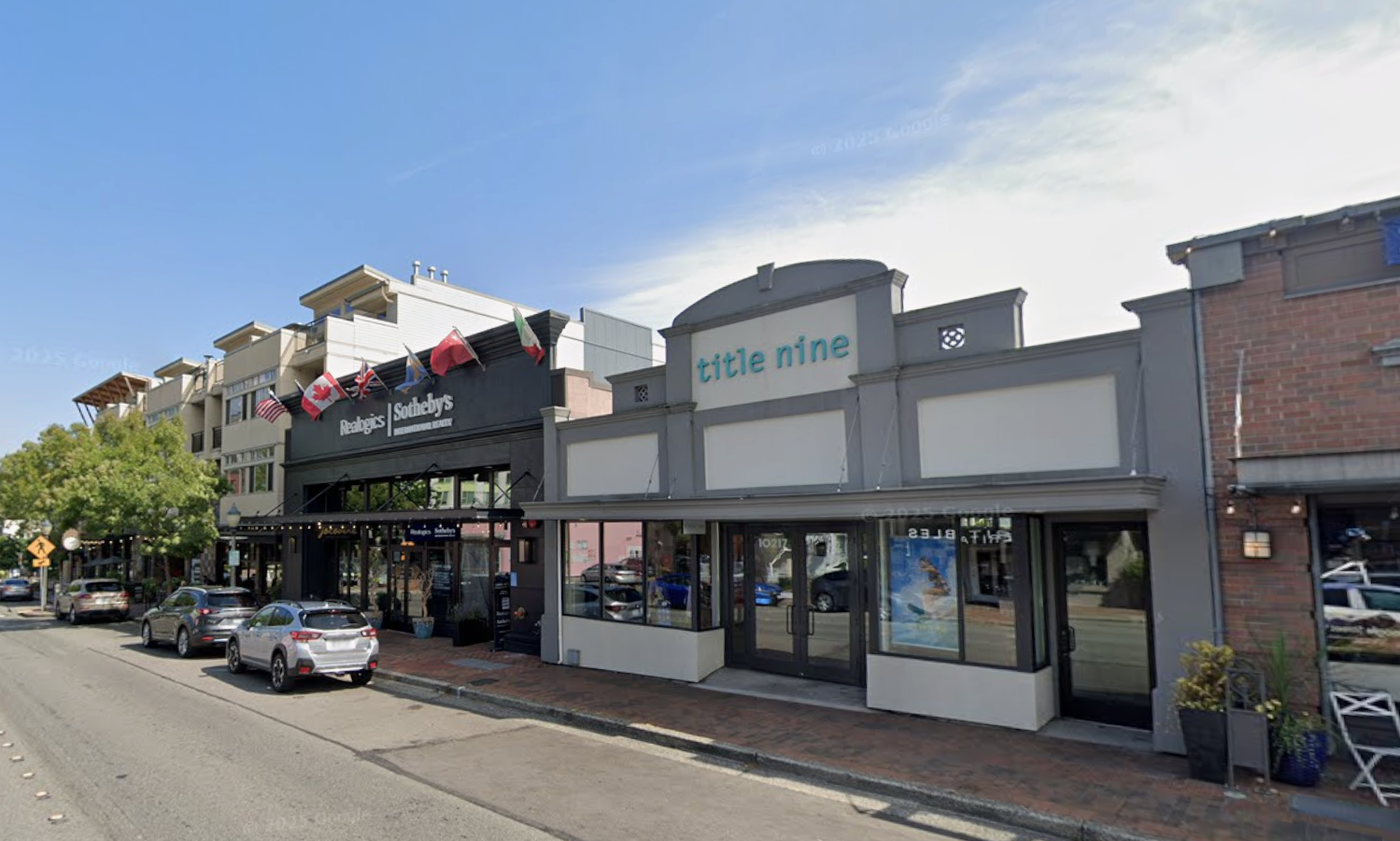
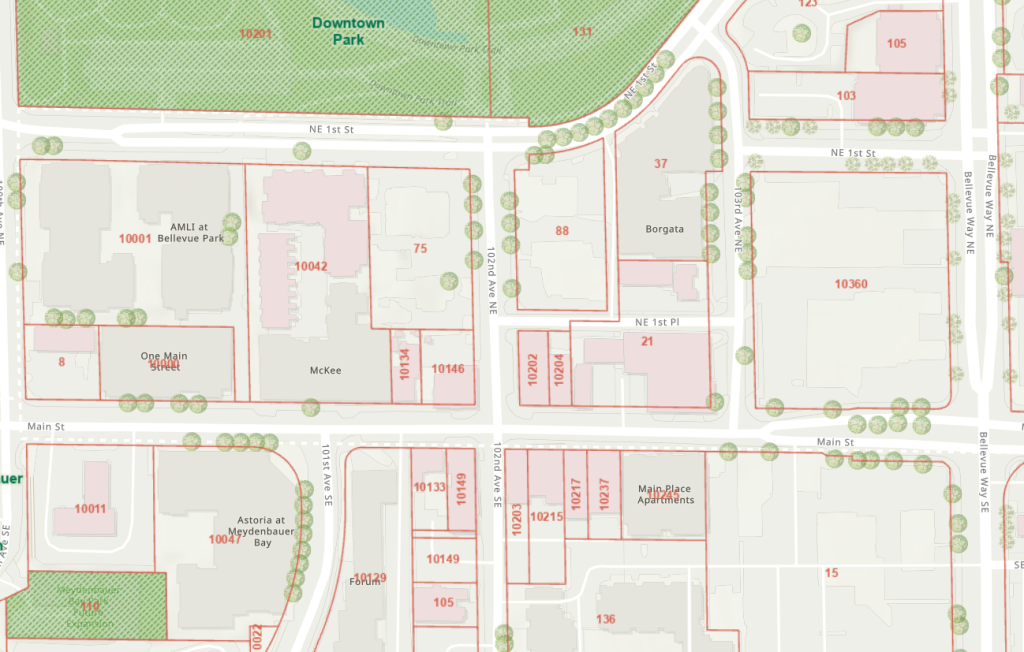
The Bellevue City Council held a last-minute discussion Tuesday night on implementing an emergency ordinance intended to keep the “character” of a small stretch of the Old Bellevue neighborhood safe from wholesale redevelopment. An idea that came from Bellevue Mayor Lynne Robinson, the proposal would restrict potential redevelopment opportunities in the name of protecting small businesses in and along Main Street between 100th Avenue NE and Bellevue Way.
Concerns around the future of Old Bellevue, one of the only areas around the city’s downtown that features lower rise buildings with storefronts right up to the sidewalk, intensified earlier this year when a permit application was submitted to build an eight-story apartment building at the intersection of Main and 103rd Avenue. The area is currently home to number of small businesses including Lavender Spa, Matcha Magic, Araya’s Place, and Glassybaby. The new project would bring 176 homes along with more than 10,000 square feet of ground floor retail.
While the proposal had been moving through the pipeline for several years, the filings from this past February targeted a start date of early 2026, suggesting a significant change to this quiet pocket of Downtown Bellevue has drawing near. Since the project already vested, it wouldn’t be directly impacted by any interim control.
With the emergency ordinance, the Bellevue Council is targeting the remaining older properties along Main Street, which could be next to enter the development pipeline.
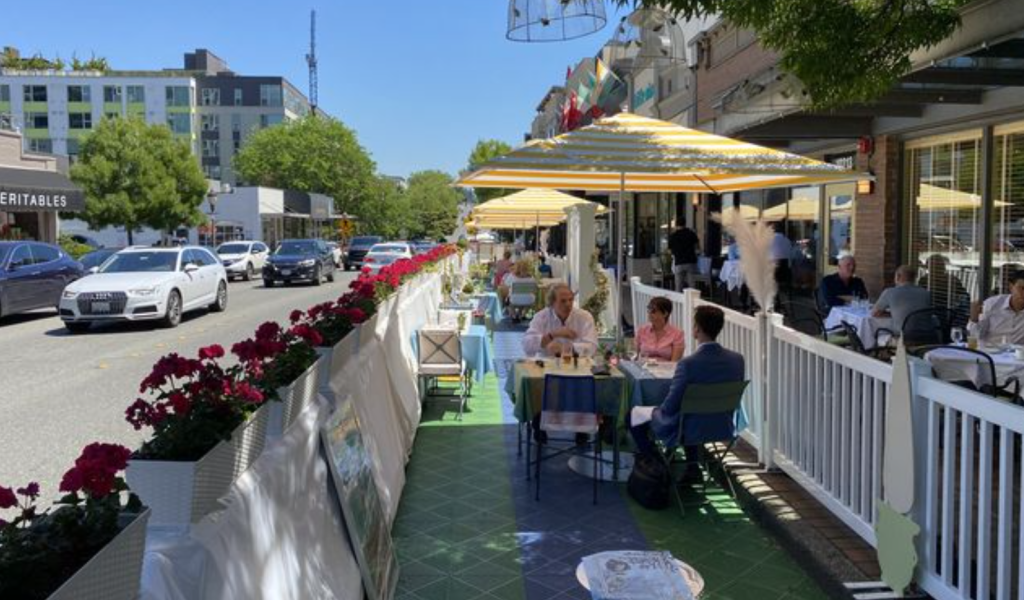
“Old Bellevue is a unique and cherished part of Bellevue, and a lot of businesses and people have located there because of the charm of Old Bellevue, and in fact, during Covid, it was one of the most prosperous parts of of our entire city, because the businesses stayed open and people flocked there,” Robinson said in explaining her request to the rest of the Council. “Currently, we have nothing on the record, nothing in the books, that requires that we preserve whatever it is about Old Bellevue that we love and that attracts businesses there.”
The Interim Official Control (IOC), Robinson explained, had been proposed by staff as a way to add an immediate barrier to wholesale redevelopment, without the need to hold a lengthy public process that involves a public hearing. With that control in place, the City would have breathing room to develop permanent regulations on its own timeline.
“This isn’t really a pause, and it’s not a moratorium,” Robinson said. “Anybody can still permit during this time, it was just mean that instead of being recommended that they retain the character, they would mandate that they retain the character in whatever development they did.”
None of the buildings, or their facades, along the stretch of Main Street in question are listed as historic landmarks, and requiring a developer to preserve a facade is not likely to actually preserve the things community members value about the area — the small businesses themselves. Through a land use control, Bellevue can’t mandate that property owners find a way to accommodate existing businesses within their new development.
In lieu of facade preservation, the Council could ultimately decide to adopt development standards that require buildings to mimic the existing structures. That similarly wouldn’t guarantee the retention of existing storefronts.
While there was broad support on the Council for preserving Old Bellevue’s “character” — however that may be defined — several Councilmembers were not fully on board with the idea of using an emergency control to address an issue that has been known about for some time.
“I do not quite understand why this had to be an emergency,” Councilmember Jared Nieuwenhuis said, referencing a past discussion on the future of Old Bellevue held at the Council’s annual retreat. “That was over, what, a year ago that we had that conversation, and I’m just concerned that this sets — I wouldn’t say it sets a bad precedent, per se — but certainly, I think property owners are caught off guard a little bit on this. So, my preference would have been that we would have convened the property owners first have the discussion, or at least let them know what we were intending to have a conversation about before taking this action.”
The mayor argued the urgency was warranted.
“Let me just explain what my urgency is: I fear that the moment I bring this up, people — developers — are going to start sending in permits to get out from under whatever it is we’re going to do, even though I’m convinced they won’t mind what we come up with,” Robinson said.
“I’m not sure what is meant by the desire to ‘preserve and reinforce the character, scale and identity’, of Old Bellevue, but I’m interested in finding out,” Councilmember Dave Hamilton said. “But considering that this idea regarding the IOC is new, I wouldn’t be ready to move forward with the final version until early next year. I think that there are a number of directly impacted community members and others that deserve the chance to understand the goals and the impact of the IOC. Community members in other neighborhoods will also be watching how we handle a potential IOC in Old Bellevue to understand how our approach there could impact them.”
Deputy Mayor Mo Malakoutian stood behind Robinson’s request, emphasizing the temporary nature of the interim control.
“I think this is a great idea. Whenever I talk to all of my friends in Seattle, the Main Old Bellevue is the only place they believe has a soul in Bellevue, unfortunately,” Malakoutian said. “Everywhere in Bellevue has a soul, in my opinion, but from outside, their view, that’s the only place. Very cute: I’ve heard that word a lot — small businesses. They can walk around. They can feel it’s a really cozy place to be.”
In the end, the Council took a unanimous vote to consider potential options at a future meeting, after staff time is spent fleshing out a recommendation. When the issue comes back, the Council will be forced with a more direct choice around how heavy-handed to be in the name of preserving “character.”

Ryan Packer has been writing for The Urbanist since 2015, and currently reports full-time as Contributing Editor. Their beats are transportation, land use, public space, traffic safety, and obscure community meetings. Packer has also reported for other regional outlets including BikePortland, Seattle Met, and PubliCola. They live in the Capitol Hill neighborhood of Seattle.