In Washington, as our current and future leaders face down our huge housing deficit, they are going to have to struggle through many issues. One particular knotty problem is what to do with the controversial policy tool called “inclusionary zoning” (“IZ” for short) that several Puget Sound cities have deployed, including Seattle.
I propose that we take the recently popularized tool called “funded inclusionary zoning” and adjust it to allow for funded in-lieu payments to affordable housing developers. Funding inclusionary zoning unlocks the benefits of inclusionary zoning while offsetting the harms of the policy. In short, it’s a path to more market rate housing and more subsidized affordable housing. But funded inclusionary zoning risks creating a dangerous rift in our pro-housing coalition. Amending this policy to allow for funded in-lieu fees will keep affordable housing developers whole, and keep our pro-housing coalition together.
What is “Inclusionary zoning?”
Inclusionary zoning requires that developers set aside some portion of the new housing they build and provide it to lower income households at affordable prices. Sometimes, builders can opt instead to pay a fee that funds affordable housing development elsewhere, as in Seattle.
The policy has its pros and cons.
Benefits of inclusionary zoning
There are several good reasons to implement inclusionary zoning.
- IZ programs are often paired with “upzones,” which allow more housing to be built on the upzoned properties. When the local government upzones in limited areas, this greatly increases the market value of the upzoned land, creating a windfall for the property owner. Inclusionary zoning is an attempt to claw back some of the value on behalf of the public.
- Inclusionary zoning is also a way to tax the rich — at least the portion engaged in urban development. (Generally, the larger scale apartment buildings that are subject to IZ are built by large-scale development firms, some of whom are extremely profitable, and funded by large banks.)
- The development community also plays an outsized role in politics. They are often worryingly cozy with officials, and sometimes even fund obviously repugnant candidates, if they see it as in their interests.
- Top it off with the fact that they bring change to neighborhoods and chop down trees, only to put up apartments with rents that feel scandalously high to many observers
There is a reasonable moral attraction to requiring a portion of development to be set aside for affordable housing through inclusionary zoning programs.
Criticisms of inclusionary zoning
Not surprisingly, most developers oppose IZ. But they aren’t the only ones. Lots of housing advocates and policy researchers oppose or at least worry about inclusionary zoning.
Their arguments are:
- IZ can be a poison pill that makes many projects infeasible, reducing overall housing supply.
- Less housing makes all housing more expensive to rent or buy. Why would we aggressively tax something we desperately want more of?
Skepticism of IZ has increased in recent years because:
- More and more research has emerged that made IZ look pretty bad, or at best with some mixed results here in Seattle. Seattle saw homebuilding shift away from lowrise zones with IZ to lowrise zones without affordability requirements.
- Housing shortages have become much more acute.
- With interest rates and construction costs so high, builders struggle to get their projects off the ground as their profit margins evaporate. As a result, housing starts are slowing down drastically.
- Tacking on builder fees, or IZ requirements is likely to further kneecap homebuilding, which has already fallen to perilously low levels.
My IZ Journey
I have had my own mixed feelings on the topic, to be frank, and they have changed as I’ve gotten more information.
On the one hand, as a pro-housing advocate, I have always thought the phrase “growth should pay for itself” is nuts when we desperately need more housing growth. I’ve often thought levying big taxes on housing sounds a bit like targeting taxes on farming or scientific research. Also, the housing development market makes too small and variable a tax base to reliably fund affordable housing.
It seemed to me that a more just approach would be to tax all our rich people quite a bit more. Among other things, this would do far more to fund lots more affordable housing. Taxing wealth rather than homebuilding would also make the tax much harder to avoid. Developers can avoid IZ by simply not building or doing so in other jurisdictions, but wealth cannot stop being wealth.
Before my change of heart, I believed that, while developers hated the IZ tax, it wasn’t going to stop them from building, because they could still turn a decent profit. Their big-business cousins made the same arguments about jobs flowing out of Seattle, and the research showed that was bunk.
But then interest rates leapt upward with inflation and the cost to build became prohibitive. Inclusionary zoning probably wasn’t a deal-killer on development when things were hot, and probably isn’t the key thing killing development right now. But the collapse in housing production got me more worried about any negative impact.
Given the fraught nature and contested claims of the space, when I was asked last year to do work on some inclusionary zoning reforms, I decided that I needed to really do my research. It turned out that among the piles of theoretical papers, there were only four good examples focused on real-world measurement and outcomes.
What did they show? On average, IZ didn’t suppress development much, although there sometimes was a modest impact on multifamily (apartment and condominium) construction. However, it did appear that IZ likely increased the price of surrounding market-rate housing. Depending on the study, the increase was from a modest one-time 2% price spike, to a much more significant compounding 2% to 3% increase, which gets expensive quickly.
My takeaway was that IZ is probably OK sometimes, but probably more often does more harm than good, and is rarely updated rapidly enough to account for changing market factors that determine its impact.
Advocates have been in search of a policy tool that would retain inclusionary zoning so that we still could get mixed-income neighborhoods, but also mitigate some of the negative impacts described above. Luckily, such a tool exists via funded IZ. This was popularized last year in Washington by Sightline (which is a client of mine – though this oped represents only my own views) with an eye toward the legislative session.
The politics in Washington State
The issue of inclusionary zoning splits the pro-housing coalition in Olympia. The pro-housing + pro-IZ block is not enough to pass a bill. Neither is the pro-housing + anti-IZ block. So when the question of IZ comes up in a housing bill, housing advocates cringe, because bills get stuck
In fact, the fight over IZ was the source of a multiyear impasse in Olympia over our very important transit-oriented development bill, a bill I had also worked on as a volunteer in my role as a board member at Futurewise.
Funded IZ
Given this impasse, I was thrilled last Fall when Sightline retained me to do a little work on evangelizing “funded inclusionary zoning” (let’s call it FIZ) which was designed to offset any harms from IZ. Funded inclusionary zoning is Portland, Oregon’s approach.
FIZ works differently than regular inclusionary zoning. Yes, it still requires the set aside of some number of units at prices that are more affordable. But instead of hoping the developer has a high enough profit margin to pay for these units and will still choose to build the housing project — the community pays for the affordable housing through a tax “abatement” program, which works kind of like a tax writeoff.
The aim of FIZ is to make it so the amount of money the developer saves from the lower taxes is roughly equal to the lost revenue associated with providing below-market-rate housing. That way the affordability requirements don’t dissuade projects from getting built.
This is great because it means we are more likely to get the market-rate housing we desperately need, and more likely to get the affordable housing we even more desperately need.
It also doesn’t need to cost the government any money.
This is due to one of the few cool things about the way we fund property taxes in Washington State. We pass our laws and specify a certain amount to be raised – say $1 billion. Then our assessors set property tax rates at a level that ensures we raise that $1 billion.
When an individual property gets a tax exemption, we still raise that billion bucks. The tax exemption just means that the individual property owner doesn’t pay as much. To offset the lost revenue, everyone else’s bill goes up by a few pennies. Since we should pay higher taxes to fund affordable housing, this is a great solution.
On this revenue neutrality point, there is one caveat. According to the Washington State Commerce Department’s guidelines, there is no legal reason for property tax abatement programs like MFTE to cost any money. However, as they note, some county assessors apply the tax-shifting law unevenly.
Relatedly, for reasons I’ve never seen explained clearly, the City of Seattle does say it has lost $9 million a year on average from its MFTE program, with another $71 million shifted to other taxpayers. The same report acknowledges that “foregone taxes represent lost tax revenue due to the way in which MFTE properties are assessed; fixing the assessment procedures would eliminate foregone taxes.”
In addition, if a funded inclusionary zoning program were to provide the funding through a mechanism other than tax abatement, such as fee waivers, this would actually reduce government revenue. As such, my recommendation is that FIZ be funded through tax abatement and that the law be written clearly to require assessors to provide a tax shift.
Given the impact on housing and government finance, I vastly prefer this approach over traditional inclusionary zoning. Not because I want to give gifts to developers — they spent hundreds of thousands of dollars keeping me out of office! For inclusionary zoning to really work, homebuilding cannot slow or trickle to a standstill — 10% of nothing is still nothing.
Pretending this isn’t the case doesn’t help. When we aren’t honest with ourselves about this uncomfortable reality, we usually layer on so many restrictions and fees that we just end up building too little housing.
Washington’s first political foray into this looks promising. Funded IZ was a key ingredient that allowed the transit-oriented development bill to finally pass the state legislature in 2025. Yes, the development community was angry about the bill because it has an allergy to anything called inclusionary zoning, and there are some onerous aspects for them. It’s also not clear whether the tax exemptions fully compensate them for any losses, although in some cases, the exemptions may also more than compensate them – providing a profit.
Nor do the size of the state’s IZ requirements vary by region – and different housing markets will have different needs at different times. The bill can and should be improved along these lines – but even the first round of FIZ is a huge step forward.
A fly in the ointment
Still, one very thorny political problem remains. The transit-oriented-development bill required something called “on-site performance.” This means that when a builder builds a new building, 10% of the units on-site have to be held for lower-income families who will pay lower rents. This means better integrated buildings in better integrated neighborhoods compared to programs like Seattle’s.
In Seattle’s inclusionary zoning scheme, we allow a developer to decide between providing affordable homes in the new building or instead paying money into a fund to build affordable housing elsewhere (the “in-lieu fee”). The builders pretty much always choose the fee. But this sometimes means shipping all that affordable housing money out of the neighborhood where new housing is getting built and to places where there are lots of affordable housing developments already. This is often in neighborhoods that already experience higher rates of poverty. Reinforcing segregation is not a good policy outcome.
Here is the rub. Funded inclusionary zoning’s requirement that units be on site presents a very big threat to one of our best allies in the housing fight. The nonprofits that build affordable housing, like Habitat for Humanity and Bellwether Housing, rely on Seattle’s in-lieu fees as a major revenue stream for their projects. Since so many builders opt for the in-lieu fee, it has provided hundreds of millions in funding, contributing to the construction of thousands of nonprofit units. From 2020 to 2023, Seattle’s IZ fee revenue averaged nearly $68 million annually, although proceeds have decreased rapidly as development has slowed.
The affordable housing developers are a big, influential group, and they do enormously important, good work. They have built and continue to manage many many thousands of units that are a lifeline for working families and very low-income households in this region. A policy change that robs nonprofit builders of a major funding stream would be counterproductive — not to mention politically fraught. Much better to find a mutually beneficial solution.
Now, the affordable housing developers did not oppose funded inclusionary zoning at the legislature last year. But that was tied to a transit-oriented development bill that triggered FIZ only in places facing new zoning increases because of the bill—so FIZ didn’t take away any existing revenue from affordable housing developers.
But the inclusion of funded IZ raised eyebrows. Given the new precedent set, affordable housing developers must be wondering if the in-lieu fees in Seattle may go away. After all, if “funded-IZ” is popular, and Seattle switches to requiring on-site performance, there is no more opportunity for in-lieu fees–the very fees that keep many of these affordable housing developers building new homes.
This would be disastrous for these affordable housing providers. As Washington evolves its housing policy around the state, I think this issue could threaten the fabric of the housing coalition. And as Seattle looks at its current catastrophic drop in construction, and mulls an update to our current program, this has raised a conundrum:
We have very good reason to convert our Seattle program to funded inclusionary zoning. This would get us more integrated mixed-income buildings, and reverse or reduce any perverse effects of our inclusionary requirements. We are facing a four-alarm fire when it comes to housing production, and we need bold solutions.
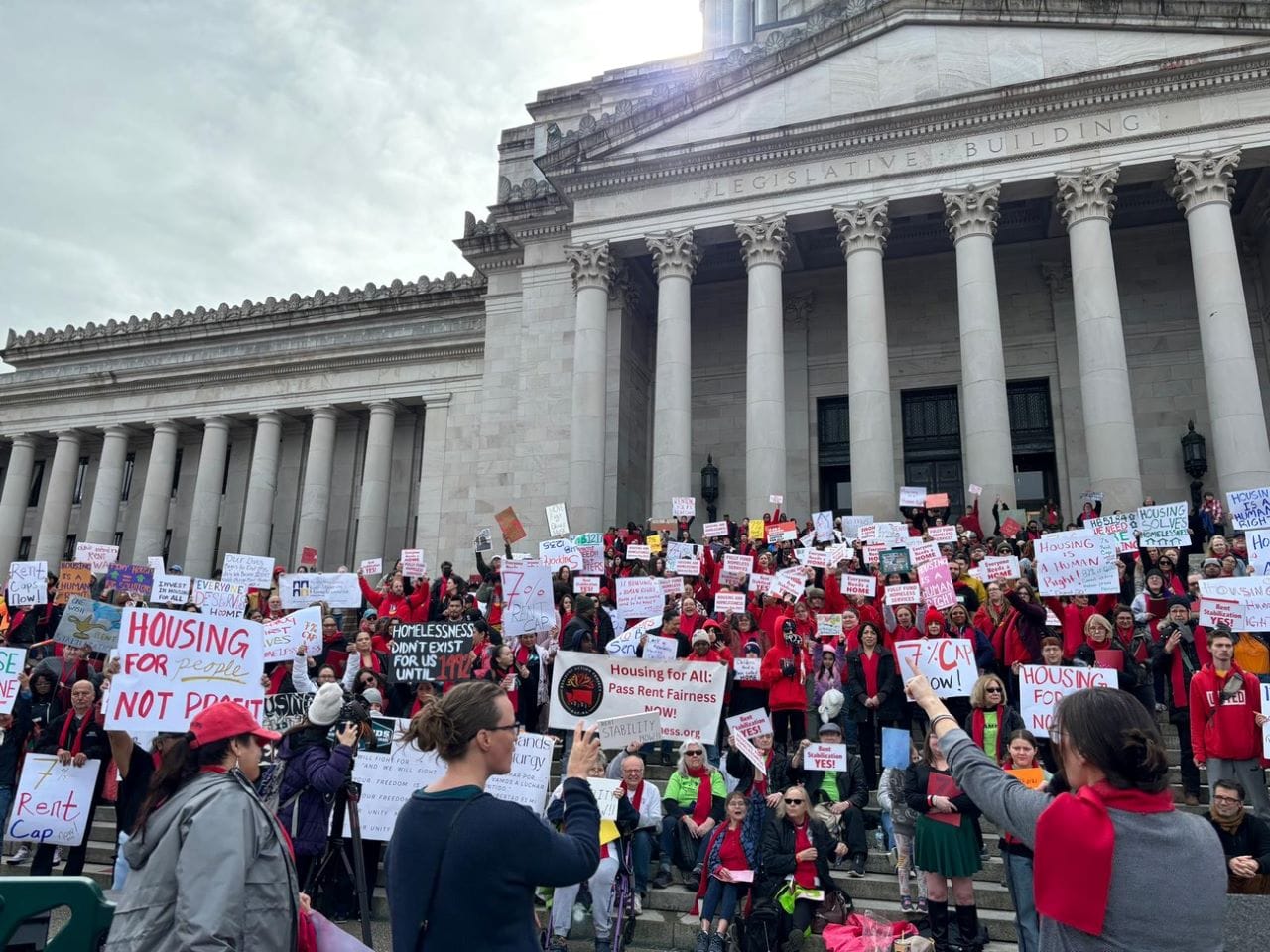
But adopting the legislature’s FIZ program would mean removing existing in-lieu fees as a revenue source for affordable housing providers — which could be quite the blow, especially at a time of financial turmoil for many nonprofit builders, which have already needed bailouts. Plus, builders will likely still fight on-site performance, since they’ve complained that administering an on-site program is burdensome. Affordable housing providers united with private-sector builders against housing policy is not a recipe for success or policy stability.
If we were to keep in-lieu fees, there is no obvious way to implement funded inclusionary zoning. And so I have been told that we have to choose between funded inclusionary zoning OR the in-lieu fees that do so much to keep affordable housing developers building new homes.
A novel solution
I reject this false choice between funded IZ or in-lieu fees. We can have nice things! I think we can have community-funded inclusionary zoning with in-lieu fees.
And here is how:
- Seattle sets an inclusionary zoning requirement, similar to now. Builders can choose between on-site performance and an in-lieu fee.
- Seattle simultaneously implements funded IZ by setting a building abatement rate for all projects subject to inclusionary zoning.
Voilà! That’s all that is required to untie the knot.
Yes, it’s weird that we are giving people a tax abatement to pass on via a cash payment to the in-lieu fund which funds affordable housing.
But weird is fine! They don’t call it sausage making for nothing. It satisfies the political and housing-outcome constraints.
A few things would make it better. It would be better to tie the fees to similar neighborhoods, so we don’t just reinforce concentrated poverty and racially segregated development patterns. We should do this with our in-lieu fees one way or another. It would be best to set the abatement rates as an exemption as exactly equivalent to the in-lieu fees paid out.
(And yes, it would be better overall to not have to build such byzantine policies, and simply guarantee the billions in funding needed for affordable housing statewide by actually taxing the rich. We should continue to fight for that. But until we have those funds secured, funded IZ presents a threat to affordable housing developers and this policy removes that threat).
Funded inclusionary zoning with a funded-in-lieu fee option would make homebuilding more feasible. It would maintain and possibly even expand the funding available for affordable housing development because more developments would get built, generating more affordable housing funding.
With proper assessment practices, funding IZ will not decrease revenue for local governments. And crucially, it would keep the region’s increasingly strong housing coalition together, pressing forward through the next waves of needed reforms.