

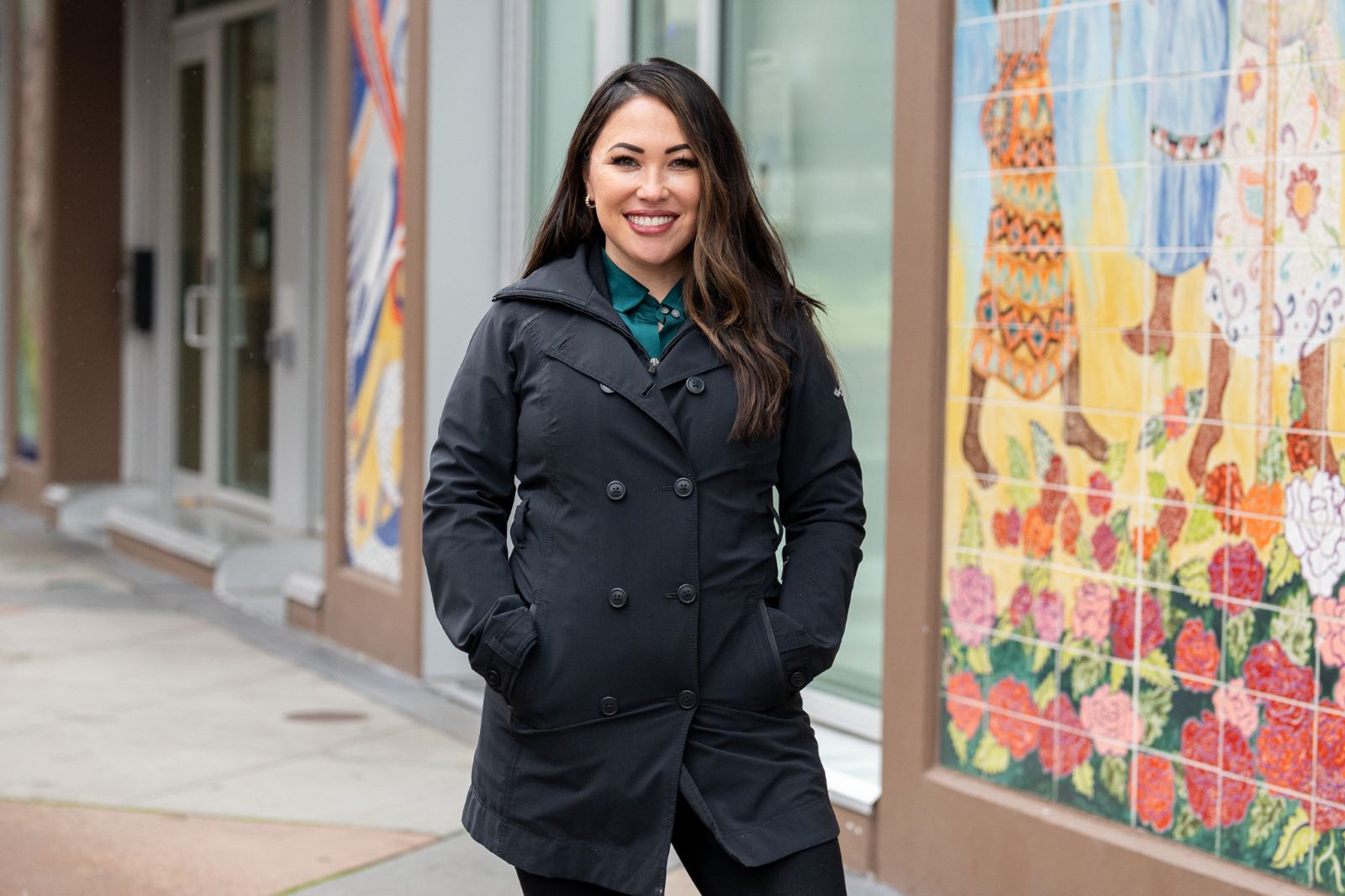
Toshiko Hasegawa rolled out her campaign for King County Council on Monday, vying for the District 2 seat that Girmay Zahilay vacated when he won last year’s election for County Executive. Like State Senator Rebecca Saldaña, won entered the race earlier this month, Hasegawa is angling for the progressive lane and stressing the urgency of affordability issues.
In her interview with The Urbanist, Hasegawa brought up the need to accelerate the RapidRide R Line bus project upgrading Route 7, spur transit-oriented development, and incentivize affordable housing. She vowed to champion the project to build a lid over I-5 to repair the “concrete scar” the freeway tore through the core of Seattle, creating housing and park space in the process.
Hasegawa has served on the Seattle Port Commission since 2022. Earlier in her career, she worked as a legislative aide for King County Councilmember Jeanne Kohl-Welles, which she said familiarized her with issues before the council.
Her opening pitch emphasized her family’s long roots in the community and the need to stop the cycle of displacement and anti-immigrant backlash that her family lived first-hand.
“I am a fourth generation Japanese American from the Beacon Hill neighborhood in South Seattle,” Hasegawa said. “My family’s story starts with my great grandfather, who immigrated to the Central District in search of a better future, and everything that he worked for was taken from him from the government. His assets were seized, his bank accounts were frozen, and him and his four children were put into American concentration camps in Minidoka in Idaho, not because of what they had done, but because of who they were.”
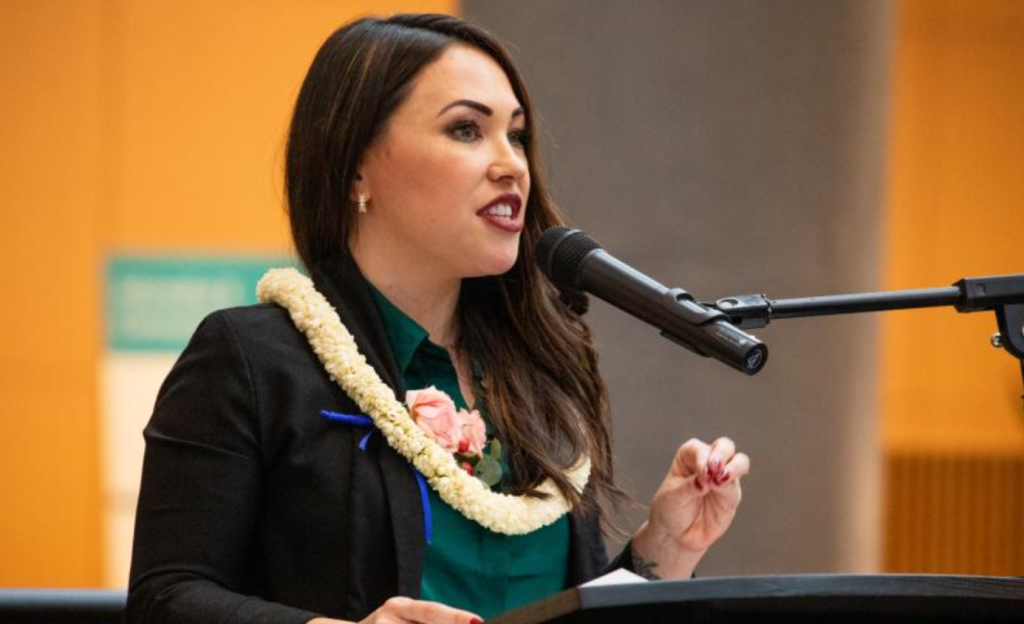
Despite that ordeal, the Hasegawas were able to reestablish themselves in Seattle and get back on their feet. Unfortunately, the affordability crisis is making it harder for other immigrants and newcomers to replicate that story and make ends meet in high-cost metro areas.
“My dad was a union leader. He was secretary treasurer the Teamsters Local 174, and he was able to sustain our family of four on the single union salary. Today, my husband and I pay $4,200 a month on childcare,” Hasegawa said. “Child care is just one representation of how affordability is crushing people and making it hard to live in these communities that we love. The American dream is no longer moving away and buying a house with a white picket fence. It’s the ability to be able to remain in place in the community that you helped build. And I believe that answering the issue of affordability is going to be key to getting a lot of the pressing issues up today right.”
Along with her husband, Hasegawa is raising her two young children in the same home her grandparents and parents lived in before her.
King County Council District 2 encompasses the University District, Laurelhurst, Ravenna, Eastlake, Capitol Hill, the Central District, South Seattle, Skyway, and the Allentown neighborhood of Tukwila. It’s a renter-heavy area bearing the brunt of the affordability crisis. If elected, part of Hasegawa’s district would overlap with the district of her dad Bob Hasegawa, who has represented the 11th Legislative District in the state legislature since 2013.
Urban development
Hasegawa trumpeted the benefits of transit-oriented development (TOD) to improve affordability and boost economic activity.
“D2 is the perfect place where we can make sure that we’re modeling what transit-oriented development development looks like. It’s already zoned residential. Many places are zoned for high rise, these are places that could truly benefit from that sort of development. Missing middle housing, I would love to see incentives to developers who can guarantee a certain number of affordable housing units for an X amount of time.”
The County doesn’t directly control the land use across much of District 2, with the exception of the Skyway, a neighborhood that sits on unincorporated land between Renton and Seattle. But the County does invest significant resources in affordable housing, in addition to adopting policies that guide land use across the entire county
One place Hasegawa would like to spur development is near I-5 downtown on space created by lidding the freeway.

“We talk about our communities as being historically impacted by [transportation] systems that have caused noise pollution, air pollution, water pollution, light pollution,” Hasegawa said. “I think about the I-5 corridor, also known as the concrete scar that cuts right through the heart of our district. I would love to be an ardent advocate for the next big project.”
She pitched it as an environmental justice project that would be a big job creator.
“Lidding I-5 would be something that connects D2 to this the urban core. It would give us square footage for over a thousand new affordable housing units, child care centers, green space, and livable areas where we could have that transit-oriented development that could address some of those environmental injustices and give us the density that we’re looking for in order to accommodate the projected growth of our area, in a way that’s close to the urban core.”
With rising construction costs hitting megaprojects across the region, lidding I-5 will also require a huge investment and likely a delicate collaboration across multiple levels of government in partnership with the private sector.
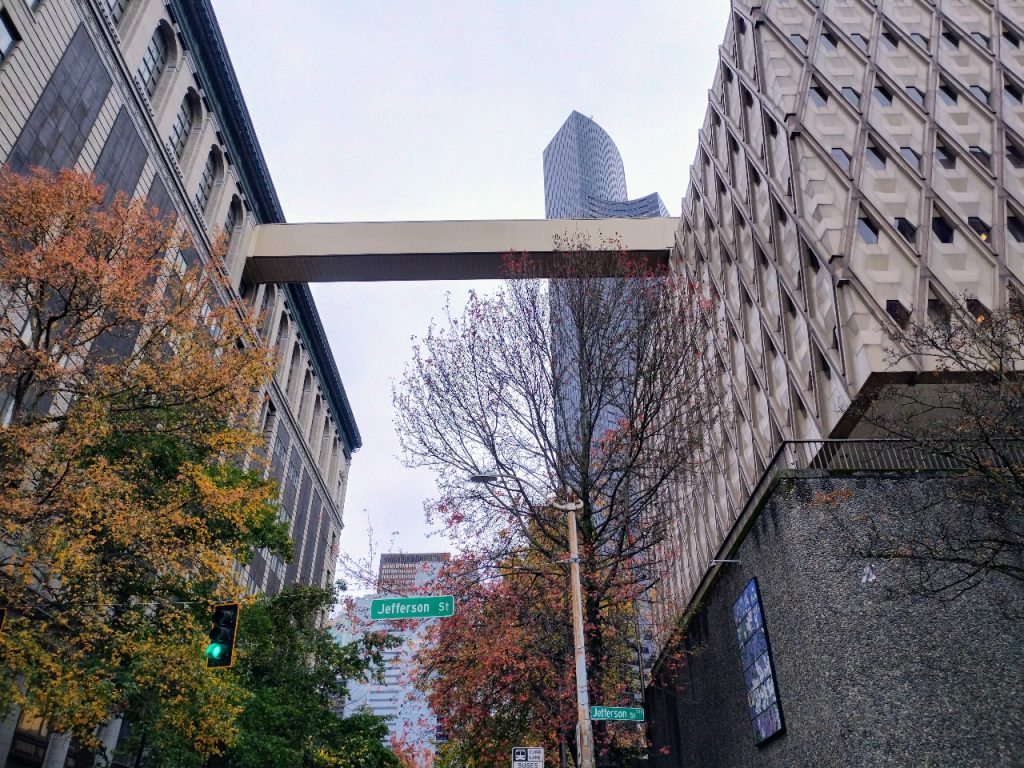
On the topic of the Civic Campus Initiative, a proposal pushed by former County Executive Dow Constantine to redevelop the County’s campus in Downtown Seattle and SoDo, Hasegawa said she supports the idea, but would like an emphasis on affordable housing and uplifting marginalized communities.
“What I would like to see happening is an equitable land banking development program where we’re doing an assessment of, in particular, those county properties that are near transit hubs, and making sure that we are developing that for affordable housing specifically,” Hasegawa said. “That is exactly what we should be doing, as opposed to selling it away to the highest bidder. I would love to champion a policy where 100% of that was set aside for social housing. I would love to see long-term agreements with community land trusts, with communities of color and historically displaced and impacted community members.”
Following in the tradition of her father, Hasegawa said a public bank would be a way to fund affordable housing and make her ambitious plans come to fruition. Bob Hasegawa has long proposed establishing a public bank at the state legislature to no avail, and the legislation (Senate Bill 5754) is back this year for another go at it.
Justice experience and standing up to Trump
Hasegawa’s campaign also made her criminal justice experience a selling point: “As renewed federal actions under Donald Trump threaten civil liberties and immigrant protections, Hasegawa is the only candidate in the race with deep, hands-on criminal justice policy experience at both the county and state levels and a Masters in Criminal Justice from Seattle University.”
Hasegawa said the County must be willing to stand its ground against federal attacks, and sue to block overreach.
“The Trump administration is waging economic warfare targeting investments into our local governments based upon our support for programs that we love, like equity programs, sustainability, environmental justice, diversity in contracting,” Hasegawa said. “Where the federal government is no longer going to be funding, this is exactly where we continue to be innovative and continue to walk the line on our priorities.”
Endorsement battle heats up
The battlelines are already forming in this race. While Saldaña announced with a broad list of endorsements, Hasegawa also touted a wide list of endorsements including:
- King County Councilmembers Rod Dembowski and Teresa Mosqueda
- Seattle City Councilmembers Alexis Mercedes Rinck, Eddie Lin, Joy Hollingsworth, and Dan Strauss
- Seattle City Attorney Erika Evans; and
- Representatives Sharon Tomiko Santos (D-Seattle, 37th LD), Chipalo Street (D-Seattle, 37th LD), David Hackney (D-Tukwila, 11th LD), Steve Bergquist (D-Renton, 11th LD), Gerry Pollet (D-Seattle, 46th LD), and Darya Farivar (D-Seattle, 46th LD).
Occasionally those endorsements overlapped, as in the case of Mosqueda and Street, who endorsed both candidates.
“Toshiko leads with both courage and care,” Rinck said in a statement. “She understands how policy decisions show up in people’s daily lives, especially for working families and communities that have too often been left out. I’ve seen her in action as a fierce advocate for justice. King County needs her experience, her values, and her steady leadership.”
Her campaign also claimed early endorsements from a number of unions, including Deep Sea Fishermen’s Union of the Pacific AFL-CIO, Inland Boatman’s Union, International Longshore & Warehouse Union Local 19, International Brotherhood of Electrical Workers Local 46, Pacific Northwest Ironworkers, Ironworkers Local 86, Masters Mates and Pilots Union, International Association of Firefighters Local 1257.
In a race with two big-name progressives, small differences are likely to get blown up. In her Urbanist interview, Saldaña noted she was the only candidate to endorse Seattle Mayor Katie Wilson before the primary, which Wilson ended up winning by nearly 10 points, shocking the political establishment. Hasegawa endorsed Bruce Harrell in the primary, before switching to a sole endorsement for Wilson.
Hasegawa emceed Wilson’s last big rally before election night, where Saldaña was also a featured speaker.
In her campaign announcement, Hasegawa noted she serves on the transition teams for newly elected Seattle Mayor Katie Wilson and King County Executive Girmay Zahilay. Those two leaders have yet to weigh in on this race.

Doug Trumm is publisher of The Urbanist. An Urbanist writer since 2015, he dreams of pedestrian streets, bus lanes, and a mass-timber building spree to end our housing crisis. He graduated from the Evans School of Public Policy and Governance at the University of Washington in 2019. He lives in Seattle's Fremont neighborhood and loves to explore the city by foot and by bike.