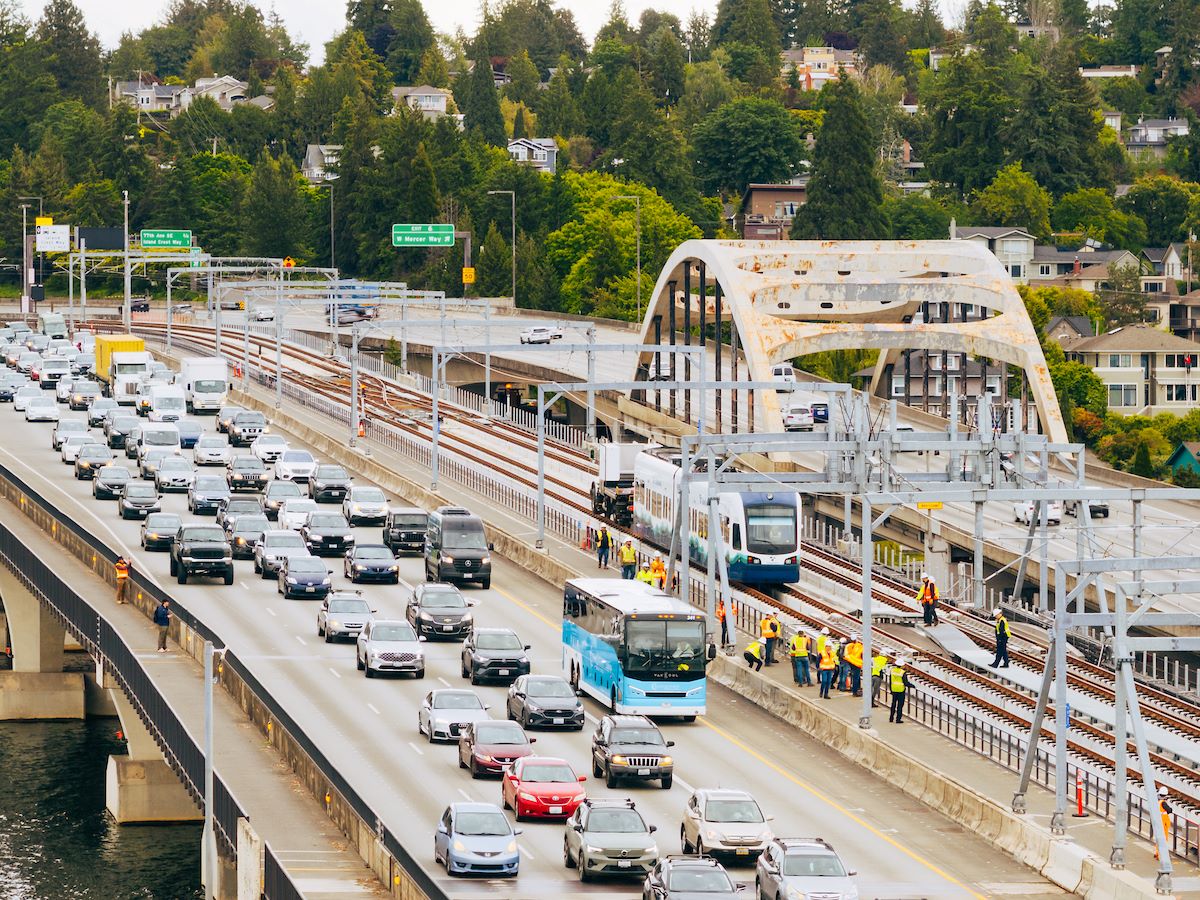
In this episode of The Urbanist Podcast, our newsroom discusses what the 2 Line opening scheduled for March 28 means for the region, and what removing former committee chair Claudia Balducci from System Expansion Committee and Executive Committee means for Sound Transit.
Hosts Ryan Packer, Amy Sundberg, and Doug Trumm also discuss the constitutional crisis created by a Department of Homeland Security that is ignoring due process rights in its haste to execute a campaign of mass deportation. They overview what state and local officials are doing to counter illegal actions by immigration agents, and prepare for the type of invasion that Minneapolis has seen.
Fresh off interviews with the two leading Seattle City Council candidates in District 5, Amy also breaks down the race that could swing control of the legislative body. As immigrants, Nilu Jenks and Julie Kang have stressed the need to defend to protect at-risk communities in the face of ICE overreach.
Finally, the crew each provides their top 3 destinations for visitors to the Seattle region.
Transcript
[00:00:02] Ryan: Welcome to the Urbanist Podcast, a show touching on the biggest headlines at The Urbanist, and also offering a deeper look from the reporters who are breaking the stories. We’re an independent reader supported publication based in the Puget Sound region. The Urbanist has been working to cover the big stories since 2014.
We do advocacy journalism for better cities. You can find us at TheUrbanist.org. My name is Ryan Packer. I’m a contributing editor here at The Urbanist. With me as the rest of our newsroom. We’ve got reporter, Amy Sundburg.
[00:00:34] Amy: Hi, Ryan. Good to be here.
[00:00:35] Ryan: Great to have you. And we’ve got publisher Doug Trumm.
[00:00:39] Doug: Hey, let’s get into it.
[00:00:41] Ryan: Let’s get into it. First thing we’re gonna be talking about is the biggest news, when it comes to transit in the region in a very long time, which is the news we’re finally getting a date for the light rail connection across Lake Washington, between Seattle and the Eastside.
[00:00:58] Amy: Woo-hoo.
[00:01:00] Ryan: After years and years of waiting, we know that riders will finally be able to ride the first light rail line on a floating bridge in the entire world on March 28th. So, mark your calendars. Doug, you and I were both there for the beautiful day when they unveiled the countdown clock on the top of I 90 in Seattle. What was it like to be there for this big announcement?
[00:01:26] Doug: Yeah, it was one of those days we’ve been having. I biked over there, through a frosty arboretum meadow on the way there, trying not to wipe out on my bike. But, we get there and by the time they actually pull the veil back, the sun was shining pretty hard and it, and everyone was really excited and suddenly it felt like the middle of spring and jubilant. So there was a ton of energy there. A lot of people turned out to the little park that. We were spilling out into the road. We could see the Bellevue skyline in the distance and the bridge that’s gonna carry people there.
It was a really great backdrop for the announcement. A lot of excitement, good speeches. Sound Transit chair Dave Somers was probably right that people aren’t gonna remember the speeches very well. But they will remember that they have this great new way to get to Bellevue and beyond.
[00:02:13] Ryan: Yeah, I was struck by how many of the speakers tried to really ground in the history of what led to this moment. Dow Constantine really has a chip on his shoulder about Forward Thrust, the transit measure that failed in the seventies, and the fact that has taken us so long to, to finally build out our network.
So he was really trying to paint all of the steps leading up to this, including Jim Ellis, who helped lead the Forward Thrust plan that ultimately didn’t work. But also, the people who built the I-90 Bridge with the idea of light rail potentially being able to go on it, which a lot of people thought was gonna be completely impossible.
And then Claudia Balducci, who’s been on the Sound Transit Board almost longer than everybody had to also ground people on the fact that the Eastside fought against light rail, tooth and nail, and Kemper Freeman tried to stop it, and Mercer Island was not a big fan of having a station on their island. And all these headwinds.
And it’s gonna be a big moment when this finally is able to open. Obviously the fact that, we already have the stations open on the Eastside it’s both a huge win for the region, but it also dampens the excitement a little bit, I think. It’s easy to imagine what this would be like if we were opening the entire thing at the same time. It’d be a huge, huge moment. But also those stations are getting a lot of use and so it’s really good that we were able to do that.
It’s a different kind of thing, but I think people are still gonna be incredibly excited to get out there on day one. It is definitely the biggest transit opening, since maybe the first segment of the 1 Line open in 2008.
[00:03:58] Doug: Yeah, a lot of people were saying that. I guess farther back I might not have immediately thought that, just ’cause they all seem like a big deal. But, I do think this one’s monumental, since the idea of crossing the lake is a barrier in itself. There’s only those few, few passageways through and the fact that Bellevue and Redmond are huge job centers too. I think at least to some of the regional boosters, that’s like a huge difference. And a great connection for people to have options in where they live and still get to work. So that came up a lot.
[00:04:29] Amy: I mean the people I’ve been talking to are really excited. I think for people who haven’t been following as closely, the opening of the bridge so that there’s the cross ability is a really big deal and people are really into it. And I know people have already been asking me, where is the celebration gonna be? We know when we know the opening day, but where is it gonna be because maybe I wanna go right? That kind of thing.
[00:04:52] Ryan: Yeah, it’s a big question I had. Where’s the ribbon cutting gonna be? Is it gonna be on the bridge? Is it gonna be in Mercer Island? Which is kind of right between, but it’s not a really, a super fitting, uh, um, place given how much they fought against having their station. I think Judkins Park makes a lot of sense, but also I want Bellevue to be a part of that moment too, even though they don’t have any new stations opening. And so it’d be nice, I mean, I think we’re gonna spread the party around a little bit, but we’ll see.
[00:05:22] Doug: Yeah. And no official announcements at that event. They’re still getting their ducks in a row. And we joked about this in a previous episode that what if we put in Judkins Park? And we kind of laughed it off, but I talked to some people who thought it might actually be possible. I guess the one benefit it’s closer to some of the offices and news stations. The Bellevue station’s already opened, which would be the other kind of obvious option.
[00:05:44] Ryan: Yeah, I think that makes the most sense. But there was a little bit of a sour note for the unveiling of the clock. Can you talk a little bit about why that was, Doug?
[00:05:56] Doug: Yeah, I did an article on this, a week or two after the event, just ’cause it was still kind of sticking with me watching that surreal moment where they did give Claudia Balducci, who used to be mayor of Bellevue and Bellevue City Councilmember since 2004. So she noted she was one of the few people who saw this project through from its inception.
Because the funding for this project came from the 2008 Sound Transit 2, or ST2, what we say for short ballot measure. And, they had a failed measure before that she noted. And all that time it was in negotiation with the local governments in the area, including the Bellevue City Council, which she was on.
Then she eventually runs for the Bellevue district for the King County Council. And that’s where she got this appointment to the Sound Transit Board and served on the System Expansion Committee from 2018 as chair. So, that’s a long way of intro to say she’s not on that committee anymore because they voted to change the committee assignments that same week that they announced this opening.
And we had caught wind of that, as well. So, she is making this big unveiling, which they’re giving their honor, but they’re giving with one hand and taking from the other in kicking her off this important System Expansion Committee where a lot of the work to balance the budget, which is there’s a $35 billion long-term gap, with their ambitious expansion plans, which are gonna nearly double the light rail that they built out with ST2, to 116 miles. It’s gonna be a very extensive network. Maybe not as dense in Seattle as some would like, but it’s gonna stretch from Tacoma to Everett and get out to Issaquah.
But, she’s navigated the challenges with the 2 Line and they got there and people are excited about that, but they’re not gonna go take that experience and have her continue to, if not lead System Expansion Committee, at least be on the committee. ’cause they removed her from that and from executive committee and put her on Rider Experience where I’m sure she’ll do good work. But, I think it’s hard not to see that as a slight.
[00:07:53] Ryan: Yeah, and it’s important to note that these committee assignments were not really up for renewal. There have been some new members joining, but usually you don’t completely reconfigure your committee assignments. This was supposed to go through the end of this year, which is a very critical year for all these decisions. Claudia Balducci has literally been chairing System Expansion Committee since there was a System Expansion Committee before it was called something else in 2018. It’s just, yeah, it’s a big shift. So a lot of people are kind of anxious about this.
[00:08:29] Amy: It also looked like the new chair of the System Expansion Committee hasn’t been there for that long. Am I correct in that?
[00:08:35] Ryan: That’s true. Yeah. Angela Birney, Mayor of Redmond, she’s only been on the board for a couple years and so, it was an interesting choice, especially given this sort of rationale that Claudia’s district is transitioning into the phase of their system being open. So focusing on rider experience makes sense, because that’s also true for Redmond.
[00:08:56] Doug: Even more so.
[00:08:57] Ryan: Even more so. Yeah. ’cause ultimately there will be another line in Claudia’s district, but not in Redmond. So that is a little head scratching. But it’s more to the fact that she’s not sitting on the committee at all. Nor executive committee. Executive committee deals with high level policy. She’s being replaced by the person that she lost to for the executive race last year. So it’s hard not to see that as a factor here as well.
I watched her first Rider Experience Committee meeting yesterday after the first executive committee that she wasn’t on in the morning. And it’s undeniable the level of discussion that Claudia makes happen when she’s on a committee, cutting through to find the elephant in the room and actually put it on the table. And I just felt like it was pretty clear that was missing. Obviously, Katie Wilson, who’s now on executive committee is going to be a valuable voice, but she’s still getting her legs under her, in terms of what it means to be on that committee, as opposed to someone who’s been on the board, you know, for 10 years.
[00:09:58] Doug: Yeah. And she’s also just trying to get the ball rolling and get momentum as mayor. So I think she can walk and chew gum, but it’s a tall ask to try to be Claudia Balducci two weeks into your Sound Transit term.
[00:10:09] Amy: Is it safe to say that? This was a fairly surprising move.
[00:10:15] Ryan: It was surprising. Yeah, it was surprising both to Balducci, quoted her saying that she was surprised by this, as well as transit advocates who really weren’t expecting. And this was really only announced 24 hours before the full board where the decision was made. And, there were some people who called in, thanks to our reporting, noting that the agenda materials had been posted, expressing shock.
And, Dave Somers, the chair of the board responded to this saying, ‘ Claudia’s great by the way you can show up to any committee that you want to and still participate even though if you can’t vote.’ Even though that’s pretty unusual. Oftentimes the committees have trouble getting quorum some months, and so it’s a little unrealistic.
But yeah, it was a big surprise.
[00:10:59] Doug: Yeah, and I think a lot of people saw political retribution, you know, for her running for executive and losing. I will say that Angela Birney did endorse Claudia Balducci because Claudia had her base of support in the Eastside more so than, than the rest of the county, which ended up being more numerous as far as the votes go.
So I guess it’s not like pure political retribution, but I think it played a factor. That that was why her time was up. And I don’t know, she can still go to the meetings, but without that voting power, I don’t think she’ll have as much leverage.
So, it’s definitely gonna be an interesting time, and they’re tackling the Enterprise Initiative this year, which is what their term is for, ‘how the heck do we close this $30 billion plus hole in her long-term financial plan.’ I’m sure she’ll still be negotiating behind the scenes, but, I guess the big question is just do they have a plan, a viable plan to do that?
Because they said, ‘we don’t want to just do what we’ve always done,’ which is delay projects and cut projects and water down scope and all of that. ‘We wanna try to figure out some new creative ways to solve that gap.’ But so far I haven’t heard anything that really gets them all the way there.
[00:12:04] Ryan: Correct. And, to put my pundit hat on for a minute, I look less at the political retribution angle and more the fact that, Claudia Balducci is someone who is thinking out of the box when it comes to this. And that’s not always actually a popular thing for people who are more comfortable with the status quo to be forced to think out of the box. And so you go back to December when Dave Somers tried to force the conversation around Balducci’s idea to look at a building the second downtown tunnel. We talked about that on the podcast.
And, that was kind of killed in the crib in terms of an intentional choice to get that out of the way before the discussion is happening this year. Even though, I think if I come down on one side, it’s in favor of keeping the tunnel, but I also come down in favor of keeping it on the table because the other option is maybe canceling West Seattle.
And so should be a part of the discussion. So what I see is sidelining Balducci is really a move to really keep those discussions to a minimum. And, I saw this yesterday: she was pushing to really make sure that the board was actually getting involved in these discussions and not letting staff lead the way.
And that’s the biggest concern that I have, is not engaging fully with all the options on the table and just letting the easiest thing take over.
[00:13:25] Doug: Yeah, absolutely. You made a great point. The first meeting you watched without her, there was a lot quieter as far as actually pressing staff to explain themselves or consider other options because really that’s all it comes down to. Like, maybe her asking questions hasn’t always changed their course, but at least it forced agency staff to put their reasoning on the table. And that’s honestly been the biggest complaint from transit advocates from a process standpoint anyways, that Sound Transit won’t really show their work. They won’t explain their assumptions that led them to make an alignment choice or policy choice around service.
So, the board is supposed to be there checking under the hood, so to speak. And if there’s not someone putting questions out there, even if they’re not immediately all the answers, you know, like the tunnel questioning being one where maybe she’s wrong, but at least she’s forcing a discussion about it.
And she was asking those questions early in the process before there was a huge financial problem, because of all the trouble about getting a station in either Chinatown or Pioneer Square and then figuring how to do the transfers from the Eastside. That whole Chinatown Station debate was also about the whole system having good transfers.
And she was saying back then like, well, let’s look at other options like connecting West Seattle and Ballard and then doing that as a driverless metro would save money on operations, ’cause you could run trains more frequently because there be drivers and you wouldn’t have to worry about scheduling. And it was then board chair Dow Constantine who was like, eh, we don’t, we don’t want to get into that. So it seems to be a pattern between Constantine, Somers, other folks who are like, let’s just stick to the plan.
And that’s fine if the plan is working out great, but we’re seeing it starting to not work out so good.
[00:15:08] Amy: I will say as a person who lives in West Seattle and therefore has a personal stake in some of the decisions coming up this year, personally I would like to know that Sound Transit is exploring all the options and really asking the tough questions. If they are gonna cancel the line to West Seattle, I wanna know that there really was nothing else they could do.
Right? Also, I just hope they don’t cancel it. But beyond that personally, I want someone there asking questions.
[00:15:40] Ryan: Well, we’re gonna continue to track what’s happening at the Sound Transit Board. There’s a big board retreat coming up on March 18th when a lot of these decisions are gonna really come to a head. And so we’ll be as usual, one of the only few news outlets that are actually in the room during those retreats. I’ve been to the past three ones and they have been fairly interesting, but also always important. We’ll be tracking that.
We’re gonna switch gears and talk about another huge topic around the region right now, which is the response of all levels of government to the actions of the federal government and particularly the department within Homeland Security. Amy, you have been all over the story, providing incredible coverage for all these policies and potential moves that could be made in response. What are you tracking right now?
[00:16:29] Amy: I think when we, when we speak about this topic, it’s important. A lot of the focus is on what’s happening right now in Minneapolis and what’s been happening before that in Los Angeles and Chicago and other cities around the country where ICE deploys an intense amount of force, right?
So I don’t know if you wanna call it an invasion of the city. Certainly some people are. It seems like that’s what it feels like on the ground. And so there’s a lot of concern about that sort of deployment happening here in Seattle or in Washington state. But I do wanna say upfront that even though that deployment has not yet happened and we’re trying to prepare for it on many levels of government, that does not mean that ICE isn’t already active in our communities.
They are here, they’re taking people and detaining them every day. They are here in Seattle, they’re in South King County, they’re on the Eastside and beyond, right? Obviously I am more in touch with what’s happening closer to where I’m covering, but that doesn’t mean that it isn’t happening elsewhere in the state as well.
I think a lot of people are not aware of how much this is already impacting at risk communities and in particular immigrant and refugee communities. What I’m hearing is just a lot of fear. The stories that you’re hearing from elsewhere of people being afraid to leave their houses because they’re afraid that they will be detained or killed if they do so that is, that is already happening here as well. People are very afraid.
I went to a Seattle town hall a couple weeks ago, that was Katie Wilson’s transition committee for federal response, and the focus of that was really on, on ICE and ICE’s activities. And, a few community members came to speak at that town hall and they said, ‘I was so afraid to even come to this town hall. Like, I thought that I might be endangering myself by coming here, but I wanted to be heard. I wanted to let my community members know like how bad it really is.’
And I will be honest, I was there. At the beginning of the meeting, they talked about spaces that people could go to if ICE came to the meeting, where ICE wouldn’t be allowed to go in to those spaces, right, because of the jurisdictional way that works. And I was sitting in this packed room. I’m bad at estimating, but it was definitely over a hundred people. And I was like, thank goodness so many community members showed up who aren’t as in, in much danger because with this many other people here, we will have a much better chance of protecting the people who need to be protected, if something were to happen like that.
Clearly nothing did happen or I would’ve reported on it, but, that is the type of thing that’s already going through my mind. And I just think it’s so important to realize that even though we’re not having the degree of suffering and fear that’s happening in say, Minneapolis right now, that doesn’t mean it’s not happening here. It, it definitely is. And what we’re preparing for is for it to get even worse.
[00:19:44] Doug: Right now, ICE agents outnumber police officers in the Twin Cities, and that’s, that’s pretty shocking. Definitely, I can see why they feel like it’s an invasion. I’m originally from Minnesota, have a lot of family members in Minneapolis and St. Paul, and yeah, I mean, it’s changed their daily lives, to have to avoid areas or, carve time outta your day if you’re gonna help to try to keep your neighbors from getting snatched. And I think people, even if you’re not that worried that you are gonna end up in a immigration detention center, like the feeling that you that’s happening in your neighborhood does not contribute to a sense of safety or wellbeing.
And now that they’ve pivoted to targeting allies and people who are trying to disrupt the illegal detentions of random people off the street, you could get arrested even if you’re more, more so just being punished for helping rather than intended to be deported.
So yeah, it creates a sense of chaos and danger. I think it’s good that people are trying to learn the lessons from Minneapolis, get those neighborhood groups together, get the signal lists and the whistles and everything else they’ll need. Mutual aid groups and all that.
Because it seems like they’re gonna ramp up activity. And we already have a nearly 1600 bed facility in Tacoma, the Northwest Detention Center, that seems like it’s pretty much full to the gills. ICE is operating at a level where they can do that here in our state. And they’ve already applied to expand that facility. So they’re definitely intending to do more.
[00:21:16] Ryan: Amy, I know a lot of people were waiting for Katie Wilson to take some type of action to protect the city. Ultimately she did make an announcement that got some pushback from the right wing because it’s a day that ends in “Y”. But what was this announcement and what would it actually do?
[00:21:35] Amy: Right? Yes. Katie Wilson did make an announcement. She listed several steps that the mayor’s office intends to take in response to ICE’s behavior in Minneapolis and elsewhere, and to prepare should they descend upon us in a similar way. A lot of them were kind of common sense sort of things, like making sure city employees have updated training on how to respond to ICE in various circumstances. Making sure that all the city departments conduct a privacy review to find out, how is their data protected? Is their data sufficiently protected? Are there any holes where data could possibly get out? Like that kind of thing. Signage in private places where ICE is not allowed to go.
So I think those are things that, that perhaps there have already been some movement on, but there they’re important to, to recommit to doing those things. But as well, she issued an executive order, to prohibit civil federal immigration authorities, which is mostly ICE from using property that is city owned and city controlled for civil immigration enforcement activities.
So that includes parks, parking lots, like garages, the Seattle Center. It doesn’t cover things like schools because the Seattle School District would have to do their own policy, in order to have it cover schools. That I think is a meaningful thing to do. They still haven’t invested the $4 million that was allocated in the budget cycle in November for immigrant legal defense, et cetera. So they’re saying they’re gonna step up the urgency of actually allocating those dollars. And it’s February, I know it’s hard to move quickly, but I do think that getting those funds out the door should be a top priority and it sounds like it will be a top priority.
And for me, what I thought was very interesting was they said they would require the Seattle Police Department to investigate any reports of immigration enforcement activity. So that would include documenting the activity with their body-worn cameras or the cameras in their vehicles. It would include seeing if the ICE officers making sure they are actually ICE right and not random private individuals.
And I think this is trying to take lessons from Minneapolis, securing the scenes of when, when something goes down that might be illegal, right? Like if somebody is shot, to make a relevant example, making sure that evidence can be collected from that scene. That’s not the feds.
[00:24:14] Doug: I think you’ve done a good job in your various reporting though, of putting out how these well-intentioned high level policy bills, if it’s counting on cooperation from the police, sometimes that doesn’t always work out too well in practice. And I know the flip side of all the body-worn cameras is that ICE can just subpoena the footage, if they’re trying to either defend themselves or, intimidate people, trying to protect folks who could be at risk of deportation.
[00:24:41] Amy: Yeah, I’d much rather see legal observers, independent individual and concerned neighbors there with their phones, frankly, recording it, and get video that way. Also, there’s already been pushback from the Seattle Police Officers Guild. Mike Solan is the president, and he’s gonna step down sometime this month, I believe, but in the meantime, he’s still there and he’s already said, ‘we’re not gonna do this.’ And to be fair to the police, it is rather a sticky situation because you have the federal law enforcement and then you have the local law enforcement and like how those two bodies interact, right? That does put SPD in a bit of a hard place.
However, I mean, at the end of the day, you have to make the call, right, as to who, who are you serving and protecting, and what are you willing to do about that? We had Chief Shon Barnes say almost a year ago now, they, he fully expected to be arrested at some point because he was gonna stand up to the federal government.
And now that, it’s coming closer to maybe that point, that’s not so much what we’re hearing anymore and certainly not from SPOG. So I completely understand the people who are like, I want SPD protect us. I want them to be involved. But I am afraid that those people are going to be disappointed in practice.
[00:26:02] Doug: He’s already done a couple things to undermine the mayors so far. So, it’s hard to count on Chief Barnes to just be a good soldier and carry out every Katie Wilson dictate.
[00:26:12] Amy: Right. And I mean, I asked them, how is this gonna be enacted? This requirement and it’s not going to be part of SPD policy, which I think is a really important point. It really, in my opinion, should be made actual official policy because they think that will help to hold police officers accountable for actually if they do it or not.
And if they don’t do it well, it was a part of policy, and that will make a difference in the accountability process. So, obviously it could be made into policy later, and I hope to see that, because right now I think it’s just a directive.
[00:26:49] Ryan: Amy, one thing that I think a lot of people are watching for is to see what katie Wilson’s gonna do about the surveillance cameras that were approved under the previous city council and mayor. Have you heard about any potential movement on that front?
[00:27:05] Amy: Yes. I heard a lot of people express disappointment that, that in this press release when Mayor Wilson put out the list of things that she’s gonna do in response, that surveillance was not mentioned. It was not on that list at all. It wasn’t even really obliquely referenced. It wasn’t there. And I think people were surprised and people were disappointed, because of her platform when she ran, she was pretty clear that she thought surveillance, especially at this time, was not the best idea, and could endanger vulnerable people who live in Seattle. So there has been no movement on that.
I think it’s tricky. To be clear, I think this is a urgent time, and that the urgency of the moment probably needs to be at the forefront of decision making. But that, of course, that’s my personal opinion. I will say that there would be potential political fallout from curtailing the surveillance or turning off the cameras, which is I think, the main demand that people are making. You know, city council is divided on this issue. SPD loves their surveillance. And, there’s a lot of messaging around how surveillance could keep Seattleites safe.
People who follow the issue, privacy advocates, et cetera, would push back on that. But, but that doesn’t mean, you know, a lot of people don’t know much about it, and so it can be a convincing argument. Making SPD angry in month two is tough, right? Like, if I were the new mayor, I might hesitate a little too.
But like I said, I think it’s an urgent moment. Right now some of this surveillance has lower retention times, but some of it has longer retention times. So, if you don’t shut off the cameras until more ICE agents come, there’s the potential that there’s some data that will have been recorded before they came and that they could still get ahold of.
So there, there are a lot of considerations there. And I hope that we do hear more since this was, I feel like one of her promises on the campaign trail was to really take a closer look at this, and act.
[00:29:14] Ryan: If it stays in place the way it is right now, you’ve covered some potential changes that could be forced via bills and Olympia. Could you talk a little bit about what, what that might look like?
[00:29:26] Amy: The main bill in Olympia that’s still moving right now, that impacts surveillance is the ALPR bill that Senator Trudeau has sponsored.
[00:29:35] Ryan: And what’s ALPR?
[00:29:36] Amy: Automatic license plate readers, this is license plate cameras. So that could be, for example, in the news, the most right now is the Flock cameras. But it’s not just Flock and I think there’s a lot of confusion about that right now. It is not just flock. There are several companies that do these sorts of cameras. And the ones that do Seattle’s camera, it’s Axon who does Seattle’s cameras, their ALPR. And it’s not just flock who has the problems, it’s more just that Flock is a very big network and has been under a lot of scrutiny right now from the press. So that’s what people have heard about.
But, you know, all of these systems have similar vulnerabilities, so I wouldn’t… I am hearing that across the country, some cities are switching now from Flock to Axon because of this, and I don’t think that that’s a super helpful move, frankly. So this bill and Olympia, it actually did pass the Senate. So, I’ll be moving along to the house now. It would put limitations on what would be allowed with these ALPR cameras. However, it was weakened. It was already weakened. It was supposed to have a data retention time of 72 hours for any of the data that’s collected by the cameras.
There are a lot of reasons why you could keep data for longer than that. So that would just be the data that mostly doesn’t matter. There’s nothing on a hot list that says this license plate is important in any way. That kind of thing. Just basically normal people going about their day’s data, 72 hours, which privacy advocates were already saying: ‘That’s too long. They don’t really need that data period, because this is just ordinary folks.’
And they’ve increased that time significantly, and the reason that is concerning, aside from the fact that advocates are already trying to get it lower, is that if the time goes beyond a certain length, it becomes much more dangerous for reproductive rights as well, because often what they find is law enforcement doesn’t necessarily go searching for someone who had an abortion like immediately. But if you retain the data for more than, I don’t remember what the amount is, five days a week, something like that, then those people seeking reproductive care become in a lot more danger as well.
So it was disappointing to see the retention rates go up.
[00:31:55] Doug: And I know we had a number of other bills that kind of impact ICE and the mass deportation campaign that the president is carrying out. But, I also wanted to talk about the response at the statewide executive level, because in late january, we also had a press conference from Governor Bob Ferguson and Attorney General Nick Brown that you covered, Amy.
And they kind of said, we have a plan, but we can’t tell you the plan, I guess is the short version. So talk more about that because I, I do think they have some stuff up their sleeve, but obviously they’re playing hard to the ‘we don’t want to give the enemy our playbook.’
[00:32:28] Amy: Yes, they said more than once during that press conference that they don’t wanna give up their playbook, and that now Seattle has taken up that message as well, which, which is interesting. I will say one of the most notable things that, for me that came out of that press conference was when Attorney General Nick Brown said, this is a constitutional crisis that we’re in. And, you know, it certainly seemed like that, but when you have the foremost legal authority in the state coming out and saying that unequivocally, I think that’s a big deal. It certainly means that I’m just calling it a constitutional crisis all the time with no worries about whether I’m being accurate.
So it’s a big deal. I think that a lot of the strategy will be legal, and it’ll be sorts of legal things that as non-lawyers, some of the nuances might escape us even if they were to explain it. So, there’s that. A lot of it honestly that they were willing to share, seemed pretty: we’re like, oh, we’re coordinating, we’re talking about it. And I’m like, well, that’s great. I mean, we should be talking about it.
There was the hope that the legislature would do something, and there are some bills in the legislature right now, that are pertaining to this. I would say most of them are gonna have minimal impact. So I wouldn’t put all my hope in the legislature. It’s a tough spot for everyone because both the Governor and the Attorney General said, you know, we can’t prevent ICE from coming here. They could potentially deploy the National Guard, but that’s a big move.
And again, similar to the police problem, then you have the National Guard versus federal forces. What, what does that look like? How is that gonna work? Like, what are people going to be willing to do in that situation? There are a lot of there.
[00:34:16] Doug: And that’s what Minnesota Governor Tim Walz did shortly after the shootings, the killings of people trying to interrupt ICE, the legal observers. And, it hasn’t been a game changer. Well, I guess no one’s been killed since then that we know of. But, it doesn’t mean that the deportations have stopped or that people have suddenly felt secure with all these ICE agents running around in the streets of the Twin Cities. So, the governor didn’t say he would do that. He kind of just put it on the table as a potential.
[00:34:44] Amy: Right. It’s a thing he could do. But will he do it? And he, I think said pretty upfront he doesn’t know in what circumstances he would do that, right? Like everyone’s kind of playing it by ear to a certain degree, which is part of the chaos that is being encouraged right now by the federal government. It’s the same with the funding, right?
Are we gonna get the funding? Do we need to change things around? And then maybe we’ll get the funding. We’ll, we’ll do a legal case and then it will pause something and then we’ll get the funding after all. But, you know, with all this chaos, it’s very, very hard to plan. It’s especially hard to plan out like more than a few months, right? ‘Cause you just don’t know what’s gonna happen. How many ICE agents are gonna be here, how much money you’re gonna have for this project or that project. It’s all kind of up in the air.
[00:35:35] Doug: Ferguson’s over a year into being governor. But I think it seemed pretty clear he is still thinking like a state attorney general. He seemed very proud he said we’d done the most, we sued Trump more than any other state. And that’s what he did when he was attorney General. But he doesn’t really have his calling card yet as governor as far as how he stopped Trump. And maybe that’s just because it’s a harder thing to do than just count the number of lawsuits and we did do a lot of lawsuits and I’m not saying they didn’t help, but, fundamentally Trump was still able to do what he was able to do and get reelected. So it’s a complicated thing. There’s no easy answer.
[00:36:10] Amy: And the other problem with lawsuits, I mean, the lawsuits are a good idea. I support us doing as many as we can, frankly, but they do take time. So it’s not necessarily the immediate response that you will need for certain situations.
There are some bills that are still moving in the legislature. The bill about face coverings for law enforcement passed the Senate, you know, we’ve talked about that before. I’m a little skeptical about how useful that will be in practice or how enforceable that will be. I guess we’ll probably have a chance to see, to see how, how it goes.
There’s some bills that will protect agricultural workers, and potentially give them more collective bargaining rights, which I think seems insufficient to the times, but is very important. I mean, clearly agricultural workers deserve protections and the ability to do more effective collective bargaining. So that’s a positive, if that makes it through.
And then there’s also a bill that I’m following with great interest that says that the state can fine private detention facilities that won’t allow health department inspections. And the fine it grows over time, right? The longer they deny these inspections, the more money they will owe. And this bill will primarily hit the ICE detention facility in Tacoma, where we know that the conditions are, while not perhaps quite as horribly dire as some other detention facilities in the country. I mean, the bar is on the floor, right? Like the conditions there are still quite bad, and we have documentation of that going back a long time.
And there was just a lawsuit brought this week about the guard’s behavior at that detention center and a lot of brutality and potential I think that sexual misconduct perhaps as well. I haven’t, I haven’t read the law lawsuit yet, but, that was for actions that, that happened during Biden’s administration. So clearly this is a facility that has not been treating its inmates very humanely for quite some time.
[00:38:14] Doug: Yeah, and we can see with just ICE’s planned expansion. They’re just buying up warehouses, not places that have been built to house people that actually house goods. And that’s gonna be their next phase of new concentration camps basically. So if that’s what they consider suitable habitation and holding facilities, then you can only imagine what the existing facilities are like.
[00:38:38] Amy: Yeah. And I mean, we have some reports. We have a few people who have since left the detention center who have spoken about the conditions there, so, I would say this is not in question that the conditions there are quite bad. Some of the details might still be kind of murky. And that’s something that hopefully we can continue to get more clarity on. But at the end of the day, it is not suitable conditions for human beings.
[00:39:04] Doug: And that’s, that’s likely by design because part of the goal is to encourage people to self deport by making it such a miserable experience.
[00:39:11] Amy: Right. Well, and that’s also the, the whole atmosphere of fear. It has that same effect, right? If you’re so afraid you don’t wanna leave your house, you’re afraid for your family, whatever, then you’ll start considering your options. I mean, the problem is not everybody has any other option. So yes, maybe some people will self deport if they feel that they do have another option that would be a little bit safer. But some people, they came here because where they were before was not safe. And as unsafe as it might be here, it might still be safer than where they came from, which is just a huge tragedy.
[00:39:46] Doug: And I think that’s the only way that Trump can make his campaign promise math work. Because what was it he said a million people per year he wanted to deport. They don’t have the capacity to do that with flights, and ICE doing its thing. So they, they need people to self deport to make that work.
[00:40:03] Amy: Right? And they don’t have the capacity to do these big incursions like you’re seeing in Minneapolis and every city in the country, right? They have to do like one or two at a time. And that’s why we’re seeing what we’re seeing. I think that’s part of why it’s really important to emphasize that these sorts of actions are happening in other places. Because I feel like a lot of the media coverage goes to wherever the incursion is happening and understandably so. But that doesn’t mean, for example, there still isn’t a lot of really harmful and disturbing things happening in Los Angeles, right. It’s still happening there. It’s just that the news is now covering Minneapolis.
[00:40:42] Ryan: Yeah. I’m sure that these issues are gonna be front and center in this year’s elections. The Urbanist team has been very busy covering candidates who are announcing their campaigns, including in District 5 in Seattle and King County District 2.
Amy, you just talked to a new candidate, in Seattle’s District 5, which has a special election this year because Cathy Moore, who was elected in 2023, decided to resign in the middle of her term. Who did you talk to and what was your impression of this candidate?
[00:41:13] Amy: Yeah, so I talked to Julie Kang, who is one of the candidates. I’ve also talked to Nilu Jenks. And I’ll say both of them brought up without me even having to ask the issue of immigrant and refugee safety in Seattle. So it definitely is top of mind. Both of them are also immigrants themselves.
I do think that these are issues that touch home for them personally from the conversations that we were having. I mean, it’s gonna be an interesting race. Obviously, District 5 has not had an elected representative because Cathy Moore resigned. Whoever wins this race will only serve a year and then potentially have to run again for the next full term. So that’s an interesting facet. District 5 is a very large district and it has its own challenges as every district does. We talked about many of those including accessibility, transit access, the food desert problem, food access, gun violence. So there’s a lot of problems that need addressing in District 5.
[00:42:22] Doug: Yes, Lake City lost its QFC, which is why that’s been so top of mind there. I think it’s a fascinating district and really with control of city council up for grabs it’s going to be an interesting bellwether because normally North Seattle’s wealthy and largely White compared to the rest of the city.
D5 is sort of the exception. It’s more diverse than the rest of North Seattle. And, there’s a sizable Latino and Asian population that that could be folks that feel like ICE is coming for them. So, that’s why this issue is coming up. And, while it went towards centrists in the last election with Cathy Moore absolutely cleaning up, part of that was having a candidate who wasn’t very well funded and seen as sort of a novice, I guess, or, or just a little too raw in Christiana ObeySumner, who we did endorse in the general election at the Urbanist.
But in the Primary we endorsed Nilu Jenks, and she finished third, and not to play what if, but there are some people have theorized that she would’ve put up a little closer race, but, considering the margin that Moore won by, she was probably destined for victory. And she didn’t really get forced to define herself on some issues maybe, but that was a different wave of a year back in 2023.
So, it could be a much different year this time. It definitely seems like it with the momentum that progressives had in the 2025 election.
[00:43:43] Ryan: Amy, since you talked to both Nilu and Julie, what would you say the biggest distinction that you drew between the two candidates was.
[00:43:52] Amy: That’s a good question. I think Nilu seemed to be a bit more solution oriented. So that was a big difference I noticed. And I mean, one of the reasons I noticed is because I tend to care a lot about solutions. So I’m always asking about that and pushing to see what are candidates ideas or what do they think about this policy that passed or that kind of thing.
Part of it is that Nilu Jenks has experience in the gun violence prevention space. She did some work in that space, when she lived in California. Talking with her, I could tell that she had done work in that space, right. She, I think, had more ideas of what to do about the food desert situation, which maybe isn’t surprising because she actually lives in Lake City.
Whereas Julie Kang, lives more in the off of Aurora area. About the food desert situation. Julie Kang was more like, ‘oh, I’ll support state legislators who are maybe working on bills and I don’t necessarily have any new ideas about this, but we just need to work together,’ which is fine.
I mean, it’s always hard with candidates because especially early on in the race, they don’t necessarily know everything. They don’t have all the answers. And I think both candidates were very frank with me in saying that. And I think that is honest and a real thing. So one of the things to look for is, how did they respond as they learn more?
‘Cause I think some people are more open-minded and like the example I’ll give for this is a Councilmember Eddie Lin. We saw it last year with social housing and he voted against social housing and later on he was like, you know what? I’ve learned about it and I made a mistake and he was very upfront about that. I do think that he learned about social housing and now supports it more. And it was the same with surveillance. If you look at some of his early questions, he was like, ‘facial recognition is fine.’ And later, clearly he is one of the voices on council that is very concerned about surveillance. He’s learned a lot more about what the implications of it are.
[00:46:01] Ryan: Yeah. I think even Eddie’s campaign manager said in a podcast that he had encouraged Eddie to just lie to The Urbanist, when we asked about the social housing vote, and he decided that that was not a good thing to do and ultimately went with his gut.
[00:46:17] Amy: But, I actually feel like that’s something to think about is that a lot of these candidates, they don’t have all the answers. There’s certain topics they’re gonna know a lot about. And there’s other topics that they’re just not. Especially, I mean, it’s February, right? But how did they evolve over the course of the campaign, I think is really interesting. We’ll, we’ll have to wait and see on that.
[00:46:38] Doug: They will have a head start though, because they both well, Nilu also ran in 2023, but even Julie Kang applied for the position in 2025 when they ultimately went Debora Juarez for the appointment. So they both were kind of running before they were running, and had this D5 seat in mind for a while. To me what’s interesting is the similarities, because you would kind of want to pigeon hole Kang as the centrist and Nilu as the progressive, but things are always a little bit more interesting, complicated than that.
[00:47:04] Amy: Yeah, murky.
[00:47:05] Doug: But maybe this goes to speak to centrist candidates are shifting in how they talk about housing and growth. But, one thing that Kang said in your interview, which I’m really glad you brought this up, was that she supports Councilmember Alexis Mercedes Rinck, her proposal to add eight neighborhood growth centers across the city, which ultimately they had to table it and they’re planning to bring it back late this year.
So, it could be something very much would be on the docket for that group of council members to finally approve the zoning for, either at the end of this year or next year or whatever. But one of those would be in D5 and she was willing to say, okay, let’s add another neighborhood growth center in D5. I’m sure there will be some people who don’t like that. But, she wanted to be on that side of that vote, and that’s very much where, where Nilu is at as well, and has been for a while.
Hugging your opponent in that position, you could look at that as a political strategist or cynically, but also maybe just agrees. She seems pro-growth. She used to be a banker, founded a bank called Pacific International Bank, which now is Bank of Hope. She grew that bank into a 200 million in assets. And they support small business owners who are largely Korean American, although other groups as well.
So, she’s someone who’s coming at this from an economic development angle. So, that, that business versus labor divide could show up in this race. And also, who knows, maybe there could be more candidates. There’s a third candidate in this race, but sort of an unknown. I think his name is Silas or something like that.
[00:48:34] Amy: It’s early days, so it’s hard to say if we’ll get more candidates. I will say especially given the success of progressive campaigns in the last two cycles, it would not be at all surprising, for moderates to co-opt more of the progressive language, which, which happens anyways, right? Like, that’s not like that’s a new thing. But it seems like politically a savvy move at the moment.
Also candidates don’t always follow through on what they say they’re gonna do, which of course is hard for voters ’cause, it’s hard to necessarily know, right? You try to be as savvy as you can, but, obviously if someone chooses to misrepresent their views, it can be hard to find that out until afterwards.
[00:49:22] Doug: Another big way that candidates cleave in these Seattle City Council races is in their relative enthusiasm for cutting spending versus adding new revenue sources. And that’s definitely gonna come up in this race. And I think both candidates are being a little bit judicious, but one thing we definitely saw in the Kang interview is we need to do some cuts, is definitely a traditional business talking point, and she was using that.
So that could be something to watch. And she said some openness to new taxes, but I’m not sure that will materialize or how strong that will be. But, something to watch.
[00:49:55] Amy: Yeah, it seemed like she wasn’t super familiar with the different progressive tax options, and definitely expressed willingness to explore them, but then kind of pulled back a little bit later on when we were talking about it. So I will say in general, things are a little bit less clear cut to me after that interview, than my interview with Nilu. After my interview with Nilu, I was pretty clear on where she stood on things and a little bit less so with Julie Kang.
[00:50:28] Ryan: Well to end on a later note, we’re gonna chat a little bit about our city and our region, and talk about the destinations that you always recommend to a Seattle visitor, either coming for the first time or one who hasn’t been back in a while. What are the top places that you always recommend that a Seattle visitor get to? Amy do you have, do you have three?
[00:50:51] Amy: I have so many, way more than three, but I’ll narrow it down to three. I think the place that I have taken people the most is Snoqualmie Falls. Some of them have seen Twin Peaks, some of them just like waterfalls. It’s great for people who have lower mobility ’cause you don’t have to walk that much to see the falls, but there is a walk if you have higher mobility. So it’s really versatile and there’s just a lot of greenery and stuff around there. So it has what I would call a Pacific Northwest vibe, which is really nice. So that would be one of them, I think.
One that I would now add is a troll hunt, you know, all of the troll statues that are now in our area. I think that would be a really fun thing to do. Actually I still have one to go, so it’s a fun thing for locals to do as well. But it’s also a fun thing for out of towners because they’re spread over the region, right? So it forces you to go out to Vashon Island, for example, or to go to Ballard. So you can see more of what’s around here.
And then my third one would be the Museum of Flight, because I just think it is so cool. It has the space section where you can go in and see what, like, what all of. It looks like. And then there’s this huge hanger where you can walk into all these different models of airplanes.
I’m not even an airplane nerd like at all, but I just think it’s so interesting and I wanna go into every single one that’s open and just kind of take a look and see how things look differently in the different airplanes.
[00:52:21] Ryan: Those are great.
[00:52:24] Doug: I wouldn’t have predicted that for you, Amy, but that, that makes a lot of sense when you say. I mean, we are the Jet City.
[00:52:28] Amy: I mean, I like to explore, and I’m also kind of nerdy, right? So there you go.
[00:52:34] Ryan: What are your top three?
[00:52:35] Doug: My top three and I have too many like, like Amy, but I’m really gonna lean into this is the Mariner city. This is the city on the Salish Sea, so they’re gonna be nautically themed. You gotta get on a boat, you gotta get to a beach, and you gotta eat some seafood.
And there’s a lot of different ways you can do that depending on what you’re into. But, the lowest barrier one is taking the water taxi over to West Seattle and going to Alki. It is a great way to get on the water and get a great view of the city, as you pull out of the harbor.
And then for beaches, there’s so many options. But in the summer, Golden Gardens and there’s also lighthouses you can go to, like the lighthouse at Discovery Park. There’s a great walk, I think Amy talked about before in Lincoln Park, right by the ferry terminal there. So it’s easy to combine these things if you’re only here for a short time.
But, when you’re at the beach, find a low tide and there’s charts you can check, you can, um, go tide pool hopping and look around for all the weird crustaceans and anemones and starfish and all those things. And if you find a Pacific North West dork, like me or many of my friends, they’d be happy to try to help you spot some stuff. And
[00:53:42] Amy: Also off Alki, you often see seals and otters and other marine life like that, which is cool.
[00:53:49] Doug: Oh, absolutely. Yeah. I would say if you’re trying to do that kind of nature hike. Do not put headphones in because you wanna be able to hear all that. You wanna be able to hear the birds. And uh, if you’re ever at the beach and you hear this weird, like, it sounds like a really deep inhale, like someone swimming, but it’s too strong to be human, that’s probably a seal coming up for air.
And then you gotta go put your head on a swivel and look for that seal. ‘Cause no matter how many times I see seals, it’s always fun. And there’s a lot of spots where they hang out routinely, like by the Ballard Locks, like you said, by the ferry terminals. And there’s also a secret little dock area, it’s owned by the Port of Seattle, right across from Un Bien, on the way out to Golden Gardens.
And then for seafood, there’s a ton of options. But, if you’re more on the sushi side of things and you have a little money spend, I would say Sushi Kashiba at Pike Place Market is really great. Tough to beat. And then there’s a ton of places you can get fish and chips.
[00:54:42] Ryan: Amazing.
[00:54:44] Amy: What about you, Ryan?
[00:54:45] Ryan: I think number one is, no question you gotta go to the central library. You gotta see the Koolhaas architecture. You gotta go to the red floor, you gotta go to the top and look at the view.
Number two, I’m gonna give it to Volunteer Park. You’ve gotta get to the conservatory, you’ve gotta get to the art deco Asian Art Museum. Enjoy a little bit of, especially on a nice day, people out and about.
I think for number three, I was gonna go with Smith Tower, which is always my favorite, you know, budget Space Needle. And it’s better because you’re, you’re a little bit closer to the city. You can kind of see the cars moving and people walking and people on bikes as opposed to being up so high you can’t even see anything. That’s why I love Smith Tower.
But I think actually for number three, I’m gonna go with Georgetown, really get a full experience of the city if you’re down getting a meal, walking around Georgetown, getting a sense of the Seattle history, Seattle’s oldest neighborhood. Take that Pioneer Square.
And then there’s also, if you come on the right day, you can get to tour the old Georgetown Steam plant, which is actually my favorite municipally owned building in the city. It’s one of the coolest things you’ve ever seen. It’s an old steam plant that used to power the Interurban that went down to Tacoma, but it’s been kept up in great shape. It’s being restored right now actually, so
[00:56:00] Amy: It’s so cool. They did a whole theater thing there like a couple years ago, like a, a spooky Halloween theater thing that I excitedly went to.
[00:56:09] Ryan: Yeah, they did a full play that was built for that space like 10 years ago that I saw three times and it was amazing. It’s one of my favorite places in the city. Yeah. Well, thanks so much for joining us for another, packed episode of The Urbanist Podcast. Getting into the stories behind the headlines.
We’re gonna head back to cover stories around the region, but we’ll be back in your ear holes in another two weeks. And, look forward to seeing you soon.
Doug Trumm is publisher of The Urbanist. An Urbanist writer since 2015, he dreams of pedestrian streets, bus lanes, and a mass-timber building spree to end our housing crisis. He graduated from the Evans School of Public Policy and Governance at the University of Washington in 2019. He lives in Seattle's Fremont neighborhood and loves to explore the city by foot and by bike.