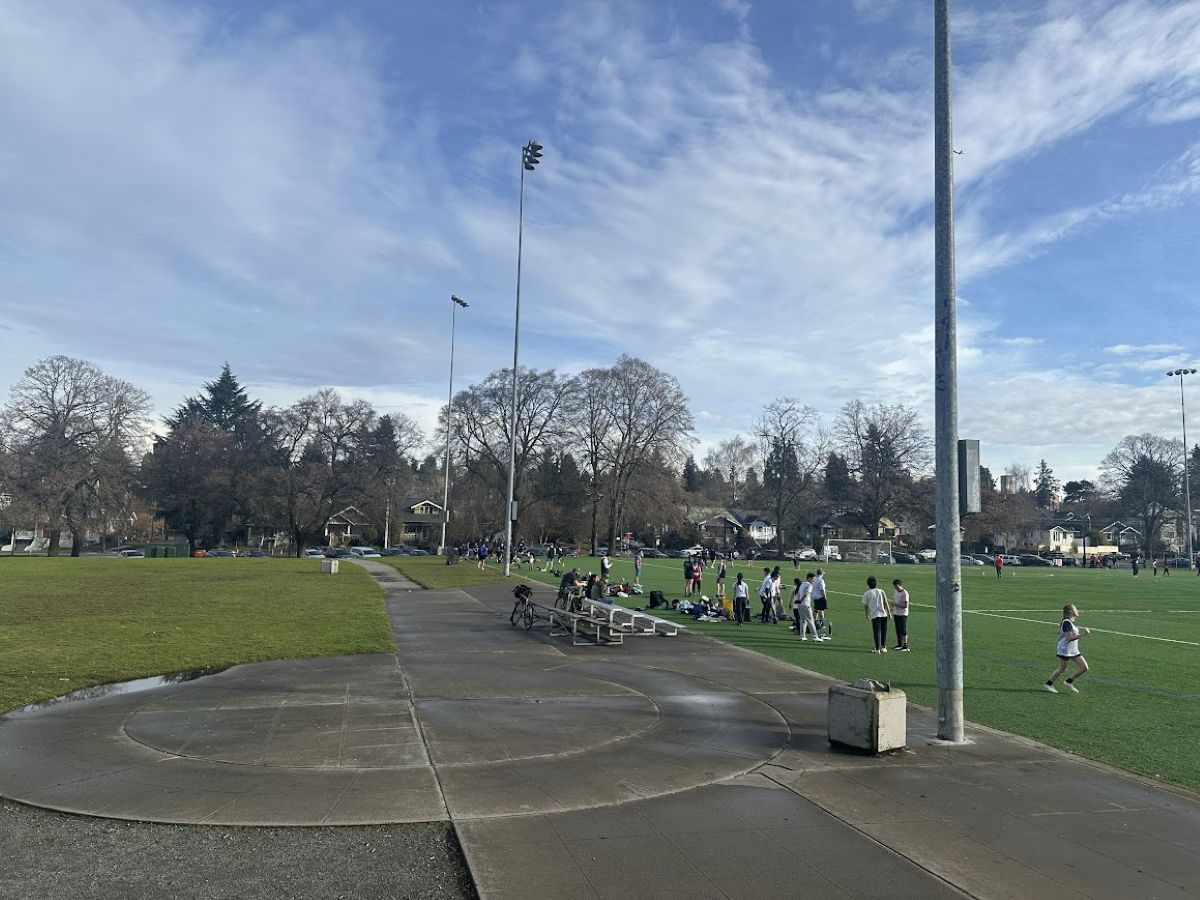
Seattle Public Schools (SPS) is seeking to add a new football/soccer hybrid field for Lincoln High School in Lower Woodland Park. The east side of Lower Woodland Park near Green Lake Way has a fully occupied athletic complex with 10 tennis courts, two soccer fields, four softball fields, a regional baseball diamond, and about 360 paved parking spots. The west side of the park near Aurora Ave N has a gravel parking lot, 290 paved parking spots, and encampment activity.
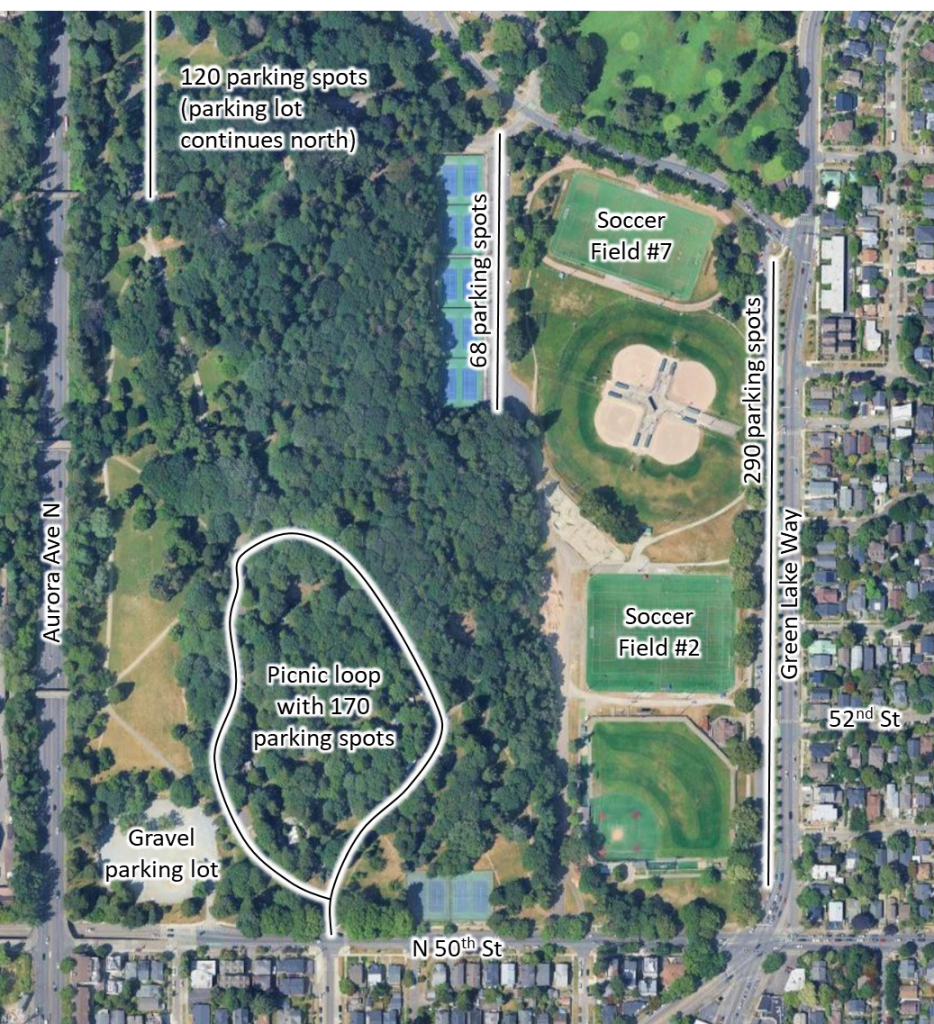
The new sports field is an opportunity to reimagine the park for a denser community. Not only will Lincoln athletics be located in the park, but the areas east and south of the park are soon to be upzoned. To keep up with demand for athletic events in the park, the western side near Aurora needs positive activation to better distribute capacity during events.
Unfortunately, SPS has chosen a plan that prioritizes parking over accessibility and events. Their preferred ‘Option A’ plan would scrape the recently rebuilt Soccer Field #2 along with historic trees to cram two fields into a footprint that’s too small for them. Sidelines will be shrunk to the legal minimum and every side of the fields will be up against dangerous conflicts: BMX bike jumps to the west, the skate park to the north, a retaining wall against Green Lake Way parking to the east, and fencing to a baseball diamond to the south:
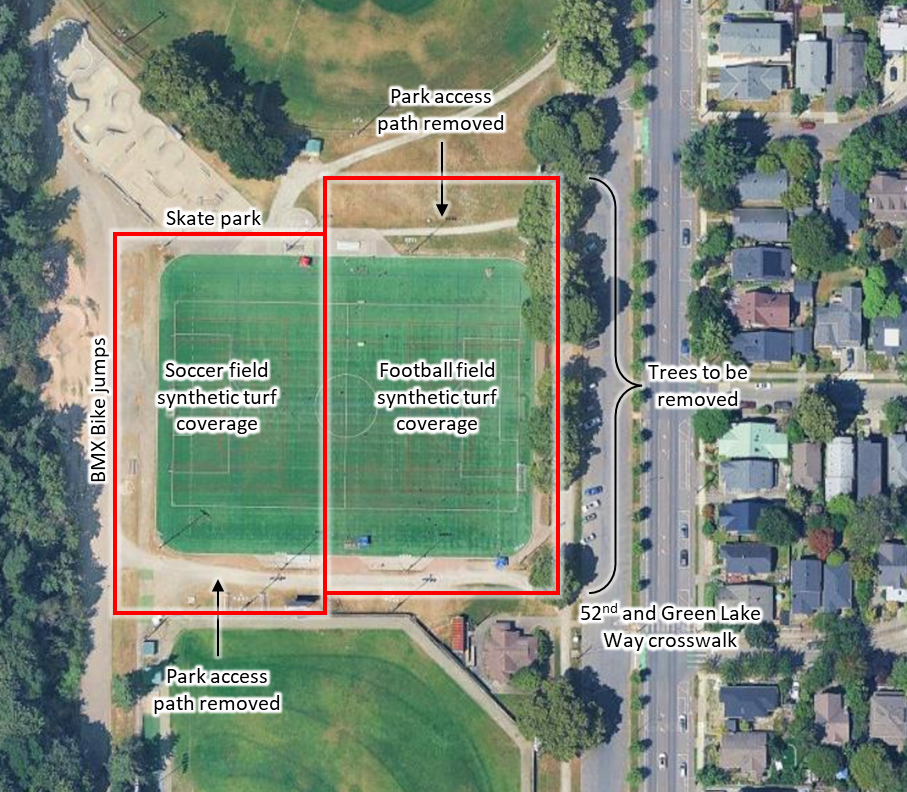
Athletic events will not be able to be hosted as there won’t be room for seating or safe space for visitors. SPS says Lincoln varsity games will be at other high schools as a result. Overcrowding will generate dangerous conflicts. As a local coach named Patrick says: ”I have coached and officiated games at the LW fields for 20+ years, and have seen the current over-use and limited parking and open space around the existing fields evolve into a crisis. Build new fields in Woodland Park – DO NOT put more density / use on the LW complex!!”
The design also blocks access to the park from the popular pedestrian crossing at 52nd street. Walking paths are eliminated and SPS has said people should walk on sidelines instead, including people that are walking their dogs. We can’t complain about dogs (and pet waste) on athletic fields if we let our designers plan our parks to be used that way. For safety, it is also likely the athletic fields will require fencing on all sides, further turning the park into a walled compound rather than an integrated community asset.
Additionally, the district’s plan would replace seven to nine large, century-old trees along Green Lake Way with synthetic turf and a retaining wall. These trees form a continuous line along the Green Lake Way walking path and are a clearly established design element of this Olmsted park’s character, visible in aerial photos dating back to 1936.
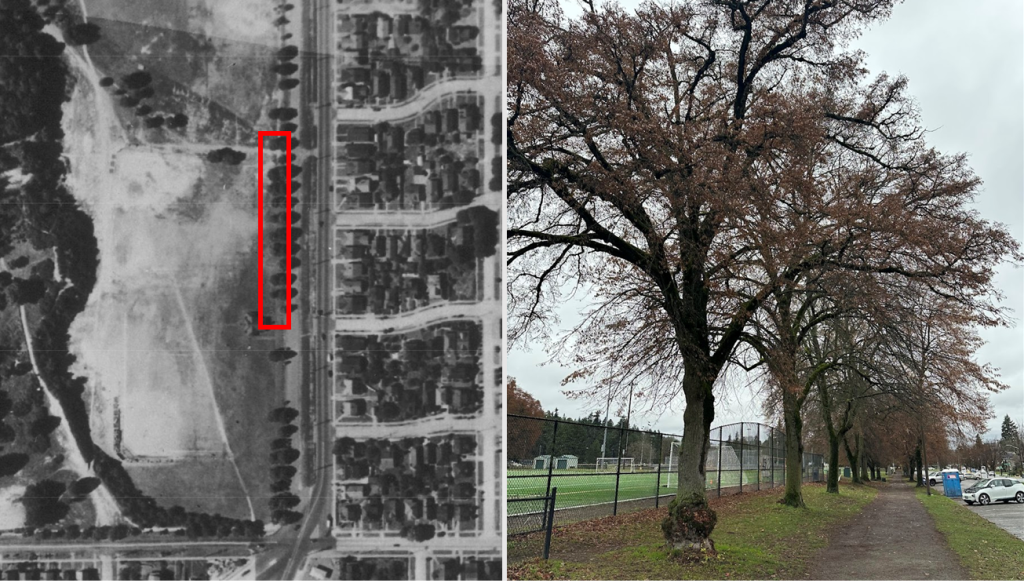
The plan also destroys recent investments made in the rebuild of Soccer Field #2, including the expensive lighting system, concrete visitor platforms, seating, and turf. The scope and budget of the project could be most severely impacted by Option A’s legal risks. By choosing a design that severs pedestrian access, generates hazardous user conflicts, and destroys historic resources, SPS is opting itself into a mandatory, multi-year Environmental Impact Statement (EIS) process.
There is a better alternative: Option C
SPS first presented their Option A to the community on November 6, 2025. They looked at developing the gravel lot at 50th and Aurora as “Option B”, but they included a new parking lot and said the design was too expensive and impactful. The community responded with concerns and an alternative called “Option C” by the end of November.
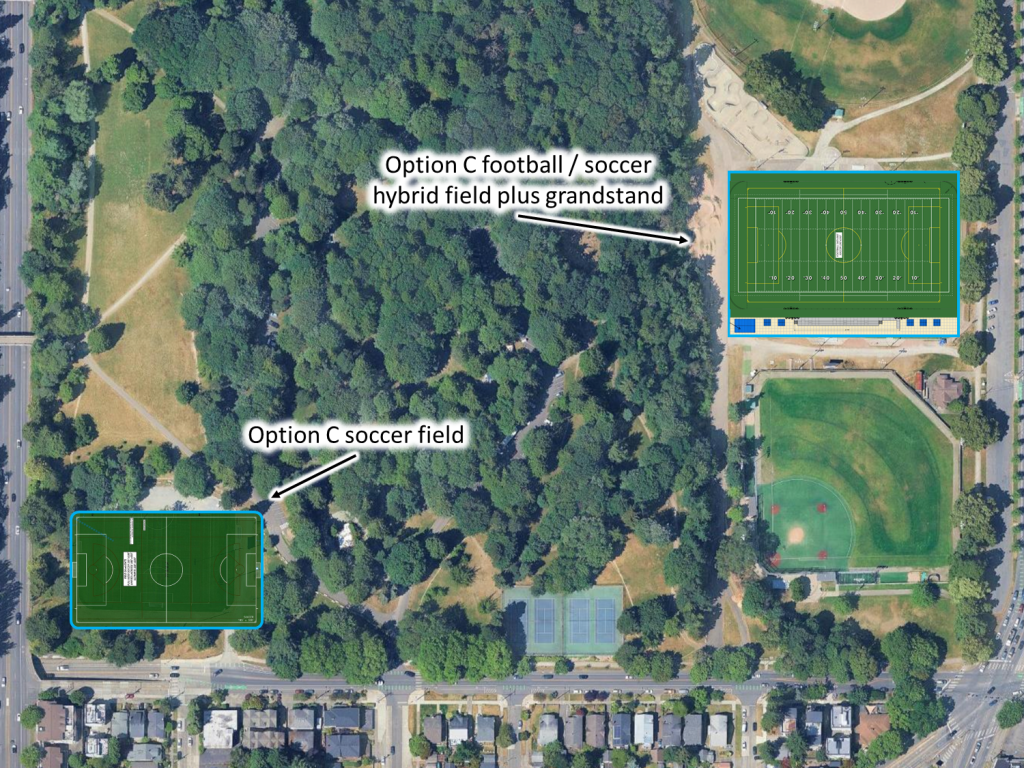
Option C incorporates low impact versions of Option A and Option B. It adds a new soccer field where the gravel parking lot is now at 50th and Aurora. For football and events, Option C would upgrade Soccer Field #2 to a hybrid field with a grandstand.
| SPS Option A | Community Option C | |
| Field Environment | No shade, no seating, and conflicts with pedestrians, BMX jumps, the skate park, and the parking lot | Both fields buffered from streets by trees and have intentional spacing and paths around them |
| Infrastructure cost | Destroys recently rebuilt Soccer Field #2, adds extensive fencing and retaining walls, adds 2 new fields | Requires earthwork to level gravel lot, preserves infrastructure and distributes capacity to parking and bathrooms near gravel lot, adds only 1 new field |
| Trees | Removes historic trees that shade the fields and paths and buffers them from roads | Removes a similar number of large trees from gravel lot (either damaged or not integral to the park design) |
| Overcrowding and Public Safety | Generates dangerous conflicts between high kinetic energy activities at athletic complex or requires fencing | Spaces activities at athletic complex and improves security on west side of park through positive activation |
| Pedestrian Access | Cuts off park access from the Tangletown neighborhood unless you walk across athletic fields | Maintains east-west paths in the athletic complex for people walking to the park and for bathroom access |
| Event Hosting Capability | No room for seating, circulation paths, or visitors; cannot host events or games for Lincoln | Adds a grandstand next to bathrooms so Lincoln and others can host games, distributes activity to gravel lot area to prevent overcrowding |
| Parking | Saves gravel parking lot that SPS says is an essential community asset | Repurposes the gravel lot, activates paved parking adjacent to the lot |
Option C Part 1: At the athletic complex
Option C adds a north-facing grandstand to the upgraded Soccer Field #2, adjacent to recently renovated bathrooms at 52nd street. Paths and intentional spacing around the field are preserved so visitors can safely circulate and people walking into the park will not be blocked by field users or fencing. Trees, lighting systems, concrete platforms, and the recently installed synthetic turf of Soccer Field #2 are all preserved.
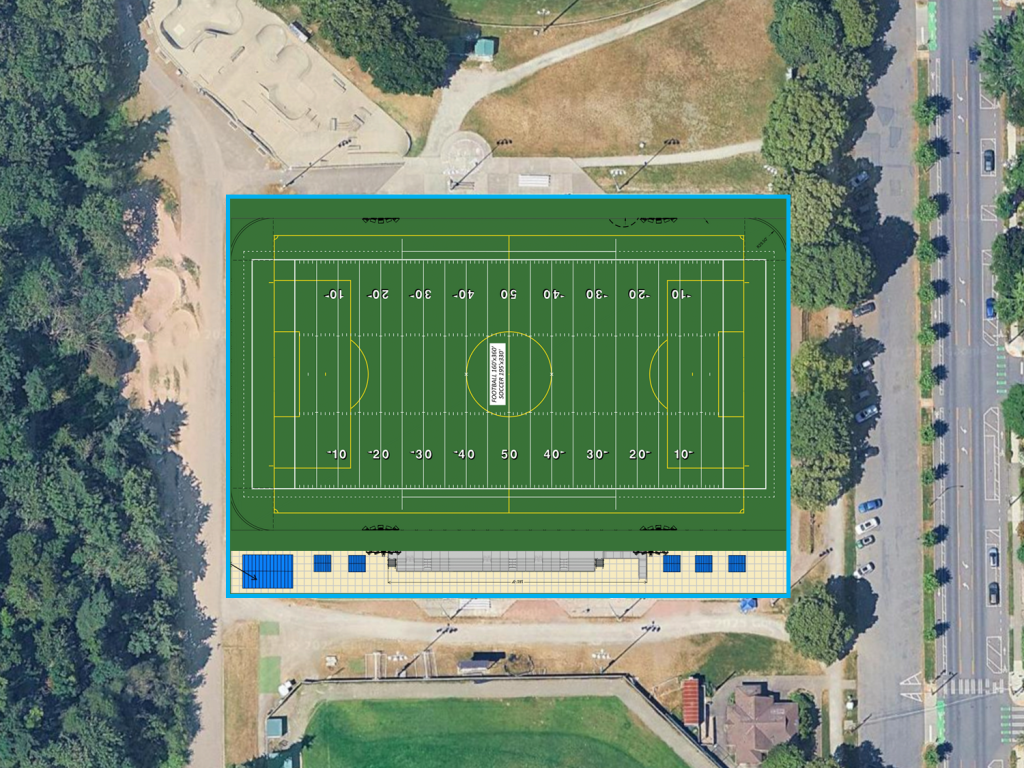
The upgraded central field would be given sufficient space away from dangerous conflicts with the skate park and BMX bike jumps. In case certain events require two fields, SPS could also utilize the nearby Soccer Field #7, located across from the Green Lake Pitch & Putt. To increase capacity and in case a third field is needed by another sports league, a new field at N 50th Street and Aurora Avenue N has its own parking and restrooms, preventing overcrowding.
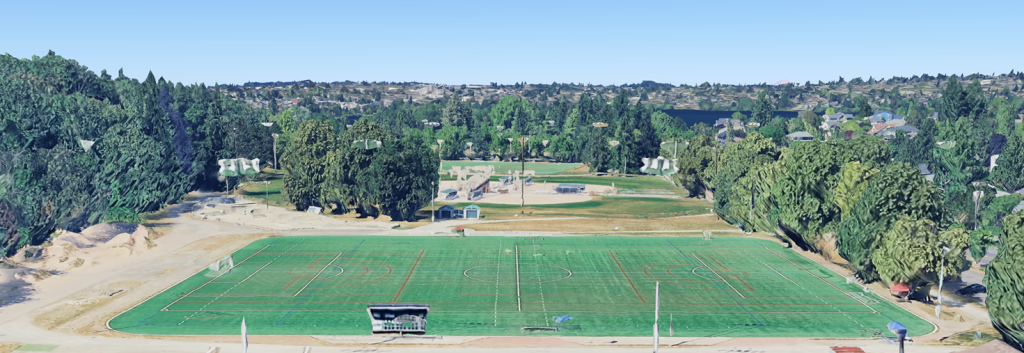
The end result at the athletic complex would be a spectacular location for hosting events. The grandstand looks out over the upgraded Soccer Field #2, the softball fields, Soccer Field #7, the Green Lake Pitch & Putt, and will possibly have glimpses of Green Lake:
The way Option C avoids all the negative impacts of Option A are apparent when you overlay the impacted areas of Option A and Option C. Infrastructure, trees, access paths, public safety, and space for visitors are all preserved.
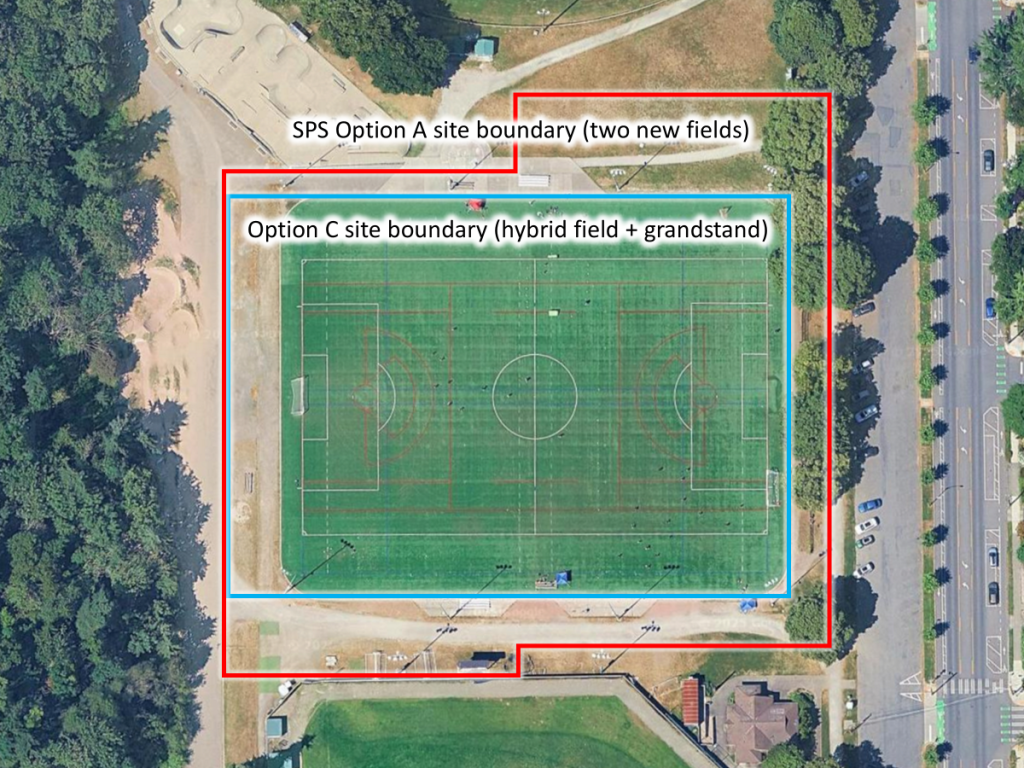
Option C Part 2: Developing the gravel lot into a soccer field
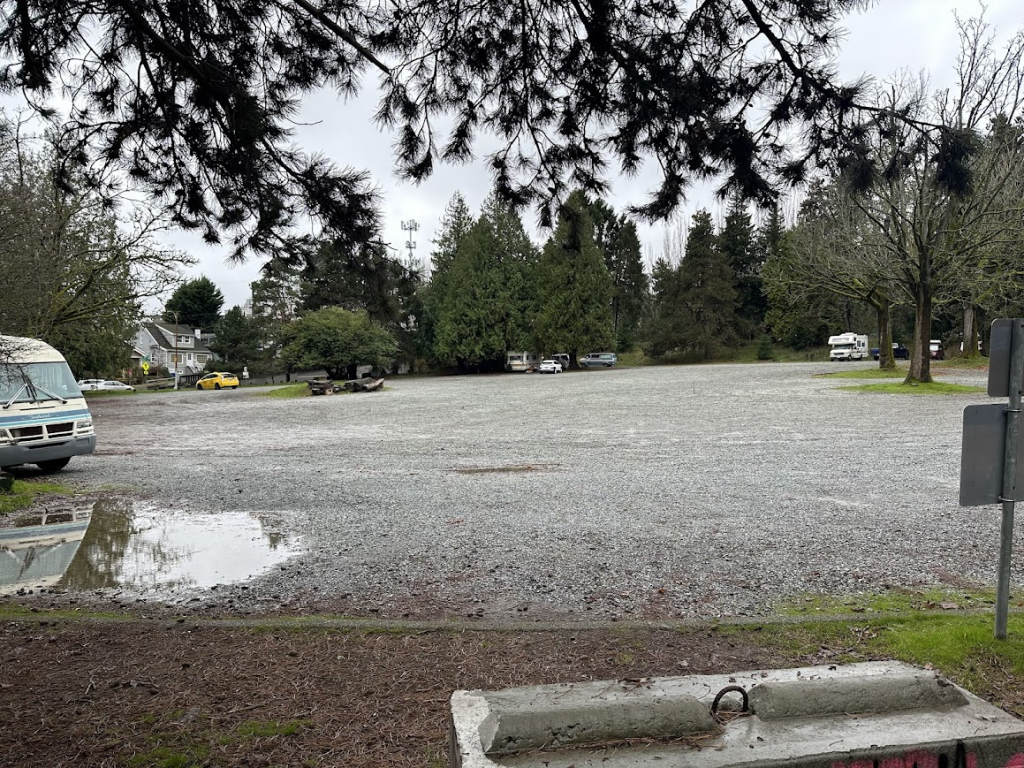
To add capacity and prevent overloading of the athletic complex, Option C develops the gravel lot near N 50th and Aurora into a soccer field. Spacing and trees will buffer the field from busy roads. The site and the adjacent picnic loop with 170 parking spots and bathrooms need positive activation. Removing vehicle access to the lot also allows for the addition of green space along the sidewalk, including rehabilitation of sidewalk trees.
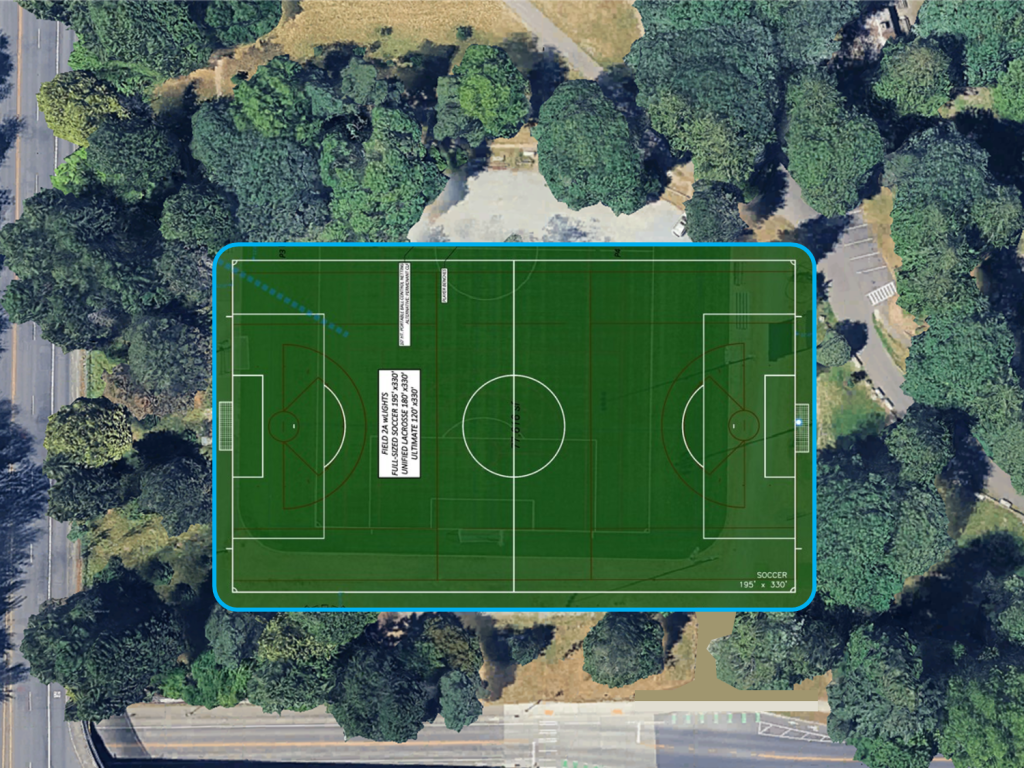
The proposed soccer field added for Option C is only 300 feet long, which is a bit shorter than the 330-foot ideal. There are at least five soccer fields in Seattle or Bellevue that are 300 feet long: Whitman Middle School, Bobby Morris Playfield at Cal Anderson Park, Queen Anne Bowl, Marymoor (Field #5), and Grass Lawn Park (Field #1). Additionally, there will still be two fields in Lower Woodland Park at 330 feet — the upgraded football/soccer hybrid field, and soccer field #7.
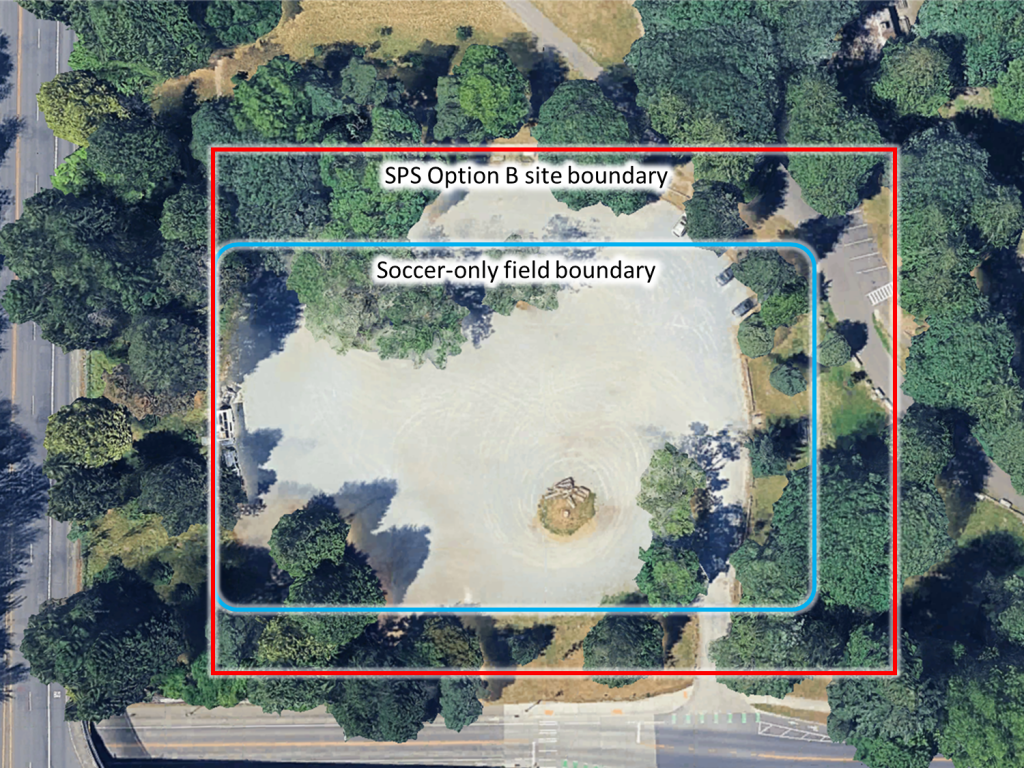
SPS studied the gravel lot location, but for an alternative they called “Option B” that included a brand new 38-spot parking lot and space for a full sized football field at 360 feet long. That required destroying 78 trees and rerouted the paved picnic loop.
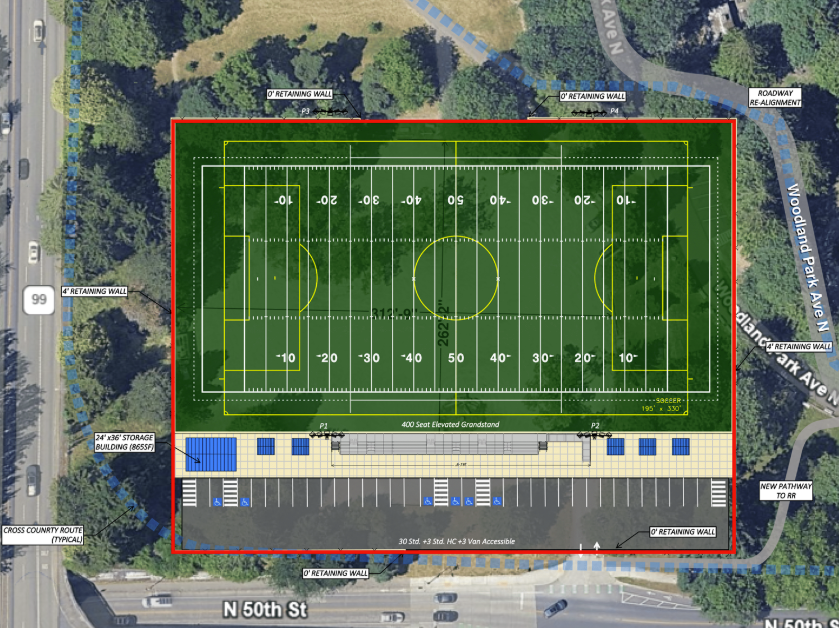
If you overlay the two options, you can see the much smaller scope of Option C on the site. By limiting impacts to the gravel parking lot, the scope of the project becomes manageable. Tree impacts are cut to a fraction of what Option C impacted, and no existing infrastructure is destroyed.
The only reason SPS offers for refusing Option C: The gravel lot parking spots are essential
When asked why they don’t consider Option C, SPS has either directly said the gravel lot cannot be removed without adding parking elsewhere, or they have hand waved “cost and scope” as a reason. SPS studied Option C sites with Option A and Option B, so Option C is firmly within the project’s geographic scope. In terms of cost, they point to their own Option B as why Option C will be too expensive, but Option B was expensive due to its massive footprint, which is because of the parking lot they added, which brings their reasoning full circle back to the issue of parking.
So is the parking in the gravel lot as essential as SPS claims? Is it so important that we should be sacrificing public safety, public events, the environment, park accessibility, park history, and recent infrastructure investments in order to save those parking spots?
There are 170 parking spots in the picnic loop directly adjacent to the gravel lot, and that number is plenty for a new soccer field. Regional events like cross county meets and cyclocross can move event hosts out of the picnic loop and onto the new soccer field, freeing up parking in the loop. Those events can also start taking advantage of the 120 spots and two sets of bathrooms towards the north end of the park near Aurora, locations that have been neglected up until now.
So who actually needs the gravel lot parking spaces? SPS has claimed that the gravel lot parking is important to the zoo, but the zoo has not used the gravel lot since it moved its primary entrance to N 59th Street and Phinney Avenue and enlarged their parking lot there. The gravel lot has also been shut down for years at a time when it has been used as a staging ground for construction projects, such as when Green Lake Way and NE 50th were recently repaved. The community has survived.
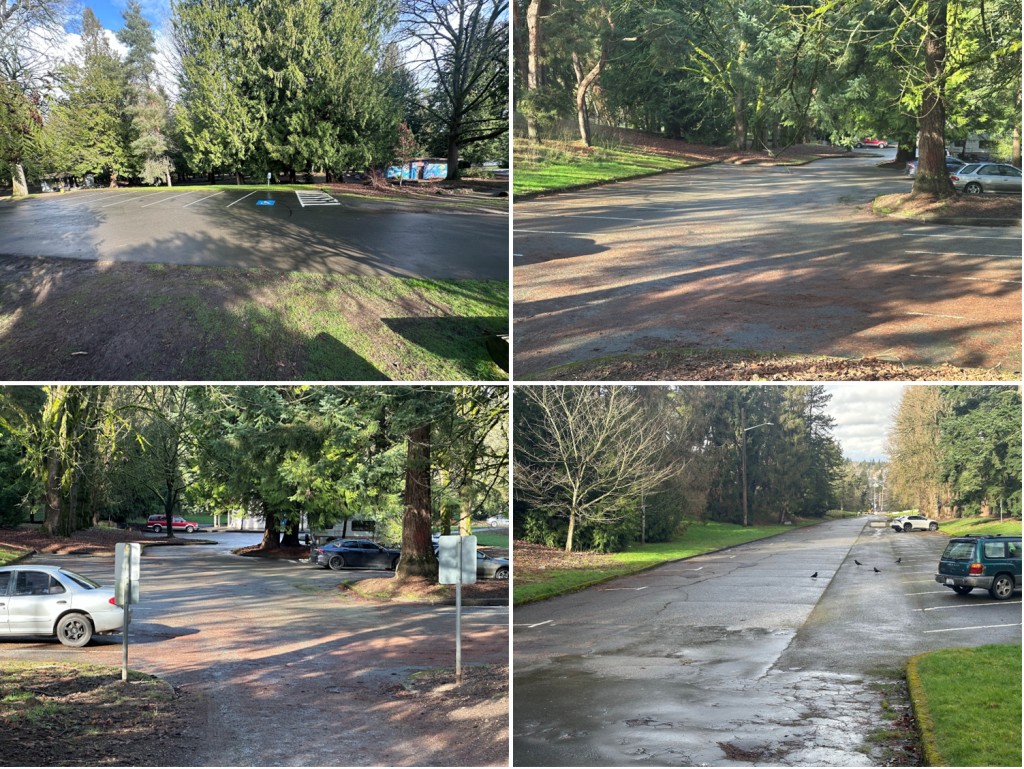
The truth is that the gravel lot is an ugly waste of space rather than an attribute. The construction project could open up opportunities to rehabilitate the trees that will surround the new field, to rebuild the curb where there is now a driving entrance, and to add green space and trees. Furthermore, having the field in the gravel lot will distribute activity away from the athletic complex, preventing overcrowding there and providing space for events.
Why has the process taken so long?
We in Friends of Woodland Park understand the frustration, and we share it. For the first year of the process in 2024, the focus was on whether to replace Wallingford Playfield or not, which turned into a huge mess and caused people outside of that area to tune out. SPS took a similarly high-handed approach when designing the field there, ignoring the community until they got a lawyer, then giving up. SPS designers then set their sights on Lower Woodland Park in the summer of 2025, but the initial focus on adding a track loop near the Green Lake Pitch & Putt was largely non-controversial.
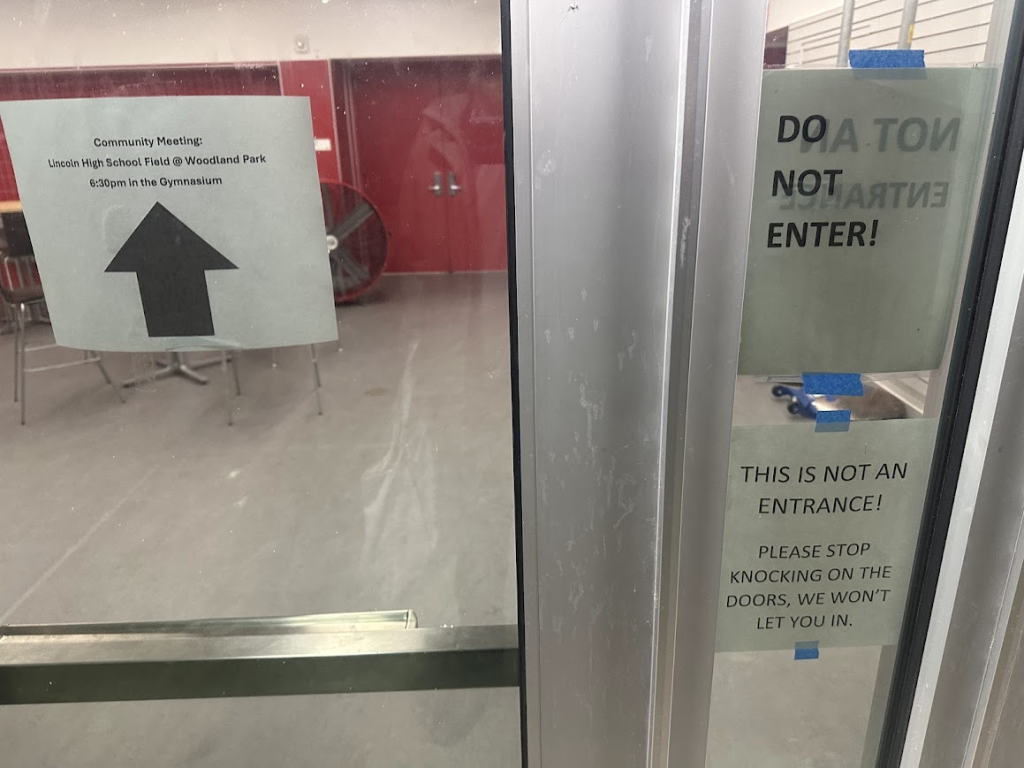
Up until the November 6th meeting last year, outreach on football field placement was directed only to organized groups, such as BMX bike jump users. Park users not affiliated with groups were not notified or invited into the conversation. The first public communication was sent out for the November meeting, where the project team ruled out Option B as too expensive and said that only Option A was possible. No questions were allowed at the meeting, and it was clear the plan was set.
Since the November 6th meeting, over 350 people have endorsed a petition calling for SPS to abandon Option A and adopt Option C. At the Parks Board Meeting on January 22nd about 20 people spoke or protested in favor of rejecting Option A and advancing Option C. Nobody spoke in favor of continuing with Option A, and I am not aware of anybody in the community that wants Option A instead of Option C. Project managers responded to community opposition by cutting their presentation short and then leaving without taking questions or speaking with anyone. So far, the project team hasn’t had a single public meeting where the public was allowed to even ask questions.
It should not be this way. An example of how the Seattle process should work is when the South Transfer station was rebuilt in Wallingford. There, project managers did genuine outreach to the community, worked with people over a period of a year and came up with a mutually agreeable solution, then rolled out a transfer station design that is the best it could possibly be. The community was included, and no lawsuits required. You’d think it would be easier to design an athletic field that everyone is in favor of than to rebuild a dump that nobody wanted. The issue is that SPS is choosing to do outreach after they have already decided on a design, and that just doesn’t work.
What will it take to convince SPS to work constructively with the community?
The only advocates for Option A at the parks board meeting January 22nd was the City’s project team — Andy Sheffer, who is Seattle Park’s Deputy Superintendent of Planning and Capital Development, consultant project manager Paige McGehee, and Richard Best, Director of SPS Capital Projects and Planning. As they have refused to speak with the public, all we can do is make guesses based on the plans and statements they have put forward, and those show that parking is their foremost concern. Perhaps there are issues with Option C, and perhaps there is a better alternative yet to be considered, but as SPS has only looked at Option A and refuses to speak with anybody, we are stuck.
We as a community need to continue to try and get this project on track. You can sign our petition here, or reach out to SPS at their project page using the “Let’s Talk” feature. If you have questions or hear back from SPS, then please let us know at friends.lwp@gmail.com.

Eric Fisk
Eric Fisk has lived in Wallingford near Lower Woodland Park since 1998. He has a graduate degree in computer science from UW and both of his kids went through Seattle Public Schools. He led the renovation of Meridian Playground, helped lead the community effort to add bike lanes via a road diet on Green Lake Way, helped moderate the South Transfer Station design, and helped with several other smaller transportation and parks projects over the years. He believes there are affordable win-win design solutions to our problems and that sustainability means fixing and sharing what we have.