
A man sexually groped out of view of the security cameras during a standard pat down procedure. A man slammed into the concrete floor for objecting to his cell being ransacked, another violent blow inflicted after being handcuffed, only to be placed in solitary confinement and stripped of his clothing on video. A man who asked to be able to review legal documents pertinent to his immigration case being retaliated against by being beaten so badly he had to be carried away on a stretcher.
These were the alleged stories documented in a lawsuit recently filed at the Pierce County Superior Court against The Geo Group, Inc., which runs Tacoma’s Northwest ICE Processing Center (NWIPC), a private, for-profit immigration detention facility used by the federal government.
Two specific guards were also named in the suit.
Three plaintiffs are alleging abuse at the NWIPC in bringing the suit against The Geo Group. All three are Black men who have been detained at NWIPC, two of whom remain in detention at this time. All the alleged events described above happened in 2024, during the Biden administration, but it appears such abuses could be ramping up under Trump.
The plaintiffs contend that the treatment described above is part of a pattern of misconduct by detention guards, that new guards are trained to follow suit, and that Geo Group covers up said misconduct. Furthermore, they allege that one of the detainee beatings described above was utilized in a training video to provide new recruits “an example of what guards can get away with if they feel a Black male detainee is mouthing off.”
The NWIPC is located in the 27th Legislative District, which is represented by Washington State Senator Yasmin Trudeau (D-Tacoma). Trudeau told The Urbanist the facility operates like a black box, in that it is very difficult to learn what’s going on inside.
“If it gets to the point where there is something that egregious being leaked [such as the lawsuit], there are definitely horrific things that are being accepted in that institution,” Trudeau said. She referenced the “level of violence and flagrant disregard for people’s bodies” showcased in the lawsuit.
Trudeau said that civil detainees at the NWICP are treated much worse than people charged and convicted of murder in this country.
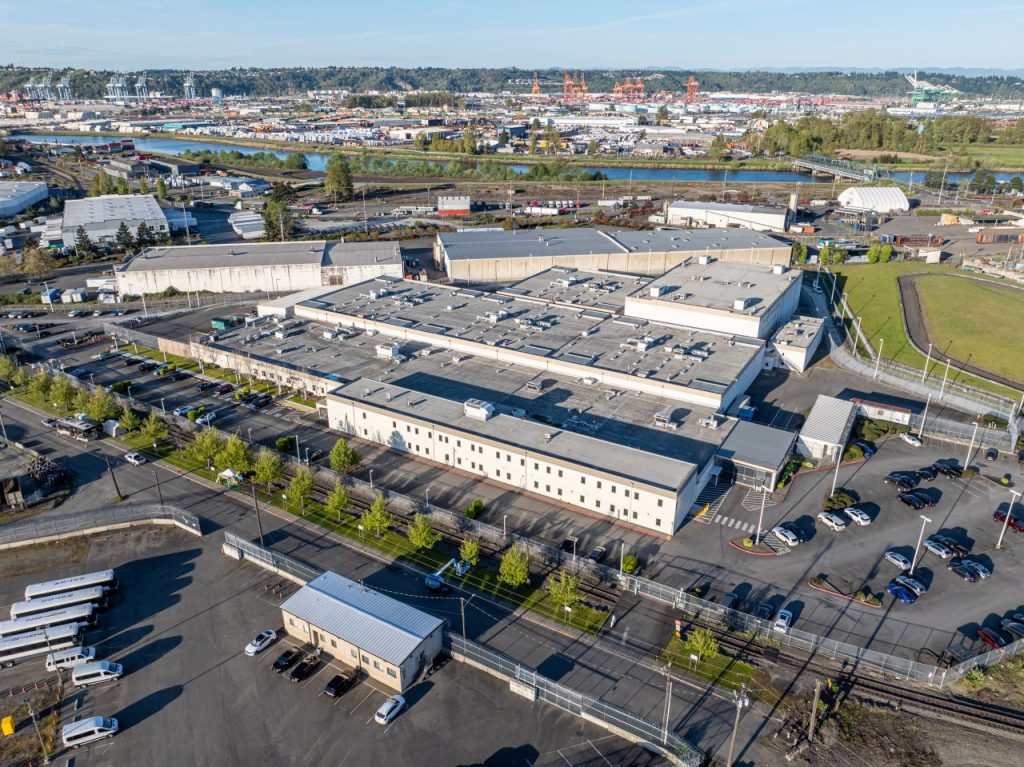
The NWIPC contains 1,575 beds and has a long history of poor conditions. In 2008, Seattle University’s International Human Rights Clinic collaborated with One America to publish a report documenting human rights violations at the center (then called the Northwest Detention Facility).
“Conditions are substandard, and are not even in compliance with the National Detention Standards, much less international human rights law,” the report reads. “These violations, unacceptable in any circumstances, are even more notable given the fact that detention—originally intended to be short-term—often lasts for months or even years.”
The report documents a laundry list of horrifying conditions, including violations of constitutional due process rights, overcrowding, inadequate emergency medical care, inhuman and degrading treatment by guards, insufficient and poor quality of food, and more.
“My perception is that that facility has continued to operate more or less the same under Democratic and Republican administrations alike,” Agelina Godoy, the University of Washington Center for Human Rights (UWCHR) director, told The Urbanist. “The reality is that abuse has been happening even when presidents spoke more palatable language about immigrants, and that abuse is hardwired into the system as a whole.”
Elected officials such as Tacoma Mayor Victoria Woodards, Washington Governor Jay Inslee, U.S. Senator Maria Cantwell, and Representative Adam Smith all documented their concern about this facility in 2018 and 2019.
The Washington Attorney General has been fighting an ongoing case against The Geo Group since 2017, in which The Geo Group has been found to have violated the state’s minimum wage law. Detainees at NWICP used to have the option to participate in a voluntary work program that paid $1 per day. The state won an appeal last year in the 9th U.S. Circuit Court of Appeals.
The facility’s contract with the federal government was due to expire in September 2025, potentially giving Congress the leverage to improve conditions during contract negotiations. Thus far, The Urbanist has been unable to confirm the status of this contract.
More recent research into conditions at the NWIPC
The UWCHR published a series of reports about conditions at the NWIPC in 2020, some of which have since been updated. This research gives context to the allegations in the recent Pierce County lawsuit.
The lawsuit, for example, alleges that Geo Group “has long employed openly racist employees and permitted discriminatory conduct.” It refers to a Proud Boys sticker on the mug of one of the prison guards named in the suit. The Proud Boys are a far-right, anti-immigrant group known to have ties to white supremacists.
Godoy, who led the research, told The Urbanist she’s heard many anecdotes about racial slurs used in the Tacoma detention center.
“It’s certainly clear to me from what I have learned about the place that it’s not uncommon for the racial characteristic of a given detained person to influence the treatment they receive,” Godoy said.
UWCHR’s research also directly pertains to the lawsuit’s allegations about the Tacoma Police Department (TPD). The lawsuit said that two of the three plaintiffs reported the incidents to TPD, but the department “effectively ignored them and allowed Defendant Geo Group to investigate itself.”
A spokesperson for TPD said the complaint has been reviewed, and the department doesn’t comment on active litigation.
UWCHR published a report in 2025 that found that of the 157 reported incidents of abuse or assault at the facility between 2015 and 2025, only two resulted in prosecution. These two cases were incidents where facility personnel were the reported victims, even though overall, most of the reported victims were detainees, not staff.
Godoy said she hasn’t seen evidence that conditions at the NWICP have worsened in the past year, other than the strain of the facility operating at capacity exacerbating already-existing abuse.
“In this sense, the abusive conditions documented for eight years by the UW Center for Human Rights—such as the overuse of solitary confinement, the denial of access to quality medical care, poor hygiene and sanitation, frequent uses of physical force and chemical gases, and a lack of adequate responses to reported sexual abuse — not only persist, but may in fact have become even more acute as the facility approaches its maximum capacity of 1575 people,” the report read.
Because NWIPC is a privately operated facility, it falls into TPD’s jurisdiction, but Godoy says that hasn’t always been clear to police officers or detention officers. However, in September 2025, TPD released a public policy acknowledging their jurisdiction over the detention center. Godoy says that while UWCHR has requested records to determine whether having an official policy is changing TPD’s response to calls within the facility, the slow records response time means there isn’t yet sufficient data to make an assessment.
UWCHR’s research also revealed the detention center’s flagrant use of solitary confinement. In 2020, the report found that the NWIPC detained people in solitary confinement for longer than any other detention facility in the country, based on the average duration of each confinement. More than 80% of reported placements in solitary confinement met the international human rights standards definition of torture. The facility regularly used solitary confinement for people suffering from mental illness and people exercising their First Amendment rights (for example, through hunger strikes).
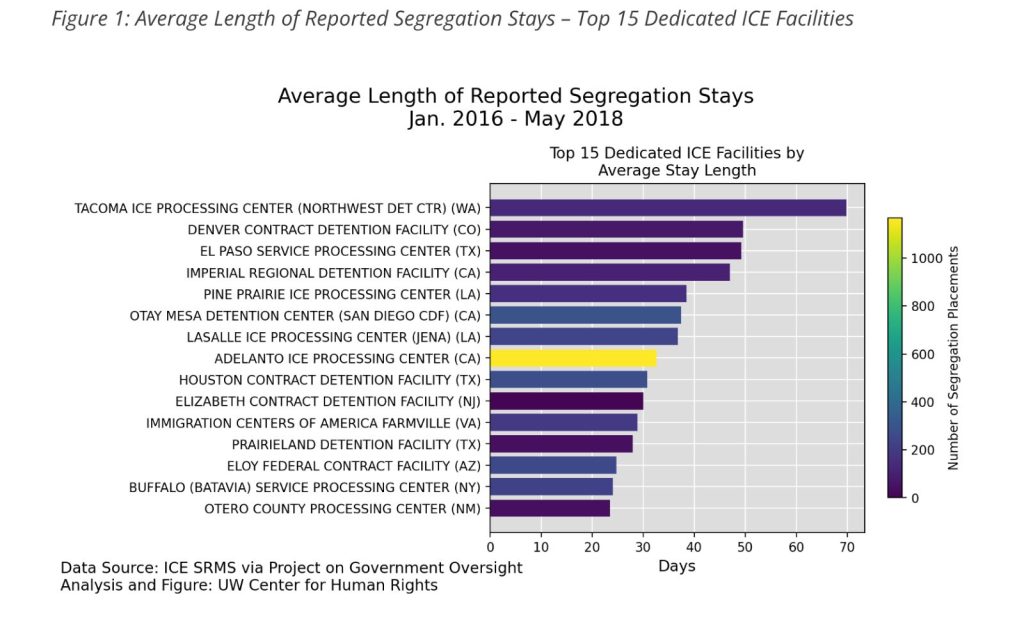
UWCHR was only able to obtain this data by filing a lawsuit against the federal government under the Freedom of Information Act. Once received, they found discrepancies between the data provided by The Geo Group and the data provided by ICE.
“Under international standards, the mere use of solitary at all in civil consent confinement facilities like the Northwest Detention Center is considered extraordinarily inadvisable and something that should not be done, period,” Godoy told The Urbanist. “So the fact that it’s not only happening, but it’s happening in ways that are secretive and unclear, and even the same facility has multiple books, like an accountant with two books, should lead to grave concerns about how effective any mechanisms for oversight or accountability are.”
ICE in Washington State
While abusive conditions at the NWIPC have been documented for almost 20 years, it is undeniable that immigration enforcement has greatly accelerated during the first year of President Donald Trump’s second term. In mid-January, ICE was holding about 73,000 people in detention, the highest number in ICE’s history.
Data collected by the Deportation Data Project shows that during the first nine months of Trump’s second term, ICE arrests quadrupled. Street arrests became much more common, leading to a sevenfold increase in arrests of people without criminal convictions. Deportations increased by a factor of 4.6.
In the past, people would interact with ICE and not necessarily be detained, but this has shifted as well. “Once people have been arrested, changes in policy have kept them locked up in detention centers for longer or indefinitely,” writes Aaron Reichlin-Melnick for the American Immigration Council’s website.
“Maybe that’s what the [Trump] administration is trying to do, is get people so scared that they are leaving,” Trudeau said. “But they’re scared because they know that once they are in the system, they are going to be treated like animals, and that their family may never find them. […] We can’t abide by a system like that.”
Recent reporting from The Washington Post details ICE’s plan to spend $38.3 billion to acquire warehouses – the plan says 16 – and retrofit them into immigration detention centers. People will move from the converted warehouse facilities to eight large-scale detention centers that will hold between 7,000 and 10,000 people.
In 2025, Congress lavished funding on departments carrying out Trump’s mass deportation campaign. “The so-called One Big Beautiful Act allocates more than $170 billion over four years for border and interior enforcement, with a stated goal of deporting 1 million immigrants each year,” the Brennan Center wrote. “That is more than the yearly budget for all local and state law enforcement agencies combined across the entire United States.”
Investigative reporting by Wired showed ICE working to spread its physical presence across the U.S., with documents for more than 150 leases and expansions, giving ICE a presence in nearly every state. Those documents indicate a potential new planned detention center at Riverfront Technical Park in Tukwila, Washington, a convenient distance from Boeing Field. This news came after a December posting on a government website indicated ICE’s interest in having more detention space in the Seattle area.
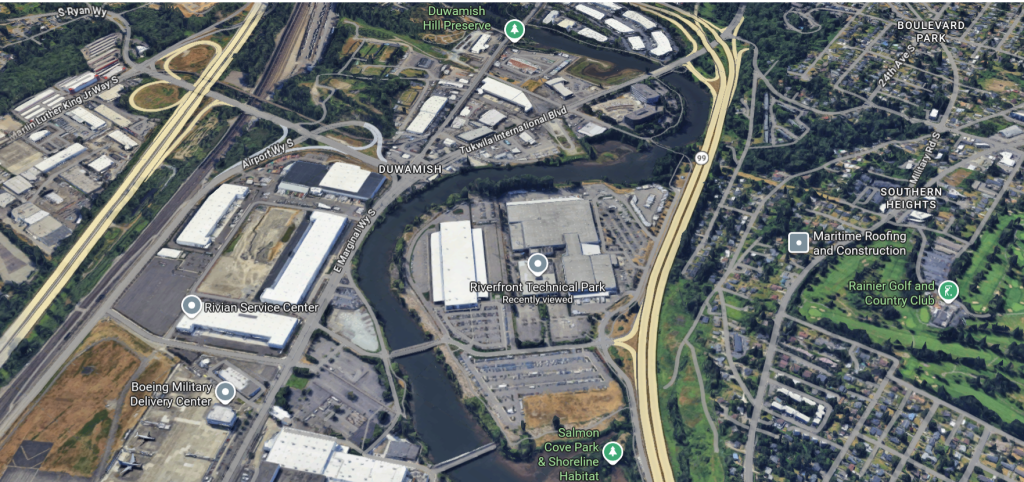
Both ICE and the owners of the Riverfront Technical Park declined to comment to KUOW about any upcoming lease.
“I would imagine, especially in a place like Tukwila that’s so diverse, the ripple effect that will have in a community in that area,” Trudeau said. “You’re talking about Renton, Tukwila, Kent, this is where a lot of immigrant communities live. I think you’re actually going to find a chilling factor if something like that is introduced. I think you’ll find a lot of people that do not want to participate in any systems, including probably even taking their kids to school, if something like that happens.”
Other cities are taking action to prevent detention centers within their jurisdictions. In 2017, the Tacoma City Council passed legislation rezoning land around the NWIPC to prevent any meaningful expansion. The City won the lawsuit brought against it by The Geo Group trying to overturn the legislation in 2021.
Meanwhile, Seattle City Councilmember Alexis Mercedes Rinck is sponsoring legislation that would put a one-year moratorium on any new or expanded jail or detention center within the city limits. The bill treats the siting of a detention center as a zoning issue, giving the City time to develop permanent regulations over the next year.
“We cannot make it clear enough, the human rights violations at facilities like the Northwest Detention Center are unacceptable, and we refuse to stand by while the federal government continues their inhumane practices,” Rinck said.
The bill will move directly to consideration by the full Seattle City Council, with a possible vote as early as Tuesday, February 24. Should the bill pass, there will be a public hearing within two months to give the public the opportunity to weigh in.
The City of SeaTac, where a federal detention facility is already located, just passed a temporary detention moratorium, and King County Councilmember Teresa Mosqueda announced she’s working on a detention moratorium for unincorporated King County.
Seattle Port Commissioner Toshiko Hasegawa is planning to introduce an order on February 24 that would disallow nonpublic Port of Seattle properties from being converted to new or expanded use for immigration detention or enforcement support.
However, the news of the potential new immigration detention center in Tukwila underscores the difficulty for individual jurisdictions to respond to what is a regional, or even statewide, issue.
Trudeau, along with Senator Lisa Orwall (D-33rd LD, SeaTac), introduced several bills designed to address detention facilities on a state level. SB 6286 would have fined the NWICP if the Geo Group didn’t allow the center to be inspected at will by the Department of Health.
SB 6109 would have prohibited the state from investing in (and therefore profiting from) private detention facilities. SB 6304 would have insured responsible principles be used by the state for its investments more generally. All three bills died at the fiscal cutoff deadline.
HB 2464, on the other hand, was passed out of the House on Monday. Sponsored by Rep. Lillian Ortiz-Self (D-21nd LD, Everett), the bill would require private detention facilities to report allegations of abuse, death, and suicide. Law enforcement agencies would also have to report annually about calls and investigations at the facilities. The bill also includes standards to improve food access and quality for detainees.
Meanwhile, The Geo Group continues to profit in spite of the documented abuses at the NWIPC. The publicly-traded company, ticker symbol GEO, reported a net income of $254.3 million for 2025, an increase of almost 700% over its reported income for 2024, which was only $31.9 million.
“Not only are you creating a situation where you’re dehumanizing people in concentration camps, but you’re also making excessive and exorbitant profit off of it,” Trudeau said. “I think we call that slavery and human trafficking.”

Amy Sundberg is the publisher of Notes from the Emerald City, a weekly newsletter on Seattle politics and policy with a particular focus on public safety, police accountability, and the criminal legal system. She also writes science fiction, fantasy, and horror novels. She is particularly fond of Seattle’s parks, where she can often be found walking her little dog.