

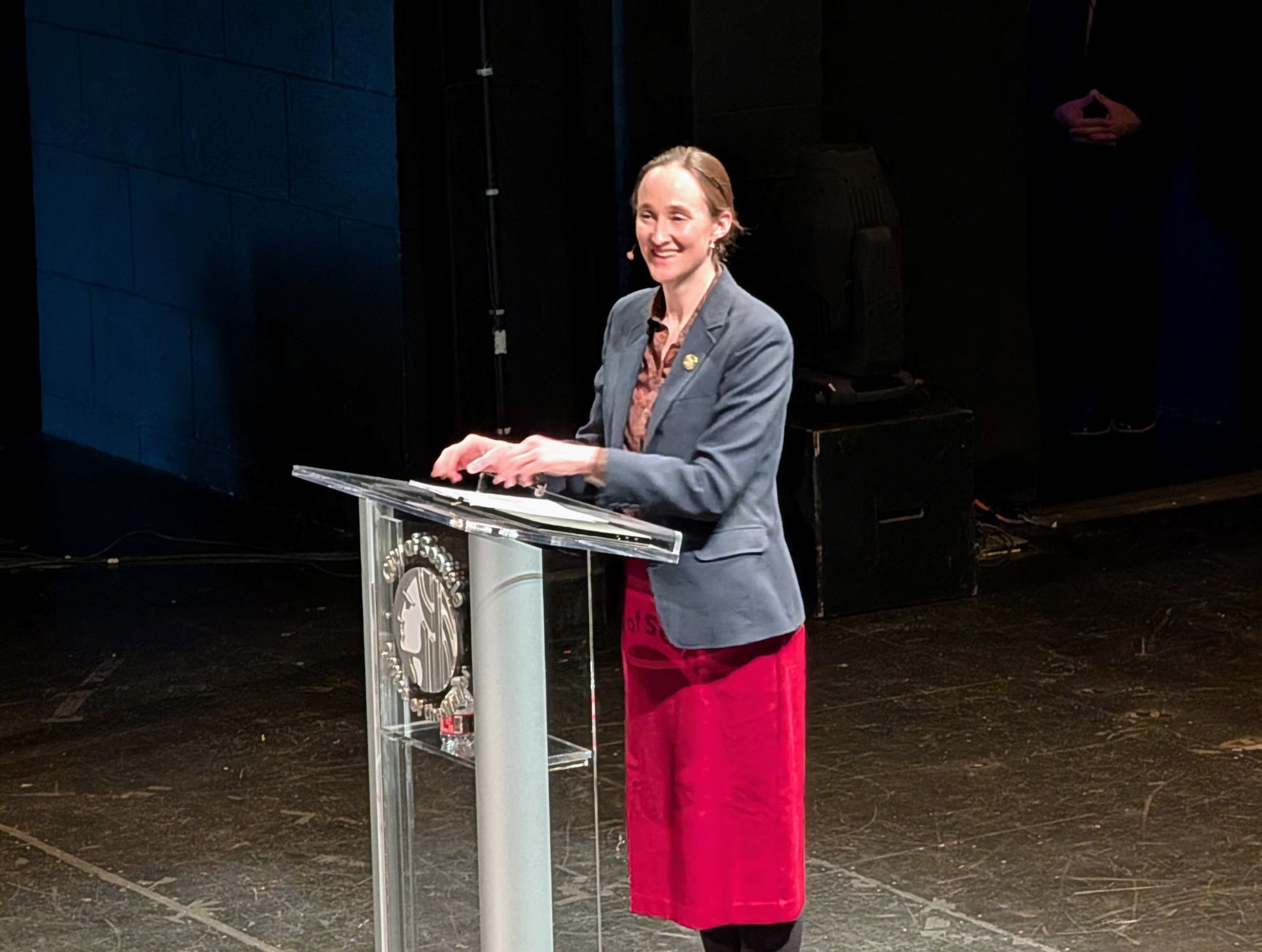
On Tuesday, Seattle Mayor Katie Wilson sketched out an affordability agenda as she delivered her annual State of the City speech, emphasizing the four pillars of affordable housing, childcare, food, and small business opportunities. Just seven weeks into her term, Wilson did not roll out any major new, fully-formed initiatives in the address, but did tease several on the horizon.
The speech took place at the Langston Hughes Performing Arts Institute in the heart of the Central District, historically a Black neighborhood and cultural center. Wilson used the speech to lay out what Seattle would do to counter Trump attacks on immigrants, communities of color, and the rule of law. In a tumultuous and divisive time, Wilson sought to raise the banner of hope, community-building, and collective resistance.
“We all know that we are in a moment when our rights are under attack from so many directions, when it feels like at a national level, we are moving backwards when it can feel impossible to believe that our country will ever emerge from the storm clouds,” Wilson said. “And in these moments, it is so important to look to history and to recognize that we have stood at similar junctures many times before, and to remember how much has been achieved through social movements that emerged in the toughest times, brought people together, and won transformative change.”
Before getting into the affordability agenda, Wilson addressed gun violence concerns. She noted she and her team had grieved with the families of two Rainier Beach High School students tragically shot dead at a bus stop last month. The mayor pledged to redouble the city’s efforts to deploy an effective gun violence prevention policy.
“My office is working to develop a robust and multi-pronged gun violence strategy that will involve collaboration across City departments, County partners and community experts, including those who have lost loved ones to gun violence, Chief Barnes and other SPD leaders bring extensive experience in gun violence reduction that will be invaluable in this effort,” Wilson said. “And in the coming days, my office will convene a panel of local and national experts who will develop and launch a strategy that is grounded in a clear understanding of Seattle’s gun violence problem and is tailored to the needs of our neighborhoods and our communities.”
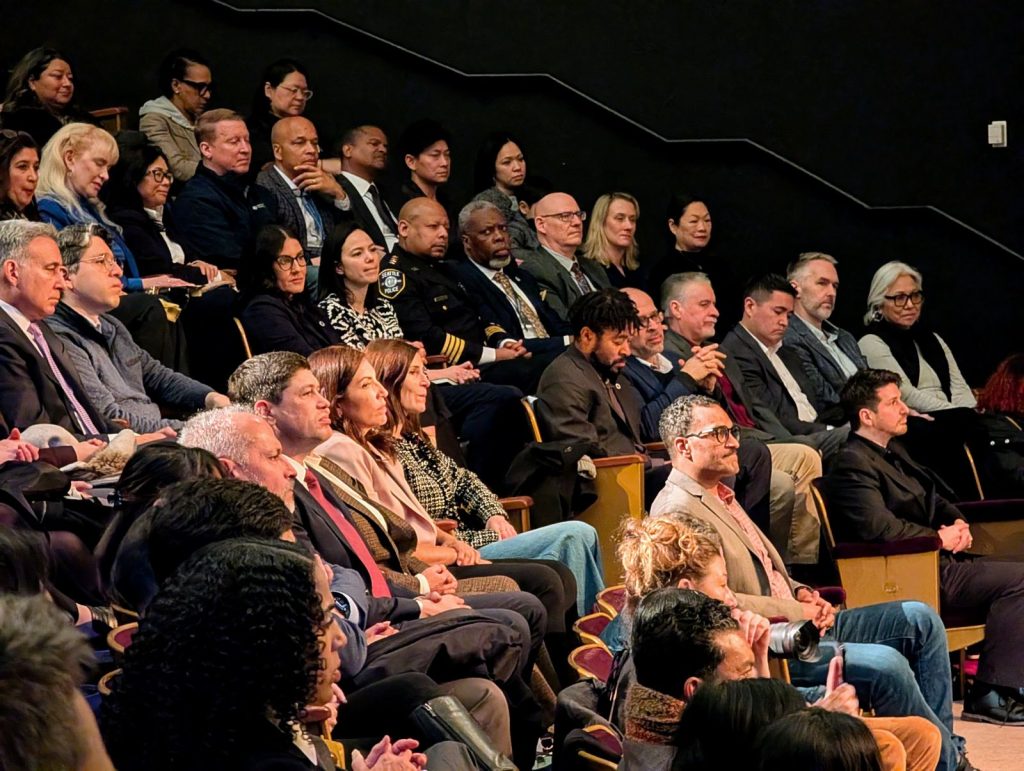
Housing and homelessness
As on the campaign trail, Wilson emphasized the issue of homelessness and clarified that her goal was for the City to produce at least 1,000 units of emergency housing in her first year — which would be the pace necessary to keep on track with her broader goal to produce 4,000 emergency housing units in her first term.
Wilson described how she intended to shift policy on homeless encampment removals (commonly called sweeps), which spiked under former Mayor Bruce Harrell. While she said the removals would continue to preserve community access to public spaces, she placed a greater emphasis on outreach, administering services, and offering viable shelter options ahead of removals.
“With well over 4,000 people sleeping unsheltered in Seattle as of last year’s Point in Time Count,” Wilson said, “I know that we have a big hill to climb, and dramatic changes will not happen overnight, but I am determined to add 1,000 new units this year with services matched to people’s needs, and we are on our way to reach this goal.”
The City has already started moving forward with siting a tiny house village/RV encampment on a piece of state-owned land in West Seattle, which would be able to accommodate 72 RVs and 20 tiny houses. That parcel had been eyed for similar types of encampments under previous administrations, but this one wasted no time in advancing it forward.
The mayor pledged “much bigger and bolder policy” to allow more housing to be built across the city, which her planning department has scoped out in phases.
“Seattle is a great city, and people and businesses want to come here and be part of it,” Wilson said. “That’s why we also need to build more housing of all shapes and sizes so more people can afford to live here. After last year’s Comprehensive Plan update, I am committed to advancing additional legislation to allow more construction of more housing in more areas.”
Wilson plugged her Renter Survey which she said has seen thousands of responses and is still open thru Feb 20. It will inform solutions for tenants. forms.office.com/pages/respon…
— Doug Trumm (@metropolitanglide.bsky.social) February 17, 2026 at 12:15 PM
[image or embed]
Wilson gave a plug for her renter survey, which is open through February 20 and available in 16 languages. With 6,000 responses already in, she said the survey will inform policymaking and clarify which issues are most pressing for tenants.
“We have heard about people forced to move every year because the rent just keeps going up so much faster than their income,” Wilson said. “We’ve heard about junk fees on everything from package delivery to mandatory concierge garbage service, and so much more. So this survey actually closes this Friday. So if you’re a renter and you haven’t filled out the survey yet, you still have a few days. Check it out at wilson.seattle.gov. I will be working closely with the City Council on policy in the months ahead. With their partnership, I hope to quickly provide renters some relief by reining in some of the most deceptive and abusive practices.”
Before she took office, the Seattle City Council already passed one idea that Wilson had pushed, banning algorithmic price-setting software that allow landlords to collude to raise prices. Wilson also gave social housing a shoutout, noting the windfall for the city’s new Seattle Social Housing Developer thanks to the high earners tax passed in a February 2025 ballot measure.
“I am thrilled to say that last week, our city council adopted the interlocal agreement, which will allow approximately $115 million to begin flowing to the social housing developer this spring. That is more than twice the revenue that was initially projected,” Wilson said. “We all know there’s a lot of wealth in this city, and it is very gratifying to know that we’re going to be able to use a very little bit of that wealth and put it to work building housing. It’s taken years to get here, and social housing, I think, really shows what sustained community led organizing looks like, and what it can achieve.”
Affordable Childcare
Wilson acknowledged the childcare cost crisis that the city a facing — an issue which her opponent sought to turn against her on the campaign trail by criticizing her decision to accept help from her parents to pay for childcare during the mayoral campaign.
“Thanks to the incredible work of the Department of Education and Early Learning and their award-winning Seattle preschool program and our child care assistance program, Seattle is actually already a national leader in this area,” Wilson said. “Now that’s really encouraging, but it’s also a little unnerving that we’re seen as leading, because any parent would tell you that there is still so much to be done. And I think it really just underscores how far the United States lags behind many other countries in our support for families.”

The mayor pledged to expand the pre-K and summer programs, while ensuring childcare worker earn living wages. She also pointed to the need for expanding the supply of family-sized housing.
“We need to bring down the cost of childcare, expand our pre-K program and summer enrichment opportunities, and also make sure that the people who are doing this work are paid enough to raise a family themselves,” Wilson said. “We also need to make it easier to site, start, and run childcare facilities in Seattle. Public space and housing are big parts of this too. We need to build more family-sized apartments and homes, expand offerings at our community centers and create more welcoming places for families to go and enjoy themselves without necessarily having to spend money. There’s a lot of pieces to this. But in the in the end, my job is to make Seattle a great place to live, work and raise a family, and part of that is making the whole arc of childhood an area of public concern.”
Food access
Wilson gave a nod to growing concerns over food deserts following Kroger’s decision to close of a number of grocery stories across the region, including a Fred Meyer in Lake City that a large swath of the city relied on. Wilson noted the history of Pike Place Market as a place for local formers to bring their produce directly to market, cutting out price-gouging middlemen, and hinted that kind of approach is needed again.
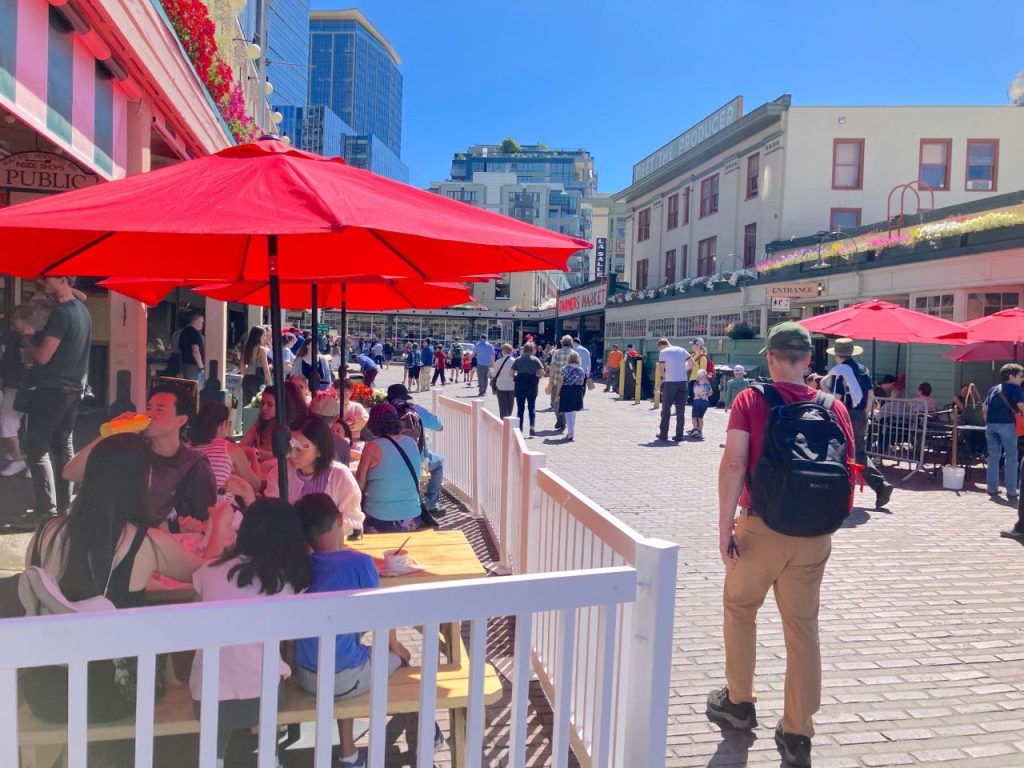
“One important step in that direction that long predates my administration is the Fresh Bucks program, which helps low-income Seattle residents afford fruits and vegetables at participating farmers markets, independent grocers and supermarkets,” Wilson said. “As of this year, we have increased monthly benefits and cleared the wait list, and Fresh Bucks is now supporting more than 17,000 households.”
The mayor stopped short of singling out a particular approach to expanding food access, but she did underscore that a new model may be needed and they’re working on it. The region’s largest union, UFCW 3000, represents grocery workers and has backed a Fresh Food for All campaign that included public option grocery stores. Wilson also backed the idea during her run — which helped earn her the union’s endorsement after the primary.
“We are also looking at new and alternative grocery models that better fit different community needs,” Wilson said. “Everyone deserves reliable, affordable access to fresh food in their own neighborhood, and we’ll be working to make that vision a reality.”
Business pitch
In a move consistent with her pledge to be a coalition-builder, Wilson spoke on the importance of business innovation and economic growth — and she even did some sports trash talking following Seattle’s victory in the NFL’s Superbowl. That made this segment of the speech almost sound like it could have been left over in a desk drawer from the Harrell years.
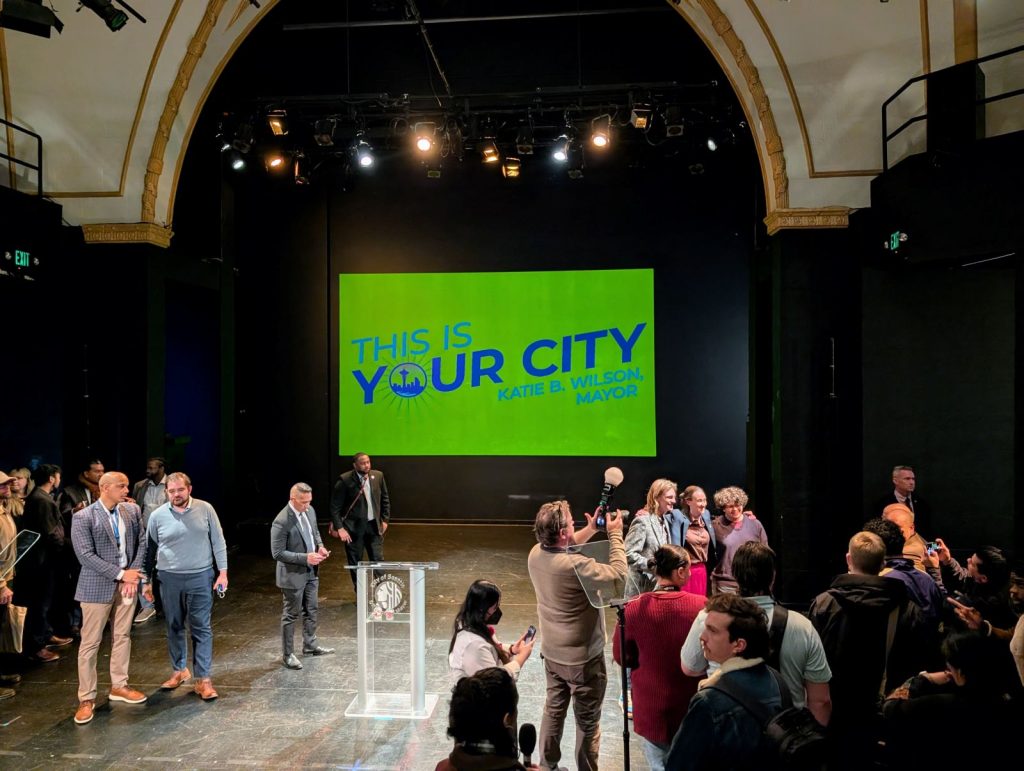
“So my message to Seattle’s employer community is that we want you at the table,” Wilson said. “We value your ideas, your investment, your partnership, and your willingness to stay engaged with us, as many of you are already doing, even if the work can be difficult, because Seattle has always been a city of builders. We build companies that change the world. We build research institutions that save lives. We build neighborhoods that reflect our values, and we build partnerships that make progress possible. And together, we can build a city that is more affordable and safer, where City Hall is known for good governance and delivering results that everyone can see and feel, a world class city that we can all be proud of.”
Wilson’s selection for Deputy Mayor, Brian Surratt, was also seen an olive branch to the business community, given his previous work as the City’s economic development director and CEO of Greater Seattle Partners, a “private/public partnership focused on attracting new business, promoting international trade, and growing our major industries for the region.”
On the other hand, Wilson did acknowledge business leaders were not likely to see eye to eye on every issue, with taxation often where the rubber meets the road.
Bus lanes and safe streets
While transportation was not framed as part of the mayor’s four-pronged affordability agenda, she did sketch out some plans to boost road safety, noting the continued failure to meet the City’s 2030 Vision Zero goal to end traffic deaths and serious injury collisions.
“I’m going to go off script for a moment here to say that a pedestrian, a young woman, was hit and killed last night in Capitol Hill, my neighborhood,” Wilson said. “We have to do better. We have to do better. We’re not on track for our Vision Zero goals, and we have to make it safe for vulnerable road users or people walking or people biking or people rolling to get around the city.”
Wilson mentioned she was excited for the crosslake opening of Sound Transit’s 2 Line — the light rail extension is scheduled for March 28. Plus, she reiterated plans to extend bus lanes to speed up Route 8 and noted Route 60 improvements and an overall boost to bus frequency are also in the works, to recover from pandemic losses.
“We are going to partner with the Seattle Department of Transportation to finally paint that bus lane on Denny Way,” Wilson said. “We’re going to speed up the crosstown Route 60, and advance a transformative Seattle transportation measure that gets us on track to restore and surpass the levels of transit service we had reached before the pandemic.”

Doug Trumm is publisher of The Urbanist. An Urbanist writer since 2015, he dreams of pedestrian streets, bus lanes, and a mass-timber building spree to end our housing crisis. He graduated from the Evans School of Public Policy and Governance at the University of Washington in 2019. He lives in Seattle's Fremont neighborhood and loves to explore the city by foot and by bike.