The Urbanist’s newsroom — Doug Trumm, Ryan Packer, and Amy Sundberg — dive into recent headlines in a podcast episode covering:
- Katie Wilson’s State of the City speech. (Read our story)
- An update on which bills are moving and which are dying at the Washington State Legislation.
- The Seattle Social Housing Developer’s big moves, including huge proceeds in its first year with a dedicated revenue source. (Read our story)
A recap of the Olympia coverage we referenced:
- Age verification for Big Tech.
- Washington’s Elevator Reform Bill Rises Again
- Curbing Mandates for Ground-Floor Retail Spaces Advances at Legislature
- Washington Legislature Grapples with Slew of Bills Regulating AI
- Washington State Reacts to Feared ICE Invasion, Constitutional Crisis
- State Lawmakers Move to Regulate License Plate Readers, Fearing ICE Misuse
- ICE’s Tacoma Detention Center Targeted in New Lawsuit Alleging Abuses
- 2026: The Year the Washington Legislature Catches Its Breath on Housing
And in a bonus closing segment, the three of us offer our Pike Place Market food recommendations.
This episode of The Urbanist Podcast was edited by yours truly. Episodes also air on KVRU 105.7 FM radio Thursdays at 4pm, on a once every two weeks cadence, give or take. Thank you to Crystal Fincher and Shannon Cheng of KVRU for their assistance getting our podcast off the ground. Please follow and rate us on your preferred podcast app to help us spread the word!
Transcript
[00:00:05] Ryan: Welcome to the Urbanist Podcast, a show touching on the biggest headlines at The Urbanist, and also offering a deeper look from the reporters breaking the stories as an independent reader supported publication. The Urbanist has been covering the Seattle metropolitan region since 2014. We do advocacy journalism for better cities.
You can find us at theurbanist.org. I am Ryan Packer, contributing editor here at The Urbanist, and we’ve got the rest of our newsroom here on deck. Publisher Doug Trumm.
[00:00:35] Doug: Hey Ryan. Thanks for having me.
[00:00:36] Ryan: Thanks for being here, Doug. And we’ve got our esteemed reporter, Amy Sundburg.
[00:00:41] Amy: Hi Ryan. Good to be here.
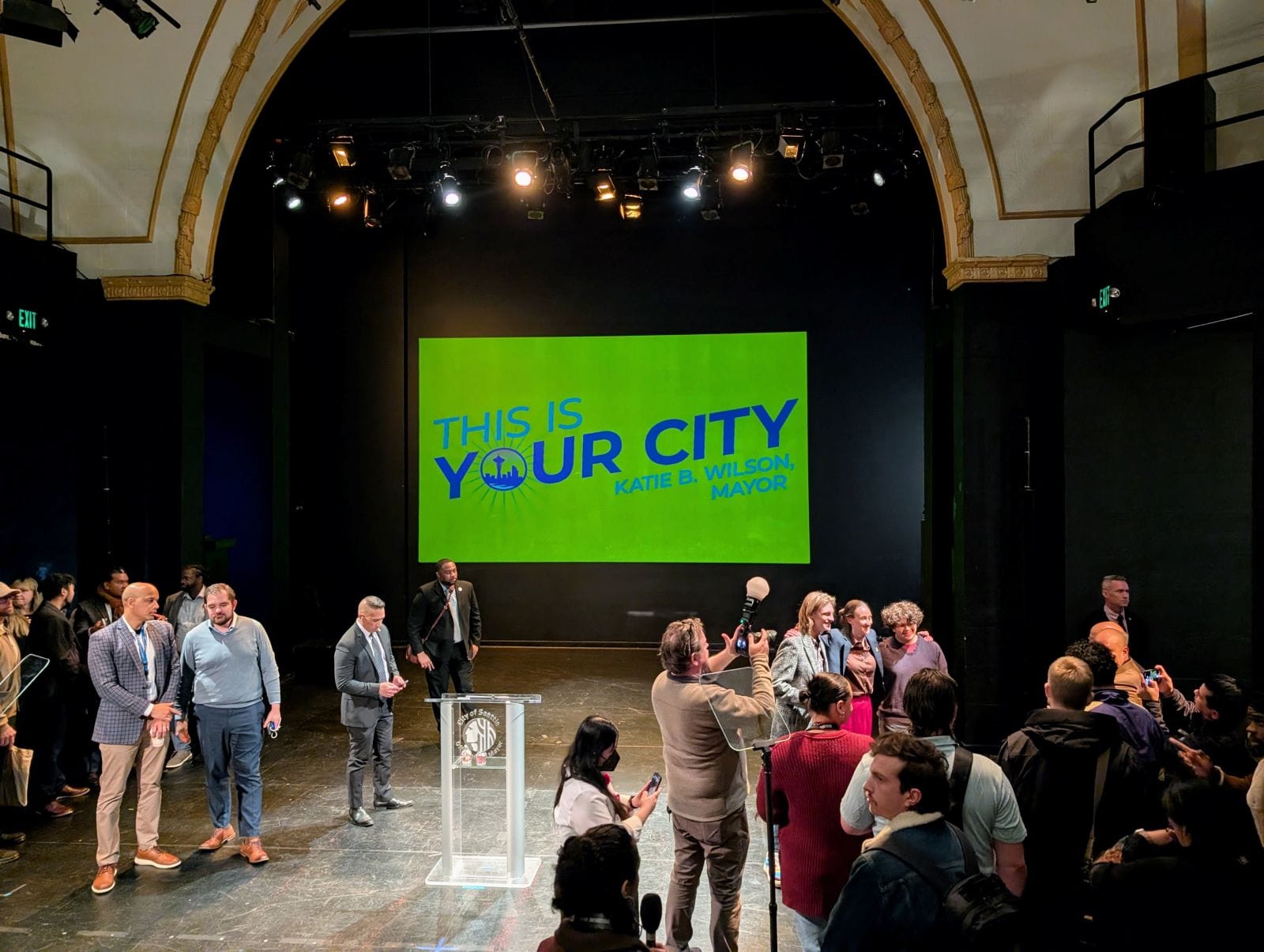
[00:00:43] Ryan: Great to have you. Well, there’s a lot happening this week. So, we’re gonna go ahead and dive right into it. Top story. Katie Wilson, Seattle Mayor gave her first State of the City address. Doug, you were there in the room at the beautiful Langston Hughes Performing Arts Center. Amy and I were both watching from our laptops, but we all watched the speech, and so we’re gonna give you our recaps and takeaways. But we’ll start with you, Doug. What was your takeaway from this speech, which Katie noted was the longest she’s ever given in her entire life.
[00:01:16] Doug: Yeah, I think if there was any doubt that she was just not gonna be able to handle the speech making side of this, I thought the speech did a good job of dispelling that. She is a good speechmaker when pressed into it, and she definitely joked that it wasn’t her main skill.
But, yeah, rolling out her affordability agenda, in a more descriptive way than in the past. She talked about the four pillars of it and hinted at programs for each, which we’ll get into a bit. But, there wasn’t like a big ‘here’s this program we’re launching now,’ but there was a lot of mention of ‘here’s these efforts that will bear fruit later in the year or next year.’
And some of these programs are just large, so you can’t just snap your fingers in seven weeks. But some folks might have wished for some big marquee thing that is immediately happening, but it’s a lot of things that are in progress.
[00:02:06] Ryan: Amy, what was your takeaway?
[00:02:08] Amy: At the time that I was listening to the speech, I thought that it wasn’t so very different than the speech I would’ve been listening to from Bruce Harrell, should he have won. And I will say upon further reflection, because now it’s been about 24 hours, I think that’s not entirely fair.
But it might also speak to the nature of these speeches because they’re so high level that they don’t really get a lot into the details of things, which tends to be what I’m interested in. And so it can be hard to distinguish one politician from another politician all, all top level stuff.
[00:02:45] Ryan: Yeah, I agree with that. And I think Mayor Wilson’s been taking some criticism for this speech in terms of Erica Barnett, at PubliCola, said she was whiffing on surveillance cameras in particular, as well as encampment sweeps. And so, I think my takeaway was kind of, I don’t understand quite why she chose to give this speech, since her inauguration was so soon ago.
I think the fact that it’s been such a short period is why there’s not a whole lot of things to announce. And so I don’t really quite get the reason, you know, I understand that everyone does a state of the city address every year, but like usually you can kind of take your first year off, you give a big inauguration speech or maybe give a big speech in the middle of the year when you have more things to announce.
There were some marquee Wilson agenda things that Denny Way bustling is a prime example of that; although, there’s not much to announce yet. SDOT’s still scoping that out. And then she kinda lumped improvements to the Route 60 that Metro was leading on in there. And I noticed that it was just something that was already in the works. And so, that’s not a criticism of her administration because as we said, it’s been seven weeks. But I think that speaks to where things are at.
[00:04:00] Doug: I’m very hesitant to criticize a progressive mayor for being too out front in the media. Yeah. It’s a little bit like double dipping from the inaugural speech. Sure. But I definitely think it is a necessary thing to get some momentum, to get a narrative building when you’re dealing with so much conservative counter efforts that started immediately, even really before she took office, you know, trying to make it seem like she, the crime was already getting worse on the data’s pointing the other direction. So, it was worth trying to build her narrative and we’re policy nerds. So, it’s sort of like, we’re hammers and we’re looking for a nail.
And this speech wasn’t about those nails. It was more about the vibes thing that Harrell was so good at. And that’s not the most important part about being mayor. The most important part is actually delivering results. But I think it’s sort of a necessary step to start building that groundswell behind those ideas.
And I do think that countering Trump, strengthening the community to face that threat that cities like Minneapolis have faced, and that the president seems likely to turn his eye of Sauron towards Seattle at some point. So I think some of those steps were important to lay, even if, as far as like, well, what tangibly are we doing tomorrow is still kind of a question mark.
[00:05:16] Ryan: Yeah, I think that’s a good point, Doug. There were some great moments in the speech. I loved hope as a discipline. I think that would’ve gotten a lot of attention if it had been in a Zohran Mamdani speech or a Zohran Mamdani video, a two minute video. I guess I do kind of think that the 30 to 40 minute State of the City address might not quite be the thing that meets the media environment that we’re in right now. Since you’re gonna end up with people kind of pulling out the parts that they don’t like or kind of were the most controversial.
[00:05:51] Amy: To be honest, I didn’t love the “hope as a discipline” part. I love that quote. It’s by famous prison abolitionist, Mariame Kaba. And it’s certainly a quote that I have referenced myself, and I think that many, many people reference. ’cause you know, it’s, it’s a very powerful quote, but to me it hit a bit of a jarring note to hear this really famous quote from a prison abolitionist who is, you know, still actively working, at the same time that Mayor Wilson was really hedging a lot on surveillance issues, for example, which I’m pretty confident no prison abolitionist is gonna be happy about.
So for me, it felt a little bit weird because I was hearing these quotes that are very leftist coded quotes, but some of what was said in the speech was not very leftist coded at all. And some of it was very directed towards the Seattle’s business community, which is fair enough. But, it just struck me as a little bit strange as a combination.
[00:06:52] Doug: Yeah. And the other thing It’s so hard for a mayor to walk that line between being thorough and considering all sides versus just letting it slide into procrastination and fear of making decisions or taking a bold step quickly. And that surveillance issue could be one of those things where she is just dragging her feet to the point of not really coming to a policy resolution or, or a shift in direction and letting the inertia carry her. And I don’t think that’s what she ran on, so hopefully that’s not the case.
[00:07:28] Amy: I think the surveillance issue is really interesting and maybe a little bit more complex than is sometimes being discussed. But I mean, it’s definitely true that that was a memorable part of her platform. I am hearing from folks who are feeling like by not acting on that now she’s breaking her promise from her campaign., There are complexities, as I mentioned, I think chief among them, we’re seeing an argument that we’ve seen many times before being brought out that the surveillance is needed for public safety and specifically due to the really tragic gun violence that happened in Rainier Beach and the CID recently.
It really reminds me of similar arguments that were made back when then Mayor Bruce Harrell was trying to adopt ShotSpotter, which is acoustic gunshot detection technology, which went through a few rounds of him trying to adopt it. And, the argument for that technology, which a lot of research shows has a a myriad of problems, right, was in fact to protect from gun violence. But what ends up happening is you have people pitted against each other from the same community. So, you know, throwing immigrants under the bus to try to help with gun violence. And I feel like it’s also a false dichotomy.
There’s plenty of things that Seattle could be doing to prevent gun violence or to reduce gun violence that we haven’t been doing a good job with. In general, I would say our gun violence prevention has been all over the map. It hasn’t been well coordinated. It’s a particular pain point for me in terms of watching what Seattle has been doing. I think we can do a lot more that has nothing to do with cameras.
[00:09:20] Ryan: Yeah. Doug, you mentioned that this was the rollout of the Wilson affordability agenda, a multi plank, multifaceted proposal, but it was a little, little bit more of a, I think, a sketch than a fully fleshed out outline. But can you talk a little bit about some of the elements that she mentioned?
[00:09:37] Doug: Definitely, yeah. It was centered around four pillars, which I think were pretty similar to what she was saying on the campaign, but, it was very clear that she had separated that into housing, which that’s pretty obvious. Childcare, food, which was a huge issue as far as where people were feeling the pinch in their pocketbook during the high inflation years of the pandemic. And then, business growth and small business support. It’s very expensive city to launch a business. That’s a number of factors. She had made those price of pizza videos during her campaign that got a lot of attention, sort of her first viral moment and those were just quick hit videos, but she’s, she’s obviously well steeped in all the complicated factors that drive up the cost of goods. That’s like the labor cost in our region, which that’s a good way to spend any money in one hand. But then there’s also just very high rents and all this regulatory burden too that sometimes Seattle heaps on businesses.
So those are things that policymakers can do something about, particularly on the regulatory burden side and to some extent on the rent side. So she’s definitely hoping to make it an easier place to grow a business. And, spoke very glowingly about how Seattle is a city of builders and innovators, and that sounded a little bit like Harrell too, but I think she struck a tone where it’s like, this is a community, and we’re not saying we’re not gonna tax you, but we’re gonna support you in your growth and then expect you to chip in as well, as you do find success.
[00:11:08] Ryan: Yeah, I was interested to hear that she didn’t add affordable transportation as a fifth plank there, which is such a realm that the city has such a direct impact on. So, that struck me as interesting, especially given the mayor’s background. I think behind housing, transportation is the single biggest cost driver for most households in Seattle. And so, that was a notable absence. Obviously she is doing work on that, so I can’t be too harsh considering that people are working on it, but yeah, just I noticed that.
[00:11:41] Doug: It’s somewhat a matter of how quickly the goalposts move. Not to say that we shouldn’t expect big things from our politicians, but we have a mayor who is an urbanist now and a longtime transportation advocate. So, the fact that she was even willing to bring up bus lanes being a major priority she was working on, which was reiterating something she already rolled out, but, you know, got a moment in this speech, and Vision Zero being off course, got a moment in his speech. That seemed authentic and was, you know, well, there was a tragedy that happened just, the day before in Capitol Hill where someone was struck. And, something she reacted to immediately and it seemed like it hit her pretty hard.
And, there were moments over Harrell’s tenure where he did speak to those issues, but it never felt quite like it hit him the same way as Wilson, and he was never really willing to go as far. And often would play both sides on issues like Lake Washington Boulevard and others where it’s very risky environments for people walking, rolling, and biking.
So, I think it’s a subtle thing, but definitely something that this mayor is gonna work on a lot more than predecessors. And we’re just taking it for granted, which is good, but also I guess we have to give credit where credit is due. That those things have more hope than before.
[00:12:50] Amy: I think that that wasn’t in her original speech, that the part about Vision Zero and the fatalities that had happened the night before. I think that she added that in because she personally thinks that’s important and I do think that’s an important point.
[00:13:05] Ryan: Yeah. That was an incident on Monday night at Bellevue and Pine Street. 27-year-old woman was hit and killed by a driver. Ended up being pinned under the Prius and had to be extricated. Obviously hit the mayor as well as a lot of people who live in Capitol Hill, like myself, pretty hard. So, she directly addressed that. I think I saw some reaction on social media that they would like to see more than just a speech drop in and actually take steps to quickly change the orientation of our streets following incidents like this.
There’s lots of low-hanging fruit, but we yet haven’t yet seen what Katie Wilson’s SDOT really looks like. So, I once again would be kinda curious to see what actually happens when we are able to fully see what this mayor’s vision looks like and how it can be implemented.
[00:13:57] Doug: And she’s definitely invited advocates to, you know, twist her arm. Like that’s something she said from the get go. But obviously I don’t think anyone can realistically expect someone the day after a tragedy to be like, well, here’s my plan to get pouring the concrete and putting up the bollards, or whatever the case may be. I mean, that would be nice if we get to a point where SDOT can move that quickly, and the political leaders can quickly build consensus or at least the will to do that. But, we’re not quite there yet. But I think that’s something in previous administrations you would appoint a task force and you might hear from them a year later. And I don’t think it’s gonna be that long, for when things like this are happening in the Wilson administration. Hopefully.
[00:14:38] Ryan: Well, I would just point out that we can stand up a Super Bowl parade that can accommodate a million people from Sunday to Wednesday. So I think we can do it.
[00:14:50] Amy: I think we can do it too. And I would say from a public safety perspective, people are really concerned about traffic safety. It’s actually something that people really want things to be done about. It’s one of the top concerns in the city. I saw a poll. So, listening to the people, it should be a priority, not just because we made this promise in the past, but because people now really care about it.
[00:15:11] Ryan: Yeah, well, we’re probably, I think, being a little tough on the mayor. But, she’s putting herself out there with this speech. I think there was a lot to digest. Doug, you’ll have a story on this speech by the time this podcast is out, so you can read Doug’s full breakdown. But I think we’ll be watching all these topics in the months ahead.
[00:15:32] Amy: I do wanna talk a little bit about her promise on homelessness, because that is very concrete. You know, when she ran, she said that she would stand up 4,000 new emergency shelter spots. And now she said that she’s gonna do a thousand of those in her first year, that things are on track to do that. And I think it’s an interesting dichotomy to look at, because she’s still sweeping, right? And that’s something that a lot of her base I think is not thrilled. But kind of the gambit is, well, if we can stand up enough of this emergency housing fast enough, we’re gonna get all these people into housing and we won’t have to sweep anymore, so that she can kind of make both sides of that argument happy.
So I’m really interested to see what happens with that.
[00:16:23] Ryan: Yeah, and so she’s pointing to her work at the Ballard encampment on Leary, which she gave a reprieve. They were able to get five additional people into a more stable shelter. Obviously, that’s not everyone in the encampment, and so it’s a tough sell in terms of not really pleasing too much of anybody.
But it is a little bit more of an intentional approach than we’ve seen in this area. When it comes to these emergency shelters, we’ve been seeing very quick movement. Very quick movement in large part because one of these sites is in West Seattle. So the West Seattle Blog has been all over the permits for this tiny house village slash RV encampment that’s gonna be on Marginal Way.
And so, it’s February 18th and we’re already talking about what this looks like, what its name is, who’s gonna operate it. That’s lightning fast. That is lightning fast. And so if we’re talking about things like that all over the city, I don’t even, we don’t have the reporters in other neighborhoods, like I said, to be able to look at these permit records for elsewhere.
But I assume that they’re moving as fast as they can on these public sites that they have pretty direct control over. This is a state lot, but it’s actually pretty quick work.
[00:17:36] Amy: And it’s a longer term fix, right? It actually goes more to the root of the problem. So if she’s able to stand up 4,000 new shelter spaces in her term, that that is a significant step forward. Obviously I’m always wait and see what happens. But it’s promising in that way. As well, the city will have to potentially consider investing more in keeping people from falling into homelessness in the first place, especially with various federal cuts that might make that more likely.
[00:18:08] Ryan: Yeah. I think she alluded to the fact that the budget is gonna be her biggest hurdle. She’s gonna have to find funding sources, you know, she has the proviso that’s keeping a straight jacket on the funding for the Unified Care Team, and she has the housing levy with its restrictions. But, she had a long hinted during the campaign that she would look at the housing levee as a source for some of emergency dollars. Got kind of lambasted for that from the affordable housing nonprofit world. But she’s gonna have to get creative.
[00:18:40] Doug: Yeah, and I wanted to return a little bit, to a point Amy made that the Stop The Sweeps camp being her base. And I think that’s somewhat true as far as like the grassroots mobilizing the people who were volunteers at farmer’s markets and things like that, that might be true of that subset, but as far as, the last two elections or three elections, however you wanna look at it, shows that the most of the electorate, and granted, those are odd-year people, if we had even years elections, maybe it would be more representative, but, I think most of the people are not at the place where it’s either extreme of like, ‘sweep every homeless person. We don’t care if they have reliable shelter or get services.’ Or ‘no sweeps whatsoever.’
It seems like people are bristling at either approach, at least the swing voters that decide every election, which is a tough reality when you want her to pick a camp and stay in it. This subtle thing she’s doing of, ‘well, I’m not Bruce Harrell on sweeps. I’m not gonna do it as often as him, but it’s still in my tool belt.’ It’s probably the right thing politically, at least, if those election results from 2023 still have some sort of bearing.
Obviously she showed that you can talk about doing less sweeps and still get elected. So, I’m really interested to see how that plays out. But it’s tough to say that doing no sweeps is viable in the immediate term, just on both the logistical side, and the damage it could do to her. But you know, maybe I’m wrong on that. Who knows? Punditry is hard.
[00:20:10] Ryan: While zooming out from the city level to the state, Amy, you and I have both been frantically covering the legislative session, which came to a midpoint this week with the biggest deadline to date, the House of Origin cutoff. The date that every bill that’s introduced, apart from the budget that needs to get a vote in its original chamber, or is dead for the rest of the year. So, it’s been dramatic. It’s been tiring. It’s been a lot of different things, but, things are moving. So what, what have you been tracking, Amy?
[00:20:46] Amy: I’ve been trying to track as much as I can. I will say that after my experience this year, I wonder even more about the idea of having a part-time state legislature. But be that as it may, a lot of bills died this week or, or last week. A lot of bills have been dying. And, a couple of bills that died that I was particularly sad to see, the AI bill that would have stopped surveillance pricing for consumer goods. So that’s especially for grocery stores, right, which it is a basic need. The people need to eat, they need to go to grocery stores and get their food. That bill died. And I feel like it’s a very needed bill. And so I was really sad to see that. And then the other bill that died that I was sad to see was one of the bills related to immigration and specifically private detention facilities, creating a fine if the private detention facility… and to be clear, we’re talking about the Northwest ICE Processing Center, the Tacoma Immigration site– they would be fined if they didn’t allow the Department of Health to come in unannounced for inspections. Which would’ve been a huge step forward in terms of potential accountability and transparency of what’s going on in that site. And that bill also unfortunately died. I think there was some question about jurisdiction that I’m not quite clear about. So, hopefully they can figure out a way forward that will work in future years.
But, it’s not gonna happen this year. It seems very urgent for it to happen this year, so that’s unfortunate. That being said, there still is one bill that is still alive about private detention facilities. And this bill requires them to report allegations of abuse, death, and suicide.
Law enforcement agencies in the jurisdiction would also have to report as to what kind of calls they’re getting from that detention center. And it also has a whole section on improving food quality and access. So, that bill is still moving forward, which is great. I will say that while I think sentiment of the bill is wonderful, like it’s hard to know how much the Tacoma Detention Center will follow it in practice. Right. It’s one thing to pass these bills, it’s another one to enforce them. So that’s an open question.
[00:23:03] Doug: Yeah, and you pointed out how much GEO, as the company that runs these detention centers across the country, how much their profits has spiked in the Big Beautiful Bill era. Yeah, I don’t know how beautiful that is. But, it went from, I forget, it was like somewhere 50 million-ish profit in 2024 I think it was. And then suddenly it spikes to like 10 times as much in the following year. And that’s, that’s all these contracts for ICE that’s lining their pockets. It’s a big business. It’s people profiteering off this. It’s kind of disgusting.
[00:23:37] Amy: They’re making a ton of money, and I’ll say there was another bill that also died that would require Washington State to not invest in those companies that are making money on, on private detention and the torture of immigrants. And like I said, it’s dead, so Washington State can still make money that way. But, again, hopefully that’s something that can be revisited.
[00:23:59] Ryan: Yeah. It’s also been hard to cover the legislature this year without talking about the millionaires tax, which is the signature tax reform proposal from the Democrats that the governor has a lot of thoughts about. We did see a vote this week in the Senate: 22 votes against 27 in favor of a I think it’s 9.9% tax on income over a million.
This is, you know, a big step for tax reform in Washington, finally, getting our tax code a little bit more progressive in terms of its impact on upper earners in the state. But it’s not clear that the governor is gonna get a proposal that he actually likes and will sign.
[00:24:44] Amy: Indeed.
[00:24:44] Ryan: What do you think about this, Amy?
[00:24:47] Amy: It was really funny to watch Governor Ferguson in the press conference because he was kind of weaving around that question. He wouldn’t directly answer the question as to whether he would veto this tax if it wasn’t sufficiently changed. But he somehow still made it pretty clear that that’s really on the table. So, he’s, he’s being tough on this one. And he laid out a laundry list of changes that he wants to see in the bill. Even though he didn’t say it directly, it felt to me watching the press conference that it was kind of like, you better include most of these things, or, we’ll see.
His point is that he’s very concerned about the affordability crisis for Washingtonians and he wants to see the bill spend a lot more of the proceeds from this millionaires tax to provide tax relief as opposed to now where most of the money would go straight into the general fund, so it could fund any expenses the state might have.
[00:25:53] Ryan: Yeah, it’s a little bit of a philosophical disagreement, I would say between Ferguson and, and the leaders in the House and Senate, which is that Ferguson thinks that this new tax really should just go right back into Washingtonian’s pockets and doesn’t seem very concerned about a lack of structural reform to allow the state to have a pathway to providing services over the long term. ‘Cause, our tax system is incredibly dependent on a very small number of funding sources that are pretty volatile. And so that’s why we end up in these situations where we have these huge budget deficits. And the governor doesn’t seem too concerned about having a strong state government, I would say. He’s more concerned about having a state sales tax holiday, which I think is very flashy, but not super high impact.
[00:26:50] Doug: Yeah, it’s kind of a pathetic debate, when he’s saying, ‘well, no one’s going to feel this little discount you’re giving them on like toothpaste and things like that,’ which is probably true. But then he is saying they will feel a slightly larger subset of sales tax relief. And I just don’t see there’s a big of distinction there that people are gonna go, ‘oh, I didn’t feel that quarter off my toothpaste tube, but I am gonna feel some slightly larger amount over a broader set. Like, I mean, I guess there is a breaking point, but it, it goes to speak that he doesn’t really have a more of a long term or deeper ideological bend about, okay, like we can actually believe in the government to spend this money well and do more for the good of the working people of the state than just simply a little bit of sales tax money back in their pocket.
And you know, that’s not inspiring. I’m much more inspired by the politicians who do believe we can do big things and implement programs and shift the trajectory of people’s lives. Investing in education is gonna help a lot more as far as down the road than some small sales tax gift.
[00:27:55] Amy: He really wants to expand the working family’s tax credit, like a significant amount, which I thought was interesting. And so I looked into it a little bit more, because I feel like in general people are pretty positive about that program. What I realized though, looking into it, I was like, well, you know, what would be better would be some kind of guaranteed basic income program. Which would do similar things but would do them better, which you could fund from the general fund if you wanted to. I feel like it’s defining affordability as only being about less sales tax. Sales tax is very regressive. But I do think it’s more complicated than that.
[00:28:36] Ryan: Yeah, once again, I just go back to the fact that the cuts that have to get made to our state government that go mostly unreported on a lot of the time are also heavily regressive. And so we just don’t talk about that. And, you know, cutting education. So directly after the Senate passed the millionaires tax, they turned to a different bill, which is the estate tax cut, which a lot of people were kind of blindsided by. There actually had been a hearing in Senate Ways and Means a couple weeks ago that no one testified at, on this bill that would, uh, essentially lower the top tier estate tax rates in Washington, reversing a increase that the legislature passed last year, I believe.
Were you surprised to see this moving forward? Amy?
[00:29:23] Amy: It wasn’t on my radar. So in that way I was surprised. I do think the state legislature has something of a history of, of rolling back things pretty quickly after they passed them. You know, I think the argument was that the highest tax rate on estate tax in Washington State is now much higher than other states. So, it might actually have bearing on how people do their estate planning or where they live out their retirement years. And I think Democrats got spooked and, and that’s what we’re seeing play out. I feel like what’s interesting to me about all this tax talk, right, like, the millionaire’s tax won’t even go into effect until 2029 if it survives all the legal challenges and everything.
And now if we’re cutting this other money from this estate tax, as you reference, what about the long-term health of the budget, but particularly in light of the federal cuts that we know are coming down the pike, right? Like at this point, I don’t think that’s a big question mark. Maybe the amount could change, but it’s going to be significant.
[00:30:28] Doug: That’s the thing that was so jarring is that the official excuses that are out there for why they have to do that are not very well laid out. It seems like everyone’s dancing around the real thing is that they made some sort of deal. It seems to be an implication that, in order to get the millionaires tax, they wanted to get this largest estate tax in the country rolled back.
And if you were guaranteed to pass the millionaires tax, which it’s this huge hurdle to finally tax the highest incomes in our state when we have zero income tax. I mean, I think maybe some people would make that trade, but no one’s actually saying, well, that’s why we’re doing that.
Why are all these progressive people trying to, you know, hand a paycheck to some of the wealthiest families in the state? So, I think on as far as messaging to your base and even the swing voters who, who’ve generally supported an estate tax, like it’s almost political malpractice. But I, I know it’s hard to just be like, ‘well, we made a backroom deal.’
That’s a hard foot to put forward. And, to be clear, I don’t know that that in fact is going on, or if they really just legitimately were lobbied by a bunch of people who offer services or rely on business from folks who were threatening to leave the state, that that scared them enough.
I could live with it, but no one’s actually laid out that we’re doing this ’cause we, that’s how we get the millionaires tax passed. It could blow up in their face both from a, this trade if they back out the millionaires tax with governor vetoes it or something. They’ll look pretty foolish. And also blow up just from the, ‘okay, well we thought you were about redistributing wealth, not letting this extreme accumulation of wealth’ that is just absolutely taking off with the 1%, having so much of the wealth. Well, it’s not very consistent to take from one hand and give back with the other.
[00:32:04] Amy: It does have the appearance of some type of compromise. I mean, in another part of that compromise appears to be that the payroll expense tax statewide, that was proposed by Representative Shaun Scott seems not to be moving. Again, would tax large corporations. And what’s interesting about that tax is that it could potentially be implemented sooner and there was literally a in public spat between Representative Shaun Scott and Senator Jamie Peterson, who, who represent the same district, funnily enough, in a Stranger article in which Shaun Scott was like, ‘look, we can implement this tax faster than the millionaires tax, and it’s really important because we have all these federal cuts coming up.’
And then The Stranger checked in with Senator Peterson who was like, ‘that’s just not true. It can’t be implemented faster.’ So they went to the office that actually would implement these taxes and has the actual knowledge about it, and they said, ‘no, we can implement this faster. So, that was a little bit of a public brouhaha that I thought was interesting to watch.
[00:33:11] Doug: I’m curious, Amy, did they say if the governor was right about how long it would take to set up the Millionaire Tax? Because he was saying it was basically be a second term thing for him.
[00:33:21] Amy: I don’t think the article fact checked that in particular, although I think the governor has laid out a certain path for this tax and the path that he has laid out will take the time that it takes. I’m not certain if another path would’ve been possible if we had a different governor.
[00:33:36] Ryan: Yeah, I think this is definitely exposing some divides among the Democrats this session. It’s kind of been unavoidable to talk about the millionaires tax and all of its related issues so far. There’s another number of bills that I think a lot of urbanists would be interested in that we’ve been covering. On Monday, the house passed the Mosquito Fleet Act, which would empower local governments up and down Puget Sound, to create their own passenger ferry districts. Some of the new routes that could potentially get expanded under this authority could be Everett to Whidbey Island, Friday Harbor to Bellingham, and Olympia to Tacoma, maybe some other places from Olympia as well.
Port of Olympia is very interested in looking at this, and so that one’s getting a lot of excitement. Our reporting from over the weekend noted that the prime sponsor, Greg Nance from Bainbridge Island, was coming out hard against Senate Transportation Committee Chair Marko Liias for quietly killing the bill last year, and he’s coming out guns blazing this year, wants a big turnout in the Senate Transportation Committee, but it’s also rare to see a representative go so hard at one individual senator. So that was interesting.
We’ll see if we have a repeat performance of that bill in 2026. There was a pretty overwhelming vote on the house floor. Any other bills that you’re watching for Doug right now? Any bills you’ve been finding particularly uplifting.
[00:35:09] Doug: It feels like it’s a little bit of a session of cleaning up, and not doing anything as big as previous sessions. If they do pass a millionaires tax, I think that would be the thing the session is remembered for. But, you know, we’ve talked about some of the housing bills and some of those could have a marginal effect and some it could be significant. Some more minor impacts that could, could build up over time. I do wanna see the reform of vertical circulation, both in the single stair and elevator reform front. So I’m hopeful for those.
[00:35:41] Ryan: Well, that’s what I was putting down, the uplifting bills. Yeah, so the elevator bill’s very exciting. A lot of national attention for this one. I don’t think any other state has introduced such a bill. Got a little bit watered down between this year and last year, but I think it’s still pretty much intact allowing smaller elevators in buildings, up to six stories or 24 units, which is kind of that sweet spot for middle housing to be able to make single stair buildings have a smaller elevator, maybe even two for redundancy. And so, there’s a hearing this week. I think the only person to be commenting opposed is from the national elevator lobbying group. We’ll see how that one goes. Yeah, there were some housing bills that didn’t make it past cutoff.
I think mobile dwelling units was one that people were watching to see if they would move on. But there’s been a lot of local government opposition to that one. Like we mentioned. The governor’s big housing bill we’ve talked about on this podcast that would require cities to legalize housing in commercial zones, including getting rid of some of their ground floor commercial requirements. There’s been some opposition to that, particularly on Eastside where retail spaces in these quickly redeveloping cities are getting scarce. I think it’s an interesting bill that kind of puts urbanism against housing a little bit in terms of creating these vibrant mixed use districts.
Obviously we know we have empty retail space in some of our cities, but I think it’s a product of the churn and, and not necessarily a static state. And so, yeah, I think it’s gonna be interesting to see how that one balances out.
Overall, a session very focused on tax reform, not a lot on big policies.
[00:37:23] Amy: There is the big ALPR bill or automatic license plate reader bill, which is still moving along. It passed out of the Senate a few weeks ago, actually, and just had its first hearing. I think it was his first hearing in the House today, this morning. We’ll see what happens with that, because I feel like there’s a lot of debate as to how long the data retention time should be, and, and that doesn’t seem to be anywhere close to being settled.
Right now it’s 21 days. Originally the bill was 72 hours. New Hampshire has a three minute retention rate, but obviously law enforcement wants much longer. It’s really interesting to see how this technology has evolved over time because it used to be that it was just about looking up a hot list of license plates, right, stolen cars and stuff like that.
But now law enforcement wants the opportunity to retain this data so it can go back through it when it wants, if there’s anything relevant, which is definitely more of a surveillance state type of vibe to it. There’s questions about access that the vendor, not, not the agency, but the vendor would have with the data, which could be a data privacy issue, especially related to immigration right now, of course.
And then we have a, a little Seattle wrinkle in that council member Bob Kettle is very concerned about there being an exemption for these license plate reader systems that aren’t fixed. Some of them are like fixed to polls and stuff like that, and they always look at the same place all the time. And others of them are installed into cars.
In Seattle, they’re all installed in cars. So, there are elements of this bill that would make that really hard to implement technologically, because they’re not supposed to be recording, according to the bill. They wouldn’t be supposed to be recording certain sensitive locations like places of worship, for example. And it’s really hard to do that if you’re just, you know, driving around in your police cruiser, how are you gonna know when to stop recording whenever you’re passing a church or a mosque or whenever you’re passing a Planned Parenthood, that kind of thing. So, Councilmember Kettle is very concerned about this.
Obviously to make that large an exemption would really weaken the bill. So, it’s gonna be really interesting to watch the next couple weeks, where they land, if they’re able to land. And, I’ll be keeping an eye on it.
[00:39:47] Doug: Yeah, another set of legislation that I am interested in — we haven’t written about it much on our site, but I’ve heard some coverage from others — is election security bills because that to me feels like it’s gonna be the issue this November. And the primaries too. We have consistent polling showing the Trump party is very, uh, unpopular.
So the only recourse they have to retain control of the House and various state legislatures around the country, where they’re on the line, close enough to have to defend it is to, you know, monkey with the elections. And we’ve already seen that’s in the playbook. But, one bill that seeks to tackle that in our state is making it a lot harder to challenge ballots. And I think that’s a good idea. Like it would require an affidavit, a signed affidavit to challenge a ballot. So if you’re just doing that spuriously and lying, there could be recourse for you ’cause you’d be perjuring yourself. And you’d actually have to physically go sign rather than electronically sign.
Like do challenge ballots from a different state or something like that, or challenge a whole bunch of ballots in the city of Seattle, even if you lived, you know, three, four hours away. So I think that’s a nice security to put in place, especially considering the way we vote in our state. So, that people don’t abuse that system and try to swing close elections that way.
[00:41:04] Ryan: Yeah. We are less than a month away from the end of session. Pretty soon it’s gonna be budget, budget, budget. And that will be interesting to watch. And some big issues are gonna come back up, including how to use a bunch of Climate Commitment Act dollars that the governor wants to divert over to the working families tax credit that we talked about earlier. It’s a contentious proposal among environmentalists and people who wanna see climate action, so that’s gonna be interesting.
[00:41:41] Ryan: So let’s go ahead and wrap up, returning to the City of Seattle, talking about a big issue that a lot of people are tracking, which is social housing. So, this week we got some references to social housing in the Mayor’s speech, largely building on some announcements from last week. Doug, you’ve been tracking what’s happening in social housing at the city level. So what’s going on?
[00:42:05] Doug: A lot is happening. So many things. I think the biggest news recently is that they just pulled in way more money than they thought they would. And that’s really exciting news for everyone who fought for social housing. They went with the projections that the city budget office gave them, and they were conservative, I guess, because instead of pulling in somewhere in around $50 million like they predicted, they ended up getting $115 million in the first year, which goes to show how good of a year it was for folks with high incomes in Seattle, despite the spate of layoffs…
[00:42:37] Ryan: Doug, where does that money come from again?
[00:42:40] Doug: So, yeah, we should go back to the beginning for folks who haven’t followed along. But, the Seattle Social Housing Developer that was authorized in 2023 didn’t have a funding source initially. So they came back last year and passed one in February of 2025, and that tax was called an excess compensation tax. And, it’s similar to the state millionaires tax in one sense, but it’s not actually an income tax. But, it’s levied on the companies, for compensation that is above $1 million. That includes like benefits, stocks, and other retirement plan perks, stuff like that.
Once you hit that million mark, it’s I believe, 5% after that point. So, it’s only hitting people who are doing really well and maybe a stock windfall impacts that. I mean, it would’ve to be income, so it’d only be the stock you were provided that year.
But anyways, that they thought would be about 50 million, that’s how much they expected people to make over that million mark in Seattle that year. But it turned out it was over twice that. So, yeah, they have a lot more money to work with than they anticipated.
So that’s one thing that’s going on. And that led to them going to update the city council early February. They laid out their plans, and they intend to actually start buying property soon by the end of the year.
The other big news is there’s a big leadership transition. They removed their CEO kind of dramatically at the beginning of the year. His name was Roberto Jimenez and he had a lot of experience in the Sacramento Bay area. But, the various entities, including the board that runs the social housing developer, grew dissatisfied enough to remove him. That was a little bit of a shock. They did kind of hint in December that they were frustrated. One of the things they brought up was that allegedly, he doesn’t actually live in Seattle yet.
He’s still maintaining his primary residence back in the Sacramento area. So there was frustration with that. And then it could also go to some philosophical differences. There was allegations that he didn’t actually want to do the social housing model per se, but wanted to do more of the traditional, all affordable model, which is more tried and true.
And what the advocates behind the social housing measure wanted to do was actually prove out this new model. That’s the whole point. So that’s a pretty deep philosophical divide insofar that that was actually a line in the sand. And Jimenez has defended himself. He didn’t want to be removed, thought it was incorrect.
But obviously that’s been done. And they have an interim director now who is Tiffany McCoy, who you may recall was the person spearheading this measure from House Our Neighbors, the advocacy group that cooked up this idea and then ran the funding measure two years later. She’s taking over in an interim capacity. She says she doesn’t wanna become like the permanent head of this organization. For one, she doesn’t have development experience directly, but she says they’re gonna start a national search in six months. So it’s gonna be a temporary thing until they find a new director for this agency.
But in the meantime, they’re also gonna staff up. They’ve hired a development officer to be the point person on all the details with the property agreements and all of that. They hired someone from the Seattle Housing Authority to do that, with a lot of experience, and they also hired a comms person for the first time. So that definitely goes to show that they’re trying to ramp up.
[00:46:05] Amy: I have a question. It sounded like from what you were saying that the old CEO that was ousted didn’t believe in social housing as a model. He wanted to do more traditional, affordable housing. As you said, the whole point of this was to build social housing. So how does that happen that the social housing developer hires a CEO who doesn’t believe in social housing? Like that doesn’t make sense to me.
[00:46:33] Doug: I mean, we’re getting one side of the story. Jimenez did defend himself and, and I don’t know if he brought up that specific point, but I think maybe his intent, if we’re reading it more charitably, was you do something more conservative for the first few steps, in order to just get the ball rolling. So, I don’t know if that was what was behind it.
I think he didn’t want any weak spots in the armor to attack was they’re still getting outta the gates because that’s the danger that if they make some false moves that public opinion would turn against them. And, they might get their funding taken away from them somehow. It’s fairly protected because it’s passed by measure. But there’s probably vehicles, they could try to take it away. Maybe it was also just, we don’t have social housing very much in our country, so the pool of people who are well versed and demonstrated commitment to it, there’s not that many. So, maybe it was just a factor of they’re not getting the died-in-the-wool type that they expected.
[00:47:37] Amy: It’s innovative in this country. So I guess that will bring its own problems.
[00:47:42] Ryan: I mean, it ultimately illustrates the tension between the very established affordable housing world and social housing, which is a different model. We saw this during the two campaigns for these initiatives. And I think it’s clear that there’s just a lot of entrenched thinking around how you do quote unquote affordable housing.
And so even if you get somebody who’s super experienced in affordable housing and says they’re on affordable social housing, in practice, it might be a little bit harder than they even think. And like I was just kind of tweaking the model a little bit when it’s really fundamentally different.
[00:48:19] Amy: So they’re getting a lot more money to spend than we thought. Ryan, do you have thoughts about that?
[00:48:25] Ryan: I mean, everyone’s watching for their first big moves, which is likely gonna be building acquisition. So they’re probably gonna purchase an existing building or two. I’m very interested to see how that works. What happens to the existing tenants in those buildings, how they are able to stand up the social housing model in a building that might not be in great condition.
I’m very curious. And so in some ways I do wonder whether the over a hundred percent increase in expected revenue for the agency is gonna be a little bit too fast for them to have to grow. And so I I wonder if that’s gonna end up being a little bit of a mixed blessing in terms of having to really make use of all these dollars when a more limited ramp up could have been effective for them. Obviously, we know we want to have people housed. We know we want to have people be able to utilize these units, but especially if you’re gonna be buying existing buildings, it’s gonna be very interesting to see.
Obviously, we would also love to see them start building, so there’s a, related to this is another bill in the legislature actually that would allow local governments to get more directly involved in social housing PDAs, which is what this developer is technically a public development authority. That’s House Bill 1687, sponsored by Rep Reed over in Queen Anne, our urbanist champion. So I’m gonna be interested to see how that dovetails with the idea of getting the city more involved, and able to actually start building units, creating new units.
[00:49:59] Amy: One thing that’s always surprised me, it still kind of surprises me, even though I’m now very aware of it, is how difficult it can be to spend money. I always thought that, you know, the hard part is getting the money. Right. And then once you have the money, problem solved. But what I’ve seen in practice over and over again for, you know, very different programs is just because you have the money, getting that money out the door is another whole huge project of its own.
[00:50:26] Doug: Yeah. And part of the slow rolling of this… well. It’s not really still rolling, but they need to get the money in the door. And the Harrell administration was kind of jerking them around as far as fronting them the money based on the proceeds. And they eventually did do that, but not as fast as the board would’ve wanted of the social housing developer.
But now they made these hires and it was Ginger Segel was the person they brought over to be their chief real estate officer. And they have someone named Cole Husman, who’s their chief financial officer, and then they hired Lily Fowler to be their comms person.
So, you know, now they have a team that can actually hopefully handle these transactions and then communicate them to the public. And yeah, it’s not gonna be easy. Certainly now they can ramp up faster than they thought. So it’s more of a matter of their plans weren’t laid out for the money coming this fast.
But I don’t think you’ll hear many nonprofits, or public housing authorities complain about having too much money, but it is helpful to have reliable projecting for that money.
[00:51:33] Ryan: Well, we’re almost outta time, but I do want to end on a nice palate cleanser here. The days are getting lighter and sunnier. This past weekend was amazing. I was out at Pike Place Market. The market was jam packed with people during the pedestrian pilot, which is still going on hopefully for several more months or years, hopefully. We just did a story on potential barriers at Pike Place Market. You can read on the site last year that are helping to harden the market during the World Cup. But I have a question for our panelists here.
What is your favorite place to grab a bite to eat at Pike Place Market? Amy, what do you think?
[00:52:10] Amy: So first of all, I have to confess that I don’t actually go to Pike Place Market that often. And that’s actually something I wanna change because I can take the water taxi over from West Seattle and it’s lovely. I love the water taxi, and then you just walk up, and it’s a really nice outing.
So hopefully this will be the year that I start doing that more often. But I will say that one of the places I’ve really enjoyed eating is Crepe de France. They serve crepes and I love crepes so much. So I’m always happy to be able to eat a crepe. So, that is where I tend to gravitate.
[00:52:44] Ryan: That’s a great option. El Borracho is a go-to for me with their vegan burritos and tacos. I do love Lands of Origin for a quick bite right on Pike Place. They’ve got some really good vegan and non-vegan options. Always tasty. Pike Place Chowder is always a go-to. I will say that I’m at the Market at least three or four times a week, so I’m always grabbing something to eat down there. Cinnamon Works huge ass cookies, always amazing. What about you, Doug?
[00:53:16] Doug: Yeah, of course you would have like five answers, Ryan. I like to grab it back to eat there too. I will put in a good word for the Patatas Bravas at the Lonely Siren. I love Mediterranean food, Portuguese food and the brava sauce is something that I would put on, I don’t know, everything. It’s so good. And they also do a good sandwich there, like a bifana sandwich is really good. And the other thing I would say is if you want to see them toss salmon, you should buy something from the people tossing the salmon. And my, my go-to there since I don’t always want to cook a whole salmon filet is the salmon candy. It’s really delicious. So that’s a great thing if you’re showing people around. Yeah, it turns out salmon makes great candy. What, what can’t it do?
[00:54:00] Amy: I had no idea. This is news to me. I’m gonna have to try it.
[00:54:04] Doug: I think they preserve it in sugar. So it kind of has that delectable, savory, sweet thing going on. So those are two that come to mind pretty quickly. Oh, and the other one: the French Onion soup at Maximilian is really good.
[00:54:17] Ryan: Okay, but is it better than the French onion soup at Le Pichet? That’s the question.
[00:54:23] Doug: Oh, that’s close. I wasn’t sure if I could say Le Pichet because it’s on the other side of the market, but I guess it is…
[00:54:28] Ryan: It’s inside the district. As a former Pike Place Market tour guide, I can attest that it is inside you. Technically inside Pike Place Market District, if you walk into the middle of First Avenue, but once you cross the middle of the street, you’re not in the district anymore.
I just wanted to lament the fact that we officially, officially lost Jar Bar. They had been closed for almost a year, but had been hoping to reopen and I walked by and saw the sign finally noting that they wished everybody the best, but were throwing in the towel, which is a sad loss for Pike Place.
[00:55:04] Doug: Yeah. And that’s the beauty of the market having choice too. ’cause we were talking about the multiple French restaurants, but there being multiple Portuguese restaurants in the market shows just the wealth of options you have, and I’m never gonna complain about more places with good apps and tin fish and things like that. So hopefully someone can bring that back in.
[00:55:23] Ryan: Or just really small bars. We need more tiny, tiny little bars. Well that’s all the time we have this week on the Urbanist Podcast. If you like our episodes, don’t forget to rate us on your favorite podcast app. But this newsroom has to get back to reporting on the stories all around the region. And so we’ll let you go, and be back with you in two weeks. Thanks for listening. Thanks for joining us.