

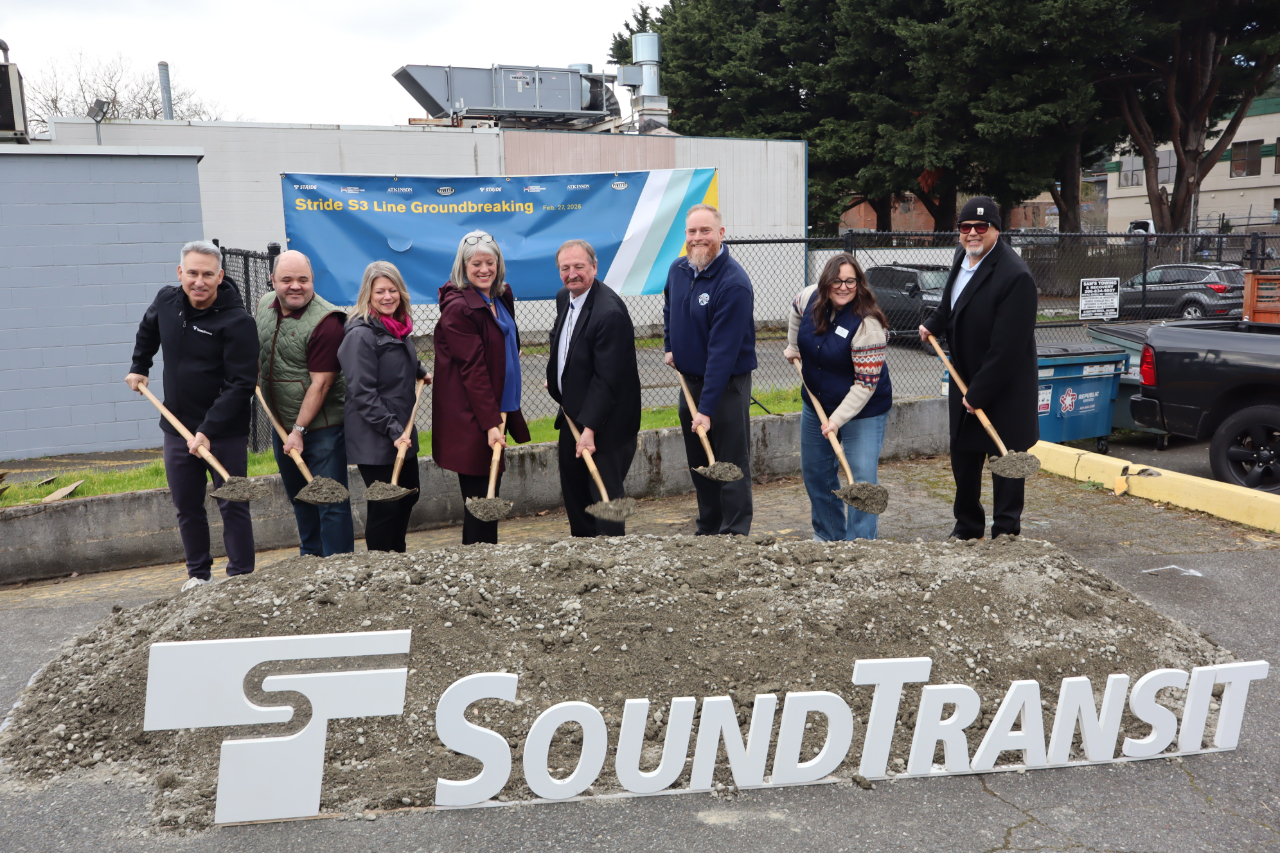
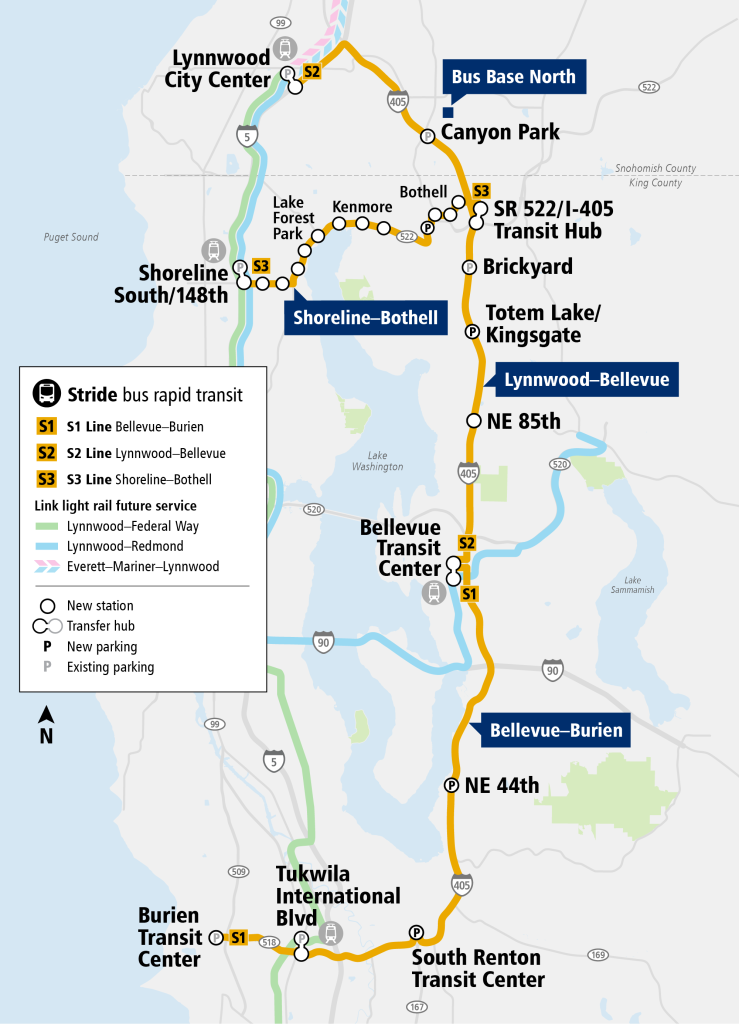
Sound Transit put shovels in the ground on north King County’s next bus rapid transit project Friday, the Stride S3 line, which will connect across the north end of Lake Washington, stretching from Bothell to Shoreline. Set to open in 2028, the S3 — as its name implies — is one of three Stride lines under construction that will upgrade existing ST Express bus routes to provide faster, more frequent service across some of the region’s fastest growing cities.
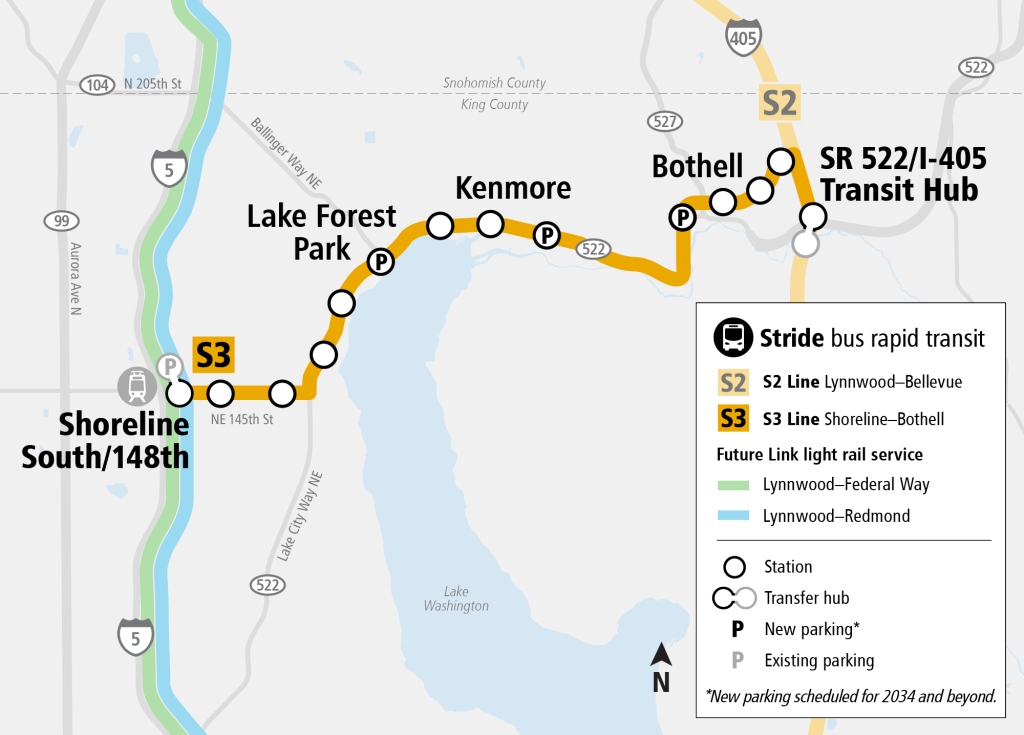
Connecting Shoreline’s light rail station at S 148th Street with Lake Forest Park, Kenmore, and Bothell, the S3 line is expected to significantly reduce travel times for riders along the State Route 522 corridor thanks to added transit signal priority, queue jumps, and some new business access and transit (BAT) lanes.
Paired with street improvements currently in progress along NE 145th Street by the City of Shoreline, transit times from Bothell to Shoreline are expected to drop significantly. Today, the trip can take more than an hour during times of peak morning congestion, but that should be cut to less than 40 minutes after the ribbon is cut.
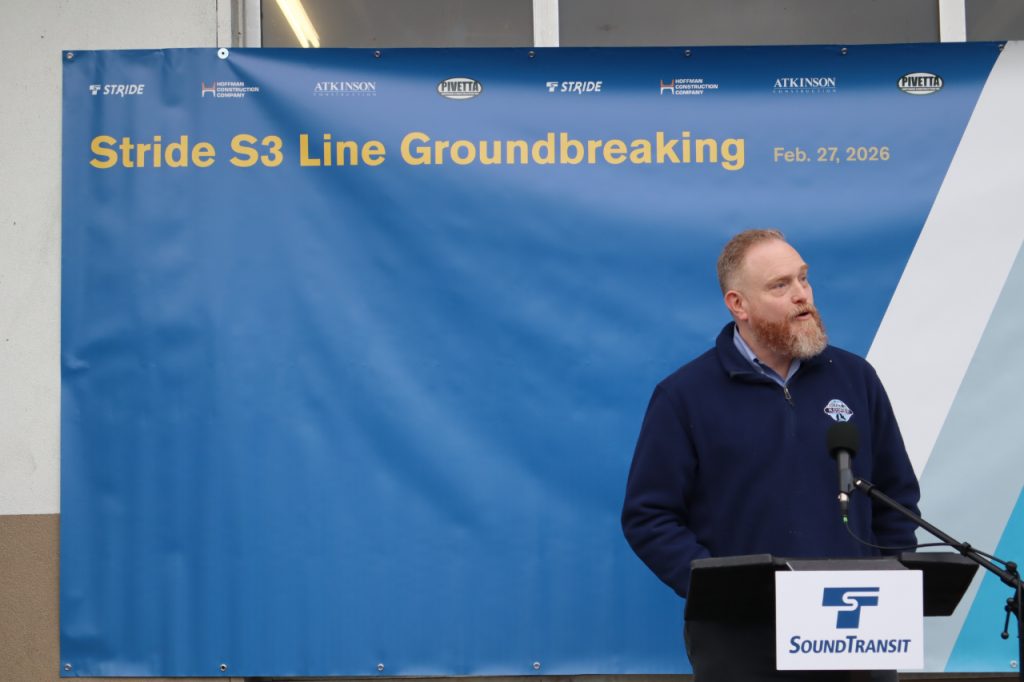
“This project is going to mean faster, more reliable connections to light rail, to neighboring cities and opportunity throughout the region, while also strengthening our identity as a vibrant, connected community,” Kenmore Mayor Nigel Herbig said ahead of Friday’s ceremonial dirt tossing. “For more than a decade, Kenmore has been planning for high-capacity transit along SR 522, and today we’re going to see that vision come to reality.”
Bus frequency along the S3 line is expected to increase to every 10 minutes during peak commuting hours, while Sound Transit is set to maintain the existing 15-minute arrival time schedule of the existing 522 ST Express bus. Last year, Sound Transit awarded a $433 million contract to MV Transportation to operate Stride service, the first private operations contract awarded in the agency’s history.
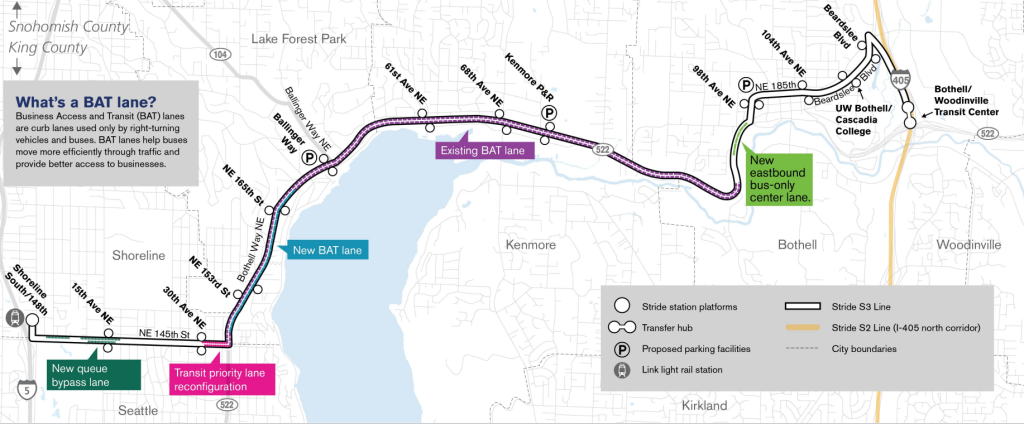
Most of the route already includes existing business access and transit (BAT) lanes that will provide buses with dedicated travel space while still providing drivers with a space to turn right into driveways. Many of those stretches of BAT lane were built by local cities along the route, including Kenmore and Bothell, over the past few years, in anticipation of the S3’s eventual arrival. As part of this phase of construction, Sound Transit will build a northbound BAT lane through a 1.6-mile stretch of Lake Forest Park, along with targeted transit improvements elsewhere along the route and upgraded stations at stops.
A bumpy road in Lake Forest Park
The northbound BAT lane through Lake Forest Park has proven to be the most contentious element of the project, with an entire group stood up to push back on the roadway expansion and associated retaining wall necessary to make it happen. Local homeowners founded Citizens Organized to Rethink Expansion (CORE) in 2023 in an attempt to get Sound Transit to rethink its plans, opposing both the hardscape coming with the retaining wall and the agency’s plan to remove dozens of trees.
In response to those concerns, the Lake Forest Park Council passed emergency legislation requiring retaining walls to come with landscaping treatments, and added requirements relating to tree replacement. The ordeal illustrates the high level of control that local jurisdictions are able to impose on Sound Transit, despite the agency’s important role in building out the regional transit network and a growing understanding of the need to operate in a more cost effective manner.

After CORE co-founder Paula Goode was elected to the Lake Forest Park Council in 2023, the City has continued to push Sound Transit to eliminate the planned BAT lane between NE 153rd and 165th Street in favor of queue jumps. But Sound Transit hasn’t budged on its design, and support for getting on with Sound Transit’s plans appears to be popular with Lake Forest Park voters.
Last fall, incumbent Councilmember John Lebo lost his bid for reelection against Josh Rosenau, a founder of the advocacy group Lake Forest Park for Bus Rapid Transit, while incumbent Semra Riddle prevailed over her CORE-endorsed opponent, Bryce James. The Urbanist Elections Committee (on which I am a member) endorsed Rosenau and Riddle. Councilmember Tracy Furutani was the only incumbent in a contested race to prevail after being endorsed by CORE, with CORE endorsing a write-in candidate in another race because both candidates supported Sound Transit’s plans.

The S3 line is also being paired with broader street upgrades that will help connect riders with stops. A $7.2 million fund from Sound Transit is providing bike and pedestrian access improvements, including upgrades to 104th Avenue NE in Bothell, new sidewalks on NE 181st Street in Kenmore and Brookside Boulevard NE in Lake Forest Park, a bikeway on 28th Avenue NE in Shoreline, and expanded sidewalk/shared use path on 30th Avenue NE between Seattle and Shoreline.
All-in on all-electric battery buses
Despite the limited market for reliable zero-emission buses in the U.S., Sound Transit is all-in on the concept of using a fully electric fleet for all three Stride routes, with its new Canyon Park bus base being fully equipped to handle the task. The S3 will be served by 60-foot articulated buses, manufactured by China-based BYD, while the S1 and S2 will see double-decker electric buses made by the British manufacturer Alexander Dennis.
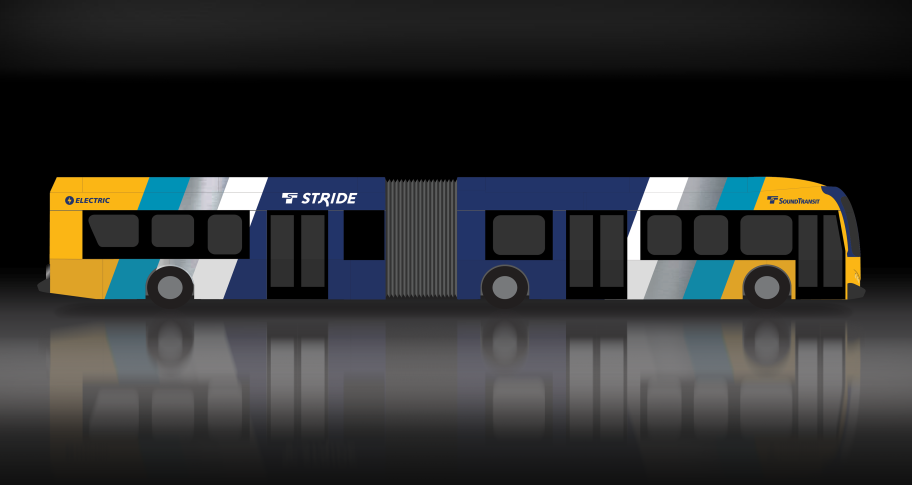
When Sound Transit awarded the contracts for these new bus purchases in 2023, there were some warning signs flashing when it came to other U.S. transit agency’s experiences with BYD. The Urbanist‘s Stephen Fesler noted some significant issues that transit operators were encountering when it came to BYD coaches in places like Albuquerque, Indianapolis, and Los Angeles. Three years later, those issues are still popping up, with LA Metro recently making the decision to ground its entire fleet of 40-foot BYD coaches operating on the J Line, just a few weeks after putting them in service this past December.
“The unfortunate news is that after about three weeks, we identified an issue with the BYD electric axle motor that required us to ground the fleet, and we’ve been evaluating that issue over the last few weeks, and are continuing to resolve that as quickly as we can with BYD,” Sean Miller, LA Metro’s Deputy Executive Director for Zero Emission Planning, told a Metro committee in mid-February.
“We continue to have challenges with BYD busses, including quality control response time for warranty support and the recent mechanical issues,” said Amy Romero, LA Metro’s Deputy Executive Director for Bus Operations.
Miller noted that many of the issues the BYD vehicles seem to be experiencing stem from being put in place on a freeway-running route. The coaches on the S3 are expected to be operated more stop-and-go than the S1 and S2 lines, which will primarily operate on I-405, a fact that could ultimately mean that Sound Transit experiences fewer issues than LA Metro. Though Miller’s comments might ultimately apply more broadly to Sound Transit’s efforts to operate all-electric on Stride.
“A lot of especially zero-emission busses aren’t intended to run at high speeds on a freeway for a long time. They’re not designed for that type of operating environment. There were indications that the electric axle motor may be experiencing accelerated wear due to those sustained high speeds,” Miller said. “We also identified a second issue with the axle motor bringing in water intrusion, and that could lead to a complete axle failure.”
Bus upgrades coming sooner
This fall, Sound Transit will switch the routing of the existing 522 bus to follow the future S3 line’s routing, cutting out the portion of the route that covers Lake City Way in Seattle and instead routing buses directly to the Shoreline South light rail station. With that change, King County Metro will implement two new bus routes, the 72 and 77, to cover that new gap in Lake City.
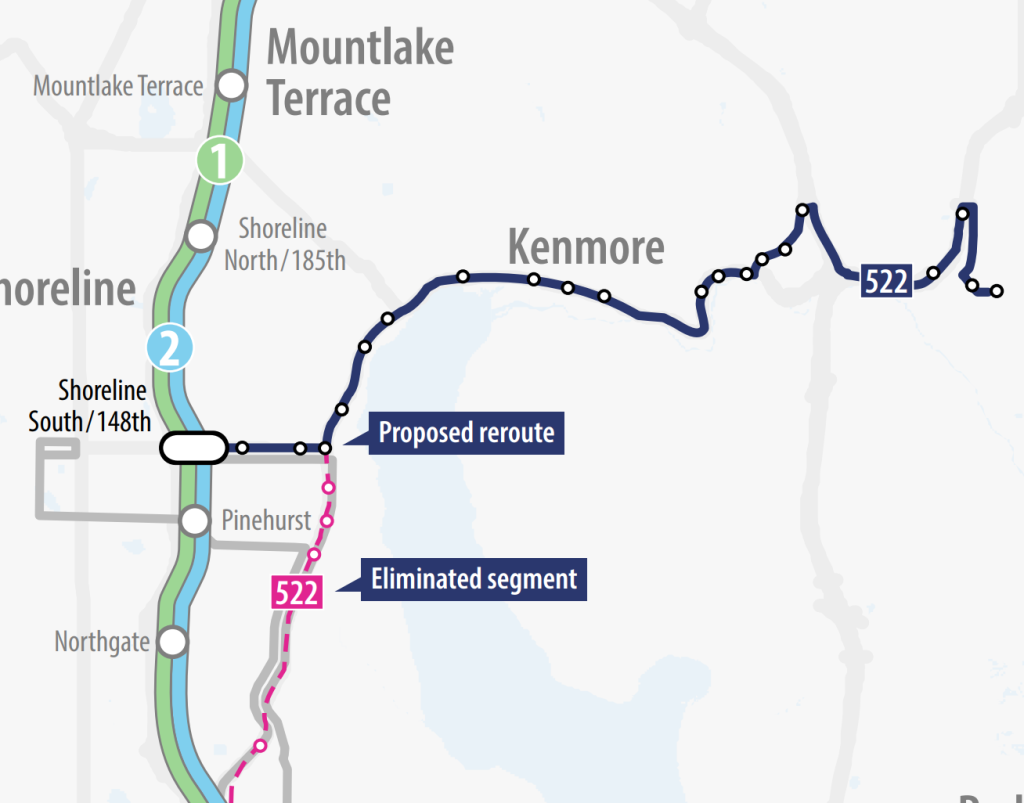
“This is a newer, shorter route will help people connect to light rail, and it will also allow us to expand the window of 15-minutes service by about an hour each day,” King County Councilmember Claudia Balducci noted Friday. “So a longer period of frequent service, which we know is the key to great transit. Frequency is freedom, right? So we’re going to be able to give riders a preview of the full benefits of the future service, and help them get used to new travel patterns.”
Ryan Packer has been writing for The Urbanist since 2015, and currently reports full-time as Contributing Editor. Their beats are transportation, land use, public space, traffic safety, and obscure community meetings. Packer has also reported for other regional outlets including BikePortland, Seattle Met, and PubliCola. They live in the Capitol Hill neighborhood of Seattle.