

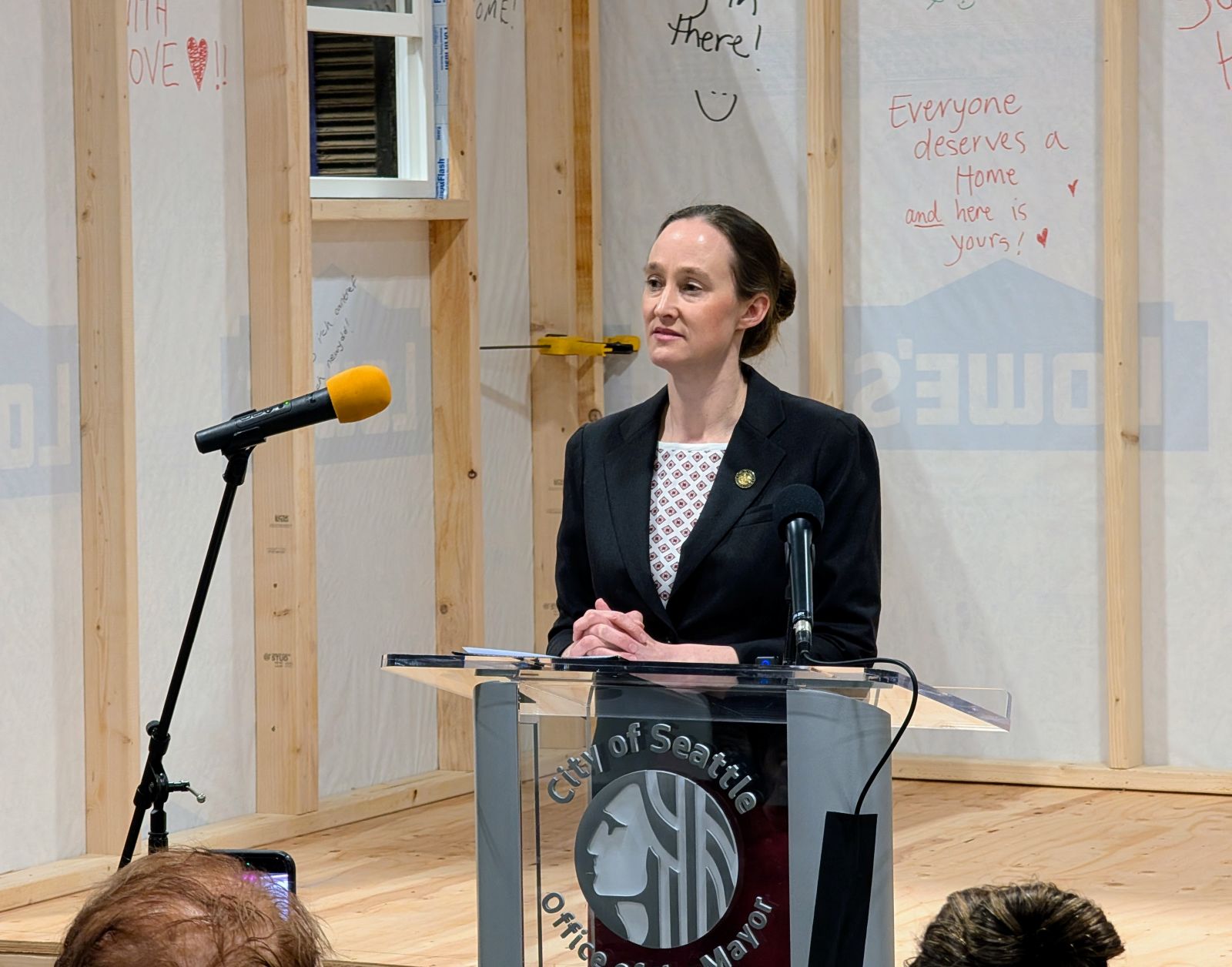
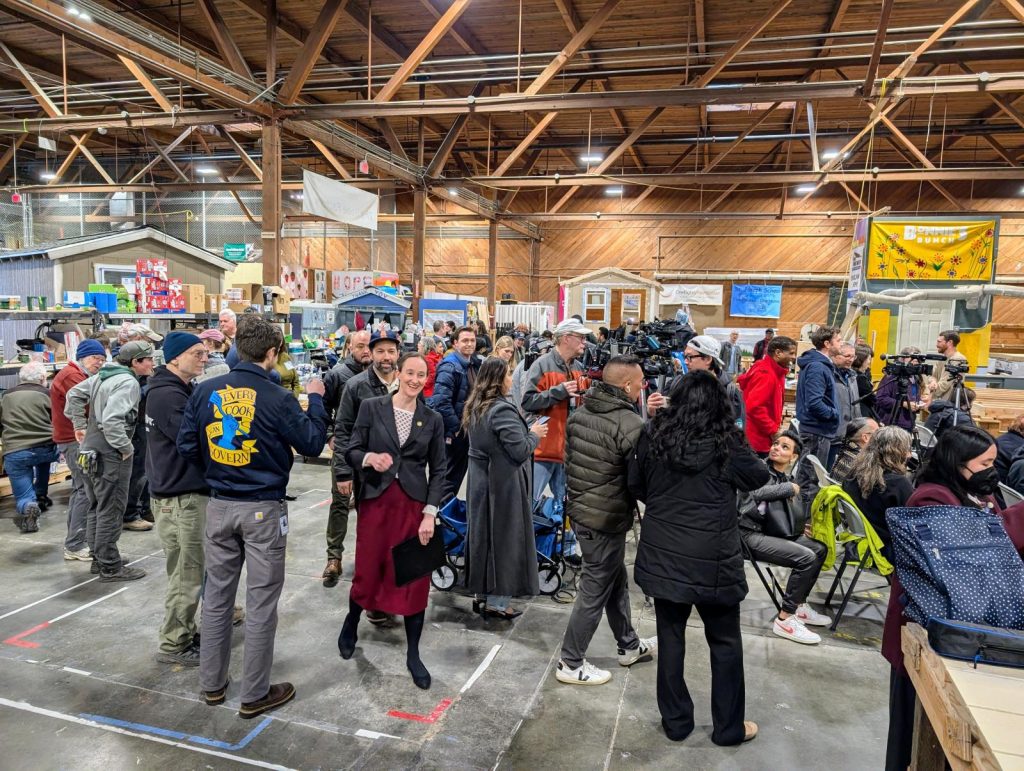
Seattle Mayor Katie Wilson rolled out new legislation on Wednesday intended to expedite production of emergency housing and expand access to indoor shelter at the Hope Factory in SoDo, a large production facility for assembling portable tiny homes.
Wilson’s office framed the “Neighbor by Neighbor Initiative” as a “citywide, all-hands-on-deck effort to rapidly expand shelter across Seattle and start bringing people inside.” Wilson has set a goal of standing up 4,000 additional units of emergency housing or shelter in her first term, with 1,000 of those in her first year.
The first piece of legislation empowers the Director of Finance & Administrative Services to directly sign lease agreements with property owners for new emergency housing, such as tiny house villages or RV safe lots. This would eliminate a significant bureaucratic hurdle in standing up such facilities.
“We’re moving faster than ever before, but I want to see the ground start breaking, the hammers start swinging, and fewer people left to sleep in doorways and tents,” Wilson said. “That’s why I have transmitted legislation to city council that will help us deliver on the goal of opening 1,000 new units of shelter with supportive services across the city this year. Now I need your help to get sites ready, to support our front-line service provides, and to be good neighbors with the shelters we need to open around the city.”
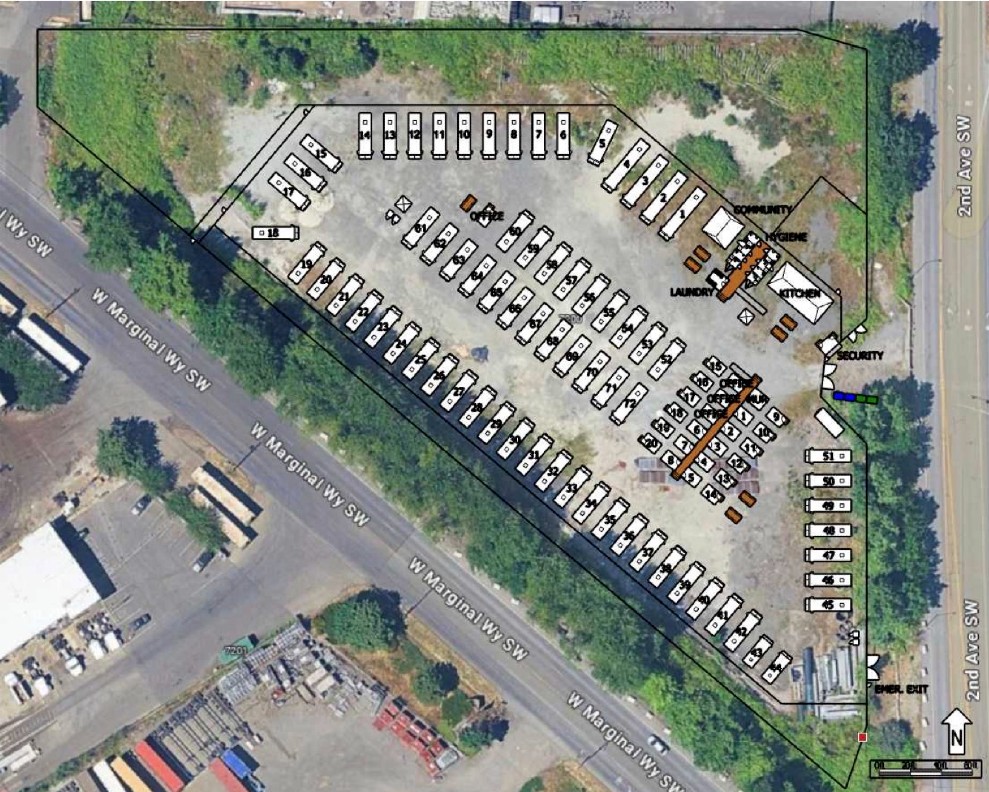
Sites for potential RV encampments and tiny home villages were identified within weeks of Wilson’s inauguration, with a state-owned parcel on W Marginal Way SW in West Seattle selected as the first to move forward. Glassyard Commons will be operated by the Low Income Housing Institute (LIHI) and will include space for 72 RVs and 20 tiny homes.
Wilson’s second bill would increase the limit on shelter size, allowing tiny house villages to grow as large as 250 people in a few select cases. That’s more that twice as large as today’s cap. Only one tiny home village that large would be allowed in each council district, with villages capped at 150 after that one gets stood up.
“The second piece of legislation will allow successful shelters to serve more people,” Wilson said. “Even the most successful shelters that do the best work and have the best relationships in their communities are currently limited to serve just 100 people. This is a very low limit, which is out of step with national best practices and what cities like LA, Tampa, and Austin are doing now, and it just doesn’t make sense when we have so many people sleeping outside with nowhere to go. My proposal would increase this limit to 150 people per site on an interim basis, provide support to address any potential public safety impacts, and additionally allow one location in each city district to serve up to 250 people in cases where it makes sense.”
It’s unclear how many village operators would take the City up on this new ability, should it be granted. Some operators, such as Chief Seattle Club executive director Derrick Belgarde, have expressed a preference for lower capacity sites so that they are more manageable and less prone to issues. The largest tiny house village site that the Low Income Housing Institute currently operates has 73 units, but most are in the 40-to-50 unit range.
The third piece of legislation reallocates $4.8 million in funding to get emergency housing creation started sooner.
“My team has identified $4.8 million from existing, underutilized City fund sources, which can be used to fund shelter and wraparound services,” Wilson said. “$3.3 million was derived from an underutilized revolving loan program that was difficult to deploy and not previously appropriated. An additional $1.5 million will be appropriated from the Downtown Health and Human Service Fund, which is a program from the 1990s that has not been used for a decade.”
Mayoral spokesperson Sage Wilson indicated that, while the one-time funds would be a boost, it would be hard to find such large sums lying around in future budgets. Former Mayor Bruce Harrell and the Seattle City Council left Wilson with a bleak budget outlook for 2027, with many one-time programs sucking up scarce city dollars as the city’s revenue forecasts look stagnant at best.
As in other public appearances, Wilson underscored that addressing the homelessness crisis was her highest priority.
“Seattle’s homelessness crisis is an emergency, and in fact, our city declared a civil state of emergency on homelessness more than 10 years ago in November of 2015,” Wilson said. “But for many years and through multiple federal administrations, we have not treated this crisis with the urgency that it demands. That pattern ends here with all of us.”
She admitted that many obstacles remained to meeting that goal, but she contended the city was increasingly aligned at putting in the work to get there.
“Let’s be clear about the challenges: Our rates of unsheltered homelessness are off the charts, even in comparison with our peer cities,” Wilson said. “We have a big hill to climb, and if the solutions were easy, it would have happened already. To address this crisis at scale, we are going to need to do hard things. But I’m also confident that we can do this, because homelessness is not only the number one priority for me and my administration, I know that it’s also the number one priority for the residents of this city, for businesses and many other stakeholders across the city.”
Wilson had not identified which councilmembers will carry each piece of legislation. That said, District 1 Councilmember Rob Saka did speak at the event and broadly offer his support.
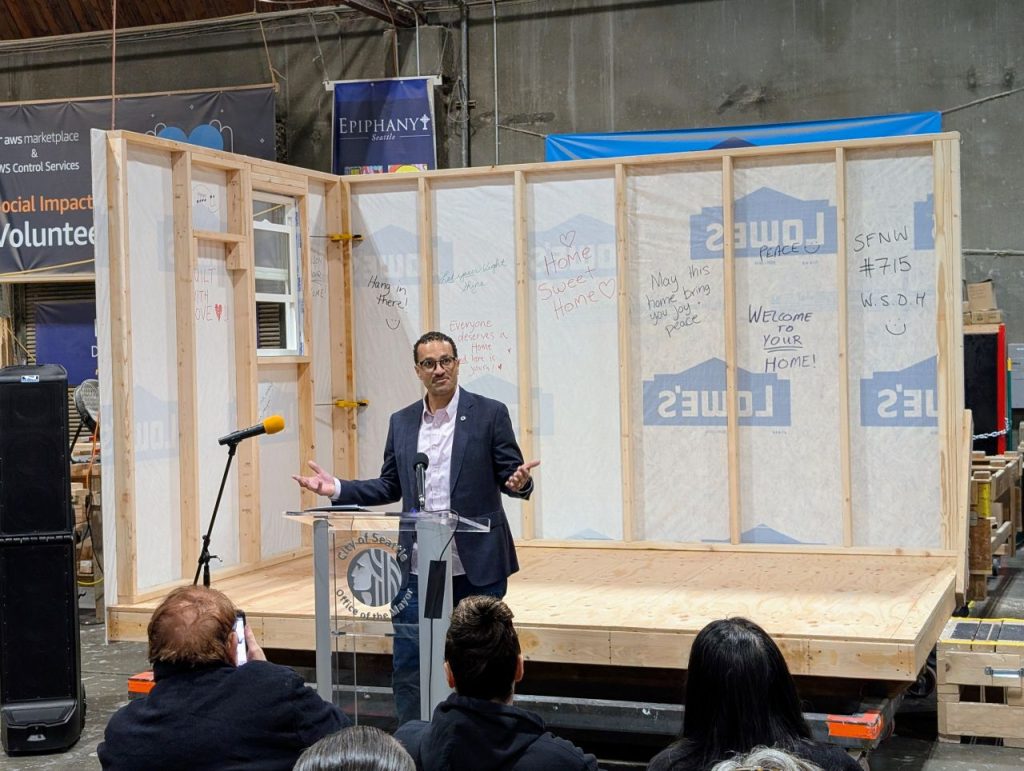
“Seattle urgently needs more shelter capacity to meet the scale of our homelessness crisis, which has gone on for too long without meaningful progress,” Saka said. “After touring Sound Foundations’ Hope Factory in my district, I saw firsthand how tiny homes can be built efficiently at scale. Expanding tiny home villages and RV safe lots is an effective, compassionate way to move people indoors and connect them to services. I commend Mayor Wilson for addressing this crisis with the urgency it demands and partnering so closely with my office to get it done.”
Additionally, District 7 Councilmember Bob Kettle did offer a supportive statement for the mayor’s press release.
“Today’s announcement of creating potentially 1,000 new units of shelter is welcome news for it builds capacity,” Kettle said. “I appreciate Mayor Wilson’s focus on this issue. My office will continue to support ways in which the city can assist our most vulnerable populations and create that safe base for all.”
Housing committee chair Dionne Foster and land use committee chair Eddie Lin are also both broadly aligned with Wilson’s agenda around making progress on homelessness, but did not release statements following Wednesday’s announcement.
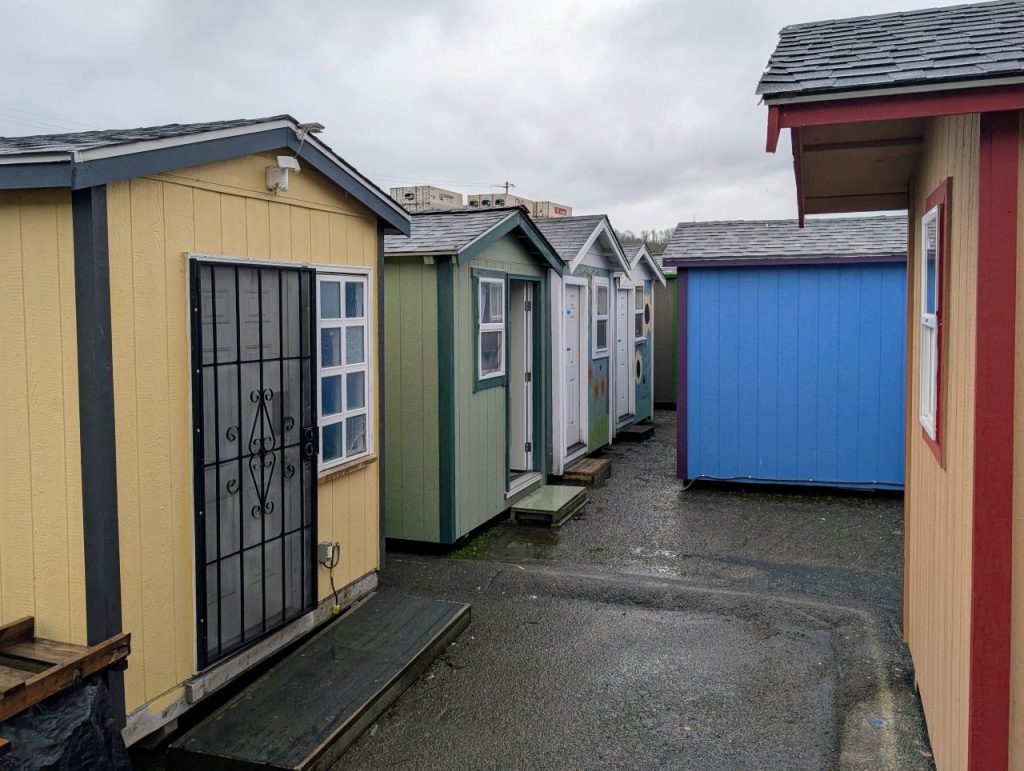
Although Wilson herself did not stick around for the second half of the speaking program or to take questions from reporters afterward, a long list of providers spoke, including those focused on substance use disorder treatment and wraparound services. Beyond Wilson and Saka, the program included:
- Steve Roberts, Hope Factory / Sound Foundations NW
- Sharon Lee, Executive Director of Low Income Housing Institute (LIHI)
- Fé LopezGaetke, Co-Executive Director, Purpose. Dignity. Action
- Grace Stiller, West Seattle resident and neighbor of Camp Second Chance
- Ann Haruki-Pinedo, Central District resident and neighbor of True Hope Village
- Chloe Gale, REACH Program, Evergreen Treatment Services
- Jilma Meneses, President and CEO, Catholic Community Services
- Derrick Belgarde, Executive Director, Chief Seattle Club
- Brandon Ashford-Whitfield, frontline service provider and OPEIU 8 member
Wilson is far from the first mayor to pledge bold action on homelessness. In fact, her predecessor Bruce Harrell pledged 1,000 units of emergency housing in first six months and 2,000 units in her first year, and came up well short on both fronts, which Wilson noted on the campaign trail.
Actions by the Trump administration shredding the social safety net and risking an economic crash are likely to exacerbate the homelessness crisis. That puts even more pressure on local leaders to queue up effective programs and try innovative solutions.
As an organizer at heart, Wilson also appears to be taking the strategy that a broader coalition is needed to tackle the problem, from big institutional players to everyday residents. The mayor launched a citywide call to volunteer to show support and be part of the solution. More information on options to get involved in support is available on the mayor’s blog.
“We need to choose to come together as a city, because we can’t keep looking away from this problem,” Wilson said. “We can’t keep pushing people from place to place without bringing more people inside. And we can’t keep forcing our busses, our parks, our libraries, to function as social service providers. Neighbor by neighbor, we can do this together.”

Doug Trumm is publisher of The Urbanist. An Urbanist writer since 2015, he dreams of pedestrian streets, bus lanes, and a mass-timber building spree to end our housing crisis. He graduated from the Evans School of Public Policy and Governance at the University of Washington in 2019. He lives in Seattle's Fremont neighborhood and loves to explore the city by foot and by bike.