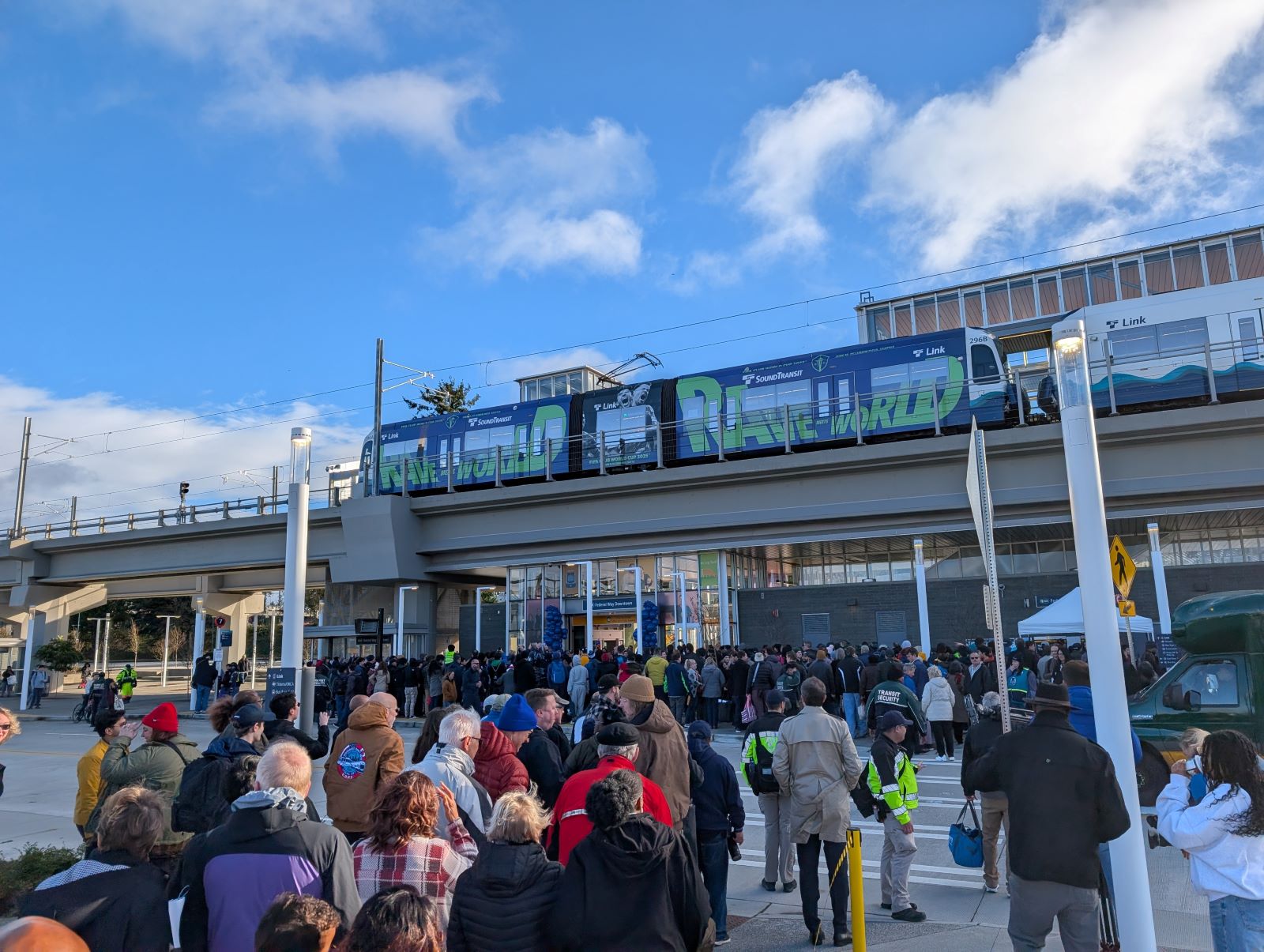
The Urbanist’s newsroom dissects the biggest headlines of the last few weeks. Ryan Packer, Amy Sundberg, and Doug Trumm discuss the Federal Way Link light rail opening in early December, Katie Wilson’s transition team and early hires, and the Seattle City Council’s vote to approve a controversial labor contract with the Seattle Police Officers Guild. The contract again punts on long-promised accountability measures and leaves several obstacles to civilian crisis response in place.
Check out our recent articles for more information:
- Thousands Packs Trains for Opening of Federal Way Light Rail
- Federal Way Link Stations Not Seeing a Housing Boom
- Seattle Approves Controversial Police Guild Contract, Three Councilmembers Dissent
- Katie Wilson’s Transition Team Features Mix of Advocates and Insiders
- Katie Wilson Charts New Course on Public Safety and Homelessness
This episode of The Urbanist Podcast was edited by your truly. Episodes also air on KVRU 105.7 FM radio Thursdays at 4pm. Thank you to Crystal Fincher and Shannon Cheng of KVRU for their assistance producing this episode.
Podcast Transcript:
Ryan: Welcome to the Urbanist Podcast, a show touching on the biggest headlines at The Urbanist, and also offering a deeper look from the reporters breaking the stories. We’re an independent reader supported publication, covering the Seattle Metropolitan region since 2014. We do advocacy journalism for better cities. You can find us at theurbanist.org. I’m Ryan Packer, contributing editor. We’ve also got Doug Trumm publisher,
Doug: Hi, Ryan. Excited to break down the stories.
Ryan: And we’ve got Amy Sundburg.
Amy: Good to be here. Excited to talk about, what’s been happening this week.
Ryan: Every couple weeks, The Urbanist will break down the biggest headlines. Here’s what we’ve got on deck for you this week. We’re gonna talk about Sound Transit opening a brand new extension down to Federal Way. We’re gonna talk about Katie Wilson, incoming mayor of Seattle, and her assembling a crack team of top staff and transition team members.
Ryan: And we’re also gonna talk about the newly approved Seattle Police Officers Guild contract.
Amy: [00:01:00] let’s go ahead and dive in and talk about the new light rail stations, because that’s very exciting for everybody I think.
Doug: Yeah definitely. And Ryan and I were there for all of the hoopla and fun times and, uh, a lot of people riding the trains for opening day. What did you think of the opening day, Ryan?
Ryan: It was a very exciting day, finally bringing light rail into South King County. Getting all the way to Federal Way. This is a day that’s been worked towards since 2008 when voters approved the Sound Transit 2 ballot measure, which envisioned getting all the way to what’s now Star Lake. Ultimately, the Great recession in 2009 prevented them from getting south of Angle Lake.
Ryan: But, with the 2016 follow up Sound Transit 3 measure, we were able to get all the way to Federal Way.
Amy: What is this expansion gonna mean for the people that live and work in South King County?
Ryan: It’s a much better connection to the regional transit network, especially from, I’d say downtown Federal [00:02:00] Way, as well as students accessing college at Highline College. There’s quite a bit of, of parking along the alignment, the trackway follows I-5. And so it’s a little more park and ride oriented than maybe the, uh, the northern section through, you know, Seattle, the University of Washington, Capitol Hill.
Ryan: But ultimately it’s gonna be better access to the region.
Doug: Yeah I think the airport connection’s gonna get a lot better too. Which I found out the reverse way when I was thinking about how I was gonna get down there for the opening from, I live in Fremont and if you connect on the A Line from the end of what used to be Angle Lake, obviously it was the end of the line.
Doug: You’re still looking at a half hour to get all the way to, uh, downtown Federal way. So that’s gonna be more like 16 minutes, I think, is what they said. So that’s a, that’s a pretty nifty connection for folks along there. And, obviously it’s not just people flying out, but thousands and thousands of people work at the airport.
Ryan: Yeah. One of the deputy CEOs [00:03:00] at Sound Transit shared with me that on his train, uh, the first one to leave Federal Way, there was a, a pilot who knew that the service was starting at 11 o’clock and used it to get to the airport in the very first revenue service train.
Amy: That’s amazing. I love stories like that. so Ryan, you mentioned that the light rail was aligned with I-5. What was the other option and what were the pros and cons?
Ryan: Yeah, so about 10 years ago, we had this big debate. Transit advocates were pushing for an alignment that went along, uh, PAC Highway SR 99, essentially directly serving the businesses and amenities that are all along the highway. But a lot of businesses were concerned that their property was gonna get taken for that alignment.
Ryan: There was also concerns about traffic impacts from temporary closures and all these impact concerns. And so ultimately all three cities along the route. Des Moines, Kent and Federal [00:04:00] Way all got on board with pushing the route over to I-5. And you know, the northernmost station at Kent Des Moines is, is pretty close to both, like, it’s a kind of most, the most narrow part of the area where I-5 and 99 are pretty close together.
Ryan: So that’s not a huge difference, although Highline College was ultimately pushing for their station to be on. On the same side of 99, so students don’t have to cross that really dangerous, noisy highway every time. Kent had been proposing to do a pedestrian bridge, but that ultimately never materialized.
Ryan: Star Lake is really the big missed opportunity. It’s right along I-5, along a wetland. There’s very little TOD. Sound Transit is not even developing any affordable housing at that site, which they are. The other two with the property they had to use to acquire to build the line.
Ryan: That’s kind of the big opportunity as well as potential infill stations will be a lot harder to add in the future. [00:05:00] But coming back and adding more stations between other ones, it’s gonna be a lot harder to do that.
Doug: Yeah, riding the train, for me was the first time I know you got to go on the early press ride, Ryan, you know, it was really a huge mix of what kind of uses and just generally was built when as you went by. You go by some pretty empty areas like forest and the wetland.
Doug: You mentioned obviously McSorley Creek Wetland, which actually was also a problem during construction because that’s part of why they had to delay due to a landslide.
Ryan: Potential landslide, right, Doug?
Doug: potential landslide, yeah, I guess it may be a bit sensationalized in the reporting but bad soil conditions that they sort of knew were there, but they didn’t expect ’em to be that, that bad. But that, that’s why this project’s opening and late 2025 instead of 2024, which is kind of the plan for most of the last decade. But, you end up going through a, a great variety of areas. There was some low density housing, some high density housing. Didn’t necessarily stop at all the high density housing, [00:06:00] but, yeah, the three stations we do have a, a real mixed bag. And I think Star Lake’s probably gonna be weak link there with a lack of TOD opportunity and, and just not as much there now either besides a big parking garage.
Doug: Yeah,
Amy: you quickly define TOD?
Doug: Oh, I hate that. I’m always the one trying to do that, when I’m editing and I didn’t do it when I was speaking. Transit oriented development, which it’s a little bit of frustrating from, from a urbanist perspective ’cause it should all be transit oriented development. Right. But, obviously we have to differentiate from the normal way we do things, especially in the suburbs where, we’re just building a lot of low density housing with largely single family homes that it’s really hard to serve a transit whether we wanted to or not.
Ryan: Yeah, I think Federal Way is the big opportunity here. You know, they have pretty grand ambitions for what I think a lot of people would kind of laughably consider a, a downtown now. The idea that Federal Way has a downtown as kind of a, a running joke. And so I think we should encourage those plans.
Ryan: They have four big sites that Sound Transit’s gonna [00:07:00] directly develop right now. Those are pretty far along actually in the process, those are gonna have retail on the ground floor and start to kind of create a mixed use district. They also have this very large parcel home to a former target that they have been working with the development agreement on with a developer which could bring like as many as 1600 units, through phased development.
Ryan: So you’re potentially looking at a very different federal way in 10 to 15 years.
Doug: Yeah, it, it certainly feels like there are things at the Federal Way Station. They’re just not that close to the, the station itself and. We learned as we were going to our little urbanist afterparty where we went to a Italian restaurant near the station, but not near enough not to have to cross two stroads to get there.
Doug: And a stroad is the urbanist term for an overbuilt road, street road that is very unpleasant to cross. We waited probably over 90 seconds just to get across one intersection, because there were so many [00:08:00] protected turns for cars. And then you’re just waiting to get your turn chance to cross both of these roads as a pedestrian, and you feel like you’re trapped in a mall parking lot hell.
Ryan: Yeah. Federal Way still has a long way to go to get out of that car-centric planning mindset. Their long-term vision, rather than slimming down that major road is to dig a tunnel so the cars can pass, pass underneath and you can have pedestrians crossing on the top of the surface, but not have to actually slow any cars down.
Ryan: While I don’t think it actually will ever happen is a great illustration of kind of the mindset of current Federal Way city planners.
Doug: Yeah. That’s not downtown thinking, is it?
Amy: So how successful do we expect the new line to be? Like how many people do we think are gonna be riding?
Doug: Well, I can give you the official agency projection, which, uh, I think was last revised to 18,000 to 23,000 daily passengers is what the extension will contribute. And to give you some context, [00:09:00] the 1 Line before this extension averaging more than 110,000 rider daily riders. That was buoyed by the addition of Lynnwood Link in 2024. So it’s definitely a growing ridership. This is gonna help a little bit, but it’s not gonna be like, a night and day thing.
Ryan: I think due to the fact that it’s a much longer trip to get to downtown Seattle than it is from Lynnwood, on the other end of the line. It has to go through the Rainier Valley to get to downtown. Sound Transit is gonna continue running express bus service between downtown Federal Way and downtown Seattle, in illustration of the fact that it’s not actually saving you a lot of time to jump on the train, like Doug said, it’s gonna be great for airport travel, but it’s not gonna be, I think the game changer that Lynnwood has been, especially because Lynnwood’s gonna have four minute service with the 2 Line extending up there.
Amy: Yeah four minute service is a big deal. I think it makes people a lot more likely to give it a try.
Doug: yeah, [00:10:00] I know a lot of my friends are excited for that. Even folks who aren’t died in the wool urbanist. It just makes it so there’s not really that mental barrier of like, oh, is the train gonna come and am I gonna make, make my trip in a reasonable amount of time and not be late? And beyond the airport connection, the silver lining of a not very quick route into downtown Seattle, where you go through Rainier Valley. I think there are a lot of, uh some trip demand for folks who like to go to Columbia City, say from Federal Way or from from Kent Des Moines. That that is a lot faster trip because much of our transit system forces you to go downtown to transfer. And, now you have some connections along this line that, that are not forcing you to do that to make a connection like that so that that’ll be an improvement.
Ryan: Now that sound transit’s gotten to Federal Way, what is next is the two line which is finally gonna extend across I-90 into Bellevue between Seattle and the Eastside. Recently [00:11:00] we’ve been hearing rumblings about a spring opening and CEO Dow Constantine has confirmed that the train will open no later than May 31st of next year.
Ryan: Well in advance of the World Cup Games in downtown Seattle. So everyone’s eagerly anticipating that opening is gonna be a huge deal when we’re finally able to bridge the Eastside and Seattle with very frequent train.
Doug: Yeah, and get Judkins Park in Seattle service too and Mercer Island. They’ve been waiting a long time.
Ryan: My question about the two line, where should the grand opening be?
Doug: I’ll, just say Judkins Park ’cause I’m Seattle for life, but, uh,
Amy: I think I think it should be on the east side because the east side hasn’t had the connection. So it makes sense to me to maybe have it over there or you could have a dual head celebration. So have it on one side and then have it move to the other side. Actually, I think that’s probably the most fair.
Ryan: [00:12:00] But then will it be in Mercer Island, which has spent a very intense amount of time fighting its light rail station?
Doug: would say if Mercer Island can approve a big upzone before the opening, then let’s give it to them. But if not, uh, no. No thank you.
Ryan: Well, that up zone might be happening under the threat of a lawsuit, so we’ll see.
Doug: We always knew we were gonna have to coerce them. Right. yeah, it’s probably gonna be Bellevue, but it feels weird ’cause they’re already open. But yeah, that is, I didn’t think about that question and it is a kind of sticky one. I think probably still thinking about that one. It sound transit. ’cause the segmented opening really complicates things.
Ryan: One thing is for sure, it’s gonna be a huge party.
Amy: Well, there’s a lot to celebrate.
Doug: And one other piece of news, which is a little minor piece of news, but it kind of fun. One thing that happened at the urbanist holiday party was that Claudia Balducci gave a little speech and she said she is going to be on a ride across the lake with some other. Sound transit staff and officials. Uh, so they are [00:13:00] actually taking passengers across there, which is another of these mini milestones. We’re counting every single milestone, as they get the floating bridge service working. ’cause that’s been a huge engineering feat to figure out how to run a train across the floating bridge.
Doug: But, it feels even closer now that we know that they’re actually taking people across.
Ryan: Yeah, hopefully the press ride isn’t too far behind. We can give our write readers a little preview of what’s happening. It’s my understanding that once the line enters simulated service, which will probably be happening a few weeks to a month before actual start, as riders will be able to use the, the trains north of International District.
Ryan: So you’ll be able to get that, that four minute service we’re talking about ahead of time.
Doug: That’ll be so awesome. And with the two line full opening, that’ll be a full build out of Sound Transit 2 or ST2. , And that was approved in 2008. So it did take about 17 years. But that still feels huge to have [00:14:00] fully completed a package like that, and it’s, I think over 62 miles of light rail lines, accounted for in that.
Amy: Yeah, I mean, it definitely makes a difference to the whole region to build out infrastructure like that.
Doug: Yeah. And Sound Transit 3 isn’t going quite as smoothly, but obviously we will have even more expansions on deck with that. But that’s probably another podcast episode.
Ryan: Moving on to our next topic. Let’s get into City of Seattle News. We’re just a few weeks away from the new Katie Wilson administration taking office, the first progressive mayor we’ve had in quite some time. It’s gonna be exciting to watch, and we’re gonna read the tea leaves when it comes to senior staff hires and the broader transition team.
Ryan: Amy, what have you been tracking when it comes to the transition team and who Katie Wilson’s bringing on to help her lead the city?
Amy: Well, you can see with her transition co-chairs kind of where a lot of her priorities [00:15:00] lie. Tiffany McCoy is the co-executive director of House Our Neighbors, a social housing. organization. And I think that just shows how dedicated Katie Wilson is to really pushing social housing and making sure that it gets done as well as we can do it here in Seattle.
Amy: So I found that one really encouraging. Karen Estevenin, who is the executive director of Protec17, shows Katie Wilson’s strong labor ties, right? So that was not a surprise at all, but always, always happy to see it.
Doug: Yeah. And those two struck me as definitely a thank you. I mean, they stand in their merits for sure. These are, these are well connected people with good ideas. But, Protec17 was the first major union to throw their weight behind Katie. And, that was before the primary when, when that wasn’t the obvious pick. A lot of labor was worried the mayor was gonna punish ’em if they, if they did something like that. And, Estevenin and Protec17 threw their neck out there and now they [00:16:00] in a better position because of it. And Tiffany McCoy similarly, was an early endorser, but also the fact that we had a social housing measure in February that the mayor kind of flubbed that by being the face of the opposition. You know, Wilson has credited that with why she even jumped in the race. So, those two are instrumental in, making sure this, this race went the way it did.
Ryan: Yeah. The other two co-chairs are Andres Mantilla of Uncommon Bridges, who used to be, the director of the Department of Neighborhoods and Brian Surratt, who’s been the CEO of Greater Seattle Partners, but used to lead the City O ffice of Economic Development.
Ryan: The way we describe this on the site is a mix of advocates and insiders, and I think, it’s clear that even with the selection of her co-chairs for transition, she’s making signals that, she’s gonna bring in people with deep background in making city government work, but also continuing [00:17:00] to highlight people who will push the city to do better.
Ryan: With Tiffany McCoy, especially leading the charge in terms of making sure that we are still advocating for new ideas.
Doug: Yeah And I thought Quynh Pham was an interesting pick, as executive Director of Friends of Little Saigon, because they’ve been working on a public safety approach for Little Saigon that isn’t based on just hotspot policing and punitive enforcement. They’re looking at a holistic approach.
Doug: I think that could be a signal that’s, that’s something that Katie Wilson wants to do on a larger scale. And really, especially with that effort too, because I know 12th and Jackson has been this intractable problem for so long. but we keep kind of doing the same approach it seems like.
Amy: Yeah, I was really interested to see Pham on there as well. And I do think it’s a strong signal of of more neighborhood based approach to public safety that Wilson has talked about on the campaign. She’s really interested in developing these relationships with various neighborhoods.[00:18:00]
Ryan: Doug, how,
Doug: And those folks aren’t people who endorsed her as far as I know, like with Surratt and Pham and Mantilla. So, she’s showing she’s not just gonna play political favoritism, but also try to work with everyone. I think even though there are a few of her, her loyalists there too,
Ryan: Doug, how much do you think people should read into the members of the transition team? How much are they gonna really influence policy after January 1st?
Doug: You know, normally I would say. Don’t read too much in these tea leaves. But I, I have talked to a few people who have said, when we go to these transition team meetings, which granted are just starting now in December, but that they felt like they were really well run and that, that they were really asking for real feedback and, and trying to actually capitalize on the knowledge.
Doug: And, that goes to speak to what some people are trying to say about Katie Wilson from the beginning is that this caricature of her as this like progressive firebrand like Kshama Sawant was, was not really the [00:19:00] Katie Wilson, anyone actually knows who’s worked with her. She is the ultimate policy nerd. And she’s gonna have a thorough process and actually hear from people. That’s at least the person that people know. And obviously people can be different once they’re actually in power but so far I think people have said, oh, this, this is a transition team.
Doug: It’s not a checking in a box. It’s actually looking for real feedback and I think the thing people always try to guess when they announce it is usually a few other people become appointees. And we’ve seen that with Brian Surratt being a co-chair and now he’s the deputy mayor. So obviously that one if you’re in that committee and getting a chance to talk to the Deputy Mayor, that’s gonna be a part of a relationship and feedback that he’s gonna carry with him probably for his whole term.
Amy: I think one thing that’s also really important to remember about Wilson is that she has a really strong background as a community organizer, and she has stated repeatedly both on the campaign trail and since. We know that she’s going to be the next mayor, that that’s how she intends [00:20:00] to lead.
Amy: And so it doesn’t surprise me at all that that first transition meeting was extremely well run because Wilson’s experience is in talking with people, bringing them all to a table, trying to get people on the same page. My guess is that we’re gonna see a really different style of leadership coming out of City Hall come January 1st.
Ryan: Doug, you mentioned Brian Surratt is gonna be Deputy mayor. Do we have some other ideas of who is gonna be filling the top jobs in the Wilson administration?
Doug: Yes, Yes we’ve been getting a little trickle here and there. In, within that same announcement, there was a handful of other names. For example, we know, Katie Wilson’s Chief of Staff is going to be Kate Brunette Kreuzer, who is a old friend of the publication for sure.
Doug: As someone who was on our, on our board at one time, I believe. And, Brunette was at Futurewise before this, and was their development director. But, has, has known Katie for a really long time through Transit Riders Union and, and other things where she [00:21:00] has been active. So, chief of staff can subtly be this pretty important role because they control who has access to the mayor and runs their cabinet. So, that is someone who urbanists should feel good about. Because she’s been doing work with Futurewise, The Urbanist and other folks who for a long time.
Doug: And then I can just run down the list of names. Jen Chan was appointed director of departments, which is sort of like a deputy mayor role. But and I think for the better, Mayor Elect Katie Wilson is not doing the four deputy mayor thing that that Bruce Harrell did.
Doug: And I think, Mayor Durkan had like three deputy mayors. Is that right?
Doug: Uh
Ryan: Deputy mayor, inflation is a real thing.
Doug: Yeah, it’s a real thing. So it’s a reorg and I think that’s probably for the better. So that, people know what the, what the hierarchy is, and what people’s responsibilities are ’cause you can say, deputy mayor for this and this and this, but I think to most people it’s just like, okay, you have four deputy mayors. It’s kind of [00:22:00] confusing. Who do I ask for help when stuff getting sorted out between the departments. That’s a pretty senior role I think, and she’ll be the liaison between the mayor’s team and, and all the different city departments, which there are a lot of.
Doug: And then Seferiana Day is the director of communications coming over from the Office of Planning and Community Development, where she was the communications director. And Alex Gallo Brown is the director of Community Relations. He was Katie’s campaign manager and a union organizer with UFCW before that. Definitely someone who she built a good relationship with over the campaign.
Doug: And
Ryan: another signal that they’re gonna continue the community organizing through the administration, right.
Doug: yeah, yeah,
Doug: Well, actually, Seferiana Day has a background in community organizing too. Both, indirectly through OPCD, but earlier in her career. And she also was with Upper Left Strategies. So someone with some political savvy. Obviously we would like Katie Wilson not to get the old Mike McGinn treatment and have all the local [00:23:00] media painting her as outta touch or ineffective. So I think, they’ll have to think about how they’re what they’re doing rather than it get communicated by their enemies.
Doug: And then we have Aly Pennucci, which I know is something Amy, you’re familiar with , as someone who covering the budget closely.
Amy: Yeah so Aly Pennucci will be the director of the city Budget office. And Ali Panucci was a long time central staffer for Seattle City Council. And when she left, I don’t know, a couple years ago, I think it was, there was a lot of concern because she was just known to be very, very good at her job, very knowledgeable.
Amy: So, there was the feeling that the city was losing a lot of its institutional knowledge when she left. So it’s great to have her back on board and get that institutional knowledge back at City Hall, as well. Yes, I’m a huge budget nerd. I think everybody knows that by now. And, Katie Wilson is gonna be facing a very challenging budget.
Amy: Her first budget , there’s gonna be deficits, there’s gonna be a lot of issues. Even if she [00:24:00] wasn’t interested in revamping it, it would be very difficult. But if she’s interested in doing anything differently, even more so, right, because obviously it’s always easier to just stay with the status quo.
Amy: So having someone as experienced as Aly Pennucci to lead that effort, I think is very encouraging.
Ryan: Once again, we’re seeing evidence that, despite the idea that Katie Wilson’s gonna come as a very inexperienced mayor that we’re, we’re getting really people with a very long history at City Hall who know what they’re doing and are gonna be able to really pick up that job on, on day one.
Doug: Yeah. And the last person that they’ve announced is Nicole Vallestero Soper, who’s the director of policy and innovation. Either you followed what she’s been up to.
Amy: No, I was just gonna ask what the Director of Policy and Innovation does. I think that that’s a new title, right?
Doug: I think so. Yeah. There’s usually [00:25:00] someone who’s like the policy lead, but I don’t think the Harrell administration had a one for one replacement of that, but they had a large cabinet with people maybe with policy and innovation in their title separately.
Ryan: Amy, what do you think about the idea of only having one deputy mayor instead having someone who’s in charge of the department heads, but also maybe we will, you know, let them actually do their jobs?
Amy: Yeah, I mean, we’ll have to see how it goes at the end of the day. Predictions are just that. They’re predictions, but we don’t actually know. But I would say , from what I’ve heard about how City Hall has been operating in the past, I feel like this is a strong effort to move away from infighting and backstabbing and like a dysfunctional, overly competitive culture, to something, yeah, where people maybe have a little bit more direct control over what they’re doing, a little bit less hovering kind of oversight and maybe less about like the political game and more about actually getting things done. That might be wishful thinking [00:26:00] on my part, but I think that’s what it signals, whether or not that’s how it works out in practice.
Amy: We’ll have to see.
Doug: Yeah, I mean, we’re reading a lot into the tea leaves this early, but. I think so far signs are good.
Ryan: There’s one more person who I don’t think has been officially announced, but, Alex Hudson, who ran for the District 3 Council race in 2023 and had been the executive director at Commute Seattle. Sounds like she’s gonna be also heading to the mayor’s office. That role is a little bit up in the air, but , in terms of her policy background, we can be sure that they’re gonna be involved in the 2026 Seattle Transit Measure renewal, which figures out how the city invests in public transit purchases, bus service from King County Metro, and pays for bus passes and things like that, as well as the monumentous decisions that are gonna come in front of Katie Wilson as a Sound Transit Board member next year.
Doug: Yeah, And that is another [00:27:00] old tie to The Urbanist with someone who served on our elections committee as well.
Doug: Oh, and I’ll add that, Nicole Vallestero Soper, Director of Policy Innovation , she was at last, at Puget Sound, Sage, which is a very influential group advocating for communities of color especially in south King County. And she worked on the 15 dollars minimum wage in SeaTac, which Katie also helped on. So, definitely another close ally, someone who has a lot of experience collaborating with the mayor and, and it looks like that position is responsible for developing and advancing specific policies that fulfill the mayor’s vision.
Doug: So, kind of a catchall position, but someone that likely will work pretty close with the mayor.
Ryan: Yeah, coming from Puget Sound Sage into the mayor’s office, sounds like, the Dionne Foster move.
Doug: And another good ally for the mayor having Dionne Foster on the council side.
Amy: Do we have any other thoughts about signals that these picks could possibly mean.
Doug: Another thing this process at least signals is that they are thinking [00:28:00] a lot about how they wanna present themselves and kind of forging a new way. The fact that their transition team, they met at Centilia Cultural Center, which is at El Centro De La Raza in Beacon Hill, it’s also where Katie Wilson had both of her victory parties.
Doug: So it’s turned into a defacto base for them at least, until they’re informally in the seventh floor of the city hall. But, having that event, it was partially open to the press, so Katie gave a public speech and then so did her co-chairs of her transition team, and then they had the co-chairs available for media interviews. We weren’t able to get there, but, I think just the fact that they put that out there, shows that they’re trying to say, ‘Hey, if you wanna talk to us about this stuff, we’re, we’re available. That is always the case, with every administration when they wanna do a lot of the stuff behind closed doors. And once they are in office, then you have the gatekeeper from the press shop that you have to go through. That might be the case once they’re in office. But right now they’re trying to reset and really offering [00:29:00] some access here, rather than have it be behind closed doors.
Amy: All right, well, let’s move on to some more big recent news, which is the passage of the new Seattle Police Officer’s Guild, a.k.a. SPOG, labor contract.
Doug: Yeah, you were there. Take, take us through what it felt like to be in that room, Amy,
Amy: I was watching, I was watching, and I was posting on Blue Sky because I knew a lot of people would wanna know what was happening as it was happening. There was a lot of public comment to start out the meeting. Most of which was asking the council members to, to not pass the contract, to vote no.
Amy: And then once they got to the contract. First of all, there are two contracts. I wanna be clear about that because I think it can be confusing to folks. There were two contracts that the council was voting on. The first one was the Seattle Police Management Association , which is different than the SPOG contract and not what everyone was talking about.
Amy: So [00:30:00] it SPMA, as they’re called, they represent higher ranking officers. So like lieutenants and captains. And their contract, while it could still definitely be improved, is a lot less egregious than the SPOG contract. So it doesn’t receive the same level of attention.
Amy: Also, it covers a lot fewer total officers. There just are less captains and lieutenants than there are officers and sergeants. So, it affects a lot fewer people who work at SPD. So they voted for the SPMA contract first, which is a different contract. And it passed unanimously, which was expected. And then they, they did the big vote, which was the SPOG contract, which has all kinds of issues that, that we can dive into, but the big surprise of the day was that Councilmember Rob Saka of [00:31:00] D1, voted against the contract, which was not something that I saw coming. But earlier that day, he published an op-ed at the Stranger, stating his intention to vote no. And at the actual meeting, he spoke for almost a whole half hour, I think it was 27, 28 minutes. He spoke about all his thoughts about the SPOG contract, including why he was not going to vote in favor of it, and
Doug: The full Saka experience..
Amy: It was maybe the longest speech during a council meeting that I’ve ever heard. I think it was, I don’t remember one being that long before. So it was, it was interesting because of course, there was a lot of tension in terms of what was gonna happen with the vote. Yeah, but also it just went on and on and on and on. So, yeah, that was a memorable experience. He brought up some of the weaknesses of the contract, most notably in accountability, which [00:32:00] I was happy to hear because I do feel like there are different aspects of the contract, and accountability often gets a short shrift, in my opinion. And that’s really why he was voting no, was because of the almost non-existent gains in accountability that the contract offers us as a community. did say some things that were not perhaps the most, uh, tactful, in terms of his colleagues on council,
Doug: Tact isn’t his signature move.
Amy: Um, yeah. So, that was very dramatic, but long.
Doug: Yeah.
Ryan: Amy, what types of police accountability measures were advocates hoping might be in the new police contract?
Amy: Yeah. So, it’s hard to talk about because a lot of it is very in the weeds. So if you’re not familiar with it, it, it doesn’t necessarily have a huge amount of meaning. So I’m gonna try to be less wonky and just explain it [00:33:00] in a lay person’s terms. But basically there was this landmark, well, it was, it was called landmark at the time, accountability ordinance that was passed in 2017. It was supposed to be this really big deal in terms of really turning a corner of police accountability in Seattle. And then the very next year, a new SPOG contract was passed that really didn’t implement this landmark mark accountability ordinance. And in some ways even perhaps went backwards. So, what advocates really wanted to see is this, this ordinance, which is now eight years old, right? So that’s a long time to wait. It was supposed to be implemented as soon as possible, but it did have to be bargained, parts of it. They wanted to see it finally be implemented and it still isn’t.
Amy: And that is kind of the easiest way to understand what’s going on with this contract. There are a lot of nitty gritty things that are involved with that. But [00:34:00] the other thing to remember is that this is an ordinance that was passed eight years ago. And it was meant at, even at the time that it was passed, it was meant as a floor of accountability.
Amy: Not a ceiling, but a floor, like the very basics. So it was not fixing all of the accountability problems, it was just let’s get it a little bit better to start and then we can build from there. And yet Seattle has been completely incapable of even reaching that floor. And then as time continues to pass, of course people get more and more upset and trust continues to erode because we’re not able to make any additional progress because we aren’t even able to meet that basic level.
Amy: I would say the other major issue with the contract, aside from money, it is very expensive. So that’s a third major issue. But, the second major issue is what it does with the CARE department and the CARE team, which is our alternative response here in Seattle, for people who [00:35:00] don’t have a gun and a badge who are supposed to go out and address behavioral health calls and, and that sort of thing. There’s been a big movement to have a response like that in Seattle since 2020., And it has just suffered so many setbacks and problems and foot dragging. But this contract was supposed to be the one that really allowed that team to thrive and allowed them to finally answer 9 1 1 calls by themselves without having to have police there , which was a really big deal. Allow them to grow at an appropriate pace for what the need was for their services. Basic things like that. And what this new contract does is it allows the team to grow, which is great, but what it doesn’t allow them to do it, it technically allows them to do solo dispatch.
Amy: So they are allowed to go to 9 1 1 calls by themselves. But it puts so many limits on those calls and in terms [00:36:00] of when they’re allowed to do it, that in practice it’s gonna be hard for them to answer a lot of the calls that they are best suited to answer. And it also really takes away from the independence of 9 1 1 dispatch. And unfortunately, if we wanna see a call response times for 911 calls go down, which I think everyone agrees would be great. We need to have that independence of dispatch to be able to send who is best suited as a first responder to each individual call.
Doug: And it definitely feels like there’s irony there in that they’re allowing the CARE team to grow larger, but then they’re saying actually you can’t do this, this, this, and this, and this. So it’s, they’re gonna have all these staff that are gonna be very hamstrung in what they can do, and it doesn’t seem like in a very efficient way to run things.
Ryan: We keep hearing that the police wanna spend their time going to crimes and spending their time, dealing with crimes. So why, why is their contract hamstringing the departments that’s intended to be able [00:37:00] to free up their own resources?
Amy: I mean, it’s political theater, right? Like it, in my opinion, the CARE team has become a very valuable bargaining chip, that SPOG can use as kind of a battering ram to get the other things that they want in the contract. So, I mean, I think that’s basically it. Because it is true that in general, most police officers would prefer to not answer these sorts of calls. And it’s also true that they’re generally very safe for these alternative responders to respond to. So it’s not actually an issue of are they gonna be in danger? And, and there are, there are a bunch of protocols in place should it turn out to be a more dangerous situation than people originally thought.
Amy: And what we see in these sorts of programs across the country is that actually it, the danger to the first responders is not a big deal. That, that they’re able to dispatch them [00:38:00] appropriately to the type of calls that they should be responding to and that they are fine and they can always call police for backup if that’s necessary.
Ryan: Amy, you mentioned that Rob Saka was a surprise “no” vote. Were there any other council members who might have been expected to push back more on the contract?
Amy: So, the final vote just was 6-3. So the contract did pass as expected. The three no votes were Rob Saka , Eddie Lin, the new D2 council member, and Alexis Mercedes Rinck. The fourth that we might’ve expected to see vote differently was Joy Hollingsworth, who’s the D3 council member. And the reason we might’ve expected to see something different there is because on the campaign trail and specifically on the Hacks and Wonks podcast , Joy Hollingsworth said that there were some issues within this SPOG contract that would make her not support it. And those issues [00:39:00] were part of this. For example , she said that she wouldn’t support a SPOG contract that didn’t give subpoena power to the accountability bodies in Seattle. And there are various reasons why that’s crucial. This new contract does not give subpoena power to these bodies. That’s yet to be negotiated.
Amy: We still don’t have it. So I think people thought because she said yes, I don’t support that, that that would mean that she would say no to this contract. Also, she doesn’t serve on the Labor Relations Policy Committee, which five of the council members do. So a majority of council, which means that legally she could vote no with no worries of an unfair labor practice. No legal problems, right? She, she didn’t have that constraint on her vote. So I think some people expected her to possibly vote differently, but she did vote yes on the contract.
Doug: Yeah, and I would add that I think a lot of people have written off his vote on this issue now [00:40:00] because of everything that’s happened in the last couple years. But Dan Strauss is normally kind of in the progressive ish wing on other issues. But on this one, no one was really counting on his vote, but used to be a progressive solidly.
Doug: And, and I think his reaction 2023 we had to face election and was worried about the defund criticism was like, oh, he put out that mailer said defund was a mistake. And you know, it looks like that wasn’t like a temporary save your skin kind of move for Councilmember Strauss, but that he has shifted right on this issue and isn’t gonna stick his neck out to try to push for a contract with more police accountability in it.
Amy: Councilmember Strauss did make a speech about his vote that he was gonna vote yes. And he said that, that we couldn’t wait. That the CARE team, we couldn’t wait for it to expand, which I thought was a little interesting since if you’re expanding it, but they can’t answer the calls they’re supposed to answer. I, I don’t know. I thought that was interesting logic, um,
Amy: [00:41:00] And that we couldn’t wait. Another interesting wrinkle, and again, this is deep in the weeds, so I apologize in advance, but, the city has finally agreed to take SPOG to interest arbitration on a few key issues of the contract. And that would not necessarily be able to go forward if the contract didn’t pass. So he was concerned about that. I don’t know how I feel about those reasons, but those are his stated reasons for voting in favor.
Doug: Arbitration is such a crapshoot. It’s hard to say, like whether that’s an outcome or, or anything close to a Sure, sure
Amy: Yeah I think the other thing just to remember about this contract, and I especially say it because Councilmember Bob Kettle has mentioned in more than one of his remarks, pushed back on the idea that this was a rushed process. So I do just wanna note that while we’ve been working on getting a SPOG contract for years, we had kind of a weird interim last year, but [00:42:00] trying to get these new accountability provisions has been the work of years. It feels rushed specifically because of the fact that Mayor Bruce Harrell introduced this contract a few weeks before the election. Right.
Amy: And the fact that this is being passed now right before Katie Wilson takes office, right before we get a new council member right before we get a new city attorney, means that these new elected officials will not get the chance to weigh in on an issue that is of supreme importance to public safety in Seattle, and they might not get that chance for their entire term because while this contract runs through the end of 2027, it is not unusual for the negotiations for the SPOG contract to be very lengthy.
Amy: And it wouldn’t be surprising if they used a delaying tactic to try to wait out Mayor Katie Wilson and see if they can maybe get a more favorable mayor into office [00:43:00] that they can negotiate with instead. So it really does not allow these elected officials to have a say in these important issues of police accountability and alternative response.
Doug: Yeah, I think if the centrist faction is gonna be pushovers like this, it actually like invites that, right? The fact that Mayor Harrell over his two contracts that he negotiated gave officers a 42% raise over five years, but didn’t demand accountability in return for that , or just as nature of doing business.
Doug: I guess it is a quid pro quo in labor negotiations, but it shouldn’t be. Like, some of these things shouldn’t be bargained, but as long as we’re doing it, you gave ’em 42% raise, but you didn’t get much back for it.
Doug: Some people have argued we’ve actually gone, either neutral or backwards on accountability over the two contracts that Harrell negotiated, and SPOG is sitting here. Like what incentives do they have to deal with Katie Wilson? At least if she’s a one term mayor. , And we [00:44:00] know they’re probably at some point gonna set the goal of making her a one term mayor. If they don’t like how she’s governing, which seems pretty high likelihood when she’s, her focus is let’s be more holistic, let’s get CARE up and running.
Doug: She, she still wants there to be effective policing, but not gonna be like a Harrell level of bending over backwards.
Amy: Right, right. Well, and I will say, at least in my opinion, this contract is an excellent deal for SPOG. They really held the line well in terms of what’s important to them, and what they want. Of course there’s that interest arbitration I mentioned that we’ll have to kind of wait and see how that plays out. I imagine that will take a long time, like a year, maybe more. But aside from that, they did very well. And this is also gonna be a contract that’s very expensive for the city. It will cost an additional $131.7 million from 2024 to 2027. And we don’t actually have that entire amount in our planning reserves.[00:45:00]
Amy: So it’s gonna make the, the budget issue even trickier for Katie Wilson and the council going forward.
Doug: And there’s already a big budget deficit that they’ve left on her doorstep.
Amy: Exactly, exactly. So this just takes even more money away from anything else that it could be spent on, to spend on this new contract, which includes things like special event premiums. , And officers still get extra money for being willing to wear body-worn cameras. That type of extra money for that most law enforcement agencies that has been phased out over time because now it’s just considered standard. But the SPOG members will still get that extra pay. So, you know, there’s, there’s a lot going on there, but when we’re, when we’re having a tight budget, I don’t even wanna say year, it’s gonna be several years, right, like every little bit counts. So it’s something to be aware of.
Doug: And, and what is the starting salary of a Seattle police officer up to now? I know it’s well over a hundred thousand.[00:46:00]
Amy: Yes, a new recruit police officer will make $118,000 in 2026. And that’s versus in 2021, that that same new police officer would’ve made $81,000. So 118 versus 81 , in the course of five years. Granted, we have had inflation during that time, it’s hit all of us, but that’s still a very, a very significant increase. And it goes up quickly as well. So within six months, that new officer would be making more
Doug: Yeah, you’re pretty quickly at like, what, like 130,000 or something like that?
Amy: 126. Yeah.
Amy: So yeah.
Amy: And I would say that’s base salary. Right. So that doesn’t include the kind of inevitable overtime payments and that sort of thing.
Doug: That’s a lot of money. There’s not many positions in the city where you can be making that just as not a senior level position. Obviously, they have to pay market rate for some specialized positions, but, you know, [00:47:00] most people are not making that. And, that’s why so much of the city budget is going to the Seattle Police Department.
Amy: Exactly exactly So this contract does nothing to help mitigate that in any way. It just continues, kicks the can down the road and continues that same problem. We are hiring more police officers now, so as we hire more police officers, that budget crunch is just gonna get more and more painful.
Doug: Yeah, and it’s interesting, circling back to Councilmember Strauss’s argument for why he voted for it. There’s sort of certain logic to it. They have this CARE expansion right before them, and I get how he wants to grab that. But as we mentioned, there’s a lot of obstacles to effectively deploying them under this contract too, so it’s a mixed bag. But I know you’ve talked to Chief Barden about how to overcome those, so I’m curious if you have thoughts about if they’re gonna be able to work around some of these restrictions and be able to get some people out in the field even if it’s not responding to 9 1 1 calls.
Amy: Yeah, I think they’ll have to, and I think Chief Barden is ready to. She [00:48:00] tends to be a very creative and proactive thinker. She has several ideas. She’s instituted a deal with King County so that CARE responders can go directly to King County Jail once someone is being released and help with their reintegration into the community, which I think is so smart. She wants to have similar relationships with local area hospitals, for when they’re discharging patients that might need assistance. There’s also the possibility of integrating the CARE team into 9-8-8, which is the relatively new mental health line that is being touted as an alternate.
Amy: You know, you call 9 1 1 if there’s a life threatening emergency, but you can call 9 8 8 if, if you’re having some kind of mental health issue. So, that design isn’t as optimal as having CARE be dispatched through 9 1 1, which is why there’s been so many efforts to, to bargain it the other way. But if if there’s [00:49:00] no other option they can go the 9, 8, 8 route. And try to design it that way. They also just go proactively around the city now and look for people who might need help. And that has been somewhat successful. And the police still have the option of tapping CARE and saying, ‘Hey, this is a call that you would be good for.’ And kind of referring CARE to the call. Obviously it’s not as efficient as having 9 1 1 do it directly, but if the police wanted to get on board more with alternative response, they certainly could and they could help make it a lot more effective.
Doug: Yeah at least that’s something. And it’s interesting that care is sort of recreating the role of a beat cop because, there’s so much research suggesting that that proactive policing is a good use of police time, but it feels like pulling teeth to get SPD to do that.
Amy: Right. Well and there are barriers like that would make a police officer doing that. [00:50:00] Like people might be afraid to talk to a police officer, right. Whereas with a CARE team member, they would be more willing to accept the help or to share what the problem is in the first place.
Doug: Well obviously we’ll have a lot to see whether Chief Barnes can keep his position, whether they’re able to get CARE up and going.
Doug: Obviously, we’ll have to actually wait and see once Wilson’s in power to see how some of these things shake out. But before we go, we wanted to talk about something a little more fun, which recently Councilmember Alexis Mercedes Rinck added a new item to the city’s official legislative priorities that they bring to the state legislature to try to ask, suggest legislation, get things moving.
Doug: And she wanted to promote more passenger only fairies, foot fairies for short. And I’m curious what you two, if you had your magic wand, what foot ferry do you want in, in our region to whisk you away to some magical getaway or commute that you have?
Amy: Yeah, I would love a ferry to Port Townsend. I [00:51:00] think that would be a super fun, like weekend getaway. I would love to not have to have a car and just, you know, whisk over there and, and enjoy my time there. And then whisk, whisk back to Seattle. I think that would be great.
Ryan: Yeah, the secret urbanist stronghold of Port Townsend, one of the first cities in the state to get rid of mandated parking with new development. They just actually this week just did a big upzone as part of their comprehensive plan. So they’re really on the housing abundance train over there.
Ryan: So the, the next step is abundant transportation options to get there from the big metropolitan regions. I guess I would probably go with a better way to get to the San Juan Islands. I think, obviously a foot ferry from Seattle would be great. I think that would be a pretty long trek, to spend on the ferry all the way from from downtown.
Ryan: Another alternative would be. Bellingham, kind of a multimodal hub. You’ve got the ferry to Alaska in Bellingham. You [00:52:00] could have another ferry. You’ve got the Amtrak station. And getting off the Amtrak and getting onto a ferry to Friday Harbor, I think seems like a really great idea to me.
Ryan: What about you, Doug? Where would you.
Doug: I know we kind of have a split in this, Ryan. Oh, I mean, a hundred percent stole mine. I was gonna say San Juans, but I know you Friday Harbor’s kind of your go-to spot partially. ’cause there is more transit options to get there. But I’m a big fan of Orcas Island. I just have a lot of fond memories there, a lot of trips there. And have to go through Anacortes to take the ferry there. And it’s a slower car ferry. A foot ferry from Seattle would be awesome. And, obviously it’s a small island, but there is a state perk on it. And if we could get a bus to take you down the main highway of of the island, that kind of goes everywhere in this weird little, U-shape island, then you would really have it made to do a to a car free trip there. So that’s my own little plug. I guess it’s selfish ’cause that’s where I like to, to go, uh, a long weekend or what have you.
Doug: But I also agree about Port Townsend.
Ryan: What do you think [00:53:00] about closer to home, do you think Lake Washington will ever see passenger ferry service go from Kirkland to Laurelhurst?
Doug: Uh probably not. The problem we have is that we are, we’re getting this great light rail line there, so I think you’re better off transferring once you cross the lake that way. But yeah, it, I could see them doing some sort of tourist focused line, but it’s hard to compete with a bus or a train going across the bridge for those lines.
Ryan: Yeah. One thing I’ve heard is that the University of Washington is pretty opposed to the idea of any, any passenger ferries in their vicinity ’cause of the impact on the UW Crew program.
Doug: They’re really proud of the boys in the boat, I suppose. Crossing the sound is, is such a bigger hurdle. Oftentimes people even drive around if they’re going on a trip because of frustrations with the ferry having long lines or just being unreliable in general. So that’s where a lot of my focus is. But, it is a dream question.
Doug: So wherever wherever you want the [00:54:00] ferry to go. That’s fine to dream. But, as far as getting the money for it, it’s, it’s a tough question in a time with a lot of strained budgets.
Ryan: This all stems from a discussion around the Mosquito Fleet Act, which was proposed last year, which would’ve empowered local governments and port districts to come up with their own funding mechanisms to support their own routes and kind of empower local government as opposed to just drawing the line on a map.
Amy: Well, I like to imagine a future where there’s just passenger fairies everywhere. I think that’s a lovely, a lovely image to end with.
Doug: Yeah, and representative Greg Nance from Bainbridge obviously has a vested interest being on an island to, to propose the Mosquito Fleet Act. But it is obviously a magical part about being here. Been fortunate enough one time to even see whales from the ferry. So, you get the full Puget Sound experience when you’re on a ferry and definitely a fun way to get around and get to all these beautiful places. Like you mentioned Port Town, since it’s with a historic downtown, as far as I know, they haven’t landmarked [00:55:00] any parking garages there unlike, unlike in Seattle’s downtown.
Ryan: Don’t give them any ideas. Doug,
Doug: No.
Ryan: King County Councilmember Teresa Mosqueda, actually wants to study a triangle route between Vashan Island, downtown, and Des Moines. So, that might actually happen sooner than you think.
Amy: Oh, that would be great
Doug: That’s cool. I’m actually on team Vashon. I like Vashon more than Bainbridge, but, who can? There’s no bad islands.
Amy: I like them all.
Doug: Well, that’s it for this episode of the Urbanist Podcast. You can hear us Thursdays on KVRU, which is 105.7 FM on your radio dial in the Seattle area.
[00:56:00]

Doug Trumm is publisher of The Urbanist. An Urbanist writer since 2015, he dreams of pedestrian streets, bus lanes, and a mass-timber building spree to end our housing crisis. He graduated from the Evans School of Public Policy and Governance at the University of Washington in 2019. He lives in Seattle's Fremont neighborhood and loves to explore the city by foot and by bike.