Sound Transit will likely not spend any more time studying the idea of cutting a planned second light rail tunnel under Downtown Seattle, following a surface-level discussion this week at the Sound Transit board.
The concept could have potentially saved the agency up to $4.5 billion, reducing an the estimated $34 billion shortfall that it’s facing over the coming decades, as it builds out the Sound Transit 3 (ST3) system approved by voters in 2016. However, overhauling expansion plans would also have come with significant risks and potential long-term impacts on the rest of the light rail system.
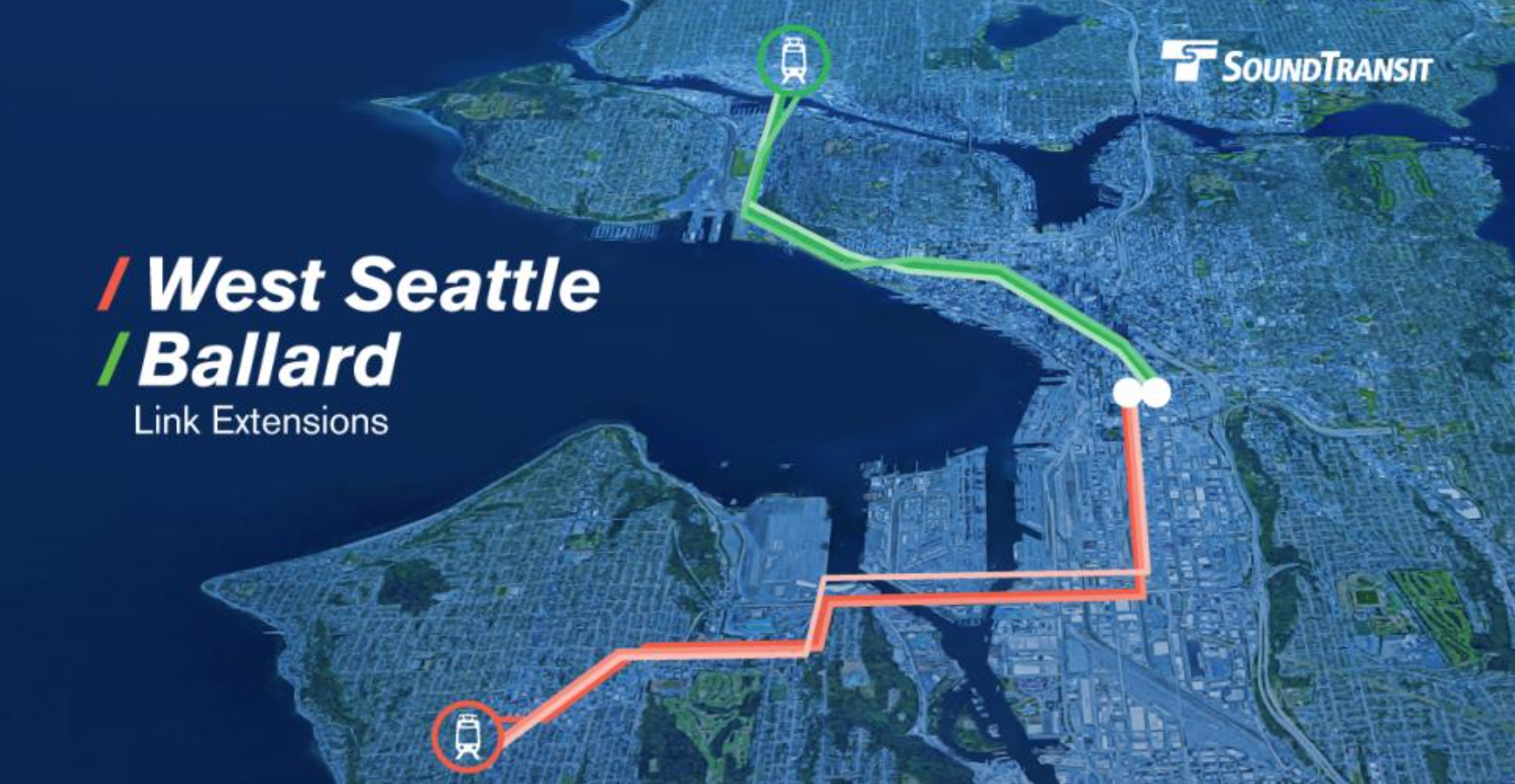
Building the Ballard Link Extension project without its downtown tunnel component was put forward this past summer by King County Councilmember Claudia Balducci, who argued that the agency should study the idea of instead utilizing the existing light rail tunnel to handle future increases in train volumes. The move was in reaction to the revelation that Ballard Link had jumped from the previous price estimate of $11.9 billion to upwards of $22 billion.
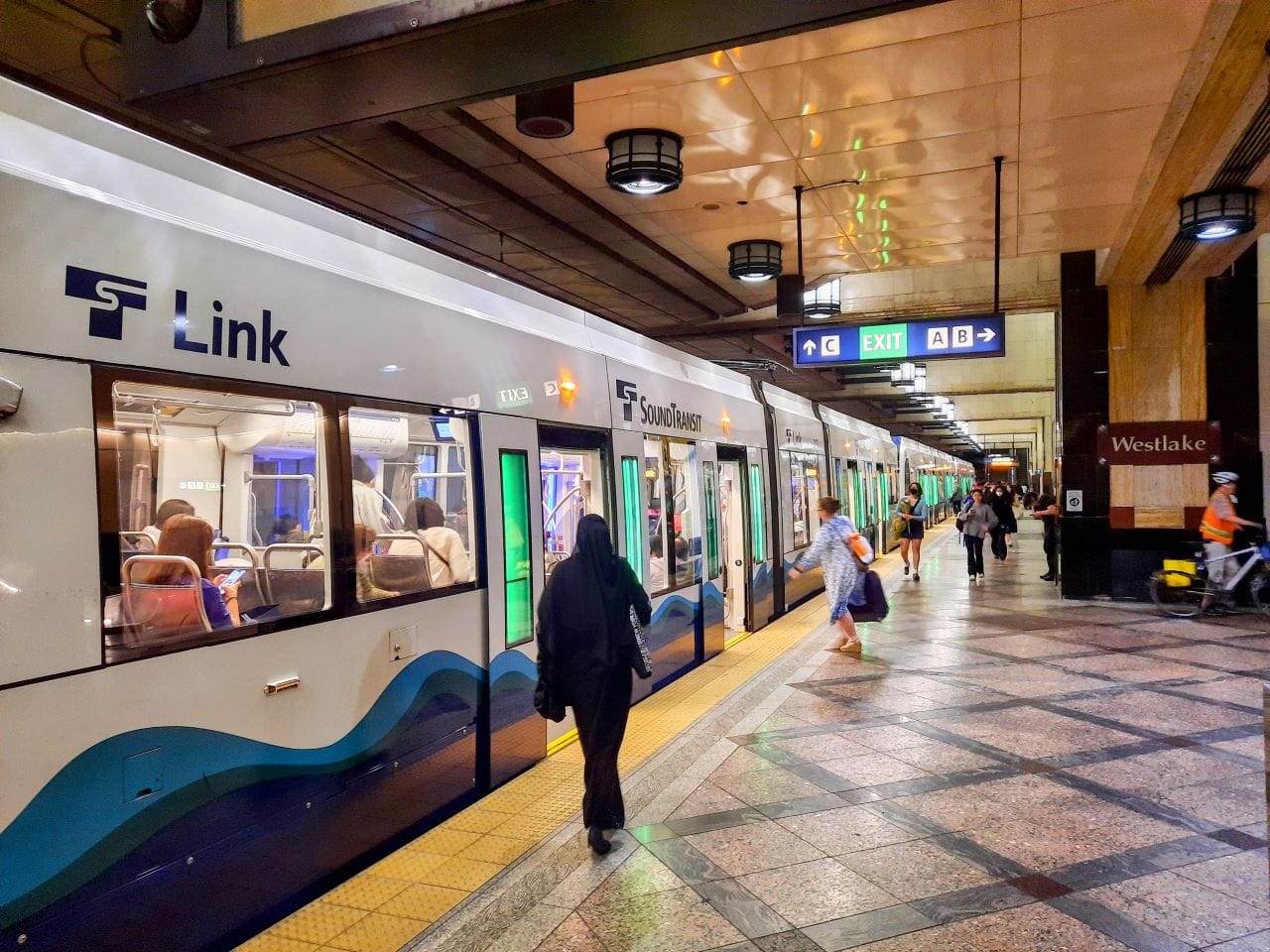
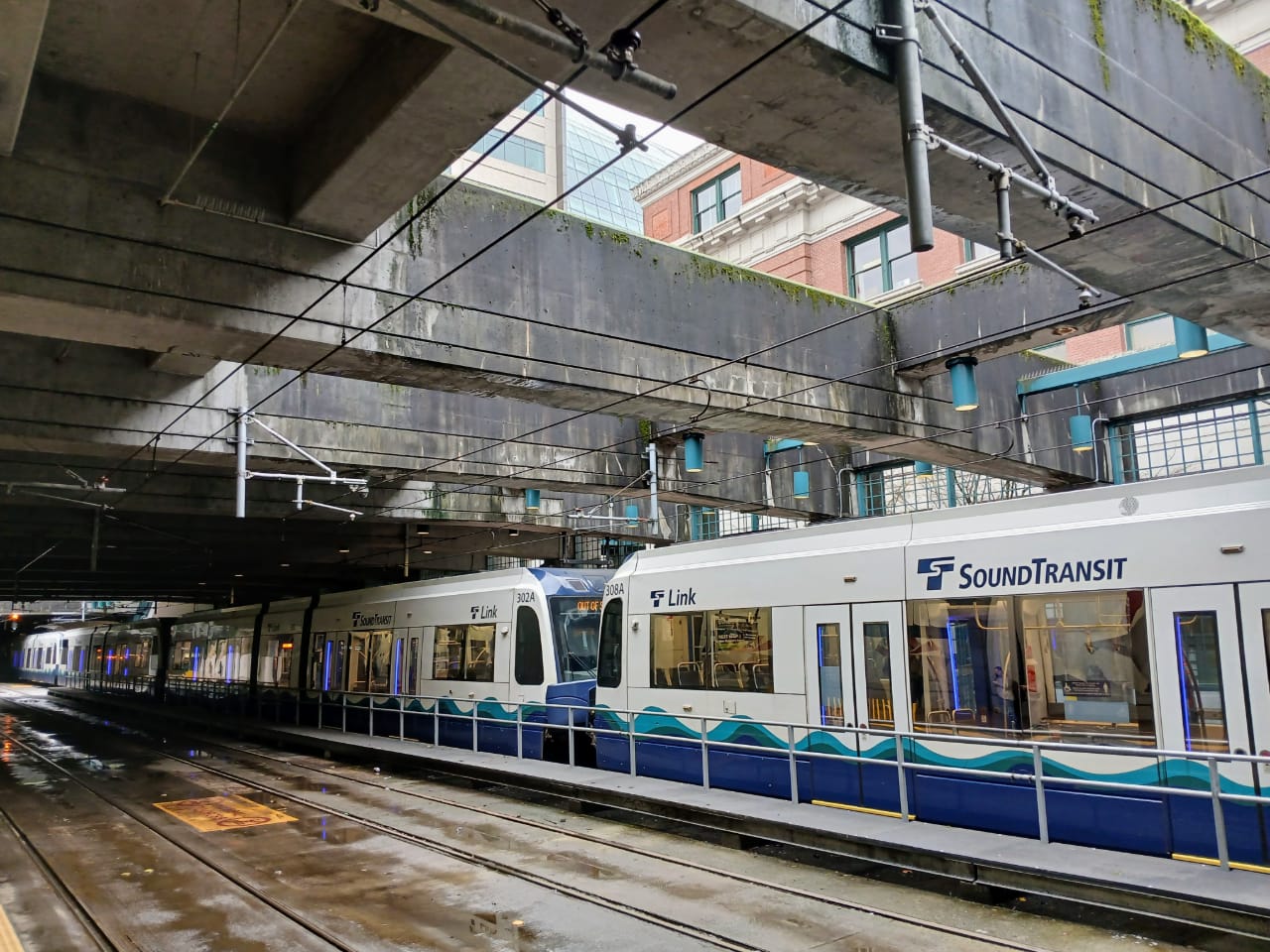
The agency determined the tunnel, which opened in 1990, needs extensive ventilation upgrades and upgraded tracks and platforms to be able to handle more trains, cutting into savings. While fitting a third light rail line in the existing tunnel would certainly be a heavy lift, it could save the agency enough to avoid having to push off other elements of the planned system by years, or to truncate lines well short of where voters signed off on.
Agency staff briefed the board on two distinct options to deliver Ballard Link without a second downtown tunnel, but a plurality of board members concluded that both of those paths were too risky to spend time studying further. The two paths are an “interline option” connecting Ballard line directly into the existing system somewhere between Westlake and Symphony Stations, and “a stub-end option” building a fully independent rail line between Ballard and Westlake, where Ballard Link riders would be forced to transfer.
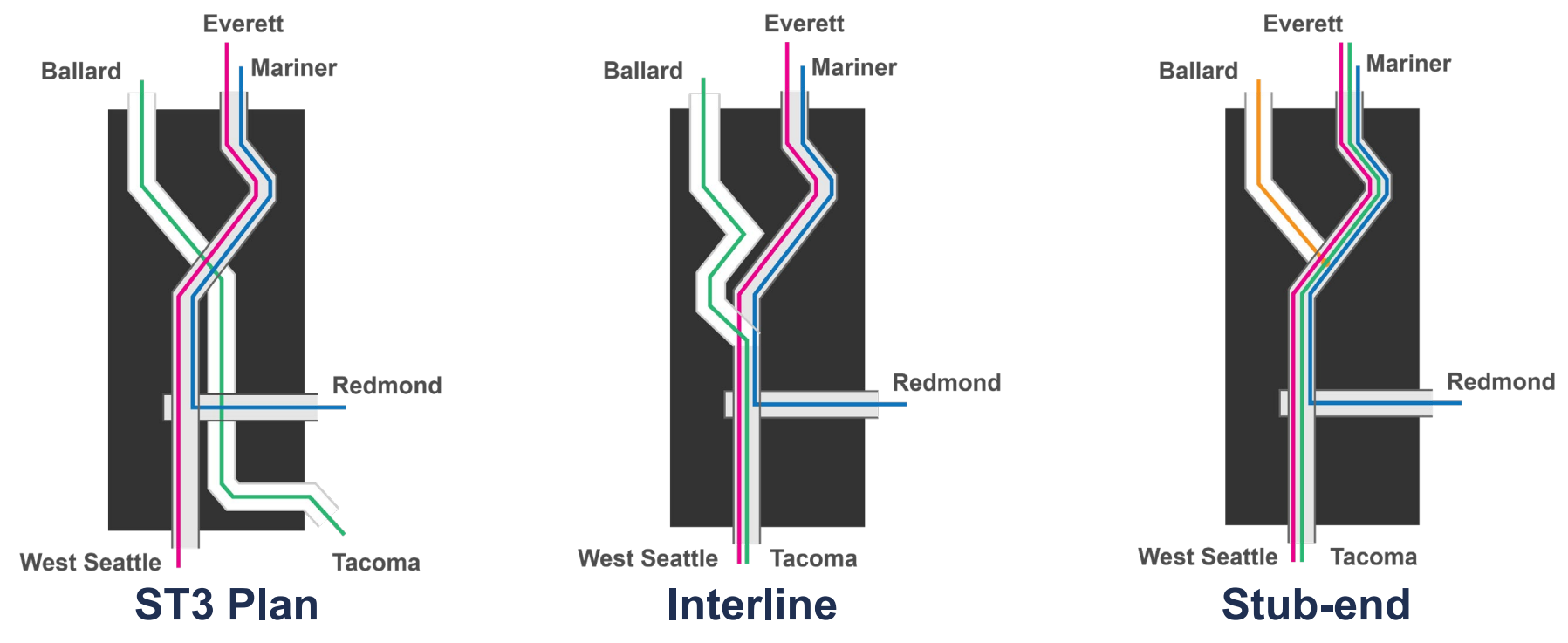
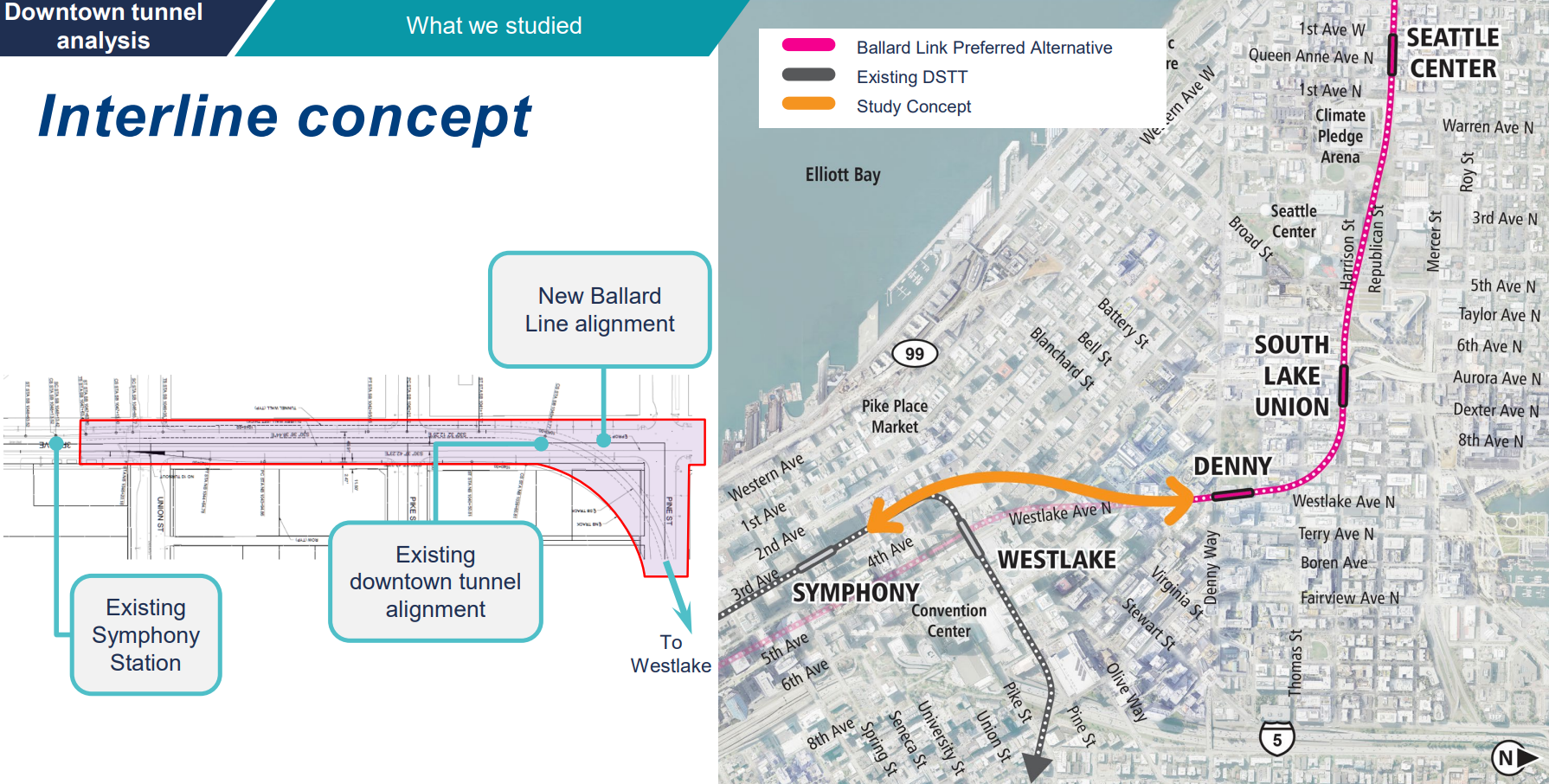
The interline option would mean major construction disruptions in the existing downtown tunnel (and the Third Avenue bus mall overhead) while the new underground interchange is built west of Symphony Station, tying Ballard Link into the tunnel. Across the existing tunnel, station platforms and vertical circulation would also likely need to be beefed up to handle three lines worth of passenger flow.
Inexplicably, the issue of the second tunnel has been treated as a separate issue from the overall Enterprise Initiative, an agency-wide process underway to uncover cost savings and efficiencies across programs to rebalance the long-term budget. Rather than getting a full vetting in the board’s System Expansion committee, where other cost savings measures are being reviewed, the proposal was instead sent to the Executive Committee, helmed by Board Chair and Snohomish County Executive Dave Somers.
Somers pushes to kill single tunnel concept
Somers is clearly eager to leave the discussion in 2025 so that the board can move on to other cost-savings options that will likely be more straightforward — though some other ideas could prove politically fraught as well. Decisions like building just one light rail station in West Seattle, at Delridge Way, or stopping the Ballard Line well short of Ballard, in Smith Cove are likely to come in front of the board next year, as they consider different scenarios to get its long-term financial plan back into alignment.
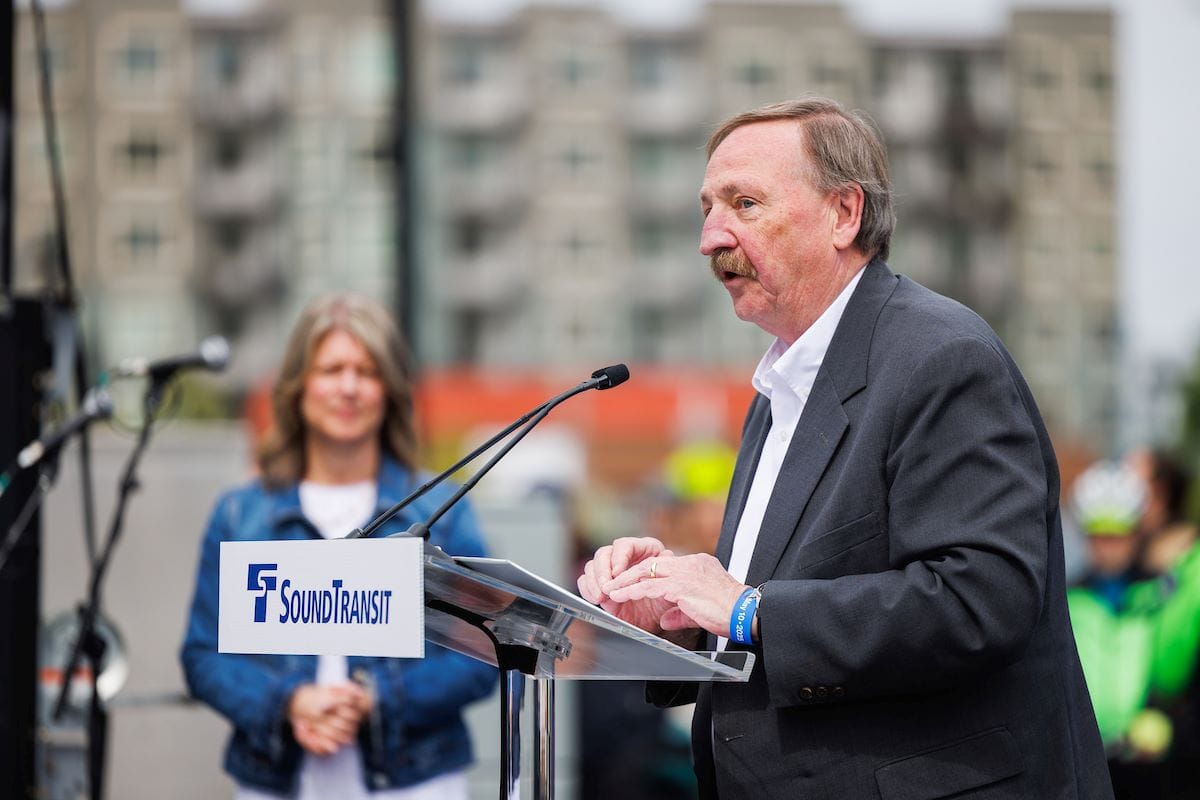
“I was also hoping we’d have a sort of a solution, or a significant solution, but at the end of the day, our best case assessment at this point is we could save $4 billion to the system, not an insignificant amount of money, but we’ve got a $32 billion systemwide issue that we’re trying to face,” Somers said. “I’m quite concerned that everything is going to stop, that the projects that are in environmental review now that have been based on the ultimate ST3 package that was passed by the voters 10 years ago — Ballard [Link], Everett Link, Tacoma [Dome] Link, everything else we’re doing in the ST3 package — those environmental process reviews and the discussions we’ve been having with the public have been around the plan we decided on 10 years ago, and changing that would be a big reset button in the environmental process.”
But Balducci pressed other board members to not give the idea short shrift, calling out the fact that this issue is being considered separate from other ideas that will help to reduce costs.
“Nobody proposed to walk away from the second tunnel or to consider doing so just because,” Balducci said. “We have some really tough decisions that are going to be placed on the table for us in a few months, and when those tradeoffs come I think it’s important for us to have all the scenarios in front of us, even if we reject some of them outright. And so, the idea that we’re going to stop considering something now seems odd to me.”
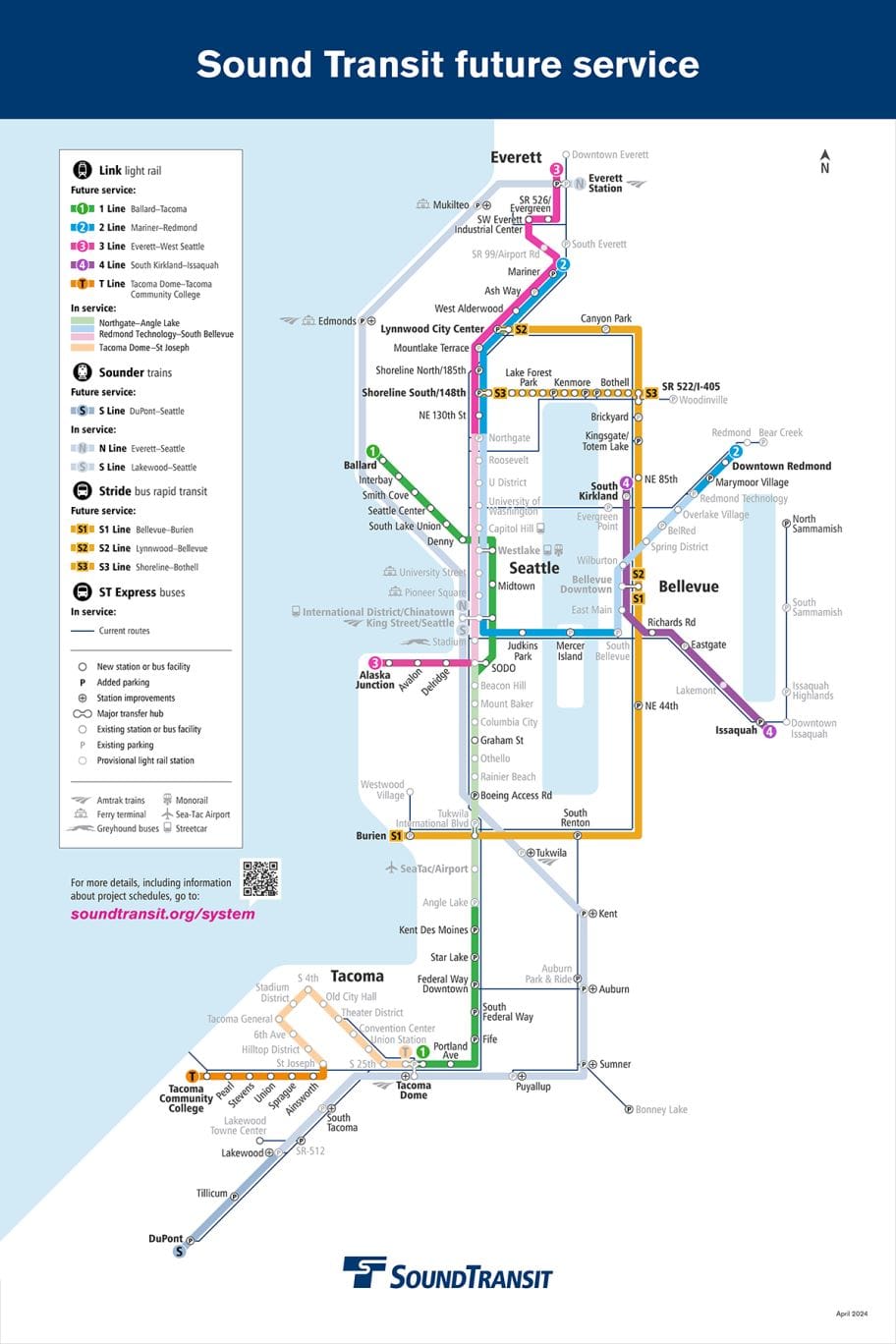
Balducci also noted that Sound Transit hasn’t fully grappled with what it will take to upgrade the existing downtown tunnel to handle more service — with or without a second tunnel.
“In a scenario where we defer or don’t build a second tunnel, we’re going to have to upgrade that tunnel anyway. We don’t know when. We don’t know how much. It’s not planned until the 2040s and it may be needed well before that. I’m just saying there are a lot of questions and tradeoffs we have not delved into, and that’s, I think, unfortunate,” Balducci said.
In contrast, numerous other boardmembers greeted the idea of opening up light rail alignments that are already under environmental review as untenable. That approach would essentially lock Sound Transit into the alignment decisions that it’s already decided to advance. Reopening the Environmental Impact Statement (EIS) process for Ballard Link would likely cost the agency another two years, staff said.
“I’m concerned with any further delay. I do think we need to move forward with both tunnels,” Everett Mayor Cassie Franklin said. “The risk here is that the delay will eliminate any savings. And I obviously am very concerned with anything that’s going to delay the completion of the spine, and I do fear that delaying this will harm the Everett Link. Because those delays, we all know, always costs money. It also reduces resiliency, and that’s resiliency is needed for the entire system.”
The idea that a major revision to Ballard Link would delay environmental review timelines for Everett Link (a project 20 miles away) seems far-fetched at first blush. On the other hand, the Trump administration may be looking for any excuse to throw a wrench in Washington state projects, given its history of punishing Democrat-run states and rescinding federal transit grants.
Cost-sharing debate for tunnel costs
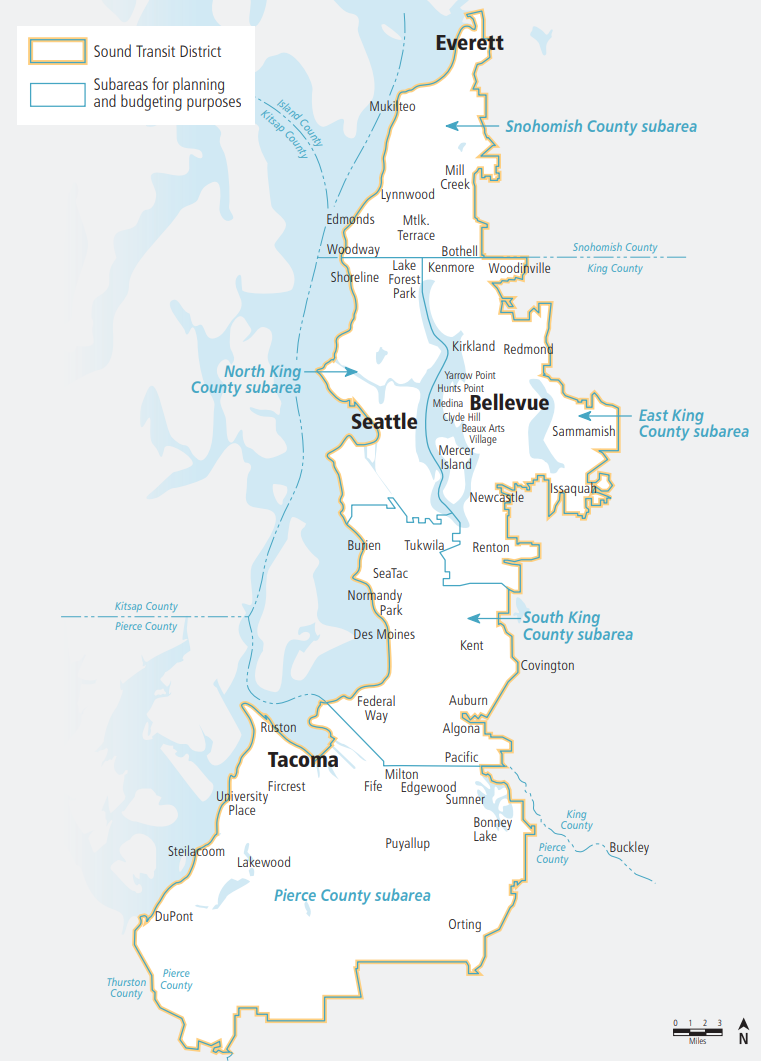
One major legacy of this month’s single-tunnel exercise is likely to be a re-examination of the cost-sharing mechanisms currently in place to pay for the downtown tunnel, due to its status as a regional asset that helps maintain that resiliency for the system. Currently, the North King subarea within the Sound Transit taxing district, which includes Seattle along with Shoreline and Lake Forest Park, is set to pay for 51% of the cost of the tunnel, based on expected ridership after all of the lines are built out.
But if transit riders inside the city would be able to make do without a second tunnel more than riders outside the city, those assumptions might get a second look.
“This presentation highlights that we can connect Ballard and West Seattle to the spine without another tunnel. Do I like it? No, but it is better than not getting to West Seattle [and] Ballard,” Seattle Councilmember Dan Strauss said. “This tunnel study demonstrates to all of us that the second tunnel has a greater impact on the region than it does for the North King subarea. If our North King subarea is responsible for 51% of the cost of this second tunnel, we need to keep this study in mind in order to balance the subarea financial plan. Said another way: if the region makes the decision that this second tunnel is needed for regional reliability, then the cost-sharing percentage needs to change.”
Seattle Mayor Bruce Harrell, attending his last Sound Transit board meeting before handing over his seat to incoming Mayor-elect Katie Wilson, also brought up the issue of shifting the costs of the tunnel onto the rest of the region.
“Everyone in this room hates a delay. Delay is a bad thing. I think we all understand that. But from a process standpoint, I don’t see how we can have a discussion about the 51% underlying assumption without this discussion, and I think that my successor and the new board members are going to have to have that tough conversation on this 51% assumption, that Seattle will be responsible for the construction cost as Seattle continues to put a lot of resources and time behind trying to address the $30 billion elephant in the room,” Harrell said.
Yet with only two board members directly representing the City of Seattle, convincing a board majority to willingly shift costs that have already been pinned on one segment of the system will likely be a very heavy lift, especially when it’s seen as hindering areas of the system that do not yet have light rail service.
All of these discussions are likely to come to a head in the wake of a daylong Sound Transit board retreat, penciled in for sometime next spring. While dropping the second downtown tunnel may not officially be on the table during that process, the ripples of this month’s debate will likely remain.