People experiencing homelessness face huge hurdles to owning a pet and navigating social services.
A kitten, 10 weeks old, under two pounds, sleeps; my toe a pillow for her head. With her eyes closed, I can see her as a newborn, still blind. Her chest rises and falls, the smallest bellows stoking a fire that would be snuffed without my care and my warmth. Michelle, my girlfriend and I adopted Ellie, this kitten, recently.
When we arrived at the shelter that day, a man who looked dirty, distressed, and desperate stood outside, kept away from the door by a crowd of shelter staff. The one security guard, twice the man’s size, did most of the physical blocking. The man’s shouts were responded to with soft, understanding condescensions from the rest.
He wanted his dog back, something he turned to us and said while we were being ushered past to our scheduled appointment. “Careful about adopting from here, they’re gonna steal back your dog and give it away to someone else.”
“His neighbor, well, not really neighbor, they live on houseboats, complained to us a third time,” we overheard a shelter staffer – whose job seemed to be looking over other people’s shoulders and gossiping on the phone – say while we waited for our turn at the solo-staffed adoption processing desk.
Most of the other staff seemed to be taking shifts blocking the man from entering and reclaiming his dog. “It was a complete sty when they got there; I’m just glad the dog’ll be going to a good home soon.”
And so, after this inconvenient delay, Michelle and I, employed and clean, walked in and back out with a cat.
—
This contrast in our experiences – our ease in gaining a pet; the man’s hardship in losing a pet – is but one example of the many ways that the poor, the underhoused, and the homeless are systematically denied a key part of living in Seattle, or just living at all: pet ownership.
Ellie is in fact our second cat. Our first cat, Paprika, is a large and beautiful “buff” orange cat. She’s highly emotionally intelligent and very social, often chatty. Her presence has always been a blessing. Ellie’s new life breathes energy and possibility into our home as well. Seeing Paprika come and lie next to this baby embodies our hopes for a harmonious household.
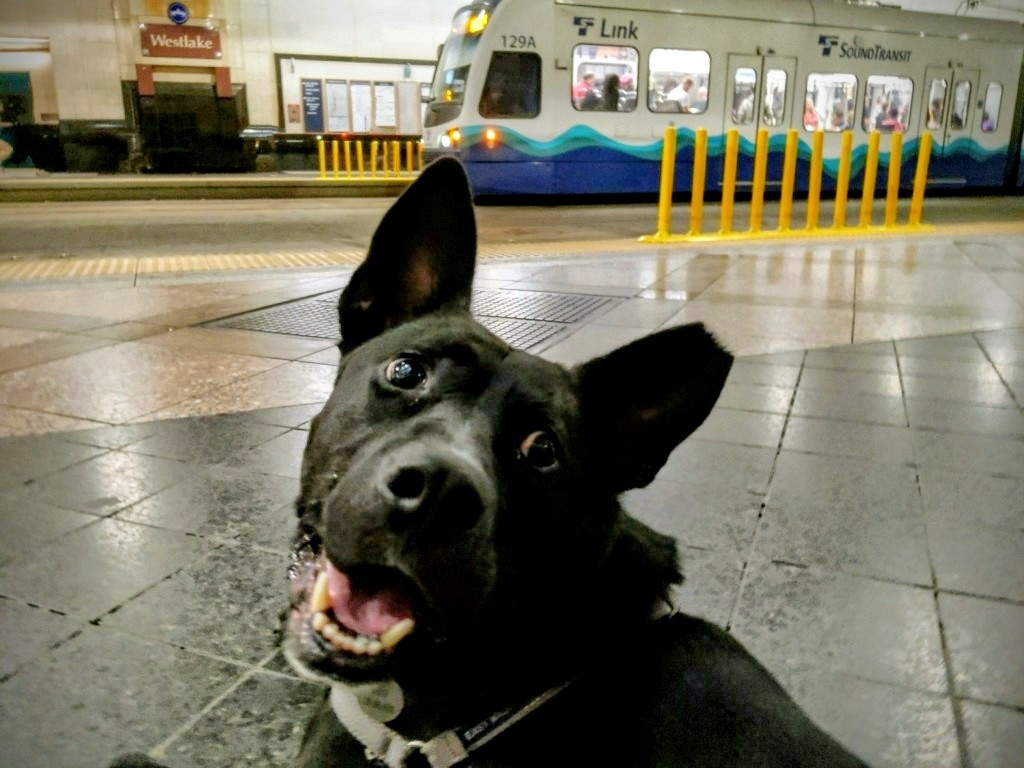
I mention all of these soft joys and comforts to say that without them, I do not believe I am able to live fully. The companionship of a pet is as necessary to many people’s lives and happiness as having a human partner. And Seattleites agree on the importance of pets, especially dogs. There have been more dogs in the city than children since at least 1997. And this pro-dog stance is officially endorsed. The ferries allow leashed dogs everywhere except for the food galleys, and Sound Transit recently announced that new rules were coming to allow leashed dogs on the light rail. All these to enable the connection between humans and their furry companions – so long as you are clean, employed and housed.
But the need for companionship is more important to many people than having shelter. A study of Los Angeles’ homeless population found that 22% of homeless people say that they avoid shelters because they know they won’t be able to keep their pet – 48% of pet-owning homeless people say they have been turned away from shelters because of their pets.
Why can’t homeless people have pets with them in shelters? Most homeless shelters aren’t equipped to house pets. They don’t have the space, the facilities, or the resources to care for and keep pets safe. In Seattle, few shelters offer the ability for a person and their pet to stay together – and those spaces are limited.
It’s even harder for unsheltered people to get pet food. Very few food banks provide it, and the ones that do provide pet food one or two days a month and require advance registration to guarantee available supplies. Otherwise, a pet owner could end up standing in line for hours only to be turned away after the two-hour pet food giveaway window. The closest always-stocked pet food banks to Seattle in Kent and Shoreline.
Veterinary care is also expensive, and much like human health, prevention is much cheaper than treatment – especially when it comes to neutering and spaying pets. Seattle Veterinary Outreach is a nonprofit organization that offers free pop-up vet clinics eight times a month. Hosted from 10 a.m.-2 p.m. across the city, there are no locations between Phinney Ridge and SoDo. People who don’t line up before 9 a.m. do not get seen. If you are homeless and seeking the bare minimum of a life with dignity and companionship, be prepared to travel far and wait long.
How do we fix this? With the targeted spend of state funds. California started the Pet Assistance and Support program in 2019, allocating $5 million for retrofitting homeless shelters with pet accommodations. The state awarded funds to 30 shelters. In 2023, it renewed funding with an additional $10 million to expand the program to new shelters and continue support of participating shelters with repairs, pet food and veterinary services.
Washington should implement a similar program. Seattle, King County, and the state continue to throw money at patchwork attempts to get people off the streets and into shelter. . Part of the problem is offering people shelter and services that do not meet their needs. If 22% of the unhoused population refuses to accept shelter because their pet will not be cared for or, worse, separated from them permanently – like the man we saw at the shelter screaming and crying in front of a crowd of well-meaning civil servants – how can our government continue operating a system that could be shutting out a fifth of the people they claim to serve?
Maybe this man was a bad owner. Maybe his home was unsafe. Maybe he wasn’t able to afford to take care of an animal. All I know is that his neighbors complained and people from the shelter, upon seeing the mess of his home, agreed that the dog should be removed from the owner, who was unwilling.
What if there had been more help and resources available to this man? Free dog food and vet care to keep his dog healthy, to remove any financial burden, and the certainty that should things get tough, he’d be able to remain with his pet? I don’t know. But I do know that in the face of claims of being a “bad owner,” he cared for his dog, and he was not allowed to have it.
Make Seattle a dog city. For everyone.