

The new mayor also issued an executive order seeking to expedite Seattle’s emergency housing production.
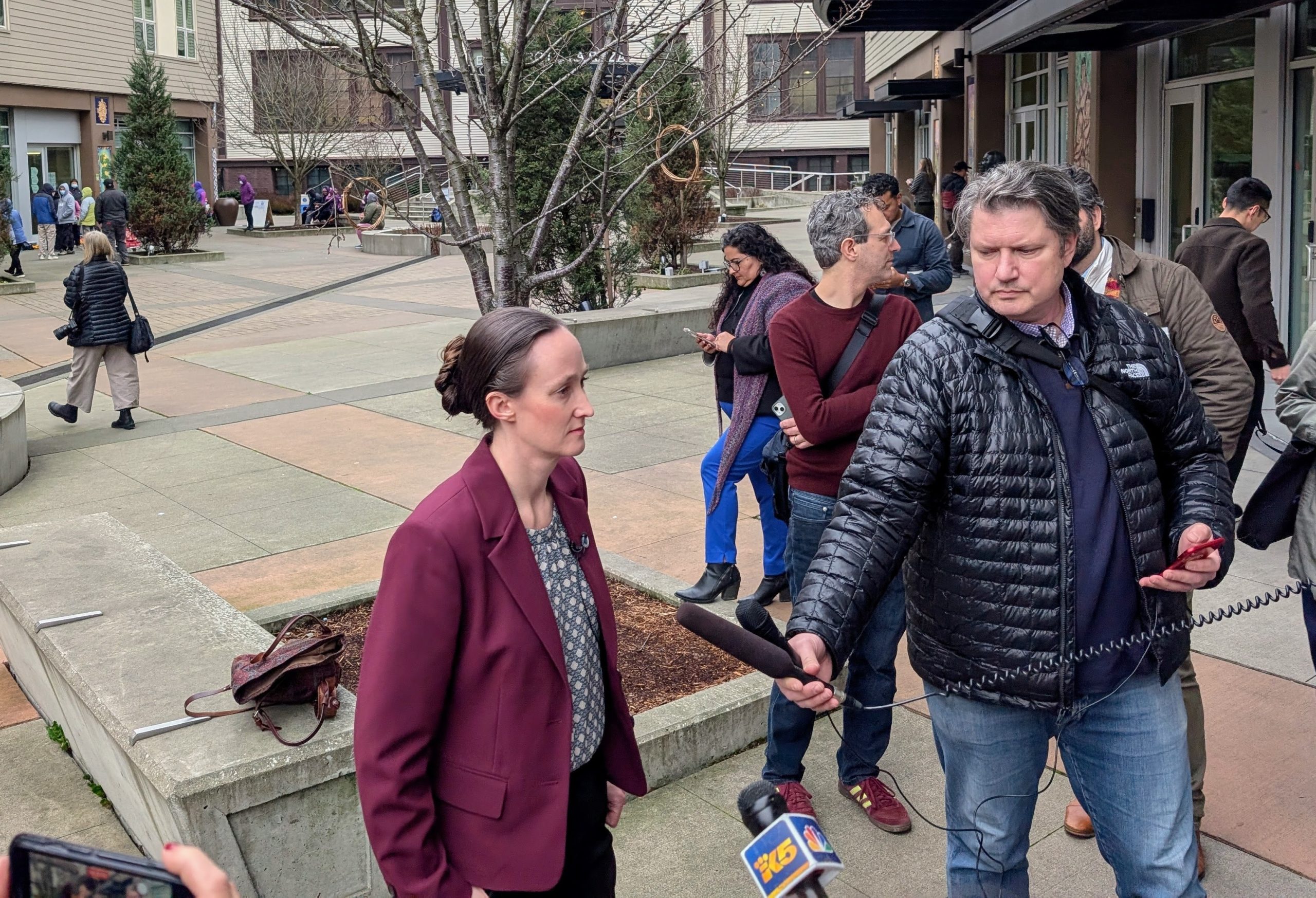
Seattle Mayor Katie Wilson rolled out two executive orders on Thursday morning, seeking to get two major initiatives rolling, two weeks into her term: expanding emergency housing to get homeless residents indoors and bus lanes to speed up the Route 8 bus.
“Seattle deserves world class public transit. Seattle voters have told us again and again that they want fast, frequent, reliable bus service. We cannot let one of our highest ridership routes consistently languish in traffic,” Wilson said. “That is not a good use of our transit tax dollars, and it’s not a good use of our time.”
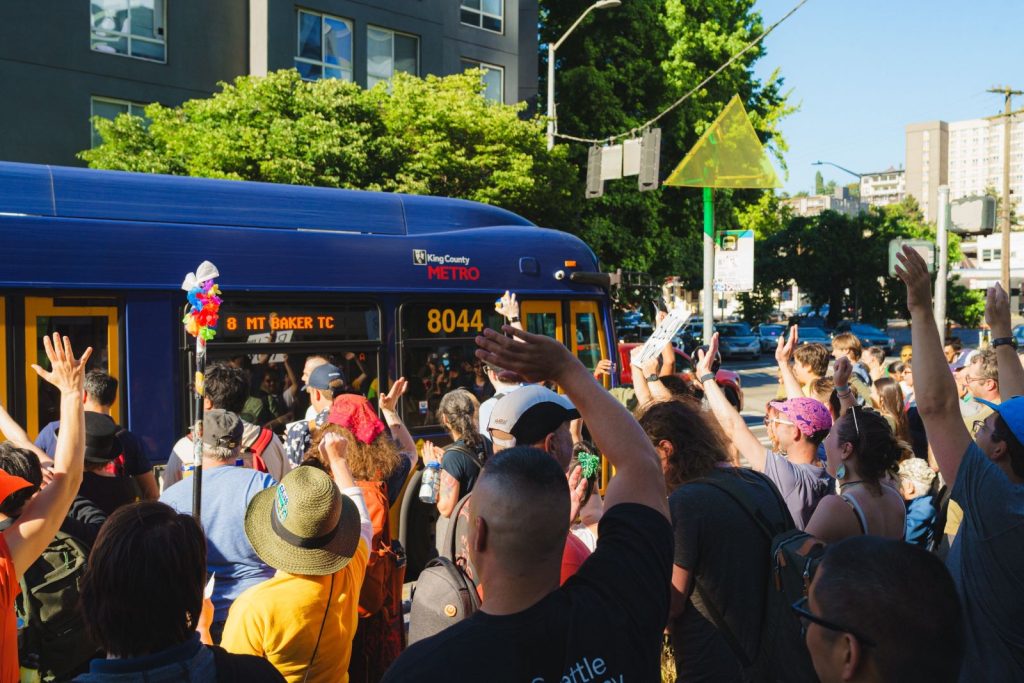
For Wilson, this issue is personal. Route 8 is one of the transit routes she relies on, and she participated in the Race The L8 event this summer, in which more than 100 advocates successfully raced a Route 8 bus on foot, some of them juggling, dancing, or hop-scotching along the way.
“As a transit rider and as a rider of Route 8, I know the feeling of waiting at the stop for the bus to come, and it’s 30 minutes late or 40 minutes late. I know the feeling of sitting on the bus knowing that you could be walking up that hill faster than that bus is going. So it is time that as a city, we take seriously what it takes to deliver excellent public transit for our residents, for our workers.”
In the press scrum, Wilson said she wanted bus lanes in the most congested section of Denny Way, from Dexter to Stewart Avenue, where advocates outraced a Route 8 bus on foot this summer. www.theurbanist.org/2025/07/22/b…
— Doug Trumm (@metropolitanglide.bsky.social) January 15, 2026 at 10:43 AM
[image or embed]
Route 8 is one of King County Metro’s most delayed and unreliable buses. Nonetheless, ridership remains high, since transit users have few alternatives to connect east-west between Uptown, South Lake Union, Capitol Hill, and the Central District. Despite its speed and reliability issues, Route 8 averaged more than 6,000 daily riders in 2025.
Wilson’s executive order gives the Seattle Department of Transportation (SDOT) three months to put an implementation plan together. She cited concerns about impacts to other bus routes (which include other high-ridership workhorses like the Route 62, Route 40, and Route 70) that intersect Denny Way as a factor behind conducting due diligence before slapping down red paint for bus lanes immediately.
“The bottom line for me is I want as much transit priority as possible, and I want it to work,” Wilson said. “We also need to figure out, with the other bus routes in that area, to make sure that we are improving the experience for all the riders in our system. We’re directing SDOT to return to the Mayor’s Office with a timeline, budget and implementation plan by April 17, along with recommendations for additional corridors where transit priority investments can deliver high impact benefits for riders and the city as a whole.”
In other words, the Wilson administration will be looking to replicate the “red carpet” treatment for other bus routes, hoping to improve service for riders in other parts of the city.
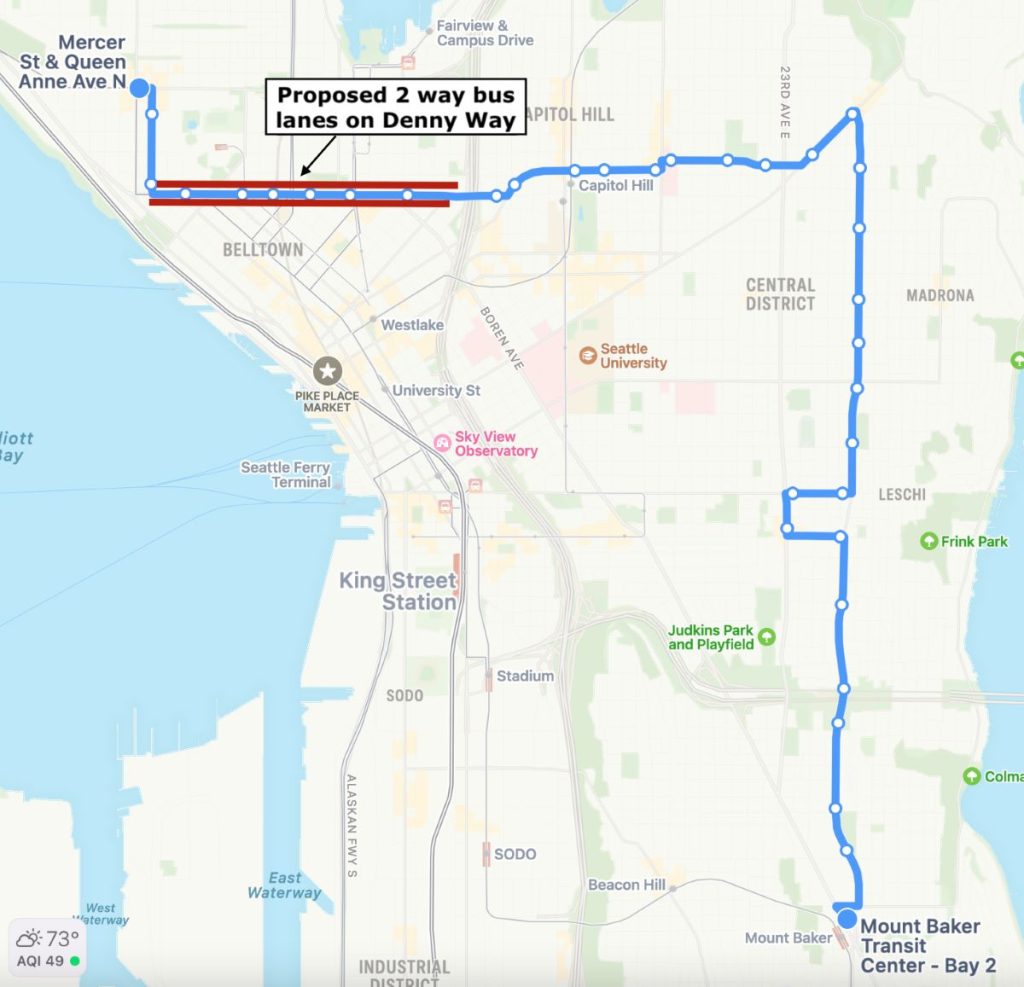
While the exact Denny Way plan is still to be determined, Wilson said an eastbound bus lane between 5th Avenue N and Fairview Avenue would be the “minimum” expectation, since that section is the “worst problem” for bus delays. Through that section, drivers attempting to get onto the I-5 ramps at Yale Avenue can back up traffic for blocks.
Jason Li and Nick Sattele from the Fix The L8 campaign were on hand for the announcement, and commended the mayor for taking action. The duo co-leads the group which advocates for Denny Way bus lanes and organized the “Race The L8” event this past summer.
We are beyond honored to have joined Mayor Wilson this morning to announce an executive order for bus lanes on Denny Way. We can't wait to finally Fix the L8 and see what she has in store for the next 4 years of Seattle's transit
— Fix the L8 (@fixthel8.bsky.social) January 15, 2026 at 10:17 AM
[image or embed]
The Harrell administration had sought to rule out the key stretch of bus lanes that advocates were pushing for, citing a traffic worries and a dubious traffic study with some questionable assumptions that Li and other advocates criticized. Wilson has already swapped out the SDOT Director who made that decision, Adiam Emery, for another interim director, with a national search planned for this year to find a permanent leader for the department.
“The previous administration, we had met with them, and the previous SDOT director was very clear that while bus lanes were definitely warranted for transit riders, it would be too difficult to do from a traffic point of view,” Sattele told The Urbanist. “[This decision] meant that bus riders would have to continue to sit in traffic, which obviously we were not happy about.”
Potential for ridership growth appears high with a faster, more reliable bus.
“There are more people walking and taking the bus than driving on Denny, despite the fact that the bus sucks,” Sattele said. “We know that there’s a lot of demand for this, and it’s in spite of the fact that the bus is so unreliable.”
Transit advocates, including Fix The L8, have launched a broader campaign called Better Bus Lanes that is seeking to roll out bus lanes citywide. Denny Way, Rainier Avenue, and Aurora Avenue were identified as three top-priority corridors to improve for riders. Li argued success on Denny Way could propel further interventions.
“This will be a really good litmus test,” Li said. “If this works, then there’s pretty much no road in the city where this won’t work… If this turns out really well, any argument people have for, ‘oh, we can’t do this on Broadway. We can’t do this on 15th [Avenue NW]. We can’t do this on more parts of Rainier [Avenue].’ All that falls apart because we can just point to Denny: ‘Hey, it worked here.'”
Wilson focuses the city’s homelessness response on bringing people inside
Wilson is also seeking to accelerate “efforts to rapidly bring people inside by expediting the expansion of shelter and affordable housing.” Her executive order convenes some stakeholders and resources toward that goal.
“Yesterday morning, I went to visit an encampment in Ballard that was scheduled for removal, and we’ve delayed that removal to determine whether we can find a better outcome for the folks who are staying there,” Wilson said. “The conversations that I had on site with folks who are living at that spot and community advocates and our Unified Care Team here at the City really underscored for me the message that I was delivering all of last year during the campaign, which is that we do not have enough shelter, enough housing, enough services. And the vast majority of our neighbors who are sleeping unsheltered on our streets, they want help.”
Her executive order lays out a number of efforts to boost shelter and housing production:
- Immediately launching an interdepartmental team to identify options for incentives, permitting changes, and other policy changes that can speed up the process of opening new shelter and housing in Seattle.
- Identifying and prioritizing city owned public land and working with other agencies and levels of government to identify other public lands which could be used to temporarily or permanently site new emergency shelter and housing.
- Coordinating with our regional partners to identify shelter programs that have the capacity to add units to existing programs, and
- Working with organizations with expertise in behavioral health to support substance use disorder treatment and mental health counseling for housing and shelter programs.
“We’re going to be moving aggressively, and this is the beginning, not the end,” Wilson added.
The mayor gave her remarks at the “mid-point meeting” of her 60-person transition team, which is conducting outreach and planning to guide her administration’s early moves. Wilson indicated she would be leaning on the leaders in the room to keep making progress on affordability and housing issues, across income levels.
“This is a continuum, and we need everything: We need more affordable housing. We need more market-rate housing. We need more shelter,” Wilson said. “Over the coming weeks and months, we’re going to be taking a lot more actions to get there, and we’re going to be relying on all of you for your expertise and your organizing to help us make that happen.”
While the City seeks to expand its available shelter and supportive housing, Wilson signaled intent to do modify policy around encampment removals, using that tool less often than her predecessor. Under Mayor Bruce Harrell, Seattle greatly ramped up camp removals, conducting a record amount of sweeps.
“I heard this all last year during the campaign, where there’s an intense level of frustration with an approach that moves people around without actually getting inside,” Wilson told reporters. “And I really think that business owners and residents understand that. They understand that we need real solutions, and not just moving people around.”
Some news outlets appeared focused on the encampment removal side of the proposal, and how it could enflame homeowners and business owners. That said, the Downtown Seattle Association (DSA) greeted the news with a fairly supportive statement.
“Mayor Wilson’s executive order is an important and welcome step toward breaking down the barriers that slow the delivery of affordable housing and new shelter in Seattle,” said Dennis Sills, DSA’s Vice President of Advocacy and Economic Development in a press release. “Creating a dedicated, interdepartmental team to cut red tape, reduce costs and speed up permitting sends a clear signal that the city is serious about addressing urgency with action. It’s important Seattle move from a bias for rules to a bias for housing, and Mayor Wilson’s announcement is a great first step towards this paradigm change.
The Downtown Seattle Association is looking for additional housing reforms, and has recently emphasized more housing downtown as part of its plans for economic recovery and activation.
“This announcement should be seen as a strong start, and we look forward to more reforms ahead that will speed up the production of all housing types across Seattle, while encouraging future housing financing and investment which is crucial component of developing more units,” Sills said. “Increasing housing supply at every level is essential to affordability, economic recovery and a more vibrant, inclusive downtown and city overall.”
Update: This article was updated with the statement from the Downtown Seattle Association at 10:15am Friday.

Doug Trumm is publisher of The Urbanist. An Urbanist writer since 2015, he dreams of pedestrian streets, bus lanes, and a mass-timber building spree to end our housing crisis. He graduated from the Evans School of Public Policy and Governance at the University of Washington in 2019. He lives in Seattle's Fremont neighborhood and loves to explore the city by foot and by bike.