

King County Councilmember Claudia Balducci originally became a bicyclist commuter for health and well-being. Within a year of moving to Bellevue from New York City, she’d already gotten a car, having given up on the public transit system. But she swiftly learned that even a bicycle wouldn’t cut it on Washington’s roadways.
“That will teach you a lot about how our system works and doesn’t work,” she told attendees at the University of Washington’s (UW) OpenThePaths2026 conference on February 27.
Held by the UW Taskar Center for Accessible Technology, the conference was meant to highlight the state’s first-ever nearly complete map of pedestrian infrastructure, OS-CONNECT, which maps the pedestrian infrastructure across the area where 90% of the state’s population lives.
The map
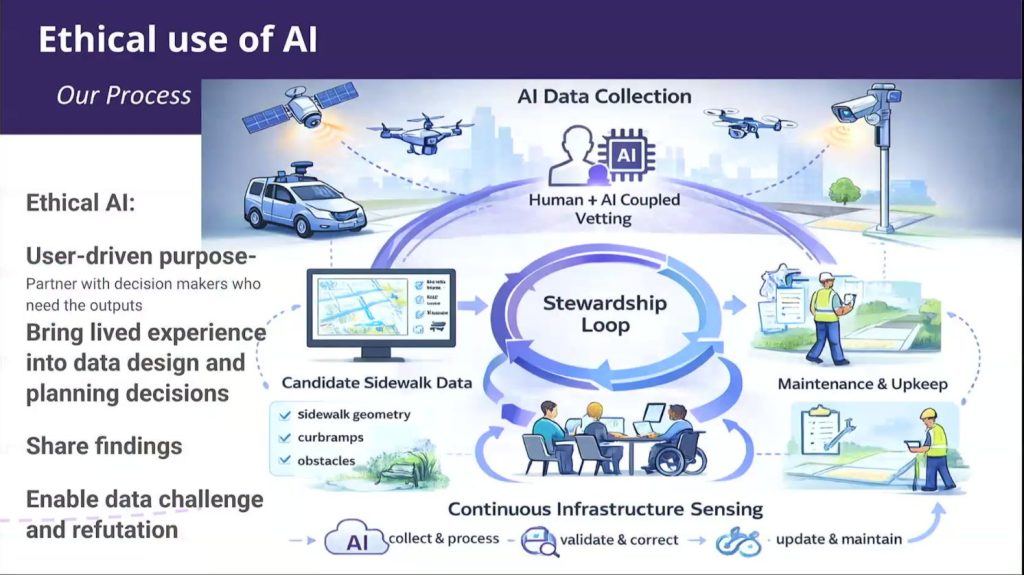
While AI created that map, humans vetted it — and in opening the second day of conference presentations, Taskar Center researcher Anat Caspi, the host and moderator of the conference, said that humans would be continuously responsible for vetting and maintaining the data shared. She said that the center had envisioned the constantly updated map as a platform to encourage buy-in from the public and center people walking, rolling, and biking. At the same time, the Taskar Center would share the vetted data with different agencies and providers.
“One of the biggest issues that we’re facing with this data, as well as other areas where low information has existed, is that it’s low-resourced,” Caspi explained. “We don’t have a single source to provide us with data just as it has been available for car travel, and so car travel becomes the only mode we know […] about, both in terms of ridership, in terms of who’s there, what are they using, what roads are being used, and how much. But we don’t have this kind of information collected and shared across all the different partners that support active transporters, and so that’s really the vision.”
Caspi acknowledged that many institutional barriers exist preventing policymakers from “really subscribing to that shared vision and open shared data that supports non-drivers.”
Legislative advocacy
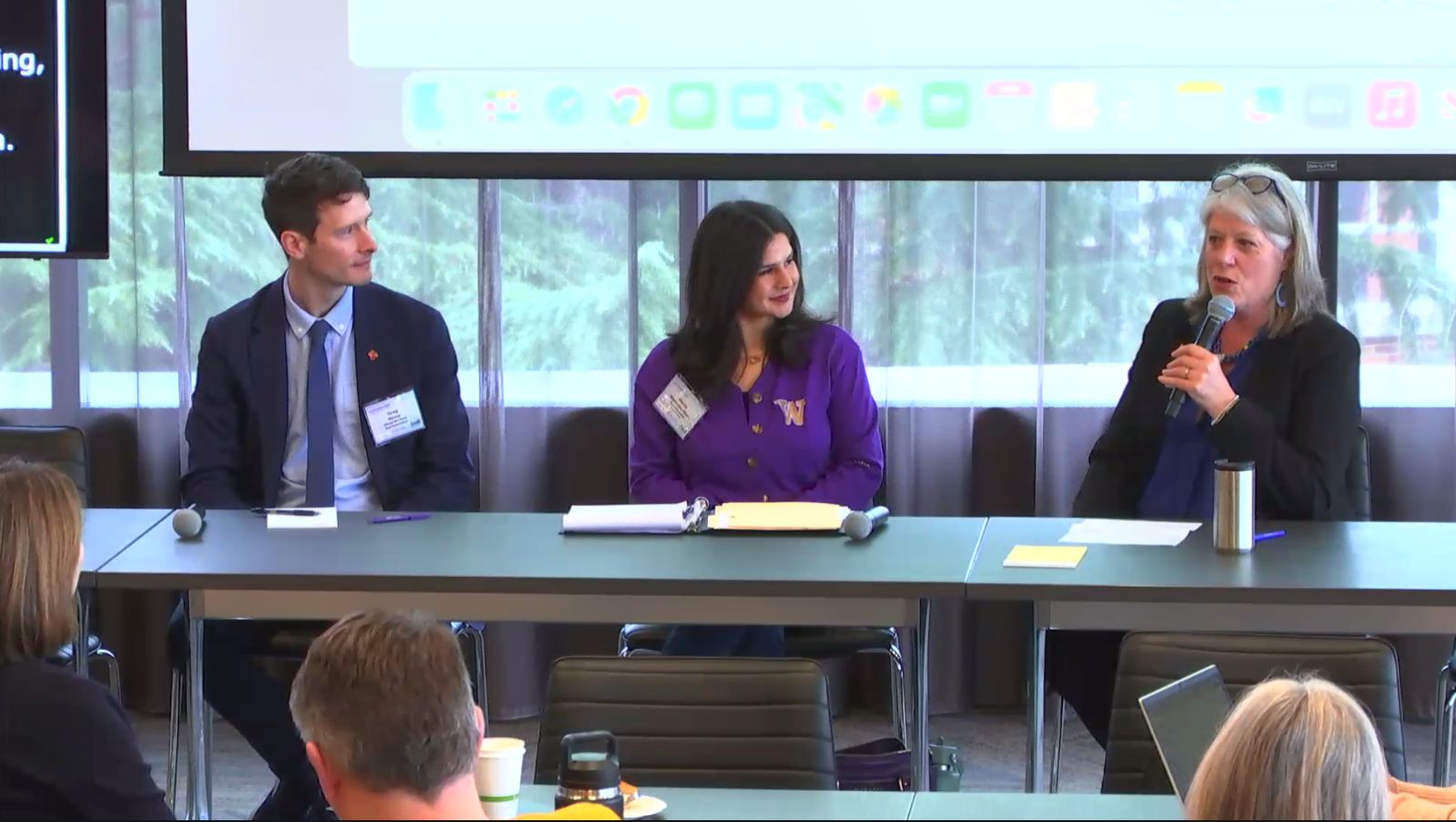
Balducci joined a morning panel alongside Seattle City Councilmember Alexis Mercedes Rinck and Rep. Greg Nance (D-23rd, Bainbridge Island), a sponsor of the Mosquito Fleet Act, which seeks to give local jurisdictions more tools to expand foot ferries. The trio, all of whom are pushing for accessible public transit in-office and in advocacy roles, covered a variety of topics, primarily focusing on how to get legislators to perk up, listen, and act on different community needs.
Rinck said that she’s among the 20% of Seattleites who don’t own a car, and who get around using public transit. But when does that 20% — or any percentage — begin to matter in public legislative discourse?
Balducci said that she believes it takes some sort of “forcing function.” She pointed to accessibility requirements as an example. Before ADA regulations, people with disabilities had very limited access to transit. Unfortunately, she said, it wasn’t the result of good intentions so much as a host of lawsuits, regulations and enforcement.
“Collectively, it takes a lot of pressure. I think that we need to maintain the focus on passing good laws. And that doesn’t just mean at the state and federal level, at the local level,” Balducci said. “We need to pass good ordinances that apply to our own jurisdictions that force us to then do the right thing and send the message to the entire organization.”
Rinck pointed out that change is hard in the face of a majority of people who still benefit from the way things are. She later highlighted that while policymakers care about data from the standpoint of funding decisions, that’s not the only thing that gets them to sit up and care.
“I would love if every policymaker looked at data and cared about data, but that’s not the way to do it. I want to emphasize how important it is to understand what drives your decision-making,” Rinck said. “Not everybody cares about data. They care about the re-election. They care about looking good. They care about whether or not they’re embarrassed to leave. Those are tools, too. That’s my very spicy take.”
“Sometimes,” she continued, “the thing that gets the decision-makers to do the thing we need them to do is, for a very silly reason, a silly rationale, but if we’re about really effectuating change, that is … a realistic tool in our toolbox.”
Nance agreed, saying that it’s extra difficult to get transportation bills the proper attention they need, especially with so many spreadsheets and numbers attached. What gets these kinds of pro-transit bills passed, he said, is story — personal stories about individuals, to put faces to those spreadsheets and numbers. It’s also important to personalize that data before getting too far along in the process, to head off any cross-aisle “shouting,” as Nance put it, at public meetings.
Community action
That’s where advocacy leaders like Paulo Nunes-Ueno and Kirk Hovenkotter come into play, which made their panel following the elected leaders well-timed. At the conference, the pair of transportation advocates presented the Megaproject For Safety, a roadway safety initiative that Transportation Choices Coalition (TCC) spearheaded. Hovenkotter is the executive director of TCC, while Nunes-Ueno runs his own transportation consulting firm.
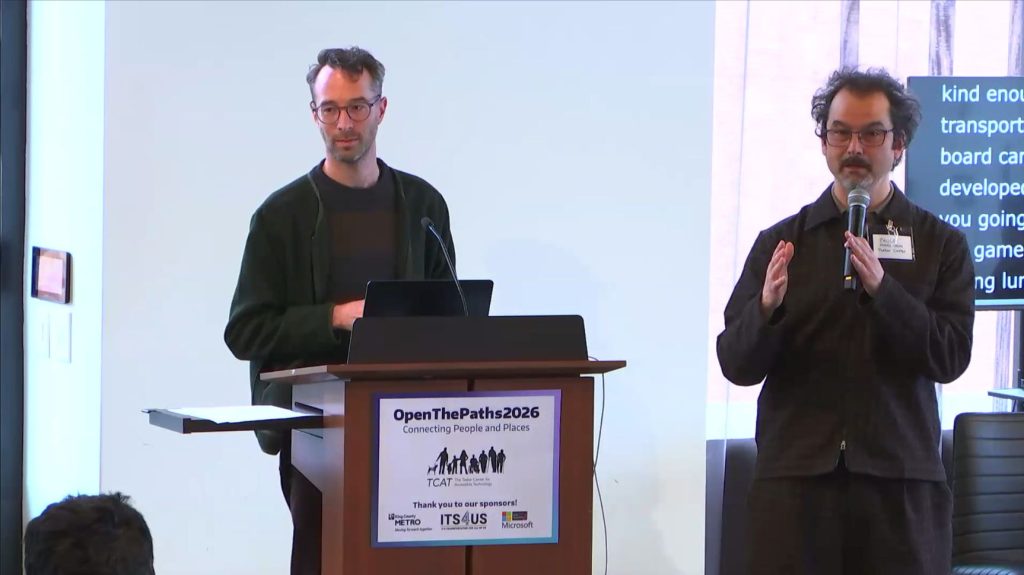
The initiative calls for dedicated state funding to prioritize making the state’s most dangerous roads, many of which are state highways doubling as main streets, safer. The coalition’s webpage states that new money — which a measure like a road usage charge could create — would fund the initiative.
“I also want to use this as a moment to talk about how you can keep and build momentum around an idea like this. We all know there’s great ideas or a dime a dozen, but it’s how you organize and how you put pressure on decision makers and bureaucracies to be able to get them done,” Hovenkotter said, before outlining the project for attendees. “That’s the conversation that I really want to have with Paulo and with you all in the room today.”
2023 was Washington’s deadliest year for traffic deaths, marking a 33-year record high. Of the more than 800 people who died, 160 were pedestrians. 2024’s numbers were nearly as grim, with more than 730 people dying in traffic crashes, 155 of whom were pedestrians.
Every municipality has its known danger roads, Hovenkotter said, and listed a few of them — Aurora Avenue in Seattle, Pacific Avenue in Tacoma, Division Street in Spokane, and U.S. 2 in Monroe. The problem is not just that they persist, but that, as cities and towns overhaul their zoning codes to allow for more middle housing as required by state law, the surrounding streets will get increasingly worse at meeting residents’ needs.
“I can promise you almost 100% of the properties along these roadways are going to be upzoned for new housing,” Hovenkotter said. “And the ask that we have is, ‘If we’re going to add new housing here, how do we make the roads that this housing is going on places we can be proud of, places that are easy to walk and get to these destinations and get to these homes? They’re not the roads that we know they need to be to be the homes for so many more people in our state. But we know that our state can do big things when it puts its mind, money, and might to a problem.”
Hovenkotter pointed out that the state has no problem committing both billions of dollars and decades of time to infrastructure like floating bridges and freight. So why not commit similar resources to pedestrian safety along Washington’s major roadways?
Hovenkotter said that in last year’s legislative session, following former Washington State Department of Transportation (WSDOT) Secretary Roger Millar’s call on the legislature to put $150 million per year towards funding safer main street highways, the coalition asked the legislature of $1.5 billion over the course of 10 years to fund those safer roadways.
“Last year, we were lucky to win $100 million committed towards these roadways in the [2027 – 2029] biennium,” Hovenkotter said. “It was a really exciting win, and this went from an idea at the beginning of session to something that had $100 million committed to it.”
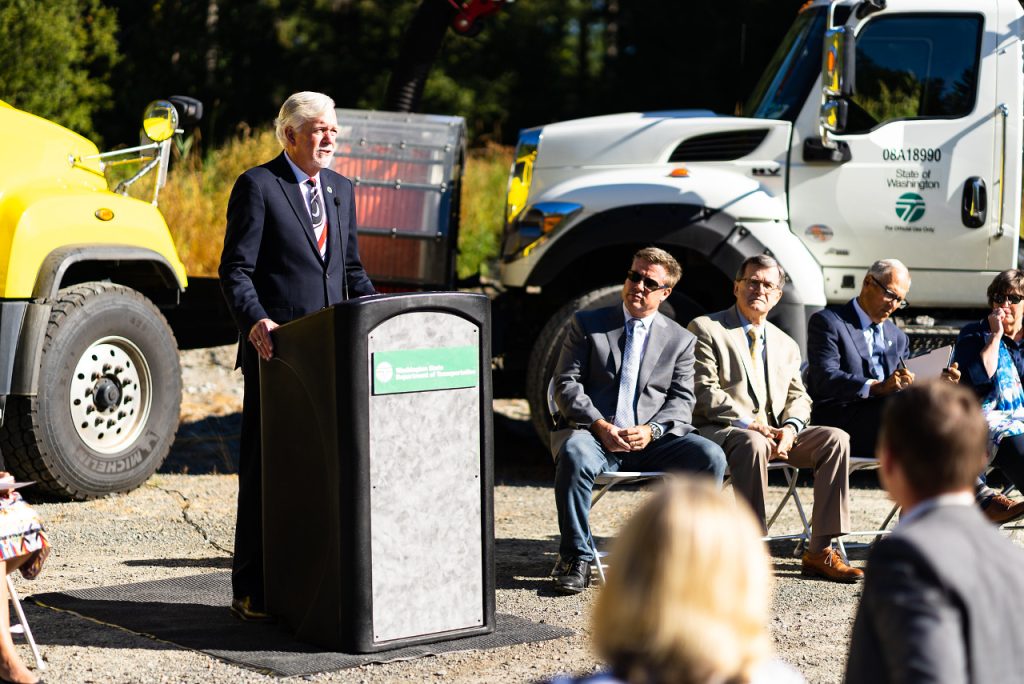
During the question and answer session, Barb Chamberlain, WSDOT’s director of active transportation, offered a slight correction. She pointed out that while Hovenkotter framed it as a win — and she appreciated that “advocates always have to say we had a win” — it was not, as she put it “new money” going towards those efforts, but repurposed funds already going to a similar purpose.
“It is within the preservation budget where we’re supposed to be doing Complete Streets work, so it’s money on specific projects, not on other projects. The real win would be new additive funding. ‘Additive’ is the key word here,” Chamberlain continued. “We want these transformational projects. We need new money to do transformative work, because you still want us to do the basic work — nobody gets across the river if the bridge is closed. No mode moves. So, ask for new money, when you are asking.”
She also highlighted that different agencies operate different roadways, and noted that there is a difference between roadway design and operation decisions and land use decisions.
“‘Wide and fast’ — those are functions of roadway design and operational decisions. … ‘Busy and complex,’ those are land use decisions. That is your city council or your county council,” Chamberlain said, indicating where residents could direct their advocacy energy. “What is the zoning? What is the anti-displacement housing policy? What are they going to do at the city level or the county level that means that the uses alongside the road and the design of the road work together? Because they don’t today. This is definitely not disputing the core premise, which is that we have a lot of car sewers [areas that are dangerous because of cars and car infrastructure]. And they need to be better. But just work all of the policy here, not only the transportation policy and not only the state. I think that’s my big takeaway.”
Another attendee, Jen Mayer, King County Metro’s equity and social justice capital implementation manager, agreed with Chamberlain about the funding, and said that she would love to see more interagency partnerships. While she acknowledged that sometimes these partnerships can mean long processes towards goals — she knows from personal experience — she also said it’s worth it, particularly dollar-wise.
“It would be way cheaper … all the different agencies are doing all sorts of stuff. Any time you dig dirt, I would like to have a model where we have a sidewalk SWAT team that says, ‘Oh, by the way, I saw you’re having a truck lay some ground here. Can you build some sidewalk along the side? Can you do ramps?’” Mayer said. “Can we be more opportunistic in our partnerships? Because it’s a lot of money to mobilize for sidewalks and ramps and crosswalks. But if somebody’s already mobilizing in that area, it’s way cheap to give them a little more money to do the work that we want to see get done. … I’d love to have more partnerships on the smaller scale as well as on the bigger scale.”
But, as conference speakers stressed throughout the morning, nothing changes without the public pushing for it.
Readers looking to get involved with transportation safety on a local level can check out organizations like the Seattle Streets Alliance, Tacoma on the Go, and the Transit Riders Union. Those looking to get involved at a state level can check out organizations like the Transportation Choices Coalition and Cascade Bicycle Club.