Examining urban policy to improve cities and quality of life.
  • Features
    • Spatial Planning
      • Architecture
      • Land Use & Development
      • Parks & Public Space
      • Plans & Policy
    • Transportation
      • Cycling
      • Driving
      • Transit
      • Walking
    • Economics & Politics
      • Economics
      • Housing
      • Politics & Government
      • Social Welfare
    • Culture & Innovation
      • Civics & Culture
      • Education
      • Environment & Sustainability
      • Technology
  • Video
  • Calendar
  • About
    • Organization Profile
    • Staff & Contributors
    • Comment Policy
    • Guest Contributing
  • Subscriber List
  • Donate
Data/HALA/Housing/Land Use & Development/Maps

A Year After New Microhousing Rules Went Into Effect, Neither Side Should Be Happy With The Outcome

by Ethan Phelps-Goodman on February 16, 2016

When the Seattle City Council passed new rules on microhousing in 2014, opponents had hoped to put an end to the small apartments, while advocates warned that the Council would be killing off one of the few sources of affordable new construction. Over a year after the new rules came into effect, there’s now enough data to evaluate the impact of the changes. Unfortunately, the results will likely be disappointing to both sides.

For opponents of microhousing, the rules failed to reign in development: about the same number of projects entered the pipeline in 2015 as the year before the rule change. But just as affordability advocates warned, the new projects no longer include the lowest priced units.

Prior to the rule change, there were two types of microhousing. The most common form, typified by the aPodment brand, consisted of up to eight individually rented sleeping rooms around a shared kitchen. An even denser model called “congregate housing” placed no maximum on the number of sleeping rooms sharing a kitchen.

The compromise reached in 2014 did away with the first model entirely and replaced it with a new category called “small efficiency dwelling units”. These units would have to be a minimum of 220 square feet and include a kitchen in every unit, among other new regulations. Congregate housing remained mostly unchanged in form, but could now only be built in commercial zones, not lowrise residential zones as before.

To evaluate the effects of these changes, I compared an official City analysis of microhousing development from 2010-2013 with permit data from 2015. (I left 2014 out of the analysis completely, since the City study that I rely on for pre-rule change data only covers through June 2014.) The map below shows all of the new microhousing developments for which permit applications were made in 2015.

Interactive map of 2015 microhousing projects. Click on pins to see project information and renderings. (City of Seattle and Seattle In Progress)

Perhaps surprisingly, the permit applications show only a minor dip after the new regulations. Applications held steady in 2011 and 2012 at exactly 12 projects per year, then doubled in 2013 to 24 applications. In 2015, Seattle saw 23 permit applications. The decline was slightly more noticeable in terms of total number of units: 2013 applications totaled 1,285 units, compared to 1,025 in 2015.
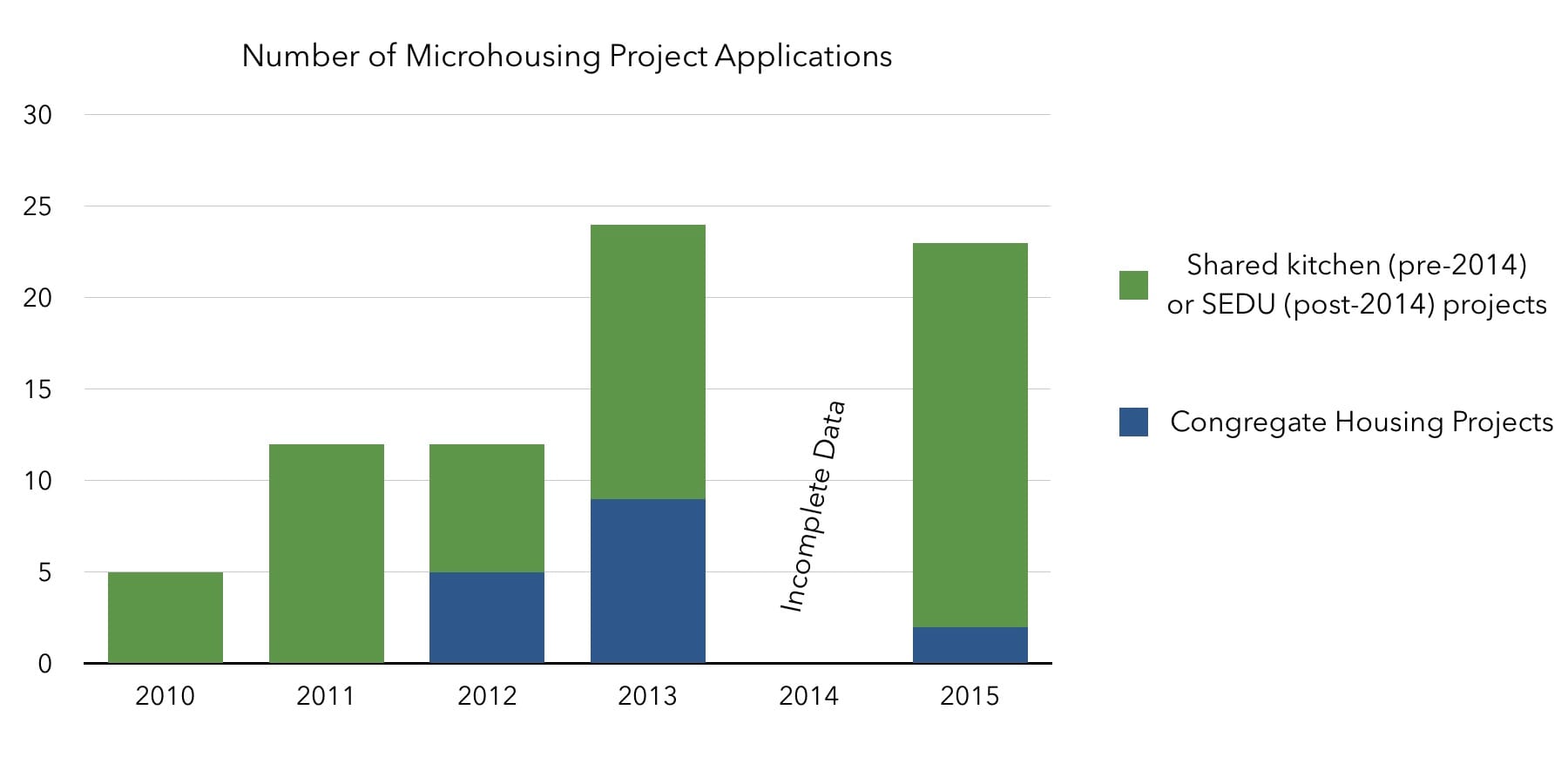
Microhousing development application data. Click to enlarge. (City of Seattle and Seattle in Progress)

These numbers don’t mean that the regulations had no effect, however. Applications for congregate residences, the densest and most affordable form of microhousing, dropped off from 9 in 2013 to just 2 in 2015, due to restrictions on where they can be built.

Plus, the 900+ small efficiency dwelling units applied for in 2015 must conform to the new requirements of an in-unit kitchen and a minimum of 220 square feet. It’s too soon to know rental prices on these new projects. But an analysis of six microhousing projects built under the old rules showed that the smallest units, averaging 160 square feet, rented for $785 per month, while larger units, averaging 246 square feet, rented for $954 per month. Since the new rules require in-unit kitchens and a more extensive review process, it’s reasonable to believe that the cheapest units produced under the new rules could rent for $300 per month more than the cheapest units produced under the old rules.

I asked David Neiman, an architect and developer who has produced microhousing before and after the rule change, what he thought of the new rules. “Our energy has been directed into producing housing that is significantly larger, more expensive and less plentiful than before — the exact opposite direction from where we need to be going,” Neiman said.

The Housing Affordability and Livability Agenda currently before City Council includes a recommendation to re-visit the new microhousing rules. “The industry was building 1,000 units a year of affordable housing…with no public subsidy whatsoever,” Neiman says. “We could get back there in an instant with the stroke of a pen.”

Facebook Twitter Tumblr Reddit Email 7
Previous Post

A New Transit Hub: Montlake Triangle

Next Post

CascadiaCast Episode 5: Cathy Tuttle

Profile photo of Ethan Phelps-Goodman
Ethan Phelps-Goodman

Ethan Phelps-Goodman is a civic organizer, software developer and data journalist. He runs Seattle in Progress, a web app that documents what's being built in Seattle neighborhoods, and Seattle Tech Workers for Housing, a grassroots housing advocacy group.

  • rossb

    Great research and great article. I agree with Neiman said — we really need to liberalize these rules to get more affordable housing. It is crazy that we went the wrong direction on this.

  • andrewbrick

    rein in.

  • Maureen O’Brien O’Reilly

    Ding-ding ding-ding….ok Seattle…sharing is caring or let them eat kitchens?
    Even at $15/hour that rent increase means >twenty more work hours.
    No good.

  • Brian S

    “The industry was building 1,000 units a year of affordable housing…with no public subsidy whatsoever,” Neiman says..

    Keeping everyone honest in what they state as facts: Remember that many of the projects that had community kitchens also double dipped and got long term property tax breaks as well before the city finally closed that loophole…..while it might be technically true that units got built with no direct public subsidy… the tax break was certainly a GIANT incentive for the industry and because each of those properties will be served by police and fire (services those buildings taxes are no longer helping to support)… they did indeed get a very large public subsidy. Just sayin.

    • Randall Spaan

      Micro-studios (a.k.a. “apodments”) penciled quite nicely without the 12-year KC tax break. (BTW, I hate that name & don’t know why anyone would actually trademark it! Who would want to live in a pod except two peas?) Anyway, “apodments” (or as I prefer, micro-studios) were being developed before one clever developer discovered that KC was willing to apply the break to a single sleeping suite in a micro-studio development as if it were a studio apartment unit. The tax break was just “gravy,” so to speak. The proof of this is that after the loop hole was closed the rate of development of micro-studios did not slow down; indeed, it accelerated~!

  • David

    When the single family protectionists and NIMBYs shed their crocodile tears about the lack of affordable housing, along with their faux-leftist denunciations of greedy developers, remember crap like this. They don’t actually care about affordable housing at all, as their actual policy preferences make clear.

  • Charles

    I’m going to be contrarian here in that I don’t think ultra small accommodations or forced sharing is the answer to affordability. I also don’t think the some of the regulations put in place by the city are necessarily an impediment to building this style of housing. As your article points out, applications continue to be made and units built for the new style of microhousing. But the thing that I object to is that the pricing of microhousing doesn’t conform to the rationale for creating these units in the first place. Microhousing units are often more expensive to rent per square foot than “standard” housing units. Sometimes as much as 4 times as much. Further, since a developer can cram in 3 or more housing units in the space that 1-2 standard units occupy, they are making additional revenue in a project. The marginal cost of plumbing and appliance packages for microhousing units do not justify the opposition that developers have had to the city’s minimum standards nor the added rental prices per square foot. They are renting for this much because of a skewed housing market with severe scarcity. A scarcity that developers have done nothing to even approach meeting the apparent demand.

    The key to addressing housing affordability is not depending on the private market to create it. Because it is only in the private market’s interest to have conditions of scarcity to generate maximum profit. If you want there to be an economic diversity of people living in this city, a substantial public component is necessary. And I’m not talking about a few hundred units, I’m talking about tens of thousands of units.

    The city owns SandPoint, so land cost is not an issue. The city clearly has up to $160 million that they would spend on an unnecessary police bunker, they could build between 1000 and 2000 units of dense housing with the necessary services (police, fire, medical) and commercial space to accommodate this population. They could rent such space to even middle class persons at 33% of AGI and have an operating profit and never have to worry about escalating land costs, comparable housing values, etc. etc.

    Building publicly financed housing in large scale would have the necessary effect in the market to make housing plentiful and affordable to all citizens from both public and private sources. Those with extraordinary incomes can choose to continue their rat race of private market housing.

Search

Connect

Donate

Random 5

  • 1

    Laughing Gas on the 120

  • 2

    Seattle Evaluates Possible Annexations Of North Highline And Duwamish "Sliver"

  • 3

    Rainbows, Made For Dancing On

  • 4

    Third & Pine, Center of the Throbbing Universe

  • 5

    California Is For People: Promenades, Plazas, and Piers

Comments

  • catphive on Sound Transit Explains NYE Service Hours, Mulls Extension
  • David on Sound Transit Explains NYE Service Hours, Mulls Extension
  • Adrian on Northedge Building Brings New Cafe And Office Space To Wallingford
  • Adrian on Mitigating Displacement: The Edith Macefield Story
  • Adrian Chu on Sawant Proposes Bill To Protect Tenants From Onerous Move-in Fees

Twitter

Follow @urbanistorg

The Urbanist
@urbanistorg

  • Laura Bernstein aka @YIMBYsea read a statement of behalf of David Moser in support of allowing Missing Middle housi… https://t.co/i4hpdeo4p8
    about 7 hours ago
  • Seattle City Council meeting that could lead to passage of U District Rezone and kickstarting of MHA is under way.… https://t.co/pHKZuv8dRQ
    about 8 hours ago
  • Seattle City Council meeting that could lead to passage of U District Rezone and kickstarting of MHA is under way.… https://t.co/hOuDDqsifn
    about 8 hours ago

Instagram

Follow

The Urbanist was founded in early 2014 in order to examine and influence urban policies. We believe cities provide unique opportunities for addressing many of the most challenging social, environmental, and economic problems. We serve as a resource for promoting and disseminating ideas, creating community, increasing political participation, and improving the places we live.

Join us each month in Belltown for a social gathering to talk about urban issues and hear from local thought leaders.

When: Second Tuesday / 5.30pm - 7.30pm
Where: Belltown Pub / 2328 First Avenue, Seattle

Questions: info@theurbanist.org

Publication content licensed under CC BY-NC-ND 3.0 US.

Back to Top