

The proposed police union contract again fails to deliver even the meager reforms promised eight years ago.
In the coming days, the Seattle City Council should do what it has failed to do for eight years: vote to reject a proposed police labor contract that continues to undercut police accountability. The proposal is a bad deal negotiated by a lame duck mayor, giving police a big pay raise while allowing them to continue to block accountability and hinder the City’s civilian crisis responders.
Councilmembers will claim, and mostly exaggerate, potential legal consequences for voting no, ignoring the certain legal consequences of voting yes: tens of millions of dollars of court settlements to those harmed by unaccountable police.
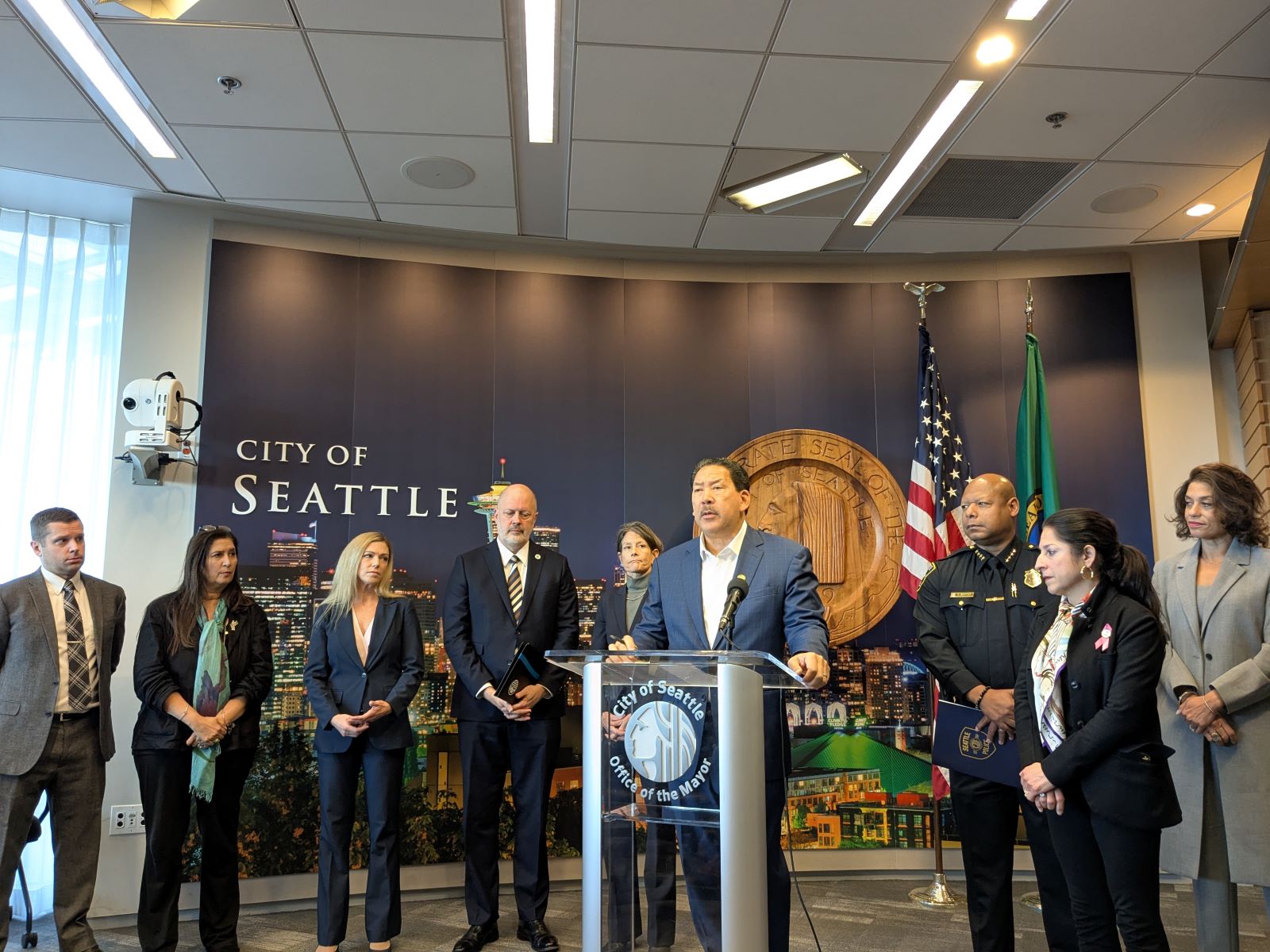
At an October 22 press conference, Mayor Harrell presented the terms of a proposed new union contract with the Seattle Police Officers Guild (SPOG), which represents rank-and-file SPD officers (officers, detectives, and sergeants). Harrell claimed that the proposed contract “significantly strengthens police accountability meeting key elements of the 2017 Accountability Ordinance.” This is false.
This proposed two-year contract includes terms that continue to undermine foundational elements of the 2017 legislation. This contract rolls back existing accountability measures, such as now proposing that the Seattle Police Department self-investigate what they determine to be minor complaints.
Over eight years after passing the 2017 legislation the Seattle City Council still appears to only be able to aspire to outdated accountability measures that they then vote against, as they did in voting for the 2018 and 2024 SPOG contracts. The 2017 legislation was a half-a-loaf compromise, yet we are still failing to salvage all of those few slices.
Below, I elaborate on the major concerns that make this proposed contract unacceptable, even for people who believe in the most modest of accountability measures. I am focusing on the most significant issues impacting police accountability and ignoring other major issues like the continuing restrictions on who the Office of Police Accountability (OPA) can subpoena in an investigation, continuing problems with calculating investigation timelines, pay rates, SPD monopolizing traffic control during major events, a decades-long call to reform the corrupt off-duty employment practices (still governed by 33-year-old agreements), and so on.
Issues of police accountability – as opposed to police reform, training, or policy – are most crucial after a federal consent decree ends. In the nearly three decades of federal consent decrees on policing there is a pattern of police returning to former bad practices at the end of federal oversight.
“The influence of a consent decree may gradually build up over time before lapsing post-treatment,” researchers John L. Worrall and Zachary A. Powell wrote in 2019.
Contract would undercut accountability for many years into the future
Sustaining whatever modest gains in police behavior that have been made in Seattle will require strong accountability measures. As important as these half-measures were in 2017, they are far more important now.
The Seattle City Council voting on a police contract of major importance just days before a new mayor, a new city council member, and a new city attorney take office is undemocratic and cynical. Given that police contracts take years to negotiate – with old contracts remaining in force until a new one is agreed upon – approving this contract would unfairly saddle newly elected Mayor Katie Wilson with restrictions she very likely won’t be able to change while in office.

In fact, passing this contract will give SPOG strong incentive to never negotiate with Mayor Wilson. SPOG is likely calculating that it’s better to delay and work the last two years of Wilson’s first term on a lapsed contract hoping that another centrist, like Harrell, sweeps into power and offers far more generous terms, including retroactive pay covering the years worked under an expired contract. When it comes to police contract negotiations, the incentives the City has created are counterproductive and continually undercut accountability.
Make your voice heard at City Council
To weigh in, email all nine city councilmembers at council@seattle.gov. Call or email them at their individual lines of contact as well. Attend and testify at the Seattle City Council meeting on Tuesday December 9th at 2:00pm, or call in with public comment. And, if they do not vote then, show up again on December 16th at 2:00pm.
Here are some tips for making public comment. Demand that they reject the proposed SPOG contract or, at the very least, delay any vote until after our new citywide councilmember, city attorney, and mayor have taken office in January.
The four foundational accountability elements the contract undermines
The four foundational elements of the 2017 legislation were:
- Moving away from having SPD officers investigate themselves when it comes to complaints or misconduct,
- Setting a clear and reasonable standard of evidence to be used in investigations into officer violations of training or policy,
- When officers appeal disciplinary decisions, having a process that did not continue the history of favoring officers, reopening investigations, and reducing discipline due to a history of leniency in police discipline, and
- Requiring the OPA to categorize and potentially investigate all complaints.
These elements are critical — even if inadequate and outdated — to the operation of any police accountability system that was to function better than what had preceded it.
In all four of these areas, the proposed contract rejects the 2017 legislation. The failures of this contract are not hidden: proposed contract “Appendix E” (starting on page 91) is labeled on the bottom of the pages “Effective through December 31, 2023,” indicating that this is from the contract finalized in 2024, whose terms are now simply folded in to the new 2025 contract. The newly proposed contract makes no significant advances over prior SPOG contracts from 2018 (except for the 2024 contract allowing two additional civilian investigators at OPA while still prohibiting those investigators from leading most, if not all, serious investigations).
Who investigates police abuse
A major advance in the 2017 legislation was that, after more than a century of police investigating police, there would be the possibility of only civilians investigating police.
Section 3.29.140(C) of the 2017 police accountability ordinance states (emphasis added): “Within 12 months of the effective date of the ordinance introduced as Council Bill 118969, intake and investigator personnel shall be entirely civilian or a mix of civilian and sworn, in whatever staffing configuration best provides for continuity, flexibility, leadership opportunity, and specialized expertise, and supports public trust in the complaint-handling process.”
The 2017 legislation established that the Office of Police Accountability (OPA) director could create an exclusively civilian body of investigators to investigate complaints against police officers. Eight years later this provision of the law remains blocked. The newly proposed SPOG contract restricts the number of civilian investigators to a maximum of four (out of around a dozen total investigators) and prevents them from independently leading an investigation that could result in substantiating serious allegations (potentially almost all investigations; see “Appendix D,” pages 89-90).
Not appreciated here is the fact that the non-civillian investigators in the OPA are exclusively SPD sergeants, who serve as regular SPD officers before spending one to three years in OPA and then returning to their regular duties at SPD. How is it remotely possible for such an investigator to hold another officer accountable when months later they may be again serving alongside them?
This failure to implement civilianization of OPA investigators in the new contract is egregious given that the last head of OPA, Gino Betts, repeatedly stated his desire to have 100% civilian investigators. Even more egregious: the state of Washington in 2021, in creating the Washington State Office of Independent Investigations, had long ago adopted a model of only having civilian investigators investigating all cases they take up. How is state legislation so far ahead of Seattle’s?
The standard of evidence for officer discipline
The 2017 legislation established a preponderance of evidence standard (meaning anything above 50% or “more likely than not”) for upholding a complaint and discipline. This was a major advance for accountability.
The proposed contract changes this standard radically to an ambiguous “elevated standard of review,” nebulously higher than a simple preponderance, but something short of “beyond reasonable doubt.” This is clearly outlined in Section 3.1 of the proposed contract (page 9) which states that “an elevated standard of review (i.e. – more than preponderance of the evidence)” will be used “for termination cases where the alleged offense is stigmatizing to a law enforcement officer.” Since many violations, including material dishonesty, is stigmatizing, and an investigation into a trivial violation could subsequently reveal material dishonesty, almost any investigation can fall into this category.
How officers appeal potential discipline
The 2017 legislation (under 3.29.420 A(7)(a)) required that all officers who appeal a disciplinary decision must do so through a hearing, open to the public, in front of the newly formed City of Seattle Public Safety Civil Service Commission (PSCSC).
The proposed contract, page 102, allows officers to go through the current and extremely flawed process of independent arbitration, a process which is closed to the public and uses standards of review that advantage the officer. For example, as noted above, an arbitrator would make decisions based on an ambiguous and highly subjective evidentiary standard, would be allowed to examine the case “de-novo” (in essence reinvestigate a closed investigation), and consider new evidence and witnesses that the officer failed to disclose earlier.
The rationale in 2017 for the exclusive PSCSC appeals process was that a person employed by and living in Seattle would make decisions rooted in the values and expectations of the local community. Arbitrators, who are selected from a broad geographic area without ties to Seattle, would, as a matter of historical precedent, make decisions based on a history of what would happen to an average officer who engaged in a similar violation in other cities. In essence, arbitrators virtually guarantee that the long history of badly behaving police facing only trivial sanctions would be perpetuated.
A perfect example of this happening in Seattle involves the case of SPD officer Adley Shepherd, where an arbitrator (in this case it was a mediator who served as a tiebreaker in an older appeals process) overturned the police chief’s termination of Shepherd and instead meted out a trivial 15-day suspension. For the arbitrator, a cop unnecessarily punching a woman in the eye, hard enough to break the eye socket, wasn’t that serious.
Mayor Harrell claims that the proposed contract makes one very narrow gain in the arbitration process: that if an arbitrator determines a violation occurred and that there should be discipline, that the arbitrator should give “deference” to the discipline imposed by the police chief. This is a trivial fix, whose efficacy depends on “deference,” to an extremely biased system.
It should be noted that while a police officer gets numerous attempts to reverse or appeal discipline decisions, the complainant gets exactly none when their complaint is rejected or fails to be upheld (there was a companion ordinance in 2017, still ignored over eight years later, that mandated the investigation into and possible development of a complainant appeals system).
Who gets to investigate complaints
The 2017 legislation required the OPA to potentially investigate all complaints, even complaints that arose within the SPD. The new contract mandates that many of these complaints can now be dealt with internally by the SPD, undercutting transparency and accountability. This hands more power to control investigations and discipline back to the police.
On page 16 of the proposed contract it states that “less than serious misconduct” complaints submitted to OPA will not be investigated by OPA but will instead be forwarded to SPD for internal investigation and decisions around discipline. Similarly, if the SPD receives a “less than serious misconduct” complaint from the community or from other officers, the SPD gets to determine how it is to be dealt with, without involving OPA.
Given the continuing failure of the OPA over more than eight years to properly classify complaints (e.g., the continuing problem of complaints not being investigated because they were classified as “contacts”) and the failure of the OIG to properly audit OPA’s work (see here and here), this change is a disaster.
Consider the 2014 case of William Wingate, two years into the federal consent decree, which resulted in a federal jury finding that the SPD officer engaged in racial discrimination and awarded $325,000 to Wingate. A crucial finding, resulting from outside investigations, was that SPD intentionally failed to report or consider this case as one of racial discrimination (SPD officers would falsely claim that no one made a discrimination or bias complaint).
The newly proposed SPOG contract returns Seattle to the days when the SPD gets to decide when and if an incident is serious and what they think the violations might be. This allows officers to bury claims of racial discrimination and misconduct – in order to maintain community trust – by simply ignoring or pretending to have misunderstood those complaints.
SPD retains control over how CARE responders are dispatched
The proposed contract still maintains tight restrictions on the types of incidents that the newly created Seattle Community Assisted Response & Engagement (CARE) can respond to without SPD officers (called solo dispatch) and gives SPD far too much discretion in determining if a particular call meets the SPD requirements for CARE’s solo dispatch or involvement.
Appendix I (pages 107-110) of the newly proposed SPOG contract outlines the conditions for Seattle’s new CARE department to solo dispatch to a behavioral or mental health crisis. Note the date of this appendix indicates that this is taken verbatim from the prior 2024 SPOG contract.
The only advance from previous SPOG agreements is that there are now no limits on the staffing for CARE. However, the restrictions as to when CARE can solo dispatch and the complete authority that SPD officers have in making a decision to allow solo dispatch, negates much of CARE’s utility. These failures are well documented by Erica Barnett and Amy Sundberg.
Conclusion
Seattle’s 2017 police reform legislation was a floor – maybe more accurately a basement – when compared to police accountability systems developed in Newark, New Jersey, Nashville, Tennessee, and other cities. There has been a failure in public understanding that federal consent decrees on policing only impose constitutional standards, not community standards or just standards. At their best, they are only a floor.
There is a common type of police killing referred to as “lawful but awful,” that is, police killings that are perfectly constitutional but are criminal, unjust, or unheard of in other countries. Neither the federal consent decree or the 2017 legislation addressed the problem of lawful but awful killings, nor did they prevent the widespread abuses of protesters in 2020.
Similarly, SPD officers continue to kill people who only had a knife or no weapon in their hand, oftentimes experiencing a serious mental health crisis, as happened most recently in March this year.
As antiquated and inadequate as Seattle’s 2017 legislation is, to leave parts of that unimplemented for the foreseeable future is unconscionable. You will hear questionable claims from the current mayor and council members about “binding arbitration” and “unfair labor practices.” Don’t be fooled.
You will be told that some unresolved issues will still be bargained over during the term of the new contract, a process called “binding arbitration,” where a labor arbitrator listens to the city and SPOG and then decides what is fair. It is absurd to allow fundamental issues of public safety and police accountability to be decided by a random arbitrator.
Additionally, the public has not seen actual agreements that lay out precisely what issues and parameters will be subject to binding arbitration, except for a City Council staff memo that claims this will happen on only two issues related directly to accountability (the discipline appeals process and who can be subpoenaed, see items 4 and 5 on page 4 of the memo). Without documents from SPOG indicating precisely what the issues and parameters are, that both sides have agreed to submit to binding arbitration, this cannot be evaluated or taken seriously.
You will also be told that if the council fails to vote for the proposed contract that SPOG will launch an unfair labor practice (ULP). That happens frequently in labor relations and is not something to fear. In fact, after the people of Seattle have waited patiently for over eight years, walking away from an unacceptable SPOG contract and facing a hypothetical ULP would be a relief and offer some glimmer of hope.
When council members vote on the proposed contract, on December 9th or 16th, it should be a vote for hope and not a vote based on imagined fear or endless failed promises for the future. It should be a vote that ends the repeated cycle of the City acceding to SPOG’s demands while SPOG blocks the most moderate of accountability measures.