

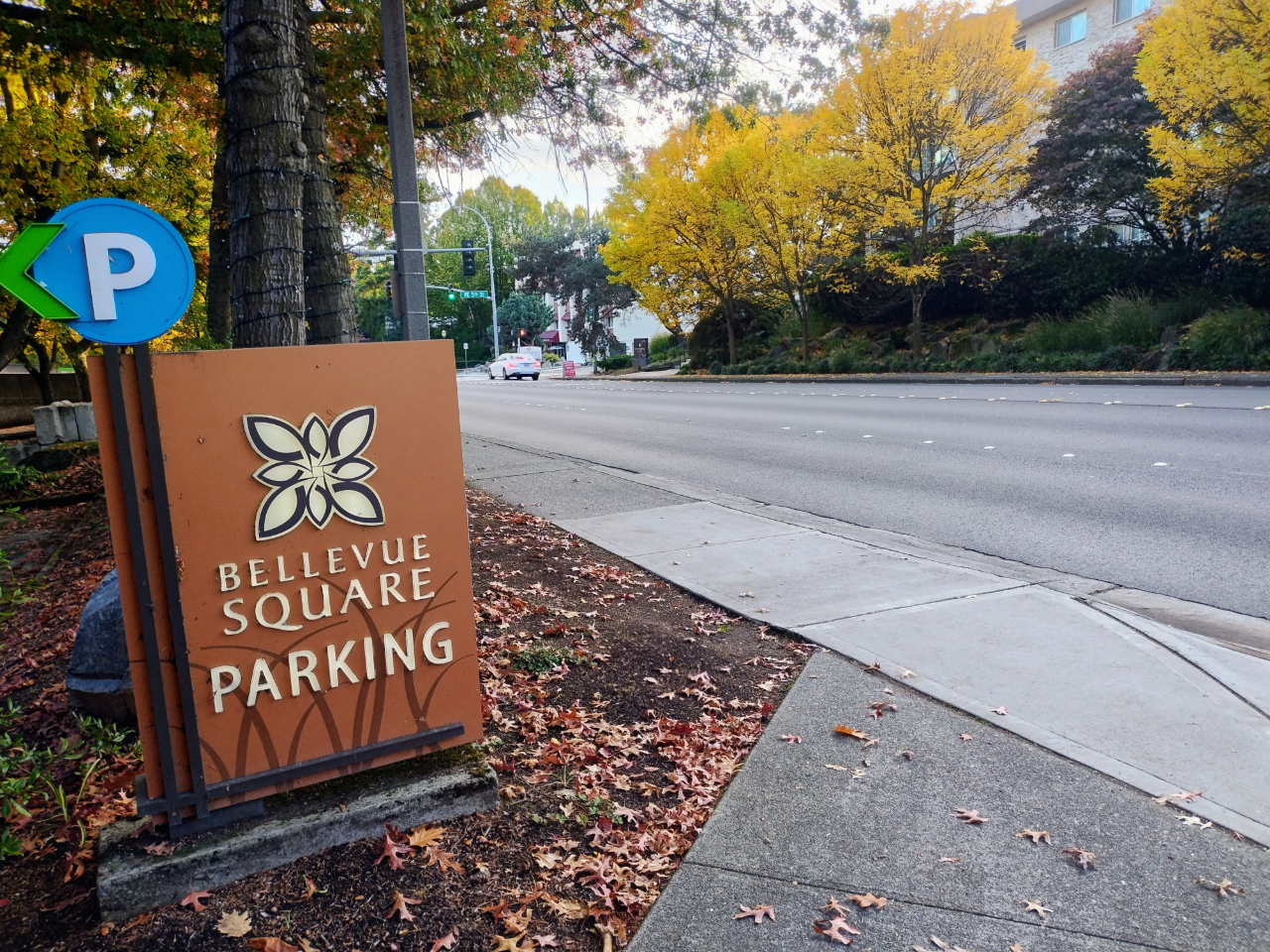
City planners in Bellevue are set to tackle parking reform, ensuring that the Eastside’s largest city comes into compliance with a new state law lowering the ceiling on how many off-street parking stalls can be required with new developments. But in doing so, Bellevue will explore going even further than the new state-required baseline, looking at changes intended to give maximum flexibility to bring down housing costs and push the city in a more multimodal direction.
Last week, the Bellevue City Council unanimously approved expanding the scope for potential changes to parking requirements the city will adopt by the end of this year, in compliance with Senate Bill 5184.
Approved last spring, the new law bars all cities with more than 30,000 residents from requiring more than one parking stall for every two units in an apartment building, nor more than two stalls for every 1,000 square feet of commercial space. It also exempts certain projects from any parking requirements at all, including affordable housing, senior housing, smaller apartment units, and commercial spaces in mixed-use buildings.
Coming into compliance in 2026 will ensure Bellevue meets a January 2027 deadline for cities over 50,000 in population; smaller cities have an additional 18 months. Bellevue will consider dropping all parking mandates citywide, a path that has been chosen in places like Spokane, Shoreline, and Bremerton but that SB 5184 does not require. Short of that bold step, the City will also consider removing minimums near transit routes, and explore treating building rehabilitation or adaptive reuse — typically required to fully comply with parking requirements that could render their project infeasible — differently than it does new developments.
Adopting lower minimums, or even eliminating them altogether, won’t mean builders can’t build more parking stalls than required. But it does mean that developers can tailor the amount of parking to match expected demand. Some development projects that might be on the verge of viability could move forward without an arbitrary number of stalls.
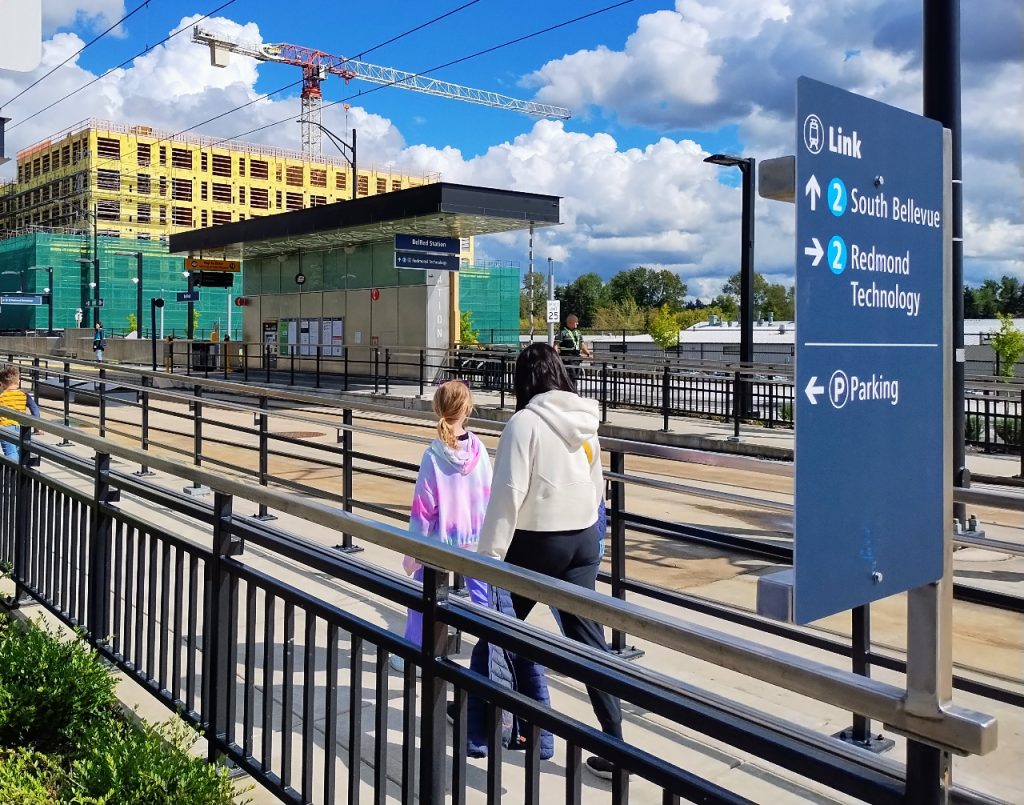
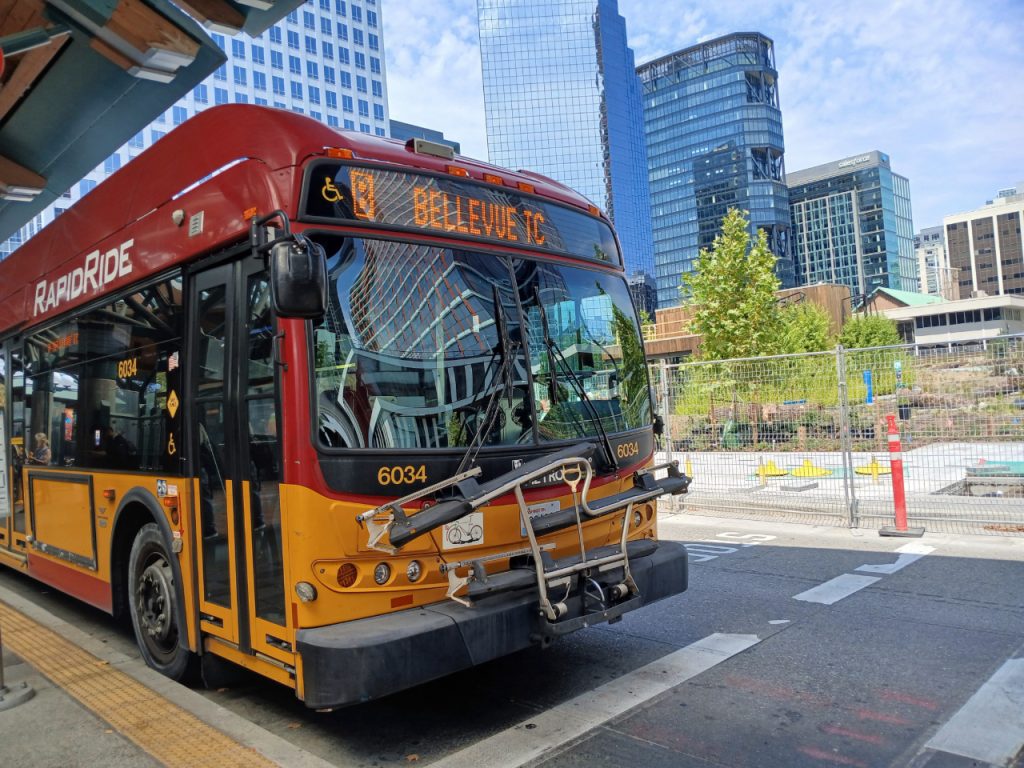
By 2029, Bellevue will have to drop mandated off-street parking within a half-mile distance of light rail stations, and within a quarter mile of King County Metro RapidRide stops, thanks to another 2025 law supporting transit-oriented development. But adopting three years early could be a major win for housing reforms in Bellevue, especially given the zoning changes that have already been adopted near the city’s light rail stations, which are set to be connected to Seattle in a matter of months.
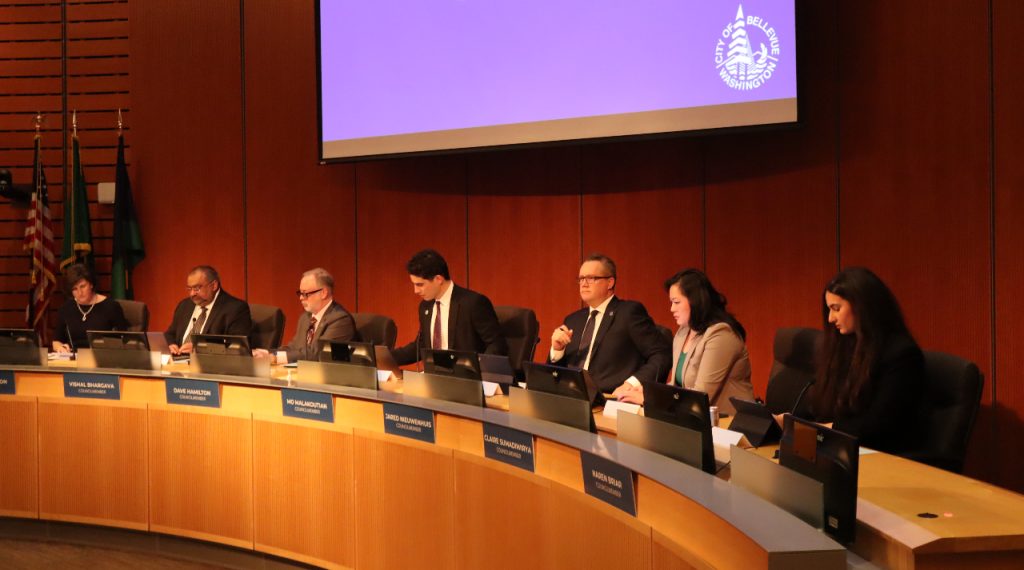
During an initial discussion of this topic last week, it became clear that changes to the Bellevue City Council’s composition over the past year will likely have a major impact on the ultimate outcome. Since 2023, five of the council’s seven seats have turned over, with progressive candidates faring particularly well this past November. Vishal Bhargava and Naren Briar, two of the council’s newest members, seemed the most open to studying the broadest range of options, including full removal of parking mandates citywide.
“Are minimum parking requirements a good thing or not? And I’m not entirely convinced they’re a good thing, and that it sort of impacts the direction, at least my point of view, on the scope for the study. I mean, they do raise costs for development, housing costs. I know there is also a question of not matching real demand,” Bhargava said. “If we’re stuck to those sorts of approaches that are not flexible over time, that creates those hard and fast requirements that don’t seem to work. The other thing that I think that we have to think about is the impact they have on actual development potential.”
Briar, who took office at the beginning of this year after defeating longtime incumbent Conrad Lee, expressed concern about Bellevue receiving a top-down mandate from Olympia but quickly pivoted to using data to guide the city’s position on how far to go. A 2020 study looking at the effect of parking reforms in Seattle showed that dropping minimums near transit led to 18,000 fewer parking spaces, saving more than a half billion dollars in construction costs.
“Personally, I’m not a fan of the state mandates and how prescriptive they can be at times. Nevertheless, I do think we need to expand our scope, especially if we’re seeing continued investments into our transit infrastructure, and if we’re hurting our local businesses. I’ve spoken to so many entrepreneurs who can’t just seem to settle in Bellevue because the minimum parking mandates are not feasible,” Briar said. “It is important that we understand through the engagement and evaluation process what other cities are doing and how these impacts are prevailing.”
Meanwhile Councilmember Lynne Robinson, fresh off a six-year run as Bellevue’s Mayor and now one of the council’s most moderate members, pushed back on the entire concept behind SB 5184. Robinson conflated the idea of removing mandated parking with builders not building any parking, and even suggested that the City should look at trying to get changes made at the legislature. SB 5184 was approved by more than a two-to-one vote across the two legislative chambers, with strong support from Governor Bob Ferguson’s office.
“There are some things the state is assuming that I just don’t agree with. I don’t agree that four-bedroom low-income housing necessarily does not require parking, and that troubles me, because we’ve seen some of our affordable housing families really struggle,” Robinson said. “I also don’t agree that senior housing doesn’t require parking. We’re not talking about the seniors. We’re talking about all the people who come and serve them, who are dependent on cars for their businesses. So that’s troublesome to me, and I almost wonder if we shouldn’t push back a little bit. I know it’s already a done deal, but maybe there could be a revision made if our intergovernmental staff were to think that was a good idea.”
Mo Malakoutian, Bellevue’s new Mayor, referenced a point raised by Bellevue City staff, that the majority of the city’s parking requirements have been sitting on the books unchanged for decades, with regulations in place in a 1962 zoning book — the oldest one found at City Hall — “mostly matching” the ones in effect today.
“It’s really not a compliance [issue], although it is a compliance [issue], but also it’s updating a code that is maybe for a city, that maybe we don’t have that city anymore. We have a much better city,” Malakoutian said.
Much process lies ahead, with Bellevue’s planning commission set to tackle the issue after City staff conduct public outreach with Bellevue residents. That body has watered down bold proposals developed by Bellevue city staff before, significantly scaling back middle housing regulations last year that ultimately mean fewer homes can be built near transit in a city intending to add over 150,000 homes over the next two decades.
But as a starting point, Bellevue is starting much closer to the end zone on parking reform than many Eastside urbanists might have expected, a fact that bodes well for the conversation that will unfold over the next year.

Ryan Packer has been writing for The Urbanist since 2015, and currently reports full-time as Contributing Editor. Their beats are transportation, land use, public space, traffic safety, and obscure community meetings. Packer has also reported for other regional outlets including BikePortland, Seattle Met, and PubliCola. They live in the Capitol Hill neighborhood of Seattle.