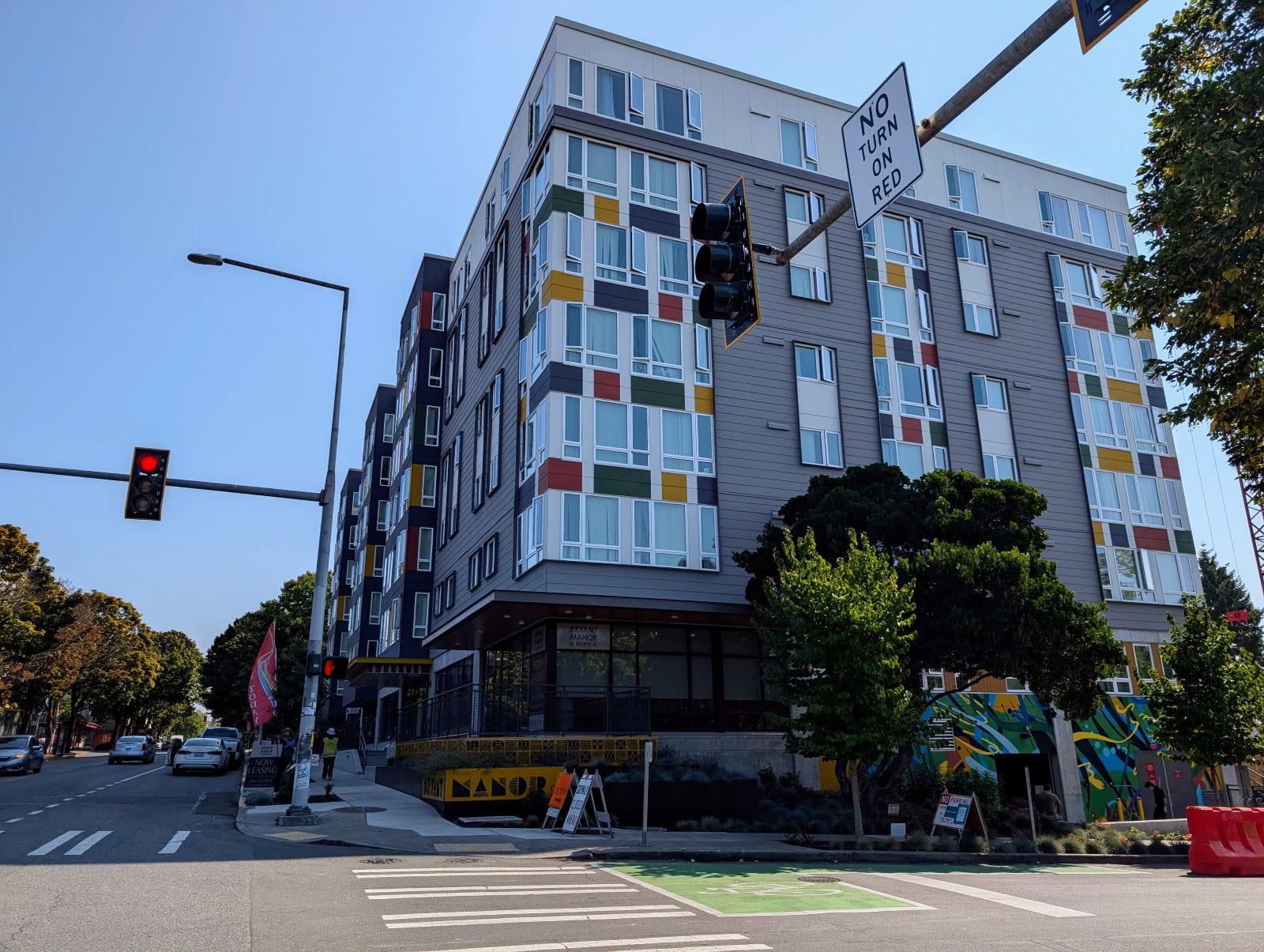
Affordable housing production is trending upward across the United States, and Seattle is leading the way. A new report from RentCafe found the Seattle metropolitan area has produced 14,290 affordable apartments over the previous five years, more than any other metro region.
Seattle’s total narrowly edged out New York City, which produced 14,240 affordable apartments in the same time period from 2020 to 2024, and Austin, Texas, which produced 13,342. Minnesota’s Twin Cities metro came in fourth with 10,722 apartments produced, followed by Atlanta, Denver, Los Angeles, and the “Bay Area.”
Note: San Francisco (along with the North Bay) was broken out a separate category from the East and South Bay Area in this study. Combined, the two Bay Area listings accounted for 16,301 affordable apartments, a total which would have led the list.
RentCafe’s analysis included only apartments in 100% affordable buildings, which does leave out a small subset of the data from mixed-income buildings. The study only counted apartments, not affordable homeownership projects, which also represents a small fraction of overall production.
With the growth in production, affordable apartments are a growing share of overall apartment production. “Affordable housing for renters accounted for one-quarter of the [Seattle] metro’s total of 59,000 new apartment buildings during this time,” RentCafe’s Florin Petrut noted.
Affordable housing composed 31.7% of overall apartments in New York over the past five years, since the region produced fewer apartments than Seattle. New York’s share trailed only San Francisco, where over a third of apartments were affordable since 2020. San Francisco produced fewer total apartment units than any other top 20 city, while Seattle outpaced the vastly larger New York market by nearly one-third.
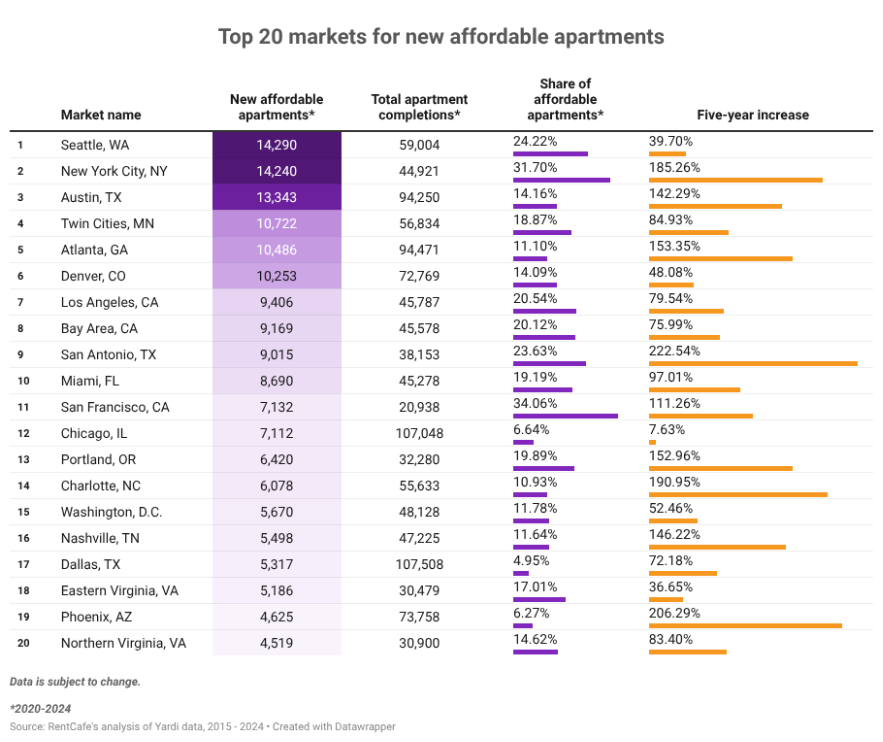
For some regions the uptick in affordable housing was dramatic, but less so for Seattle, where the five-year time period was up nearly 40% over the previous five years — one of the smallest increases in the dataset. That means Seattle’s affordable housing sector was also the leader over the entire decade, not just the last five years. Metro Seattle produced more than 24,000 affordable apartments over the decade.
Most metros have momentum in affordable sector
On the other hand, if trendlines continue for fast-building metros, Seattle could get its title stolen in the decade ahead. For example, San Antonio’s affordable housing production was up 222%, Phoenix’s was up 206%, and New York City was up 185%. Although, in Phoenix’s case, that still amounted to just 4,626 affordable apartments, which shows how anemic affordable construction had been previously.
“Notably, affordable housing is starting to make up a larger portion of all new apartment construction,” Petrut noted. “In 2024, nearly 14% of all new apartments were income-restricted — up from just under 9% ten years earlier — indicating a growing emphasis on affordability in new development.”
A few regions bucked that trend, and continue to emphasize market-rate apartment development to a large degree. For example, just 5% of the more than 107,000 apartments produced in the Dallas metro from 2020 to 2024 were income-restricted affordable units. The Chicagoland area also produced just over 107,000 apartments, and just 6.6% were affordable. Houston did not even crack the top 20, despite being the sixth-most populous metro in the country.
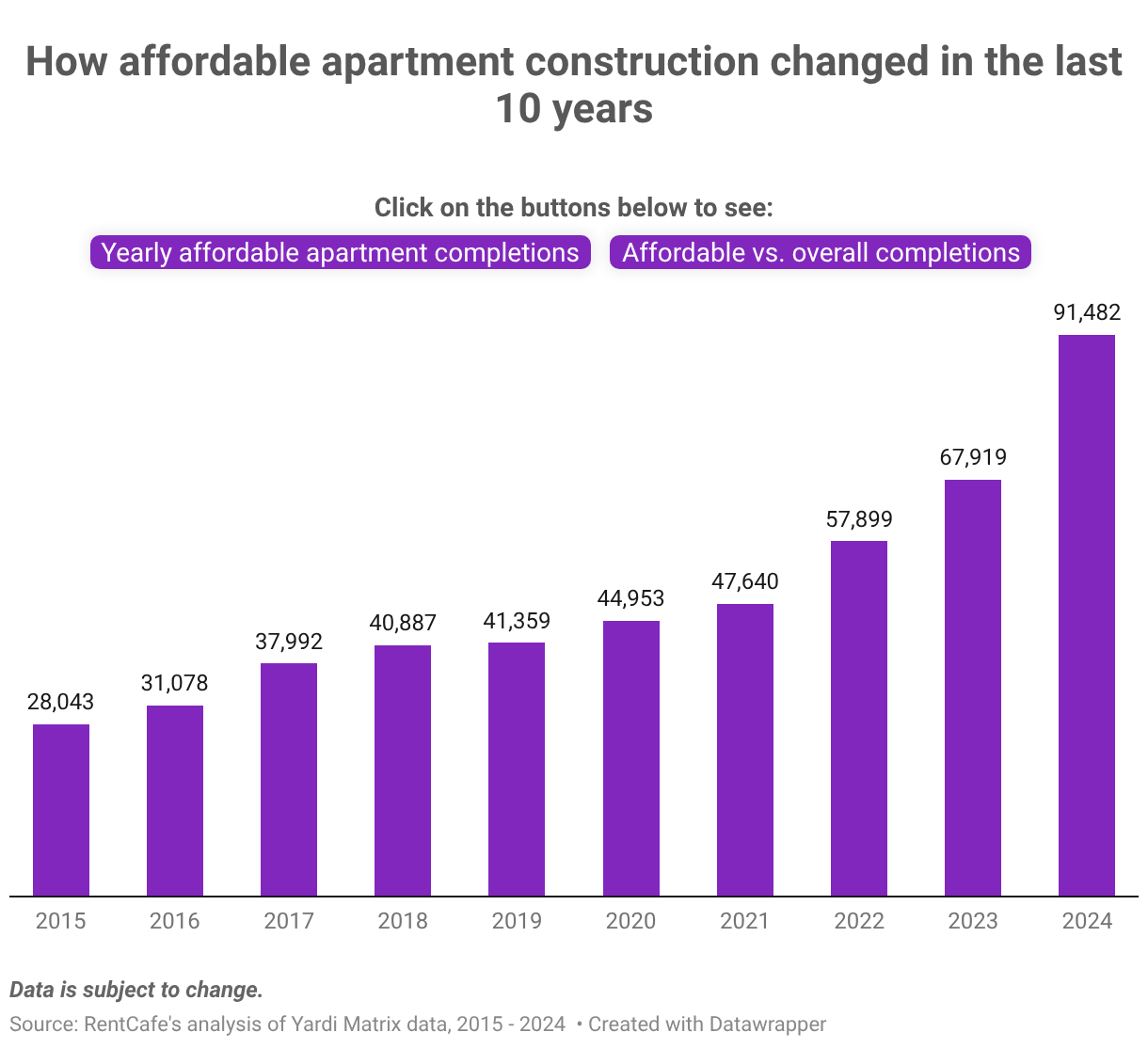
Nationwide, 2024 was a banner year, delivering 91,000 affordable units, the highest total in decades. “Nearly 310,000 affordable apartments have been built nationwide since 2020, accounting for 12.6% of all new apartment buildings,” Petrut wrote. “Affordable housing construction rose 73% compared to 2015–2019, outpacing overall apartment building growth.”
Part of the credit for the affordable housing surge goes to the pandemic response strategy engineered under President Joe Biden: “The American Rescue Plan has helped move things forward by directing billions of dollars into housing through State and Local Fiscal Recovery Funds,” Petrut wrote. “On top of that, many states introduced or expanded their own tax credit programs. These efforts helped developers cover rising costs and move projects across the finish line faster while simultaneously keeping rents affordable for the long term.”
How Seattle invests in affordable housing
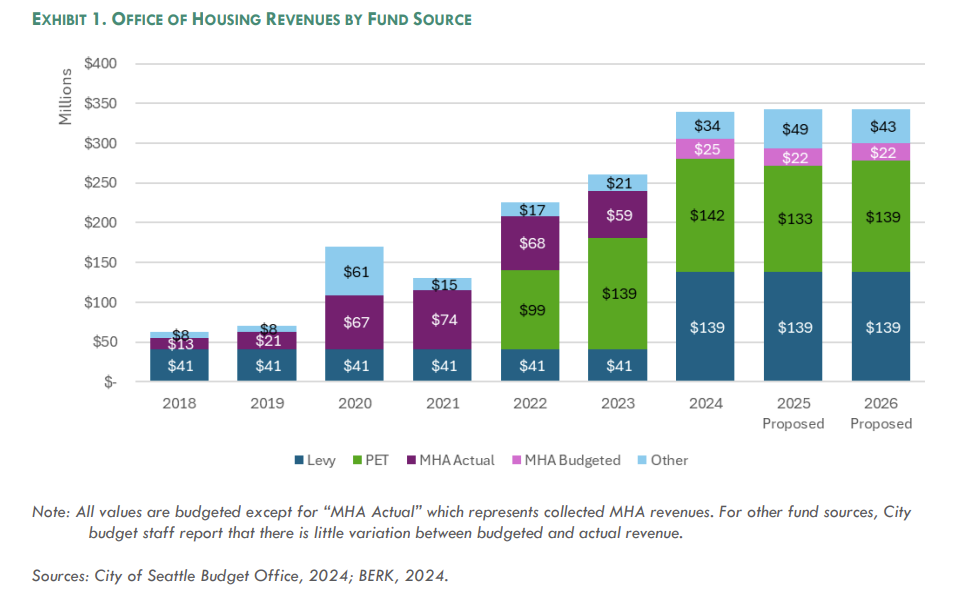
Seattle goes beyond many other American cities in directly funding affordable housing production. The City of Seattle is spending nearly $350 million per year on affordable housing, which comes from a variety of revenue sources.
Since the 1980s, the Seattle Housing Levy has augmented affordable housing creation. The 2023 renewal tripled the size of the levy to a $970 million seven-year package, and it passed by a wide margin. At its new level, the levy provides $139 million in annual funding.
In 2020, Seattle also passed the “JumpStart” payroll tax on the largest companies in the city. Initially the revenue stream provided Covid relief, but over the longer-term the tax was intended to focus a majority of investments on affordable housing — at least when mayors and councils aren’t raiding it to plug budget holes and fund pet projects. The payroll tax pulled in $360 million in 2024, but only $142 million of that ended up going to the Office of Housing, a figure which was further cut in 2025.
Seattle’s Mandatory Housing Affordability or MHA program — an inclusionary zoning regime that traded upzones allowing larger apartment buildings for new affordability requirements — also raises affordable housing funds via in-lieu payments from builders who opt out of providing income-restricted homes on-site. As a developer fee, MHA revenue is volatile and varies with the pace of construction activity, which has been slowing recently in Seattle, especially in the office sector. MHA topped out at $74 million in collections in 2021, but has declined since, settling out around $22 million in 2025 and in 2026 projections.
In 2025, Seattle voters approved another dedicated revenue source, this time focused on social housing. An “excess compensation” tax hitting high earners who make more than $1 million per year is expected to raise more than $50 million annually for the recently launched Seattle Social Housing Developer, which is pursuing a mixed-income model popularized in cities like Vienna.
Other jurisdictions in the region lag far behind Seattle in affordable housing investments, but most are taking strides to boost production. The Washington State Legislature has also steadily grown the size of the state Housing Trusting Fund, setting a new record with $400 million allocated in 2024, which has also helped get more affordable housing projects off the ground.
King County has flirted with a billion-dollar bond for workforce housing — although it’s not clear how soon such an initiative could materialize after a study found the County would need to back the bonds with a dedicated funding source or risk its general fund.
The region’s largest employers — including Amazon and Microsoft — have also made large pledges of housing grants and low-interest loans to aid nonprofit builders. Two top executives at Microsoft and Amazon shared a Seattle Times op-ed byline this week arguing the state “must make it easier to build our way out of the housing crisis” — and touting that “together, our two companies have committed $1.6 billion to preserve and build more than 26,000 affordable homes.”
Growth in affordable housing production has also brought its own problems. By 2025, vacancy rates at affordable apartments in King County had climbed above 10%, which is reportedly threatening to bankrupt some buildings and providers and has already led to bailouts. While demand remains high for low income housing, overproduction in the higher income segments (e.g., around 60% of area median income) has emerged an issue, at least in some parts of the region.
Still not enough
Leading the nation in affordable housing production is a feather in Seattle’s cap, but local housing advocates would be the first to admit it’s far from enough. In 2018, King County’s Affordable Housing Task Force projected that the county would need to add 244,000 net new affordable homes by 2040.
“According to our estimates, we need 156,000 more affordable homes today and another 88,000 affordable homes by 2040 to ensure that no low-income or working households are cost burdened,” the task force wrote. “That means we need to build, preserve or subsidize a total of 244,000 net new homes by 2040 if we are to ensure that all low-income families in King County have a safe and healthy home that costs less than 30 percent of their income.”
To meet the goal would have required a 11,000 affordable homes per year pace, which the region has not met thus far, even with its nation-leading production. To make up for its slow start out of the gates, King County would need to average 15,000 net new affordable homes annually from 2026 through 2040 to meet its target.
And state leaders are projecting that solving the housing crisis will also take robust market-rate production, setting a target of 1 million additional housing units over the next 20 years, or 50,000 per year.
More work remains to hit housing targets, and simply outproducing peer cities may not be enough, if Seattle wants to solve its affordability crisis.