Broad decreases in potential housing density across three of Burien’s most exclusive neighborhoods will not advance, following a 4-3 vote at the Burien City Council early this week. The narrow decision, which reversed a 5-2 vote to advance the idea last fall, was a clear signal of the shift on Burien’s council as a result of last November’s elections.
Burien voters chose the more left-leaning candidate in all four races that were on their ballots, reelecting two incumbents and bringing two other newcomers onto the council. That bloc of candidates was endorsed by The Urbanist Elections Committee (on which I serve).
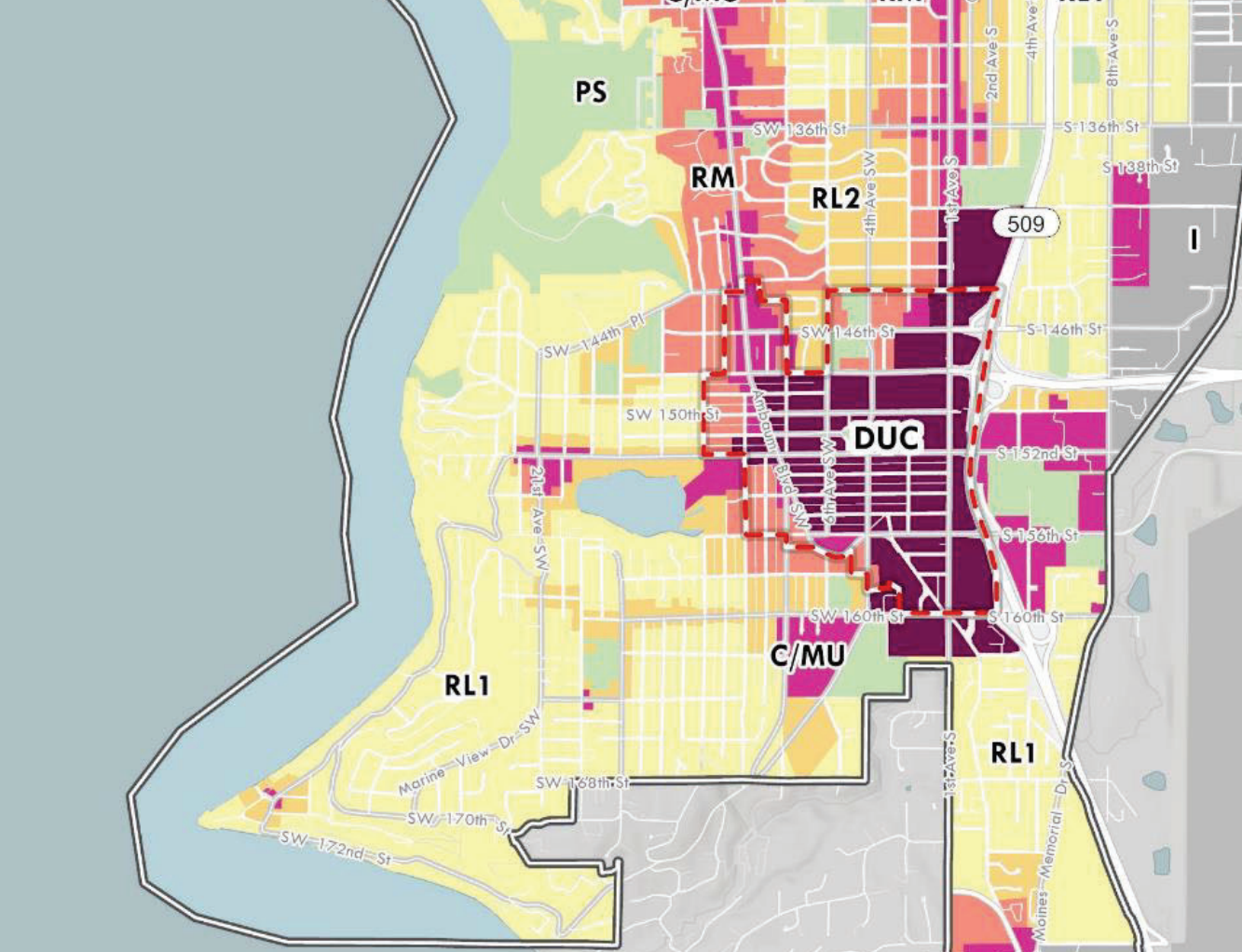
Zoning changes adopted in 2024, in line with a major update to Burien’s Comprehensive Plan, allowed additional housing density across many of the city’s neighborhoods, building on state mandates to open up areas that had long been off-limits to anything but single family development. While Burien was only required to allow property owners to develop as many as two housing units away from the walksheds of RapidRide bus lines, the city went further and allowed additional density with a goal of fostering walkability and neighborhood amenities in Three Tree Point, Seahurst, and around Lake Burien.
The areas in question have a new baseline of allowing four units per lot, with another two able to be added if they meet certain requirements for affordability or are close to frequent transit. With an additional incentive to preserve existing houses, property owners can now ultimately assemble seven units per lot.
That fact seemed to fly under the radar of many residents in those neighborhoods, and it wasn’t until 2025 that community opposition reached the city council. By September, the council’s moderate majority — who had ultimately voted to approve the upzones in the first place — directed staff to consider a zoning rollback that would be adopted this year.
“Citizens have repeatedly expressed concerns over further burdening the already taxed and fragile infrastructures in this area. Sewage and water systems, roads and electrical grids are already strained to meet current capacity and historically, frequently fail, which upzoning would completely overwhelm and prove unsustainable. Some areas are more than two miles from public transit in any direction,” Three Tree Point resident Dawn Lemmel told the Council Monday night. “In September, you assured us our voices had been heard and acknowledged we are not NIMBYs, but in fact, staunch advocates and defenders of our city’s fragile resources and ecosystem.”
On Monday, Councilmember Linda Akey advanced a motion to keep considering the downzones, a move that was not recommended by Burien planning staff for a host of reasons. After that motion failed 4-3, Akey attempted unsuccessfully to get the council to table a motion to approve what had been recommended by staff because that motion’s language was “too close” to the one she had just made. After a brief recess to confer with Burien’s City Attorney, Akey’s motion was quickly overruled.
Earlier in the meeting, Akey had dropped the news that she plans to resign from the council sometime in the near future due to an impending move out of the city, a fact that could shift the council’s composition even further.
The council’s new progressive bloc didn’t spend much time explaining its reasoning behind taking the downzones off the table, with Councilmember Sam Méndez, who replaced retiring Councilmember Jimmy Matta, providing the most substantive comments.
“For me, a lot of this boils down to equity. We’re mandated by the state to increase density. That’s also a value that I personally believe and ran on, and so we must do so as equitably across the city as we can,” Méndez said. “The plan, as is already, places a disproportionate burden on neighborhoods east of Highway 509, which I already have reservations with, given the negative impacts of folks living under the flight path. I want to see more people moving to Burien outside of the flight path, where where we can and then consideration of equities, especially critical when considering neighborhoods that have been historically redlined, such as my own neighborhood [of Seahurst], keeping people of color and the working class out of neighborhoods.”

Hugo Garcia, now Burien’s Deputy Mayor, did weigh in to note that his position has remained unchanged since last year and that he was aligned with Méndez’s comments, but Mayor Sarah Moore, who had the biggest margin of victory in November, did not directly weigh in. As a “weak mayor” system of government, Burien elects its Mayor and Deputy Mayor from among the council, with the pair elected by the progressive bloc earlier this month and the moderates in dissent.
Last fall’s motion to advance the rezones was made by Stephanie Mora, who lost to former Burien planning commissioner Rocco DeVito by 13 points in November, the closest race out of the four. DeVito didn’t provide comments Monday, a fact that might relate to a hot mic moment that occurred at a December 10 planning commission meeting where DeVito was testifying against the proposed downzones. “F*** those rich people!” DeVito was heard saying while his microphone was unknowingly off mute, a fact that he later apologized for.
DeVito had been clear about his position against downzoning the city’s wealthier areas, telling The Urbanist last year that he saw the move to scale things back as being in line with Burien’s broader history of wanting to keep certain types of development out of the city.
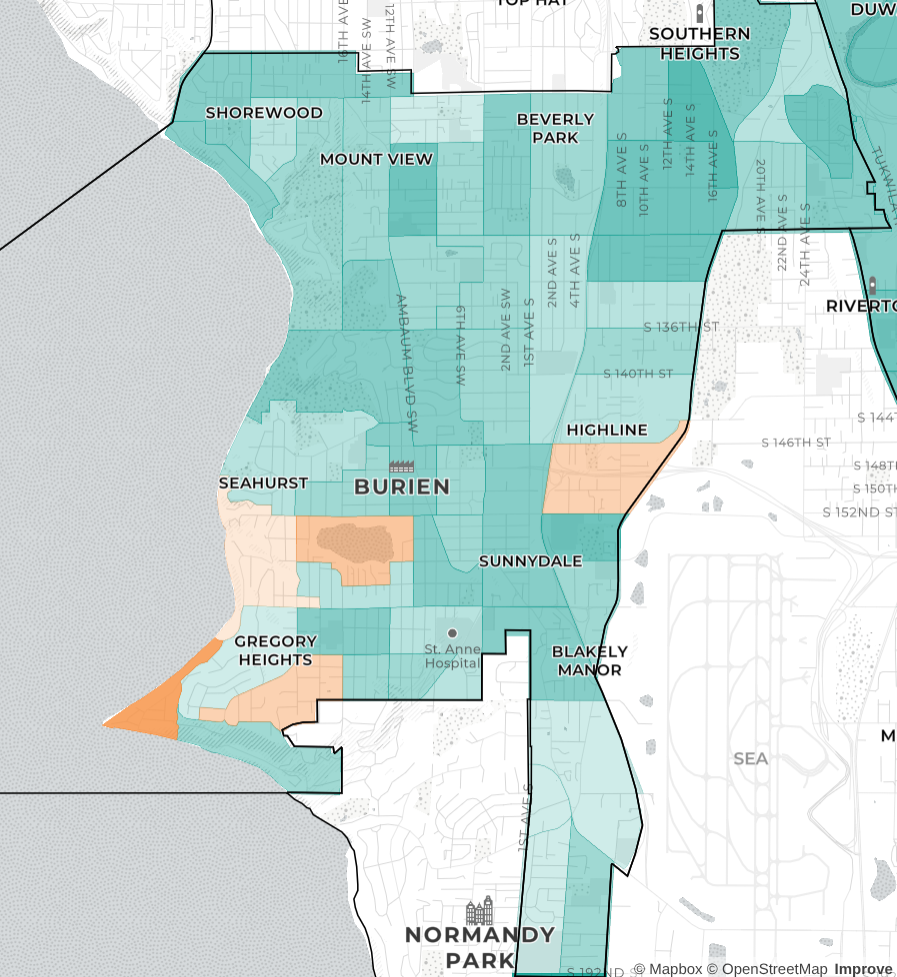
Electoral maps from November go a long way toward explaining why this change was advanced forward in the first place. The four more moderate candidates, including Mora, performed strongest in areas that would have been targeted for downzoning. In Three Tree Point, Mora outperformed DeVito by more than 50 points, but DeVito swept nearly every single other area of the city in a pattern that was mirrored in the other three races.
Dealing with this unfinished business from the previous council ultimately sets the stage for changes that the new Burien council will want to affirmatively pursue. Those are likely to include potential changes to an outdoor “camping” ban that essentially criminalizes being homeless in the city, one of the harshest such laws in the US, and whether to retain Burien’s controversial City Manager, Adolfo Bailon.
Under Bailon’s leadership, the city forfeited $1 million for emergency shelter that had been offered by King County to help get unsheltered residents housed, and Bailon has come under fire for a lack of transparency and a tendency to lash out after being criticized.