As people all over the world watch the violent and unconstitutional actions of the U.S. Immigration and Customs Enforcement (ICE) in Minneapolis and elsewhere in the United States, elected officials in Washington state are being forced to prepare for the possibility of a similar ICE invasion closer to home.
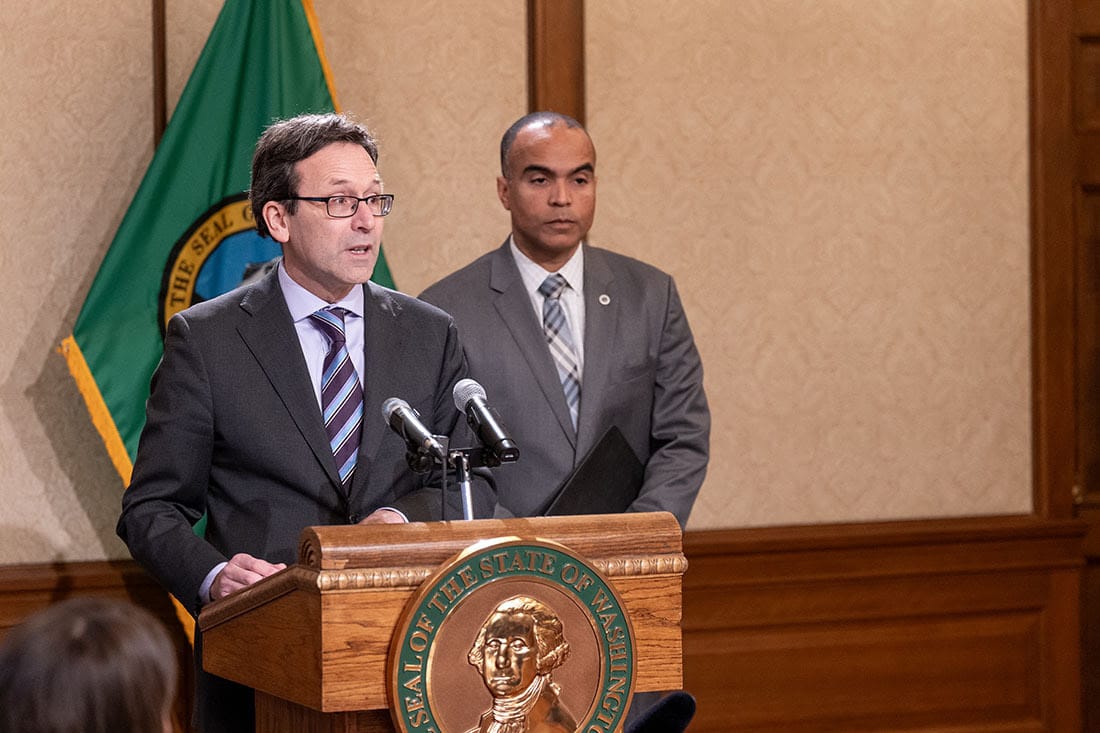
“The ICE memorandum […] that basically instructs agents to ignore the Fourth Amendment of the United States Constitution, to throw it in the trash, that represents a constitutional crisis at the level of everything the founders of this country warned us against, warning us against the tyranny that could arise if we put our heads in the sand,” Washington State Attorney General Nick Brown said.
Early in January, ICE released a memorandum saying their agents can enter people’s homes without a judicial warrant in a direct assault to the Fourth Amendment. A large-scale operation in Minneapolis that began in December has resulted in ICE agents killing two U.S. citizens who didn’t pose any danger to the agents in question.
“It feels like Minneapolis is being used as a testing ground, both in the brutality of the tactics, and we have seen since they killed Renee Good, we have seen such an acceleration in the brutality and illegality of the tactics that are used against observers, violating people’s civil rights with just absolute impunity,” said Minnesota Rep. Aisha Gomez on an episode of The Majority Report.
Meanwhile, at least 31 people died in ICE custody last year, which Axios reported is a 20-year high.
Earlier this week U.S. District Court Judge Katherine M. Mendez explored the question as to whether the surge of federal ICE agents has been meant to coerce local and state governments into changing their policies.
A few days later, Tom Homan, the executive associate director for ICE’s Enforcement and Removal Operations (ERO), made a statement that implied ICE enforcement is in fact being used to extort cooperation from state and local governments.
“The withdrawal of law enforcement resources here is dependent upon cooperation,” Homan said.
Given the behavior of the federal government, state and city elected officials are being forced to come up with response plans to prepare for the possibility of a large contingent of federal forces being sent to invade Washington state.
State-level response
On Monday, Governor Bob Ferguson joined Brown to outline how the state is preparing to respond if ICE were to come in greater force to Washington. However, they kept their remarks very broad.
“People have asked what we can do if ICE descends on Washington state, as they have in Minnesota, and I will not speculate on our strategy,” Brown said. “I’m not going to hand our playbook to them.”
In addition to aggressive legal action – Brown brought 50 lawsuits against the Trump administration in its first year – Ferguson outlined other steps he was taking, including meeting with the head of the Washington State National Guard and coordinating with state and local partners.
However, Ferguson was clear that he cannot prevent ICE from operating in the state.
This week, Ferguson and Brown sent a letter to Secretary of Homeland Security Kristi Noem condemning the actions of ICE in Minneapolis and objecting to the illegal orders to ICE that violate the Fourth Amendment.

“If ICE agents attempt any such unconstitutional measures in the state of Washington, we will do everything in our power to oppose it. Our state will consider all legal options to hold the U.S. Government and individual ICE agents accountable for violating Washingtonians’ constitutional rights,” the letter reads.
Ferguson also mentioned bills being considered by the state legislature this session, chief among them Senate Bill 5855, which would prohibit law enforcement officers from wearing face coverings, and Senate Bill 5876, which would prohibit people from having badges and using law enforcement insignia if they aren’t law enforcement.
In spite of Ferguson’s promises to “not be shy” about taking ICE agents to court if they choose to flaunt the law and wear masks, there are questions about how enforceable SB 5855 would be in practice. The bill includes a private right of action for people detained by a masked officer, but in addition to the potential dangers for a private citizen who chooses to sue an ICE officer, officers wouldn’t be liable for wearing a mask as long as they complied with other state identification requirements.
SB 5855 passed the Senate on Wednesday and will now be considered by the House.
Brown cited the Immigrant Worker Protection Act, House Bill 2105, which would require employers to give notice to workers of federal agencies asking for employment eligibility records within 72 hours and make sure employers aren’t sharing personal employee information without a subpoena or judicial warrant.
Also relevant is Senate Bill 6045, which would give farmworkers more collective bargaining rights. Right now farmworkers don’t receive the institutional protections provided by the National Labor Relations Board, but this bill would allow farmworkers to be represented by Washington’s Public Employment Relations Commission (PERC) for the purpose of enforcing workers’ rights.
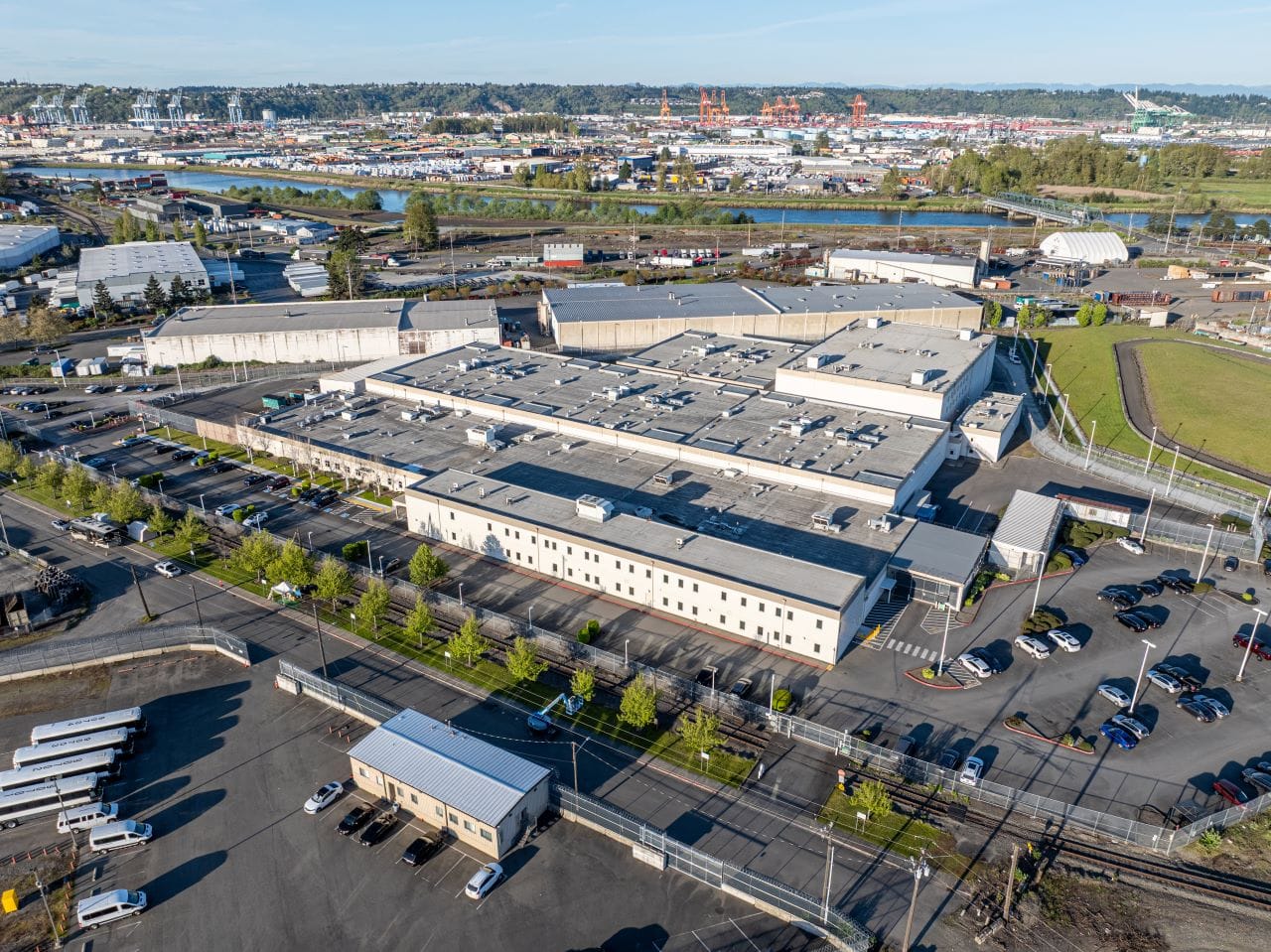
Senate Bill 6286 would allow the Department of Health to fine private detention facilities, such as Tacoma’s Northwest ICE Processing Center (NWIPC), if the department isn’t allowed to inspect the premises. The fees escalate to up to $1500 per day if a center doesn’t allow an inspection for more than 60 days.
While this bill doesn’t go as far as taxing detention facilities, which could lead to their existence being financially untenable in the state, it does at least provide real consequences for a failure to comply with inspections. Lawmakers are already aware that NWIPC doesn’t provide adequate medical care to its detainees.
“What we know from the Department of Health is they’ve had a huge number of complaints that have come in, in the hundreds, around nutrition, undercooked food, black mold, not getting access to medical care. The list goes on and on,” Senator Tina Orwall (D-33rd Legislative District, Des Moines) testified at the bill’s hearing. “And so the reason that we’re putting this hefty fine is it’s urgent. People’s health and their lives are at stake here.”
Notably, at the press conference Ferguson didn’t mention his failure to address the current loophole that allows ICE and Customs and Border Patrol (CBP) to access private drivers’ information from the state’s Department of Licensing (DOL). Researchers from the University of Washington Center for Human Rights (UWCHR) released a report in early January, finding that at least nine cases of federal immigration enforcement between September and November of last year involved a search in the DOL database.
Since that time, UWCHR has identified six additional cases and say they expect to find more cases as they continue to investigate. UWCHR confirmed that as of January 22, state officials have taken no action to cut off CBP or ICE Homeland Security Investigations (HSI), leaving Washington drivers’ information vulnerable.
Response in Seattle
Under new Seattle City Attorney Erika Evans, Seattle, along with King County, have submitted amicus briefs in a lawsuit brought by the State of Minnesota against DHS Secretary Kristi Noem and other federal officials challenging ICE’s “Operation Metro Surge.”
Seattle’s Office of Immigrant and Refugee Affairs (OIRA) presented at a council meeting this week, sharing the increased difficulties being faced by immigrants and refugees in Seattle over the last year.
Azmi Haroun, the communications advisor at OIRA, told the committee that between December 2025 and January 2026, the 10 partners they work with have seen over 100 community members having their citizenship appointments abruptly canceled with no reasons given.
Haroun said they’ve seen an increased demand for services and increased barriers to representation, such as “lawyers being allowed into the Tacoma detention center.” Many people are being held in prolonged detention without communication, pressuring them to choose deportation.
The Deportation Data Project found that since January 2025, nearly 2,000 people have been arrested for immigration detention in Washington state.
Councilmember Eddie Lin spoke of the expected escalation of the need for legal assistance if Seattle sees an ICE occupation, and how various City departments can be a part of a response.
“I’m concerned [with] how long it’s going to take to staff up and get prepared and get people ready,” Lin said. “And I know it’s a little bit hard to predict, right? But it seems like a natural disaster coming our way, but it’s the federal government.”
Lin called out the federal government for its role in spreading fear and inaccurate information.
“It is so critical that we provide accurate and timely information, and it is just so difficult to do so when our federal government is not sharing information with us,” Lin said. “I want to put blame, the primary blame, where it should sit, which is with our federal government intentionally causing this fear and chaos.”
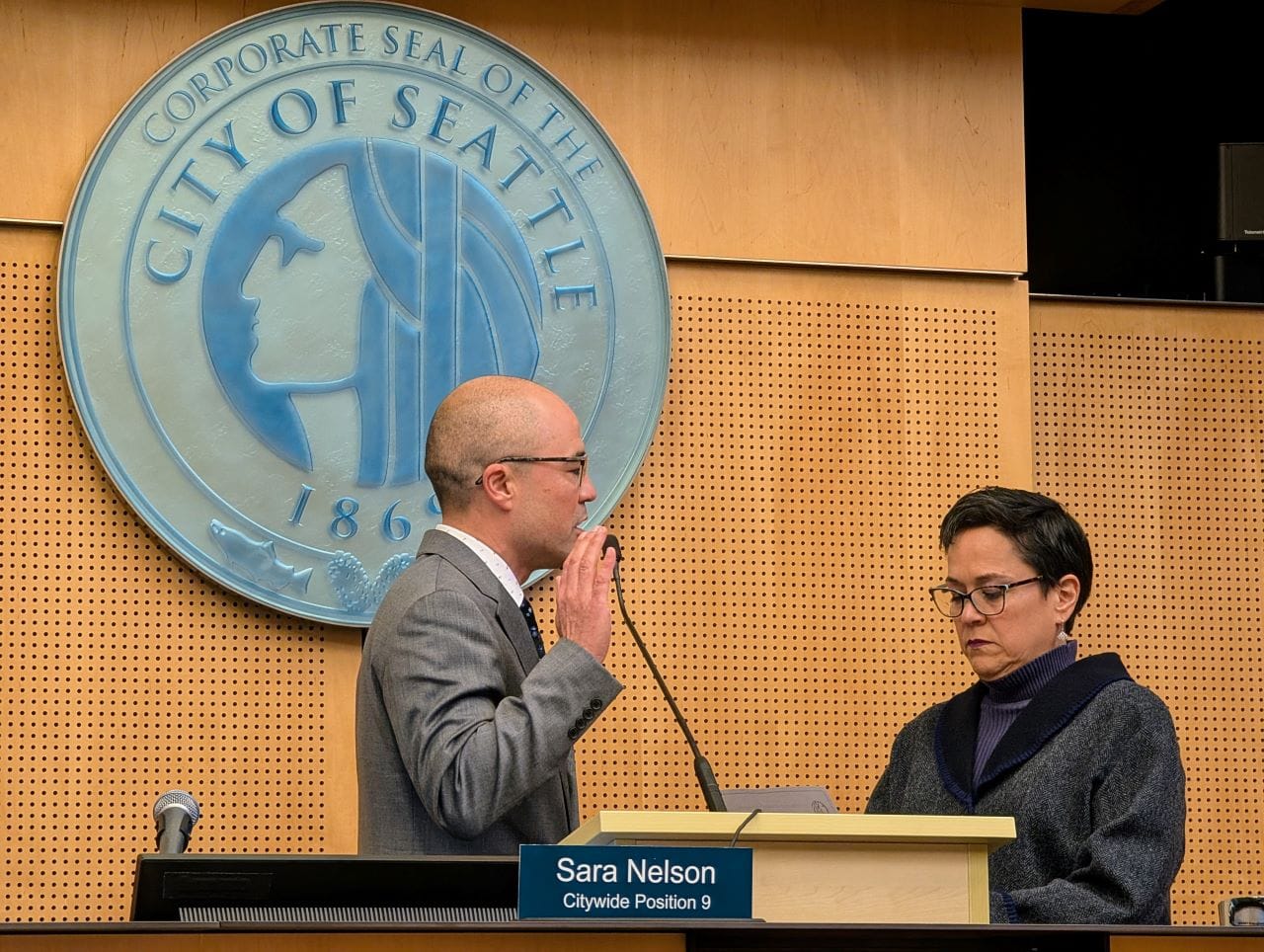
Councilmember Alexis Mercedes Rinck spoke of the atmosphere of fear preventing Seattleites from carrying on daily activities such as going to work, sending their kids to schools, and receiving medical care. “The stakes could not be higher,” Rinck said. “Our neighbors are quite literally being disappeared off of our streets.”
Rinck also spoke of community members sharing a noticeable increase in visible racism and xenophobia in Seattle’s streets.
Meanwhile, earlier in the week, Mayor Katie Wilson’s “Standing Up for Our Values” transition team held a town hall to discuss how to protect Seattleites, particularly immigrant and LGBTQ+ communities, from federal threats. More than a hundred people attended the meeting to share their experiences and concerns and stand in solidarity with community members.
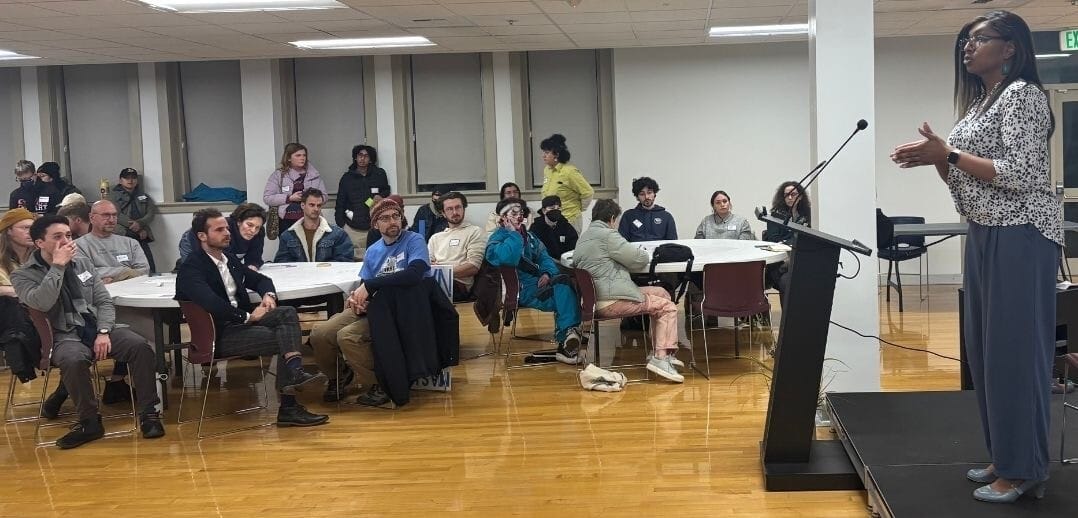
Immigrant and refugee community members spoke of how afraid they were to even be attending the meeting, and how the fear of being detained or killed impacts their daily lives. They also spoke of the fear of not being able to go safely to work, which would mean being unable to pay their rent and ultimately being evicted.
Transgender community members spoke of their experiences of transphobia in Seattle and the current transgender relocation crisis. In a recent survey, 9% of transgender respondents said they’d moved to a different state between November 2024 and June 2025, which one person estimates could mean 400,000 transgender people moved during that time period.
Attendees expressed a mixture of distrust in the Seattle Police Department (SPD) and the desire for SPD to step in to protect people from ICE and arrest ICE agents who are acting illegally.
One attendee, who was a circus artist, noted police’s mistreatment of left-wing protestors: “I also don’t think that the solution is to take that power and give it to SPD, because the Seattle Police Department is a menace to a lot of us. Last summer, when the counter protesters at Cal Anderson Park were just brutally beaten by SPD, they came out with a statement afterwards from their union reps that said, we operate in the heart of antifa land. What makes you think that they have any interest in protecting those of us who are anti-fascist?”
Many community members spoke against widespread surveillance in Seattle, saying it was making them less safe.
A person who grew up undocumented in Texas argued many companies are profiteering off mass deportation and surveillance: “I’ve witnessed the economics of criminality, of deportation, and locking people up in jails for as long as I’ve been an activist: families being torn apart, Black or Brown people being surveilled unlike ever before, while putting billions of that money into the pockets with companies like Amazon, Microsoft, Google, Oracle, Palantir, Axon, Flock and many others that profit from the economy of mass surveillance, deportation and incarceration.”
Community members had a list of requests for Wilson, including:
- Turning off the surveillance cameras, license plate readers, and the real time crime center in Seattle.
- Providing more support for immigrant and refugee communities.
- Providing more support for transgender people, especially those relocating to Seattle, including job programs.
- Canceling contracts with companies with a direct relationship to ICE.
- Requiring SPD to withdraw from the Joint Terrorism Task Force and the Washington State Fusion Center so they are not directly cooperating with ICE and DHS agents.
- Banning all staging and operations of any federal law enforcement activities on public and City property.
- Preventing SPD from arresting protesters who are protesting ICE or other immigration enforcement and/or trying to protect community members from ICE.
- Eliminating the use of SPD to attack local mutual aid networks that have organized to protect at-risk residents.
While Wilson wasn’t invited to attend this event, several community members expressed disappointment that she wasn’t present. More than one person shared feelings that WIlson hasn’t acted decisively enough since taking office.
“I think we should be clear that there are stakes for Mayor Wilson as well and the longevity of her administration,” a participant said. “So far, what you’ve seen is a lot of talk and not a lot of action. We’ve seen this during the campaign, she spoke openly against the establishment of the CCTV system in the city, and now, since she’s in office, it’s still going. What happened to that? She says she’s waiting to hear from immigrant rights groups. They’ve already spoken. They’ve said those surveillance cameras should be gone, and they’re still there.”
The Wilson administration’s response
The Mayor’s Office issued a press release on Thursday afternoon outlining the steps Wilson plans to take in response to the current constitutional crisis and federal violence.
The list of commitments includes providing City employees with updated training about how to report and respond to enforcement activity, having all departments conduct a data privacy review, posting clear signage of private spaces on city properties, and coordinating with other elected officials in the state.
In addition to moving quickly on spending money designated during the budget process last year for supporting immigrant communities, Wilson will issue an executive order prohibiting civil federal immigration authorities from using property that is City-owned and -controlled for civil immigration enforcement activities.
The Mayor’s Office announced the new “Stand Together Seattle Initiative,” which will invite private property owners to post notice that their properties cannot be accessed by federal agents without a warrant.
A hotline will also be established, led by a “trusted community-led organizational partner,” where city departments and community organizations can share information about federal enforcement activities that can then be passed along to concerned community members.
Finally, Wilson will “require the Seattle Police Department to investigate, verify, and document any reports of immigration enforcement activity.” This will include SPD officers validating the identity of ICE agents, using body-worn and in-car video, and securing scenes where ICE might have done something illegal in order to gather evidence.
However, the Mayor’s Office said the mechanism for the above is an updated directive, with no plan to enshrine the instructions in official SPD policy, which would provide accountability for SPD officers to comply.
The press release contains no mention of the surveillance technology currently operating in Seattle, which appears to allow the current surveillance status quo to continue.
“So many of us are shocked and heartbroken by the news out of Minneapolis, and share a growing concern that our city too could come under attack by the federal government,” Wilson said in the release. “The federal government is causing profound, long-term harm to so many communities, and we all have a shared responsibility to organize, practice solidarity, and do what we can to keep Seattle safe.”
As Washington and Seattle elected officials scramble to respond to the possibility of a federal incursion, Gomez has lessons to share from Minneapolis.
“The fact of the matter is that we have to be clear-eyed about the truth, which is that state and local policy are not the tool with which to respond to an authoritarian federal regime,” Gomez told The Majority Report. “Those tools are inadequate.”
Gomez presented an alternate solution to authoritarianism on the march: “We, the people” coming together, being courageous, and taking care of one another.