

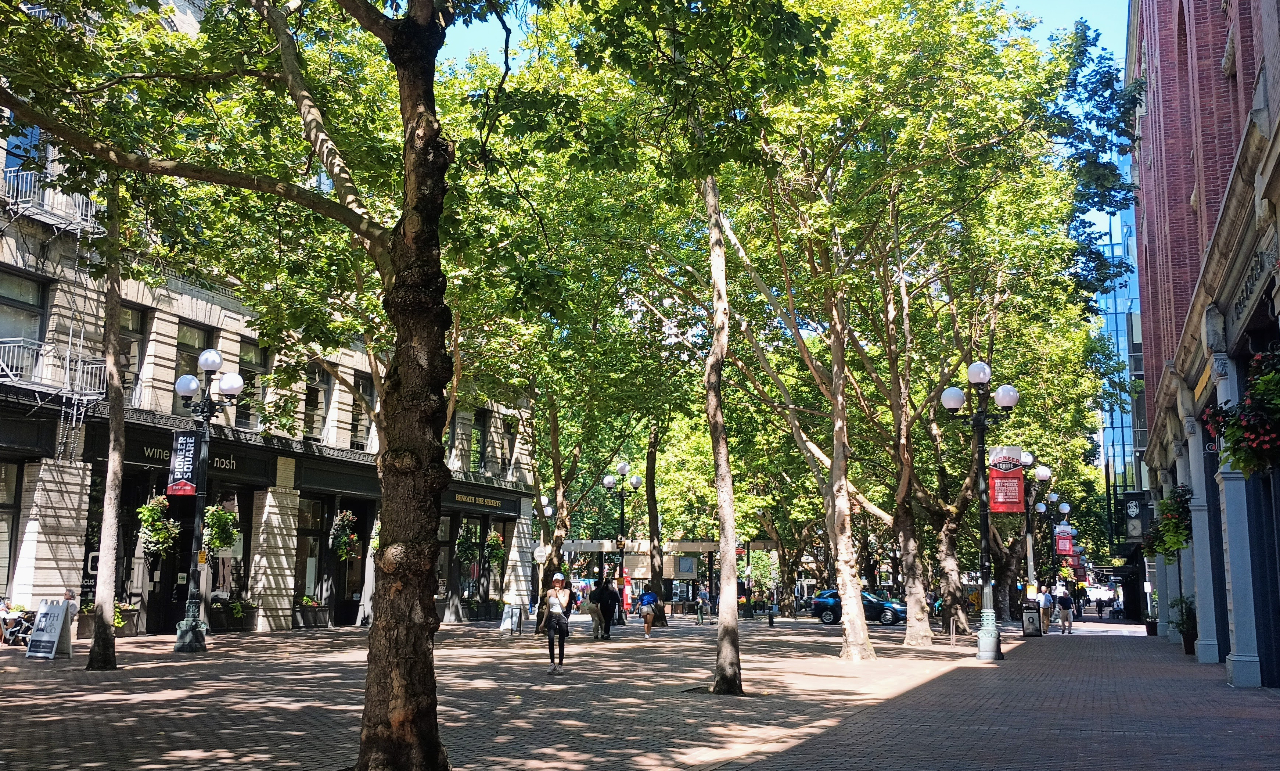
Advocates for urban trees are raising the alarm about drastic budget cuts put forward by Democrats in the Washington House. The entire urban forestry program at the state’s Department of Natural Resources (DNR) looks to be on the chopping block, with impacts rippling down to city and county governments who rely on state support to access federal dollars to maintain their urban canopy.
The Washington State Urban and Community Forestry (UCF) Program provides technical assistance to local governments, tribes, and nonprofits across the state when it comes to work to plant and sustain trees and other vegetation, and directly provides grant funding for them to advance that work. Most of the funding that it administers comes through the United States Department of Agriculture (USDA), dollars that require dedicating staffing support at the state level to secure. Since 2008, the department has administered close to 250 grants intended to increase urban tree canopy in jurisdictions of all sizes throughout Washington.
But the supplemental two-year budget released earlier this week by House leaders would zero out funding for urban forestry.
“It’s not a reduction per se, it’s an elimination of a program,” Will Rubin, Communications Manager for DNR’s Forest Resilience Division, told The Urbanist.
Some of the projects enabled via the UCF program over the past few years include installation of a rain garden with new tree plantings at the Title I First Creek Middle School in Tacoma in 2019, workforce training that resulted in the planting of 400 native plants and removal of invasive species in South King County in 2023, the planting of 302 trees in downtown Snoqualmie in 2024, and the creation of an invasive plant and pest management plan in Mason County in 2024.
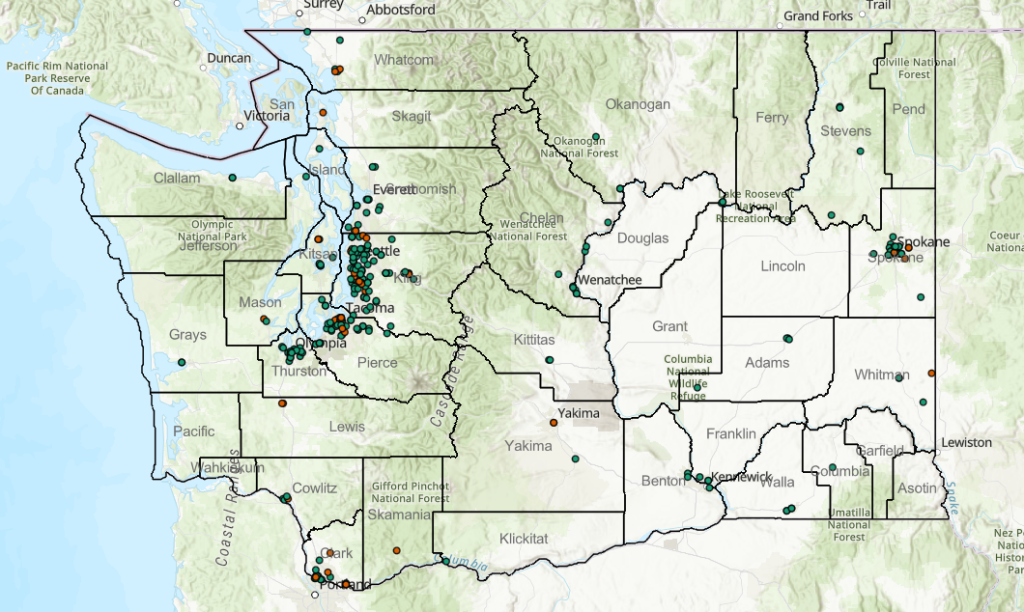
Not only would the elimination of DNR’s program make it much harder for these communities to access federal tree funding in the future, zeroing out the program right now could require those local partners to pay back any funds tied to work that isn’t able to be wrapped up by the time the state budget takes effect on July 1.
“There’s about $5.5 million of active pass-through funding out there, federal funds that the state has passed through to these communities. Those are executed projects, those are executed agreements, and cutting this program would call into question the future of those executed projects,” Rubin said. “[If] we don’t have the staff to do that work, then that work’s not getting done. So, it’s not exactly an unfunded mandate that can be accomplished without funds. It’s not like we can move these people into wildfire [division at DNR] to have them do the work over there. So, it’s an existential proposal that way.”
The Urbanist reached out to House Majority Leader Joe Fitzgibbon (D-34th, West Seattle) and Appropriations Committee Chair Timm Ormsby (D-3rd, Spokane) for a comment on these potential cuts, but neither were available for an interview ahead of the publication of this story. The House’s proposed budget still needs to be reconciled with the version advanced by the state Senate before the end of the legislative session on March 12.
In the wake of the 2021 heat dome event in Washington, in which dangerously high temperatures resulted in at least 159 excess injury deaths over the course of three sweltering weeks in June and July, there’s been increased attention on the role that urban trees play on temperature control.
Tree canopy counteracts the urban heat island effect, which drives temperatures up in cities, largely due to the heat absorbing qualities of pavement and concrete. Low-income neighborhoods and communities of color tend to be the most lacking in tree canopy and bear the brunt of urban heat as a result. A 2019 study focused on Madison, Wisconsin found that an urban tree canopy that reaches 40% maximizes the amount of cooling that occurs during high-temperature events — reducing temperatures by as much as seven to nine degrees Fahrenheit.
“The science is clear on the need for more of a urban tree canopy as far as heat islands and mitigation for climate change and making sure that some of our most vulnerable populations are able to benefit from our urban tree canopy, so those frontline communities would be directly impacted,” Snohomish County Councilmember Megan Dunn told The Urbanist.
Dunn is a member of DNR’s Urban Forestry board and has a front-row seat to the types of investments that the state program is able to leverage.
“I know it’s a hard budget year, and these are hard decisions, but eliminating the program is what we’re concerned about. I would understand the need to reduce some of it, but to completely eliminate it, I think is, unfortunately, a short-sighted decision,” Dunn said.
Another city that depends on support from the DNR program is Tacoma. With just 21% of the city’s land covered by trees, Tacoma ranks at the bottom of the list for tree canopy rates across Puget Sound, and is unlikely to meet its goal of achieving 30% tree canopy coverage by 2030. That said, Mike Carey, Tacoma’s Urban Forest Program Manager, told The Urbanist that the impacts of these state cuts would likely fall disproportionately on smaller cities and towns that don’t have their own urban forestry programs.
“The state DNR program is so fantastic in that they get to bridge those jurisdictional gaps, and they get to connect partners. So while I might be doing a project in Tacoma, and somebody might be doing a project in University Place or Federal Way or somewhere that’s surrounding us,” Carey said. “They’ve really been the hub for a lot of the work that’s happening at the state and they have awareness of all of these programs and projects, and they’ve been able to connect community partners to leverage each other. And that, in and of itself, is a huge wealth of knowledge and resource to the State of Washington that would go away.”
In the context of the $79.2 billion operating budget proposed in the House, the cuts being eyed here are not significant, with the program’s ongoing costs totaling just $3 million. But those dollars pay large dividends across the state and almost certainly bring in more dollars from outside the state than what it costs to administer.
“The grant money that we receive from the state isn’t necessarily a huge amount of money, but we’re using that to amplify our own funds, our own partnerships locally and community based organizations work,” Carey said. “And so it’s not just the money that’s being redacted, it’s the leveraging of local grant resources and local dollars as well. And that capacity just goes away with this too. And so it’s so much more than just what the state is looking to remove.”
Along with these proposed cuts, House Democrats are also poised to divert more than $300 million from the Climate Commitment Act — dollars that had been poised to fund clean energy, flood resilience programs, or public transit — in order to backfill a the state’s Working Families Tax Credit. All of this is happening in the shadow of climate denial at the federal level, with the Trump administration increasingly abandoning climate work. Many environmental advocates have pointed to that fact in pushing officials to do even more at the state level to combat climate change.
“At a time when we’re seeing longer summers, hotter summers, events like the heat dome, we can’t afford to go backwards,” Rubin said. “We can’t afford to just go pretend that urban forestry doesn’t exist, and it would have a long, run on effect with communities up and down the I-5 corridor, [and] across the state. You don’t need to be an ‘urban area’, like a Seattle or Tacoma or an Olympia or a Yakima or Spokane, to have urban forests.”

Ryan Packer has been writing for The Urbanist since 2015, and currently reports full-time as Contributing Editor. Their beats are transportation, land use, public space, traffic safety, and obscure community meetings. Packer has also reported for other regional outlets including BikePortland, Seattle Met, and PubliCola. They live in the Capitol Hill neighborhood of Seattle.