

Seattle Mayor Katie Wilson’s administration is queuing up housing density increases within two blocks of all frequent transit corridors. Seattle Office of Planning and Community Development (OPCD) Director Rico Quirondongo revealed the plan at the February 26 meeting of the Seattle Planning Commission.
The announcement comes on the heels of the roll out of the Comprehensive Plan’s second phase, which includes targeted upzones only directly along streets where frequent buses run — on top of 30 new neighborhood centers clustered around existing business districts — and completely steps away from density increases where they had previously been proposed, but where the City faced community pushback.
“I’d like to provide some clarity so that there is no misunderstanding about where we are. OPCD and the new administration have every intention of putting into our phase 4 Supplemental Environmental Impact Statement, the expansion of upzones to two blocks on either side of frequent transit corridors, and that will be all frequent transit corridors that are as defined by Seattle Department of Transportation,” Quirondongo said. “That scoping is not something that we have on paper at this time. That is not a consultant that we have on board at this time. I’m just speaking to what our intention is as staff and the discussions that we have had with the administration.”
Quirindongo said the plan would need to go through a full environmental study, which would put the zoning change to what the department is calling “Phase 4” of the One Seattle Comprehensive Plan. The plan was due at the end of 2024, but Phase 4 is looking like a 2027 or 2028 effort. The delays and cuts to scope stem from former Mayor Bruce Harrell, whose team pushed back on an early OPCD plan to add upzones more broadly than his ultimate plan did.
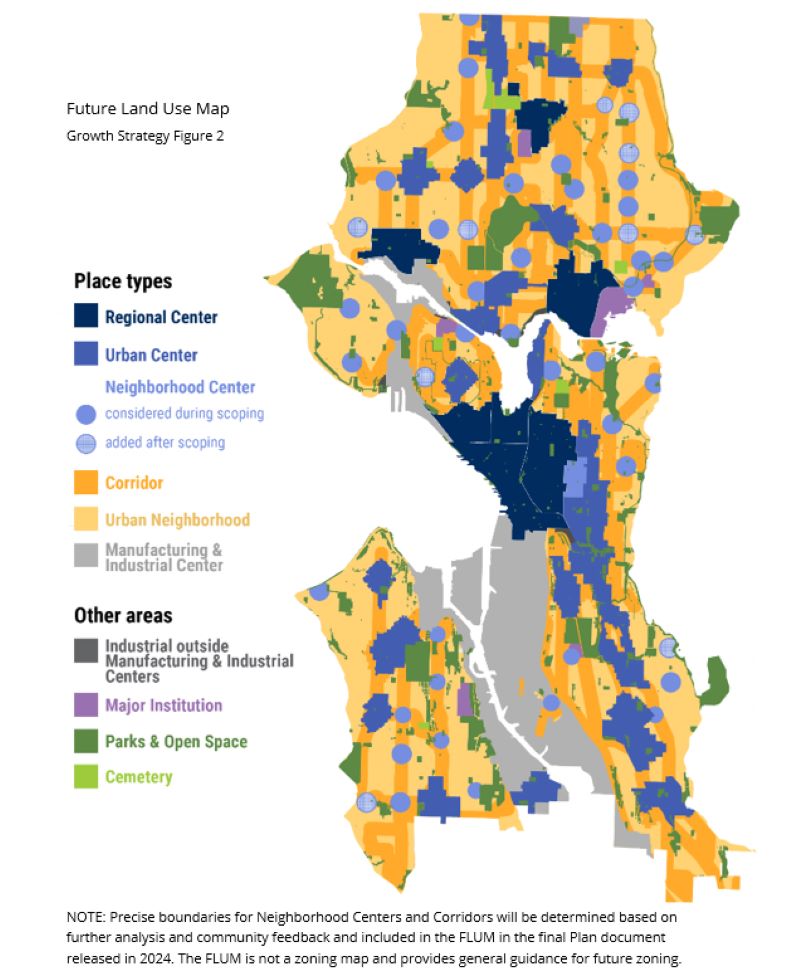
Harrell’s scaled back plan was widely criticized by housing advocates, with the Seattle Planning Commission among those pushing the City for a bolder plan adding more housing density and broader corridor upzones.
The planning commission pledged support for the two-block plan. In fact, a few planning commissioners appeared to push the City to go further, noting that policymakers could use generous land use policy to induce a virtuous cycle with more transit and greater ridership.
“We tend to maybe not center the fact that land use and density needs to come first for transit service to follow, even though it seems like it’s the other way around,” Commissioner Dhyana Quintanar Solares said. “It is this chicken and egg situation where the land use does drive where service and demand and future ridership potential and increasing fair revenue and justifying infrastructure expenditures and investments go. So I think putting forth a vision of where these corridors and the expanded TOD perspective and upzones happen should have the opportunity to plant where we want to see frequent transit.”
OPCD again pointed to legal requirements for environmental study as limiting the City’s ability to implement corridor upzones on a faster timeline. Phase 3 is already scoped to include the eight additional neighborhood growth centers that city councilmembers discussed last year. Department leaders have said shoehorning more upzones into that study would delay phase 3, as reported earlier in The Urbanist.
“The final EIS for the Comp Plan and zoning legislation that was released in early 2025 studied a preferred alternative that included upzones along transit corridors at a depth of generally half a block, in most cases, including only those parcels that had frontage on the arterial served by the transit,” Sarah Graves, OPCD’s Communications Manager, told The Urbanist following Quirondongo’s appearance at the planning commission. “OPCD had studied a concept of wider upzones in the draft EIS. However, analysis of that alternative was not as detailed as in the FEIS and not sufficient to fully address SEPA requirements legislation to enact significantly broader zoning changes, such as going out to one or two blocks from the arterial.”
The early plan that OPCD internally floated in 2023 and The Urbanist revealed through public records request, included wider transit corridor upzones using an eighth-mile radius that appears even broader than the Wilson administration plan. Harrell also cut OPCD’s 50 proposed neighborhood growth centers down to 30.
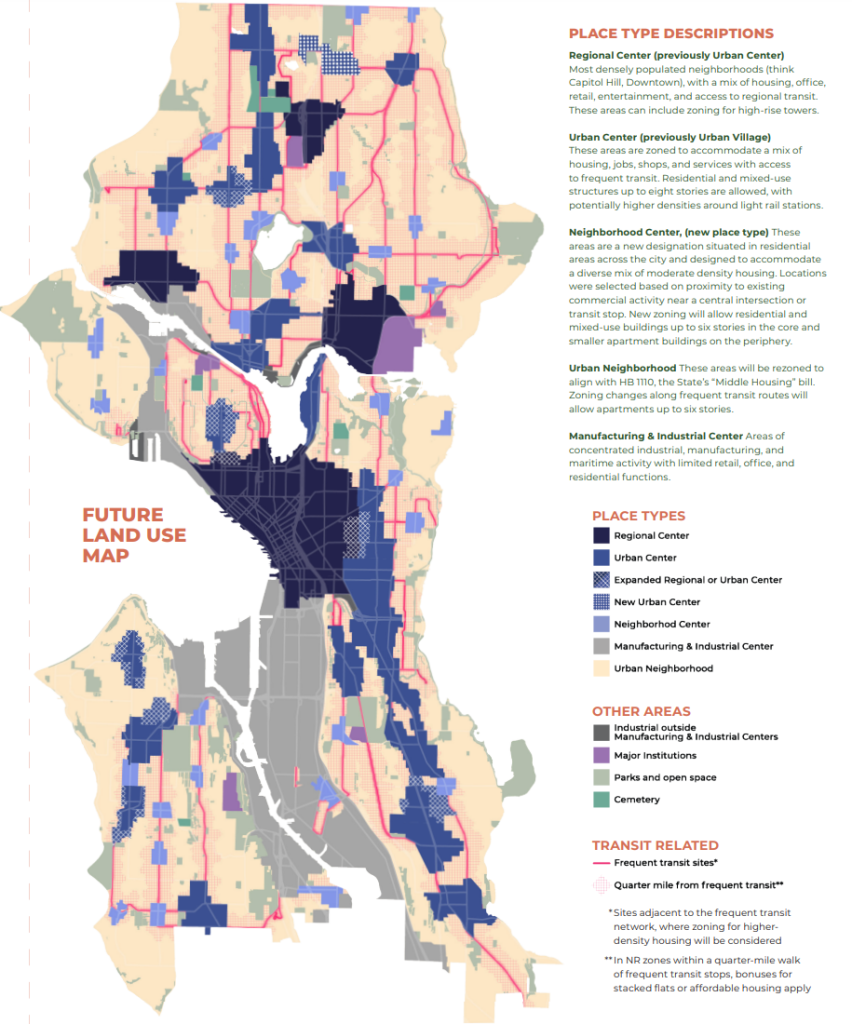
Whether two-block-radius transit corridor rezones for midrise apartments are enough to sate housing advocates and urbanists remains to be seen. As the earlier lessons with the Harrell administration shows, an overly limiting environmental study can come back to bite the city and tie policymakers’ hands later in the process.
Before all is said and done, it could be that Harrell’s decision set the city backed by four years on more fully embracing transit-oriented development citywide, rather than in handpicked locations that often allow wealthy and well-connected neighborhoods to weasel out of doing their fair share. The change in leadership does appear to mean that those transit corridor upzones are coming eventually.

Doug Trumm is publisher of The Urbanist. An Urbanist writer since 2015, he dreams of pedestrian streets, bus lanes, and a mass-timber building spree to end our housing crisis. He graduated from the Evans School of Public Policy and Governance at the University of Washington in 2019. He lives in Seattle's Fremont neighborhood and loves to explore the city by foot and by bike.