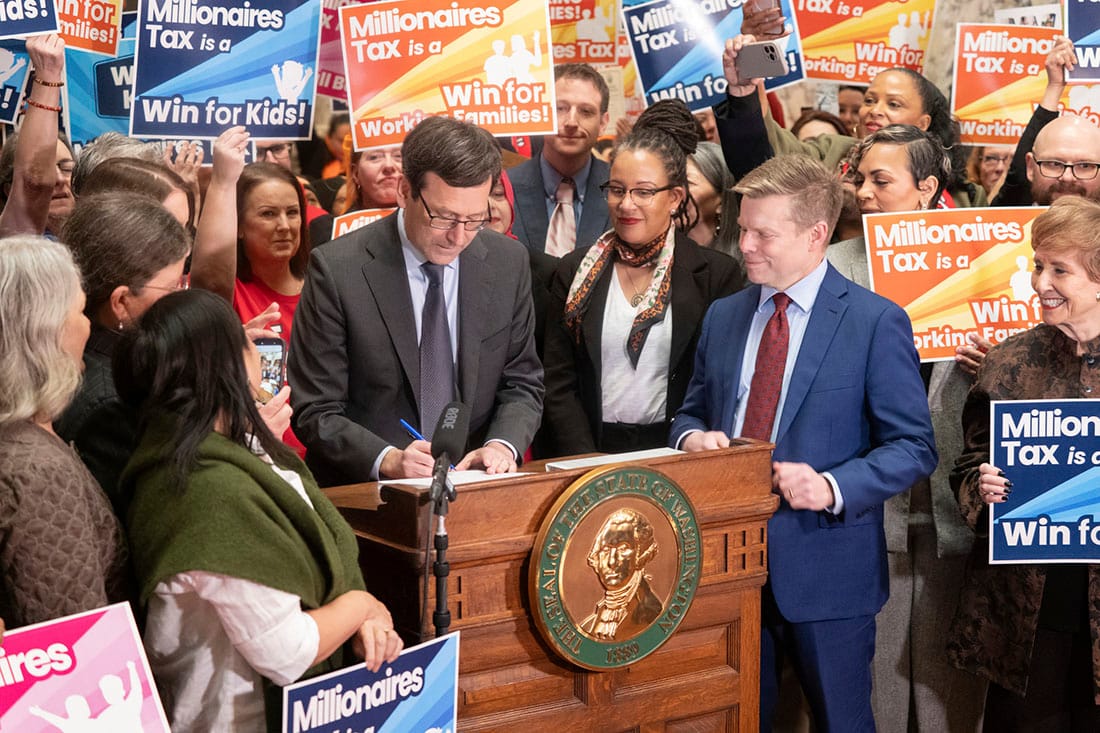
On Monday, Governor Bob Ferguson signed the historic “millionaires” income tax that State Democratic leaders see as a huge step forward in balancing the state’s tax code.
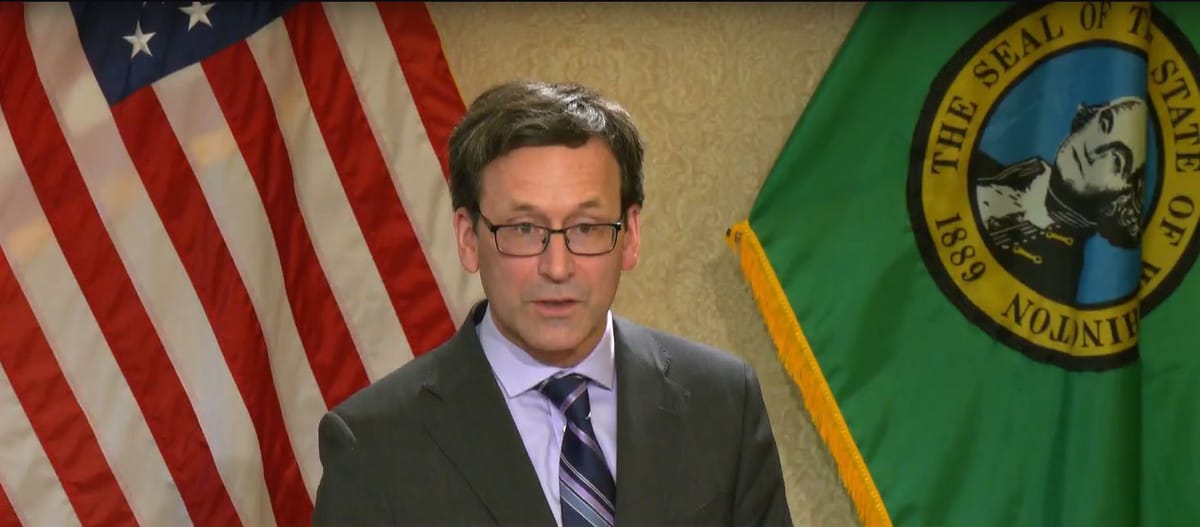
“Washington families whose income is in the bottom 20% pay a whopping 13.8% of their total income in state and local taxes, while the wealthiest pay a far smaller percentage of their income,” Ferguson said at the bill signing ceremony. “That's not fair, and that's not right.”
The new tax would levy a 9.9% tax on income above $1 million and is expected to collect between $3 billion and $4 billion per year. The state will not begin collecting the tax until 2029, in part to allow time for the expected bevy of challenges against the tax to be resolved.
“Less than one half of 1% of all Washingtonians will pay tax on income over a million dollars in a single year,” Ferguson said.
The senate bill was sponsored by Senate Majority Leader Jamie Pedersen (D-43rd Legislative District, Seattle).
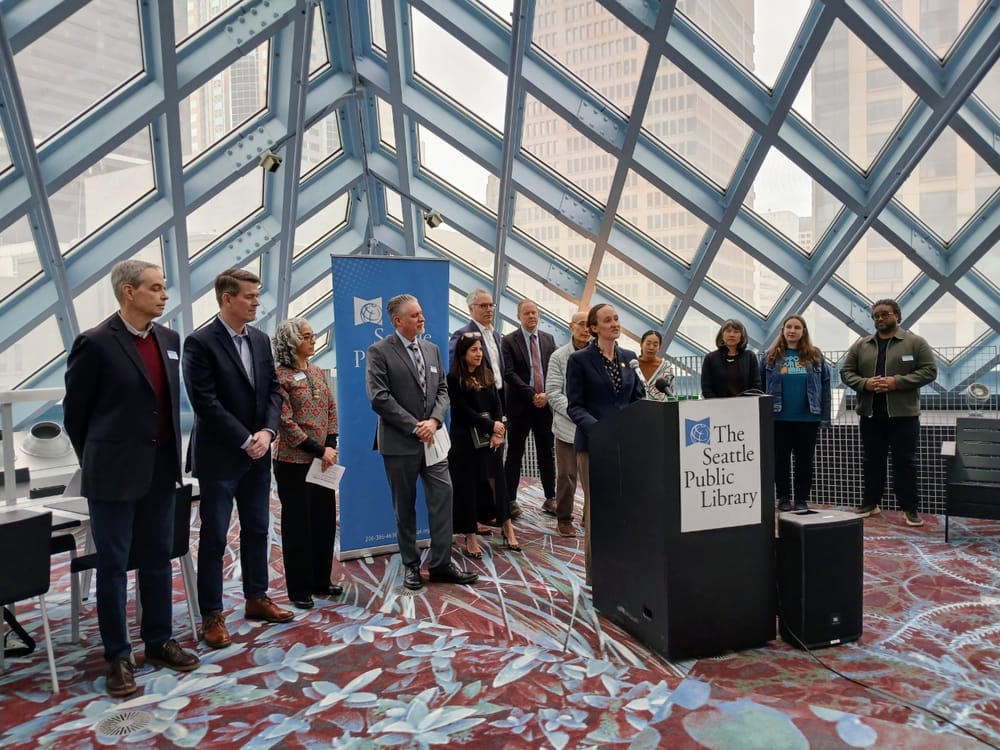
“With this bill, we're going to begin to right a historic wrong that has plagued our state for nearly 100 years and made our tax system one of the worst and most regressive in the entire country,” Pedersen said at the signing. “We've asked Washington's working families for far too long to shoulder far too much of the tax burden for the things that we all care about, and we have not asked enough of our wealthiest neighbors.”
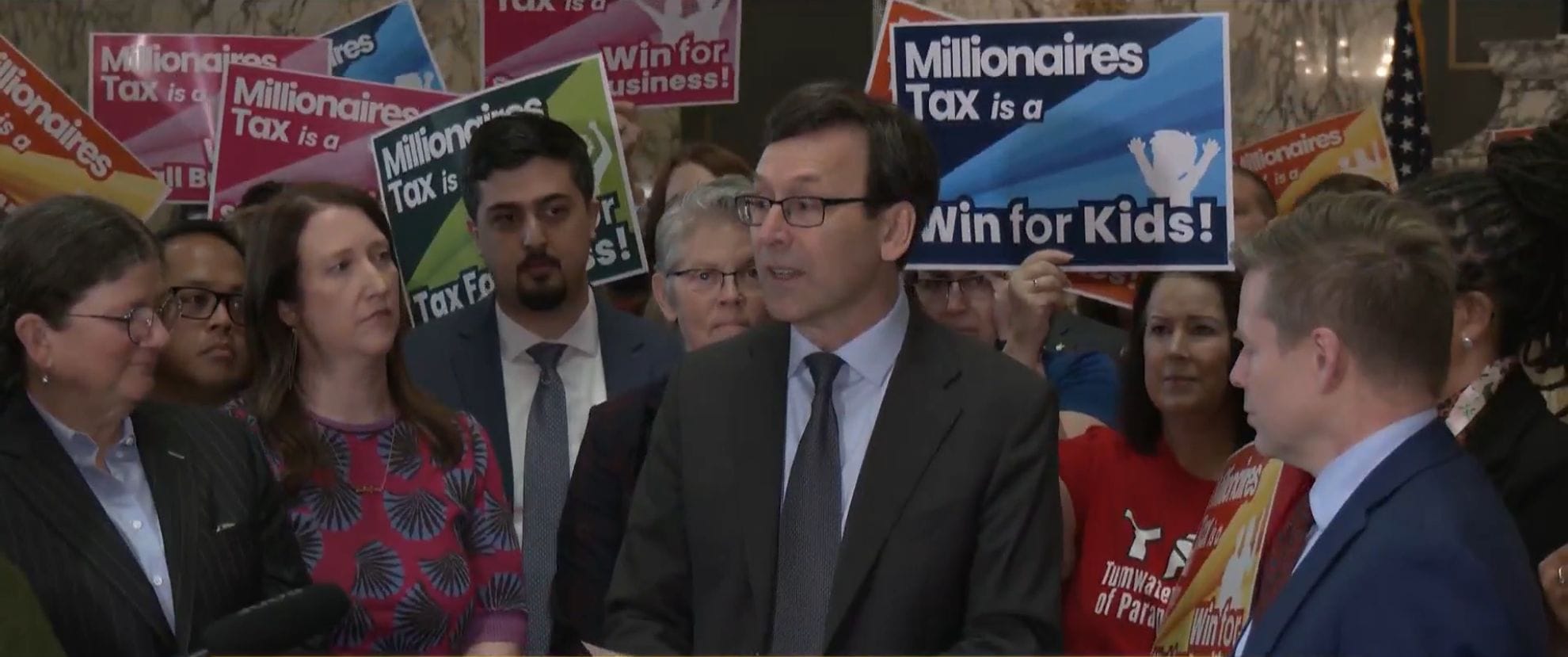
While Ferguson has been supportive of the millionaires’ tax since the beginning of the legislative session, earlier in March he threatened to postpone its passage until next year unless lawmakers allowed for “more than half” of the revenue to be given back to Washingtonians in the form of tax relief.
Later in the month, Democratic lawmakers called the governor’s bluff and presented a proposal that Ferguson supported. According to analysis by The Seattle Times, approximately 28-30% of the new tax revenue in the passed proposal will actually go to tax relief.
“I’ve also been clear that I’m open to other good ideas on how to send revenue back to the people,” Ferguson said. “My colleagues in the Legislature certainly delivered.”
The largest amount of tax relief will be provided by repealing last year’s sales tax added on previously exempt services, such as IT and software development. This repeal will negatively impact local governments who generate part of their revenues via sales taxes. In particular, Sound Transit’s long-term revenue forecast is expected to be significantly reduced as a result of this change.
The bill provides for a major expansion of the Working Families Tax Credit, more than doubling the number of working families who will qualify for the annual reimbursement that ranges from $300 to $1,300. It removes the sales tax from the purchase of diapers, over-the-counter drugs, and hygiene products such as shampoo and toothpaste. And it increases the state’s business & occupation tax exemption to $300,000 in annual gross revenue, providing tax relief to small businesses.
Five percent of millionaires’ tax revenue is dedicated to the Best Starts for Kids fund, which pays for child care and early education.
The remainder of the new revenue will go directly into the general fund, where lawmakers can allocate it as they see fit. The bill states an intent to use some of the money to fund breakfast and lunch for children in K-12 education, but it doesn’t contain an enforceable commitment to do so.
Opposition to the new tax
The fight to add an income tax has a lengthy history in Washington, with numerous false starts.
In 1932, Washingtonians voted to approve a new state income tax, but the proposal was struck down by the state’s Supreme Court the following year. Since that time, there have been numerous failed attempts to enact an income tax. Instead, revenue for the state is largely dependent on sales, property, and business & occupation taxes.
Sales tax is considered particularly regressive, falling heaviest on those with lower incomes, since a greater share of their income goes into taxable purchases. The property tax is also considered relatively regressive, with landlords typically passing on costs to tenants and “house-poor” homeowners acutely feeling property tax hikes.
Washington is one of only nine states that don’t levy an income tax on their residents.
Opponents say the millionaires tax is unconstitutional, will result in capital flight, and will stifle innovation and business development. They also worry the tax will be expanded to lower incomes further down the road.
However, a similar tax in Massachusetts is actually collecting more revenue than anticipated this year, which suggests that fears of capital flight did not materialize.
The Citizen Action Defense Fund has already announced it’s preparing to launch a lawsuit against the tax, led by former Washington Attorney General Rob McKenna, who ran for governor on the Republican ticket in 2012, but lost to Jay Inslee.
The state GOP, led by Rep. Jim Walsh (R-19th LD, Aberdeen), is planning to file lawsuits against the millionaires tax.
The cases will have to work their way up to the state Supreme Court and are likely to be heard after this year’s election, when five of the nine Supreme Court seats will be on the ballot. Two are entirely open seats with no incumbent running, while three are currently held by Ferguson appointees, who are generally assumed to enjoy at least some of the benefits of incumbency.
While the judicial code of conduct means the judges under consideration aren’t allowed to share how they’d likely rule on challenges to the millionaires income tax, it seems likely Ferguson wouldn’t have knowingly appointed a judge who would reject such a tax.
While election races for Supreme Court Justices are nonpartisan, endorsements tend to act as a sign of potential political leanings. The opportunity to swing the millionaires’ tax ruling could give conservatives extra encouragement to go all in bankrolling state Supreme Court campaigns.

Meanwhile, Brian Heywood of Let’s Go Washington has filed a referendum to appeal the tax. Heywood will need to sue in order to remove language that currently prevents such a ballot challenge. Should this effort fail, Heywood has said he’ll pursue an initiative instead.
Republican leaders have been stanchly against the millionaires’ tax, even as recent polling indicated early support among Republican voters in the state.
In spite of the oft-repeated fear of capital flight, not all wealthy individuals in the state oppose the tax.
Bryan Kirschner, a technology executive at IBM, spoke in favor of the tax at the signing on Monday.
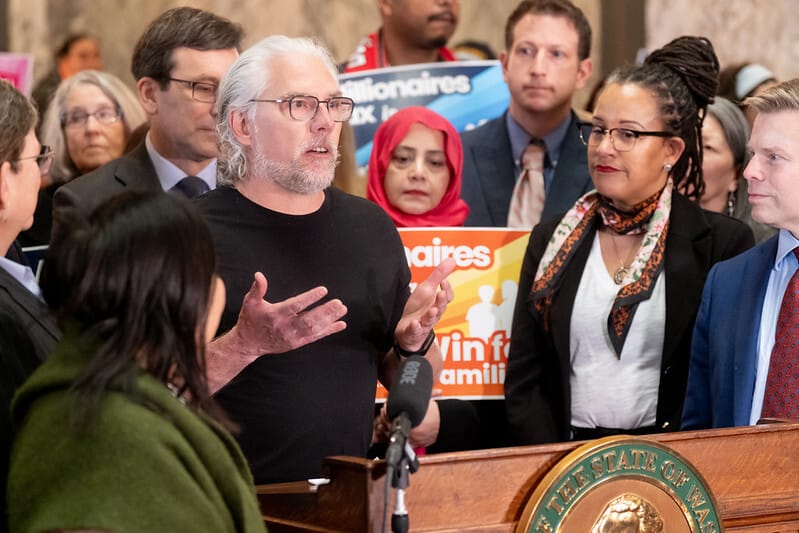
“For too long, rich people like me have paid less than we truly do [owe] thanks to a tax code skewed our way so our state budget can't do right by all people,” Kirschner said. “That's about to start to change with this millionaires tax. For those saying us rich folks will leave if taxed, I can promise you, we won't pack up en masse, and any who leave will be replaced. Washington is on the brink of creating a lot of wealth through AI. We are right to capture some of it and make sure everyone benefits through education, health care, and more tax fairness for small businesses and working families.”
Rick Steves, the travel writer and television personality, also supports the tax.
“As a wealthy person myself, I see this tax as essentially free money for all Washingtonians,” Steves wrote on his Facebook page. “Everybody in my state gains. And speaking from personal experience, I know that anyone who earns enough to be subject to this tax is beyond the point where consuming more adds to their security, their well-being, or even, arguably, their happiness — meaning there will be basically zero human cost.”
The answer to Trump?
While moving to better balance the tax code, Ferguson says the millionaires tax will also help the state continue to provide services threatened by the Trump administration.
“It's also fair to say that this disparity was made much worse by President Trump's massive tax cuts for the wealthy, paid for, by the way, with cuts to necessities like health care and food assistance that have tremendous harm to the people of Washington State,” Ferguson said. “Millionaires and billionaires, in other words, got a huge tax cut at the expense of working families.”
The Urbanist is a nonprofit newsroom powered by reader support. Become a member, get perks, and support local journalism.
But because funds from the millionaires tax won’t be collected until 2029, the state faces a few years without additional money to help soften the blow from last year’s H.R. 1 cuts. Starting in 2027, states will be forced to establish and enforce work requirements for those on expansion Medicaid and take on an increased amount of SNAP’s administrative costs. Those on expansion Medicaid will also have to requalify every six months, which is likely to lead to lapses of coverage.
Consequences from the loss of federal subsidies for health insurance have already begun to hit, with 19,000 fewer people enrolling in the state’s online marketplace for 2026, while premiums for individual insurance on the marketplace rose an average of 21%.
A different tax proposal introduced during this legislative session sought to address Trump’s cuts more directly and quickly, but was sidelined in the House’s Finance committee. Rep. Shaun Scott (D-43rd LD, Seattle) sponsored the Well Washington Fund, which would have levied a payroll expense tax on corporations similar to Seattle’s JumpStart tax.
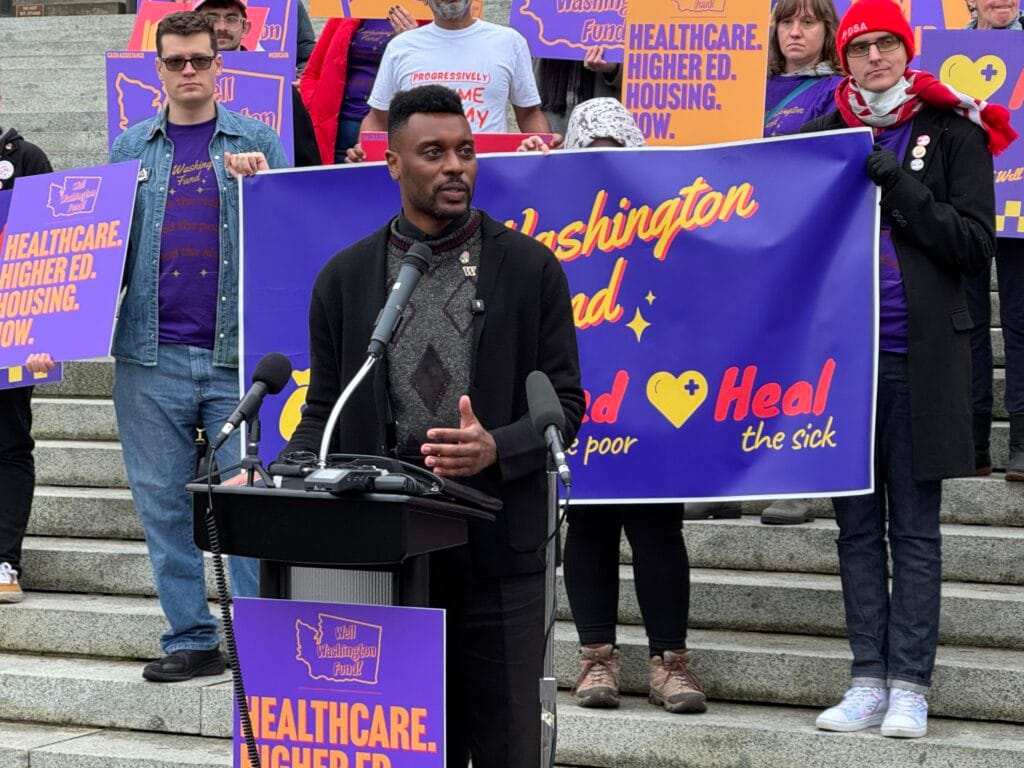
Half of the money collected would have been placed into a special fund that would have only been allowed to pay for certain categories deemed particularly at risk from the Trump administration: higher education, health care (especially Medicaid), cash assistance programs, and energy and housing programs.
“Understand that state governments could protect people from the funding reductions that we are seeing from the federal government,” Scott said in a legislative session review last weekend. “Right now, the Trump administration is grifting on the shoddy fabric of American liberalism, promising ICE agents college debt cancellation, affordable housing, gainful employment. Fascism follows austerity. When state governments step back from the social contract, authoritarianism and right wing extremists fill the void.”
Pedersen did not support the Well Washington Fund, unlike his Democratic primary challenger, Hannah Sabio-Howell, who argued this position shows Pedersen is out of step with his district. A labor advocate with progressive ties, Sabio-Howell co-chaired The Urbanist Elections Committee the last two cycles, before stepping down after last election.
Scott was also part of the successful fight to remove a $550 million corporate tax break from the millionaires tax earlier this session.
Scott pledged to reintroduce his Well Washington Fund in a future legislative session.
“If Washington is serious about protecting its people from the other Washington, we must realize there is no such thing as social justice without economic justice,” Scott said.
 Amy Sundberg