
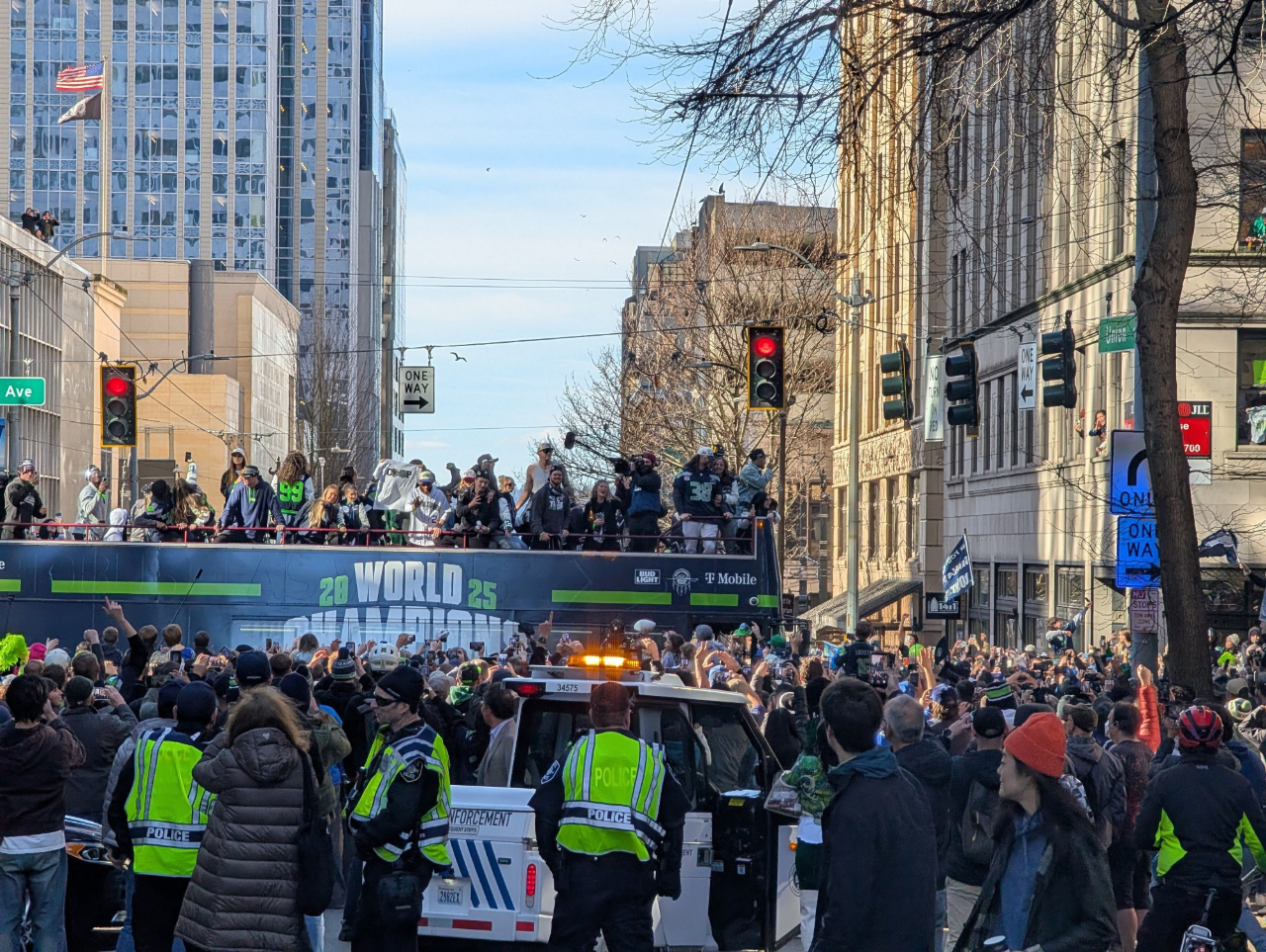
Earlier this month, the Seattle Seahawks won the Superbowl, but the city was not done etching records into the history books. On Wednesday, February 11, Seattle hosted a victory parade and smashed previous one-day records for light rail ridership and scootershare/bikeshare, as upwards of one million people attended the festivities stretching across downtown.
Sound Transit tallied a record-smashing day, exceeding 200,000 boardings on Link light rail.
“Wednesday didn’t just break our daily ridership record. It blew it out of the water,” Sound Transit said in a video released on Instagram. “Early estimates show more than 200,000 boardings on Link. That’s 100,000 more than this day last year. Sounder added more than 20,000 boardings, and many more took ST Express. As numbers continue to come in, we expect them to go up! Thank you, everyone!”
The previous Link ridership record had 159,500, according to Sound Transit. That record was set May 24, 2025 during the Northwest Folklife Festival, which attracted about 250,000 people to the Seattle Center, augmenting ridership that day.
Special trips on Sounder commuter rail trains from Tacoma and Everett also saw record ridership, with around 20,000 riders, around three times average weekday usage levels.
Lime scootershare record
Meanwhile, Lime reported nearly 60,000 trips on their shared scooters and bikes, in their largest single day of ridership in Seattle.
“The numbers confirmed that the best way to navigate the parade, or the city generally, was on two wheels, whether it was e-bike, e-scooter, or Glider,” said Brent Vigneault, General Manager of Operations at Lime, in a statement. “We worked closely with the City to prioritize safety and orderliness, including deploying extra foot patrols along the route and rebalancing vehicles to make sure folks could find a ride. Beyond being a victory for the Seahawks, we see this as a proof point for transportation in Seattle as the city prepares for the FIFA World Cup this summer: the hottest trend for sports will be getting around sustainably.”
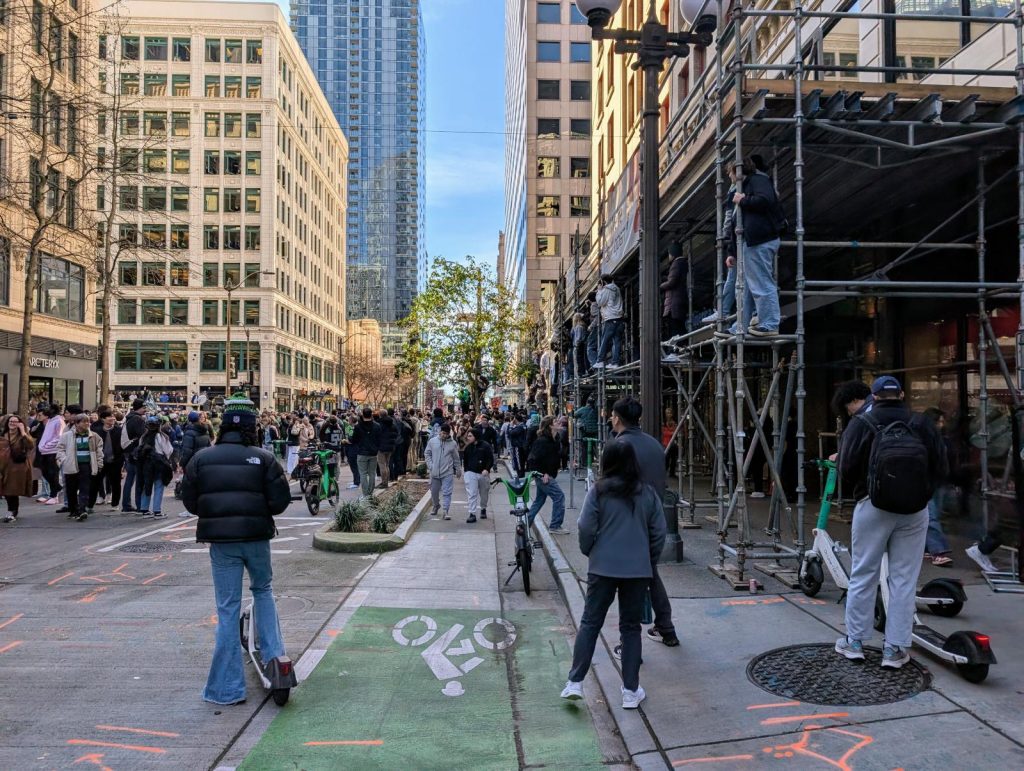
As Lime’s spokesperson alluded, the parade surge served as a stress test for the FIFA World Cup. As one of the host cities, Seattle will stage six soccer matches from June 15 to July 6. The parade day provided proof that Link can scale up considerably to meet demand, and Lime was also able to shoulder a greater load. Lime had been averaging about 20,000 daily rides this winter, before nearly tripling that figure on the victory parade day. Ridership is significantly higher in summer months, and Lime averaged about 30,000 rides per day in 2025.
The parade also demonstrated that people can still get around Seattle even if we close a car thoroughfare often deemed indispensable. Street pedestrianization does not seem as big of a lift as it has been made out to be. If you pedestrianize it, the people will come — the gridlock may not.
More ridership records inbound
In a transit system and region growing as quickly as Seattle, records are made to be broken. The expansion of the Link network continues to push system capacity and ridership potential upwards. During the World Cup, Link will almost assuredly smashes its records again, helped by a game-changing extension of the 2 Line.
The crosslake opening of the 2 Line will be a major leap forward in that regard, turning today’s East Link starter line into a 30-mile line spanning much of region. Already simulated service in preparation of the March 28 grand opening has doubled train frequencies from Seattle’s busy downtown stations north to Lynnwood.
As it stands, the 1 Line has been averaging more than 110,000 daily boardings in its best months, while the 2 Line (in its Eastside-only, abridged form) has exceeded 10,000 daily rides in its best months.
During the parade, the ridership bounce for King County Metro buses was likely less pronounced — The Urbanist has reached out to Metro for estimates and will update this story when they are available.
Unlike light rail, Metro buses were caught up in the congestion and detours that the parade down caused. The parade route on 4th Avenue required rerouting dozens of buses, while rippling traffic jams later in the day continued to disrupt bus service, likely dissuading some would-be riders from boarding. Some riders reported sluggishly slow bus routes, even well into the aftermath of the parade. Metro rerouted many bus routes to stay away from the parade, and ran a special shuttle to get riders around if their original route didn’t get them all the way.
Installing more bus lanes, as Mayor Katie Wilson has proposed, would help insulate Metro routes from congestion, particularly when paired with automatic camera enforcement to catch scofflaws. It could be a necessary step to handle future ridership surges without hiccups and bus gridlock.
And let the record also show that this year’s Superbowl also set ridership marks in the South Bay Area. Valley Transportation Authority reports that ridership in Santa Clara, California hit 30,000 light rail and bus trips on Superbowl City. That qualifies as a record-breaking day in the suburban enclave, and was 5,000 rides higher than the agency projects.
If the San Francisco 49ers still played in, well, San Francisco, one can easily fathom that transit usage would have been much higher. But, alas, the Niners have relocated to Silicon Valley strip mall land and have the transit system to match. Just another area where Seattle comes out on top.

Doug Trumm is publisher of The Urbanist. An Urbanist writer since 2015, he dreams of pedestrian streets, bus lanes, and a mass-timber building spree to end our housing crisis. He graduated from the Evans School of Public Policy and Governance at the University of Washington in 2019. He lives in Seattle's Fremont neighborhood and loves to explore the city by foot and by bike.