Washington and Oregon are officially taking a new approach to tackling a pair of aging bridges that carry Interstate 5 over the Columbia River, putting off plans for highway widening and interchange upgrades that have been moving forward for years.
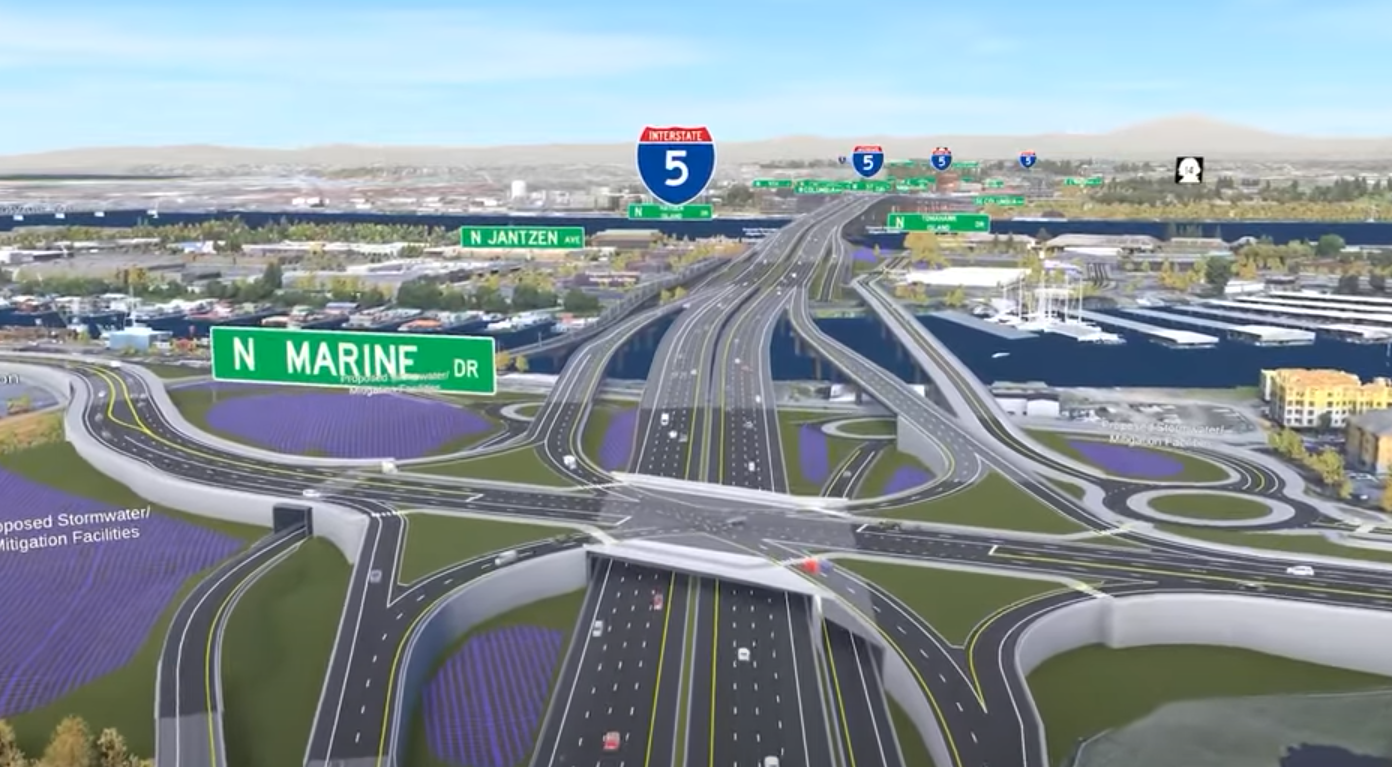
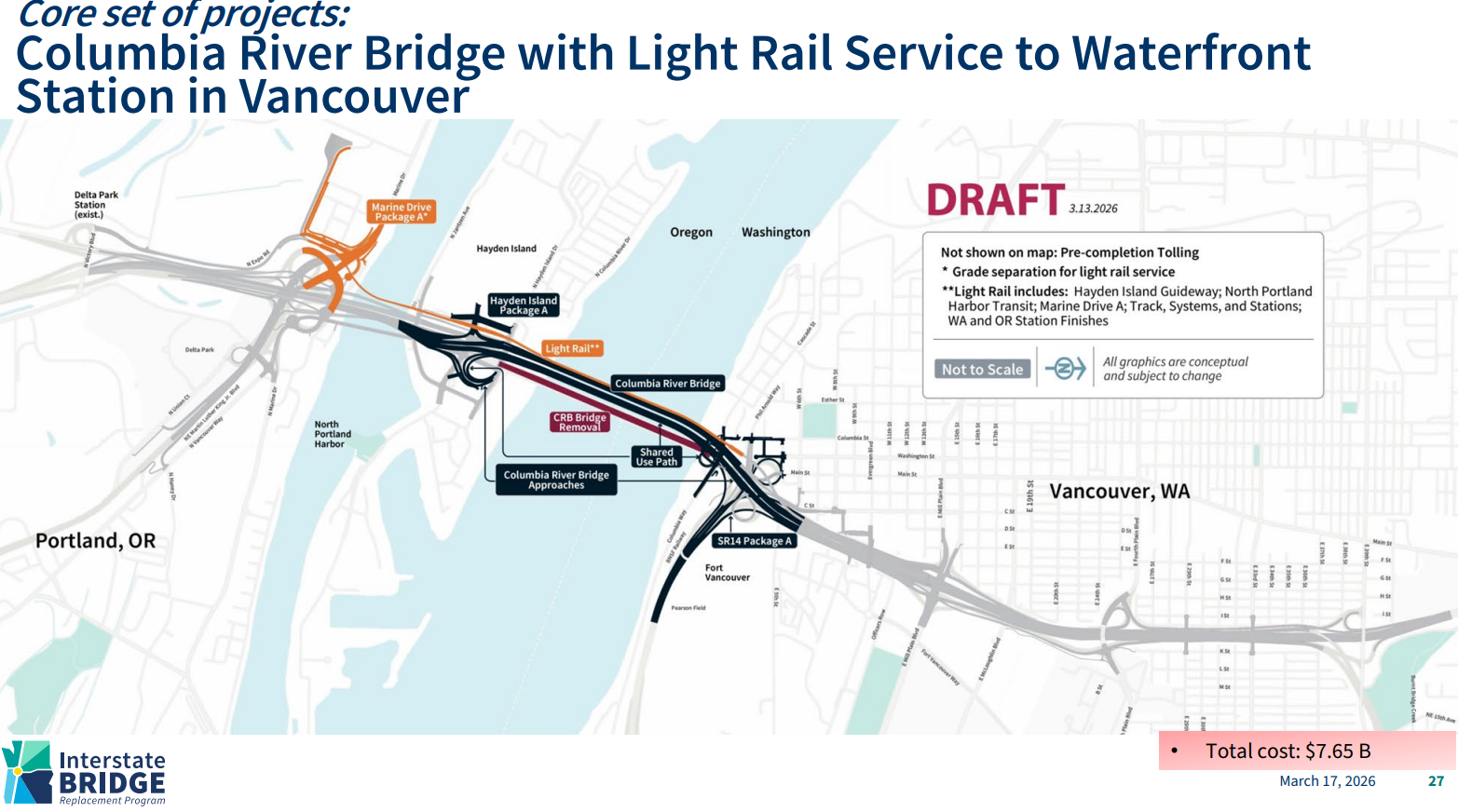
After a new $13.5 billion to $15.2 billion cost estimate for the full Interstate Bridge Replacement (IBR) was made official by project leaders Tuesday, Washington Governor Bob Ferguson announced that a "core set of projects" will become the new priority. Five miles of I-5 expansion, and seven new interchanges stretching from Portland to Vancouver, will be left to a future date, but a light rail extension between Expo Center and Downtown Vancouver remains in the plans.
State leaders are hoping for federal transit funding to advance the overall project forward. Under the Trump administration that funding is very much in doubt: Not a single new transit construction grant has been signed 421 days into Trump's second term, as Urban Institute's Yonah Freemark recently noted.
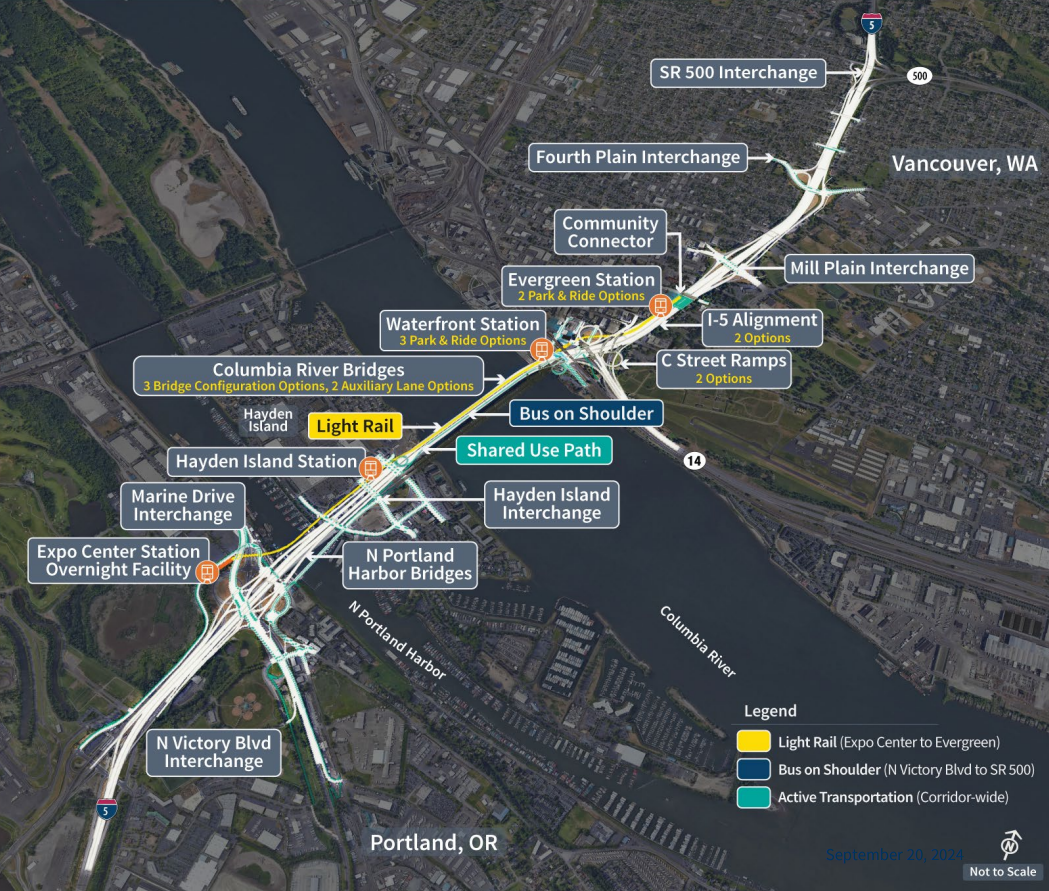
"I'm here today with key project partners to make it clear that we are all committed to moving forward with a core set of projects to replace our bridge with a modern fixed-span structure, including light rail," Ferguson told reporters. "Fortunately, we have enough funding in place to keep up our momentum and start construction on these core projects. Construction will start in 2028."
Although today was the first time that the IBR's office, jointly managed between Washington and Oregon, had publicly acknowledged the massive cost to complete the full highway project, those costs had been leaked last year by Portland economist Joe Cortright, a longtime watchdog on the IBR.
The total cost for the slimmed down set of projects is expected to be $7.65 billion, with a lower price tag of $5.9 billion attached to a bridge replacement that merely leaves room for light rail in the future. While Ferguson reaffirmed his support for the light rail extension, without funding from the Federal Transit Administration (FTA), that element looks unlikely to move forward with the bridge replacement work.
While Oregon Governor Tina Kotek, up for reelection this year, did not make an appearance at Tuesday's announcement, Ferguson claimed her full support for the new approach.
"We need a new bridge and it's time to start building it," Kotek said in a statement. "By focusing our available funding on a core set of projects, we can deliver what Oregonians have been waiting on for decades: a modern, earthquake-ready bridge, with no bridge lifts, less traffic congestion, extended light rail and better options for people walking and biking, At my direction, [the Oregon Department of Transportation] will focus on protecting Oregon taxpayers by making sure this critical project is delivered as efficiently as possible.”
The announcement is a major concession to advocates who had been pushing for the megaproject, which, if fully built would be the most expensive highway project in Pacific Northwest history, to be "right-sized" for years. The Just Crossing Alliance, which includes a broad array of environmental and sustainable transportation advocacy groups from both states, has been advocating for a bridge design that prioritizes transit and active transportation since it was formed in 2022.
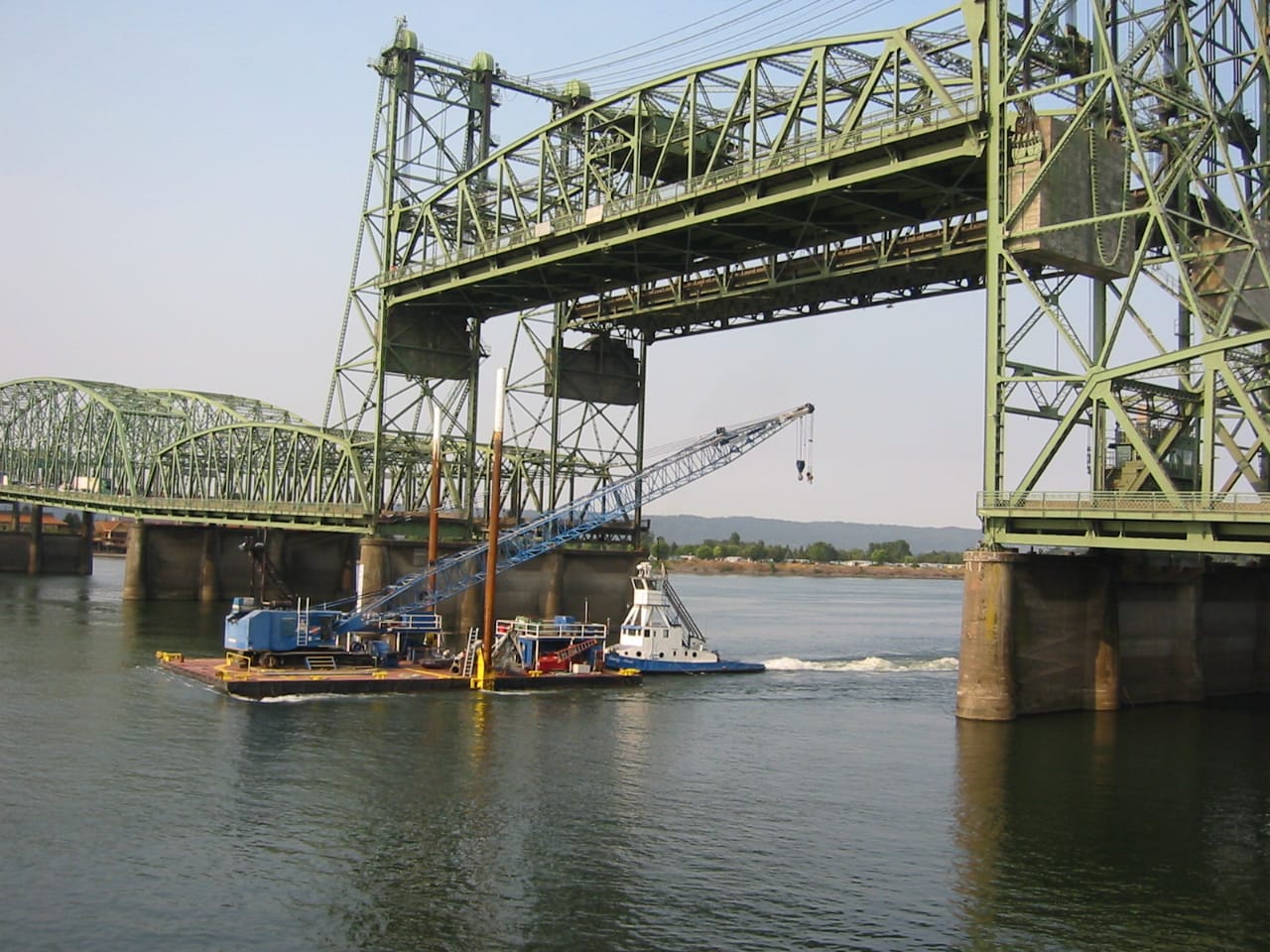
"These bridges constitute about a mile of this five-mile project, which also contains seven freeway interchanges," the alliance's website notes. "We believe breaking the IBR program into distinct projects that can be separately evaluated and prioritized would both make it easier to address the crossing itself and be more accountable to the public and the many other transportation priorities in the region."
While the shift in the conversation this week could ultimately be a first step toward that right-sizing, so far there are no signs that either Ferguson or Kotek are ready to throw in the towel on the rest of the project. Highway boosters have long touted the benefits of the IBR on regional congestion, with the addition of two "auxillary" lanes to I-5 in either direction. Project officials have also claimed safety benefits from upgraded interchanges.
The Urbanist's Spring Member Drive is in full swing, now with a website redesign offering ad-free reading for donors! Take advantage and support local journalism with a monthly donation.
Many highway skeptics will likely see this pivot as another way to get the camel's nose under the tent and keep the freeway-widening vision alive.
"We do this in phases, right? So this isn't the first and won't be the last project that happens over phases as funding comes in," Ferguson said.
Just where funding would come from for future project phases is anyone's guess. Washington's legislature has reached the point of issuing $1.3 billion in new debt just to funding basic maintenance work on the state highway network, and the future budget outlook is even more bleak in Oregon.
Just last month, Oregon legislators there redirected funding intended for multimodal projects, like safe routes to school, toward highway projects rather than rethinking highway expansions.
Oregon State Senator Khanh Pham (D-23rd District, Portland) has raised concerns that highway expansion is bankrupting the state – and that costs are being obscured from the public eye.
"I was truly shocked by the updated price tag this past January that leadership had hidden from the public," Pham told The Urbanist. "I hope today’s decision marks a turning point in the IBR project in which the agencies acknowledge the financial realities of our state budgets and the imperative to curb excessive megaproject spending to preserve funding for core functions of our transportation system. It’s imperative that policymakers in both states continue to push back against an oversized, bloated project and demand that ODOT propose and deliver a right-sized bridge with a right-sized budget that doesn’t bankrupt our state."
Even just advancing these "core projects" with a bridge that's merely ready for light rail in the future, the project remains around $450 million short of funding. A chart to be presented to the IBR's Executive Steering Group Tuesday afternoon showed how those funding gaps aren't expected until at least 2033, making it very tempting for state officials to advance toward construction now.
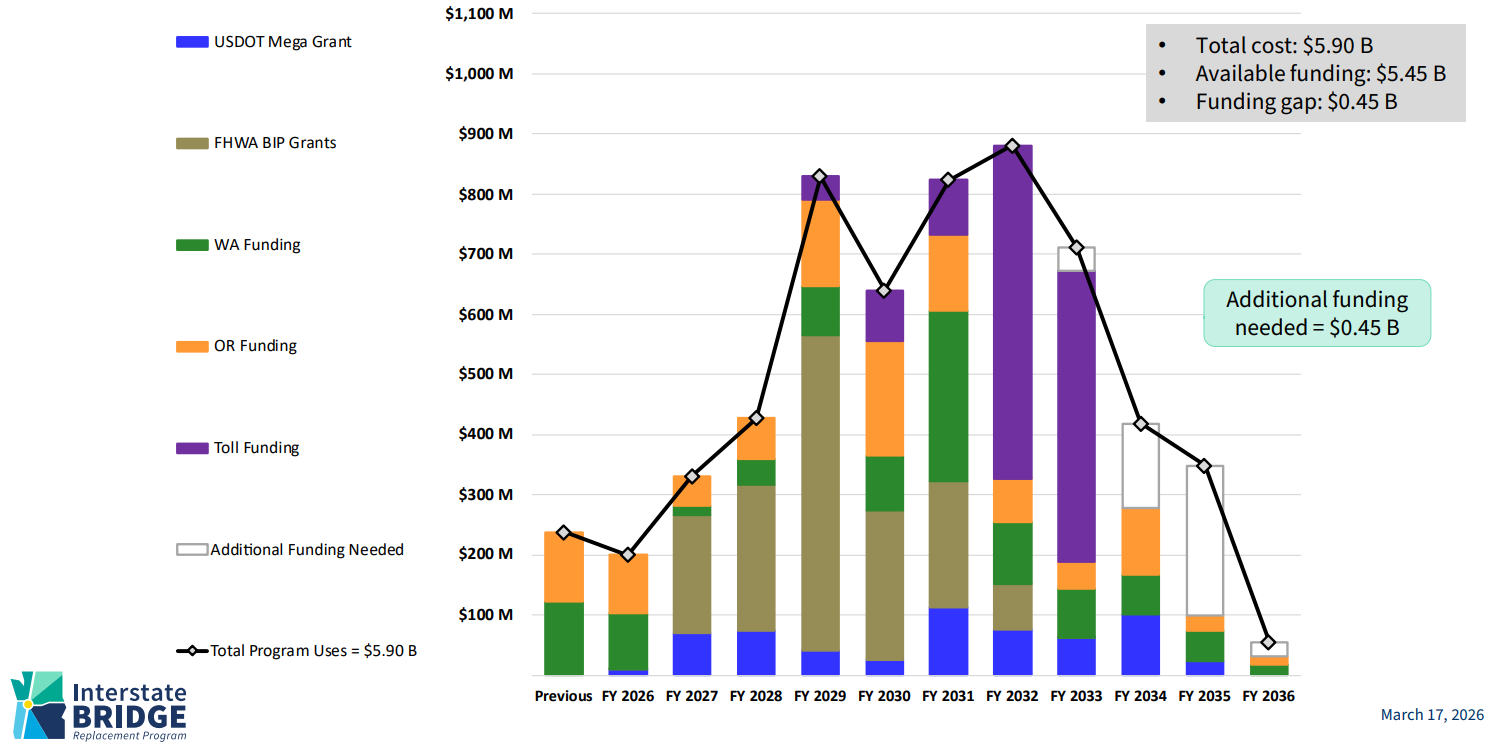
Forthcoming analysis of the impact of tolls on I-5, which have now been pushed off to 2028, is expected to narrow the funding gap even further, according to the same presentation.
With light rail's full costs added into the project, the funding gap widens to $1.2 billion, even with the receipt of a $1 billion Capital Investment Grant (CIG) from FTA – though that amount also includes the removal of the existing pair of bridges. Despite Ferguson's comments in support of extending the MAX Yellow Line to Vancouver, it's clear that the entire project can advance forward without light rail, with the CIG grant not expected to be awarded until 2031.
"I'm relatively new to this project, but I know how important light rail is," Ferguson said. "That literal and figurative train has left the station. We're going forward. We're going forward light rail."
IBR Program Administrator Carley Francis, who took over for longtime leader Greg Johnson earlier this year, told reporters that they expect to receive federal approval to move forward later this year, with a Final Environmental Impact Statement (FEIS) being finalized now. That process has been repeatedly delayed – the FEIS had initially been pledged in 2023.
While far from the end of the debate over ultimately widening I-5 over the Columbia River, Wednesday's announcement clearly represents a new era for that discussion. Officials spinning an urgent need for upgraded river crossings have now spun off that project from the rest of the megaproject, using it as a foot in the door for those less popular, unaffordable elements.
 Ryan Packer
 Ryan Packer