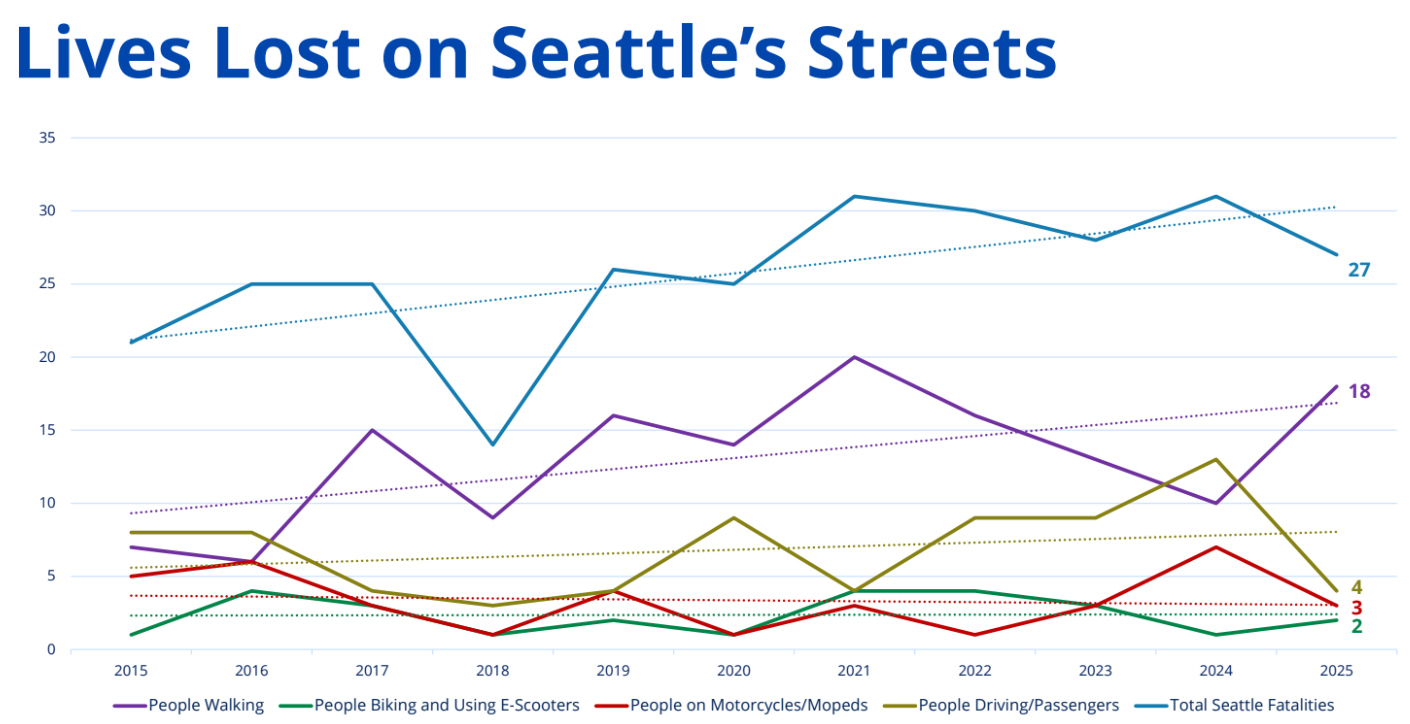
As Mayor Katie Wilson starts to get a foothold in influencing the sprawling work of the Seattle Department of Transportation (SDOT), the city's Vision Zero program is back in the spotlight this month. Newly revised data from 2025 on the impact of traffic violence across the city makes it clear that the goal of scaling serious injuries and fatalities down to zero by the end of this decade has stalled out.
Seattle saw a traffic crash that left someone seriously injured or killed roughly every 35 hours last year. More than 10 years into making a Vision Zero commitment, 27 lives were lost in total, including 18 pedestrians who were killed while trying to get around the city.
That death toll rivals 2023, when 20 pedestrians were killed, a high that hadn't been seen in decades. Despite clear success expanding the protected bike lane network, improving safe routes to school, and making safety-related upgrades on specific streets, Seattle is still heading in the wrong direction when it comes to Vision Zero.
Councilmember Rob Saka, who chairs the council's transportation committee, has called for a performance audit of the Vision Zero program, which the City Auditor's office has now tentatively scheduled for this fall. That audit would come just three years after SDOT conducted a "top to bottom" review of the same program, an effort that resulted in some recommendations for improvements, but sidestepped a thorough evaluation of missed opportunities and how to get safety results on a much faster timeline.
That opaqueness continues to this day. At a presentation last week in front of the transportation committee, Venu Nemani, SDOT's Chief Safety Officer, responded to a question from Councilmember Alexis Mercedes Rinck about post-project evaluations by bringing up two examples that dated back to the Durkan era. Nemani cited case studies from 2018 that were used to inform a citywide reduction in arterial speed limits, and a 2020 study looking at the effects of a protected bike lane installation on NE 65th Street. He did not cite any more recent examples.
Nemani also mentioned that SDOT publishes before-and-after studies from safety projects on its website, but the most recent one published dates from 2017. He did acknowledge that SDOT could do better when it comes to being transparent about the impact of its projects.
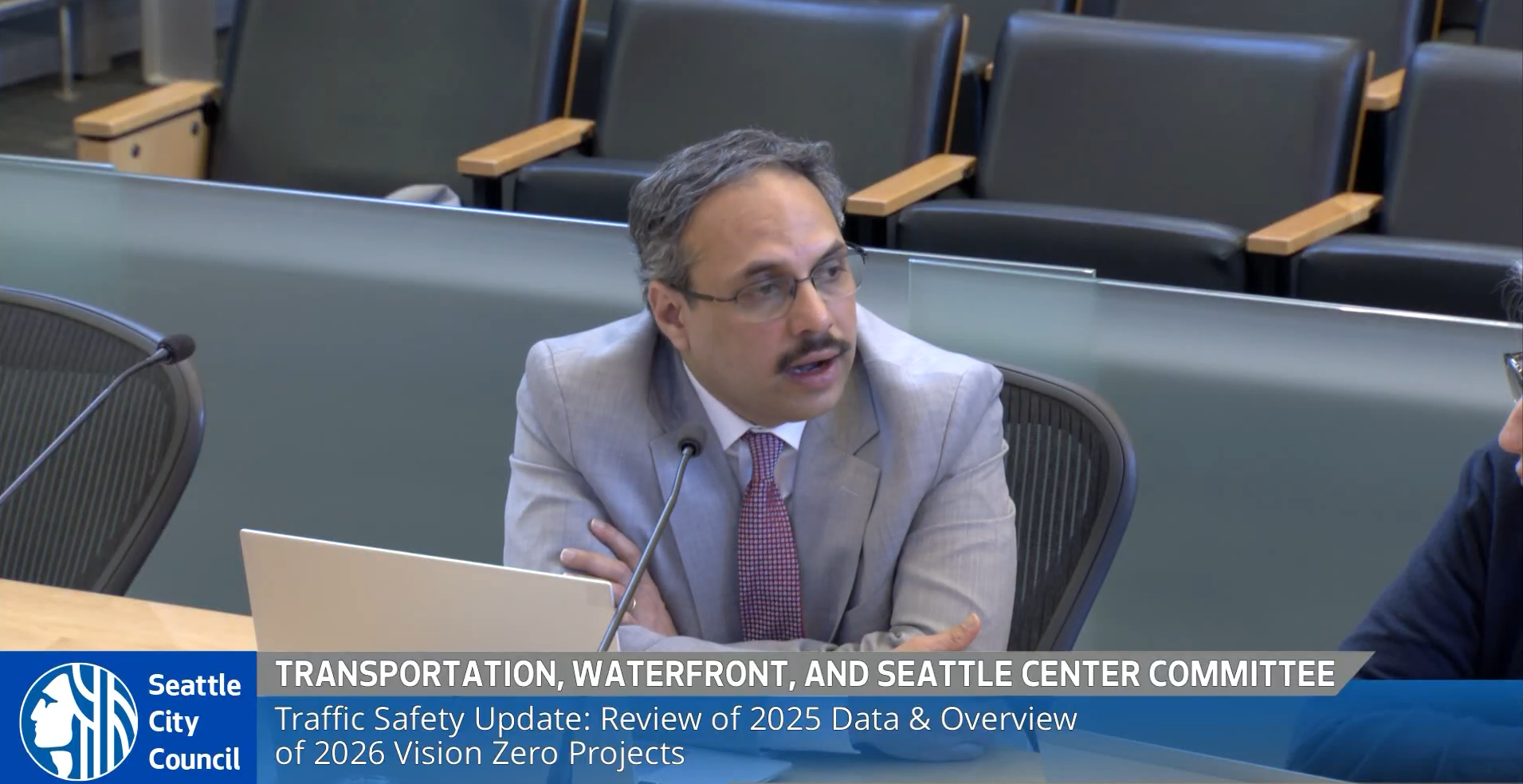
"I think we can do a lot more in the various actions that we're taking, and the post-evaluation that we could conduct for the various actions that we're taking, and actually build that concrete, data-driven, data-based result that we could leverage to do more of those types of improvements," Nemani said.
What was also left unaddressed was the degree to which potential safety enhancements get taken out of projects, often after coordination with SDOT's Transportation Operations division, the powerful group within the department that is tasked with keeping car traffic moving efficiently.
Until recently Nemani had been doing double-duty as head of that division while also serving as SDOT's Chief Safety Officer, but Transportation Ops is infamous for prioritizing vehicle flow over safety. It was that division that set aside the idea of pursuing more ambitious changes on Denny Way as part of a major repaving project, despite notes from the Vision Zero team that that would be passing on a "large opportunity" to make gains.
An auditor's report might shine more light on the inner workings of SDOT's safety program – and the degree to which the priorities of the Transportation Operations Division ultimately conflict with the department's stated safety-first mentality.
Meanwhile Saka, who was retained as head of the transportation committee this year by Council President Joy Hollingsworth, despite intense interest from at least one other councilmember in taking over the post, is clearly trying to distance himself from project-level decision-making at SDOT. Referencing his controversial budget amendment targeting a centerline median barrier on Delridge Way that restricted left turns into a daycare facility and preschool where his kids formerly attended, Saka suggested that he'd learned that getting that in the weeds isn't actually worth it.
"Personally every time that I've intervened in specific design decisions, it hasn't gone too well. Even when I've fought for immigrant and refugee communities or kids' daycares, working families, some people have lost their natural minds," Saka said. "It's easy to espouse high-level priorities, easy to espouse value statements. But if you ask anyone who's ever been at this dais or the mayor's office upstairs on the seventh floor: the devil is always in the details."
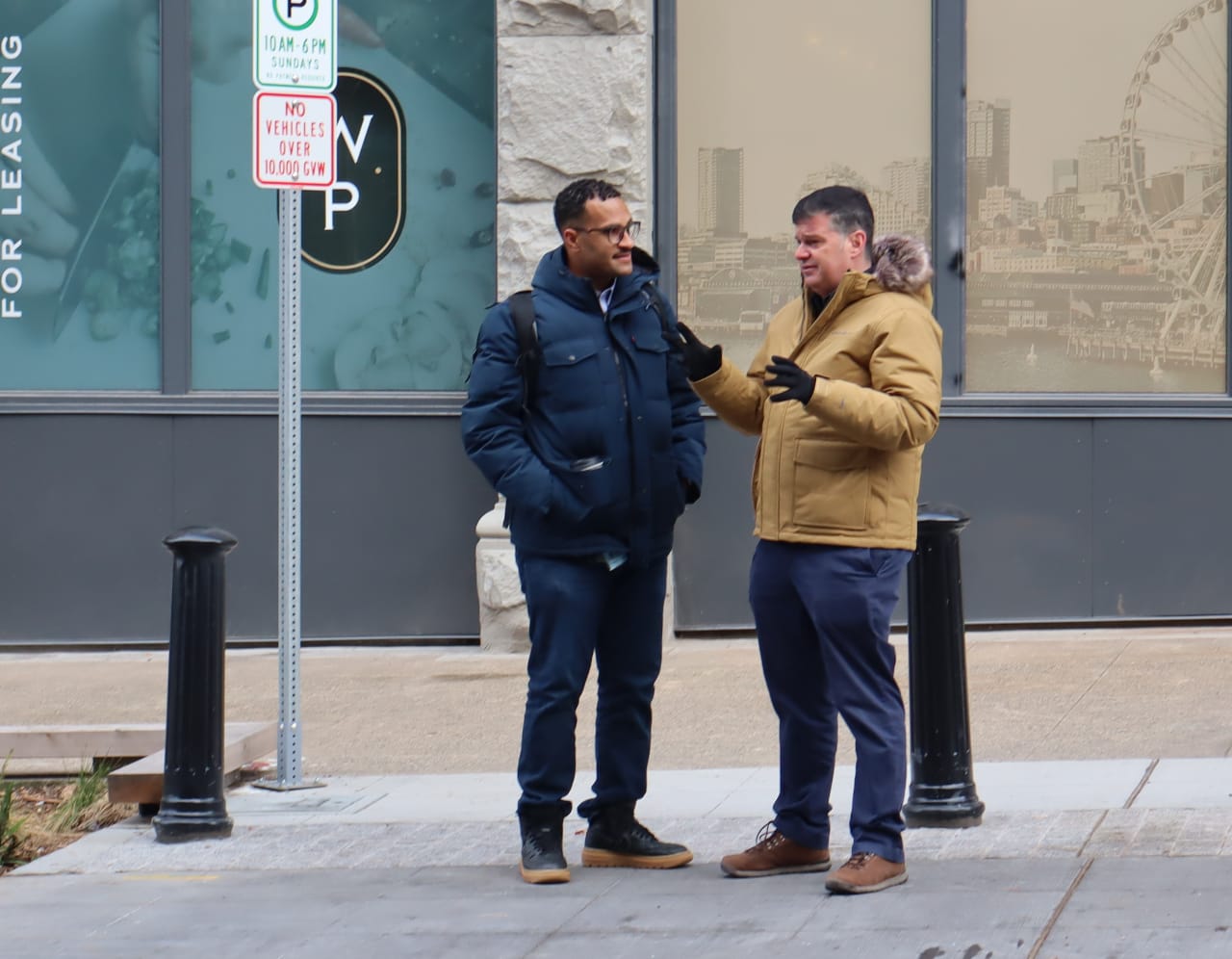
Saka instead pointed to the significant amount of money that was earmarked for safety upgrades in the 2024 Seattle Transportation Levy, pushing back on a public comment from Seattle Streets Alliance executive director Gordon Padelford that noted that what's lacking in Seattle is the political will to make tough decisions about how streets get redesigned.
"I don't disagree with that as a proposition," Saka said. "But I would also argue that nearly $1 billion in traffic safety investments over the course of eight years – the council exercising its principal power of the purse to appropriate nearly $1 billion that voters generously approved over eight years – that is about as most of the political will you can get."
The Urbanist is a nonprofit newsroom powered by reader support. Become a member, get perks, and support local journalism.
Across the state, the number of deaths on Washington roadways has continued to decline in recent years. Shelly Baldwin, the acting director of the Washington Traffic Safety Commission, told the members of that commission last week that preliminary data shows a 10% decline in deaths between 2024 and 2025, with an 18% drop last year compared to a record high in 2023. But pedestrian deaths are not declining as quickly as overall traffic fatalities, and the number of cyclists killed in traffic statewide actually rose last year compared to 2024.
Arushi Thakorlal, Seattle's Acting City Auditor, shared some additional details around the pending audit with The Urbanist, explaining that the scope of work is still to be developed.
"Informally, I'll share that Vision Zero work has been on our radar as a potential audit topic for a few years, in part from informally-stated interest from past City Councils and Councilmembers, as well as from seeing similar audits from our peers in other jurisdictions that have been effective in driving improvements and transparency," Thakorlal said. "Regarding the scope of the audit, at this time we have not developed specific objectives. Once our work formally begins, we will start by looking within CM Saka's broad request ('assess the effectiveness, efficiency, and equity of the City of Seattle Vision Zero Program in reducing traffic-related fatalities and serious injuries') and will develop more specific, targeted audit objectives."
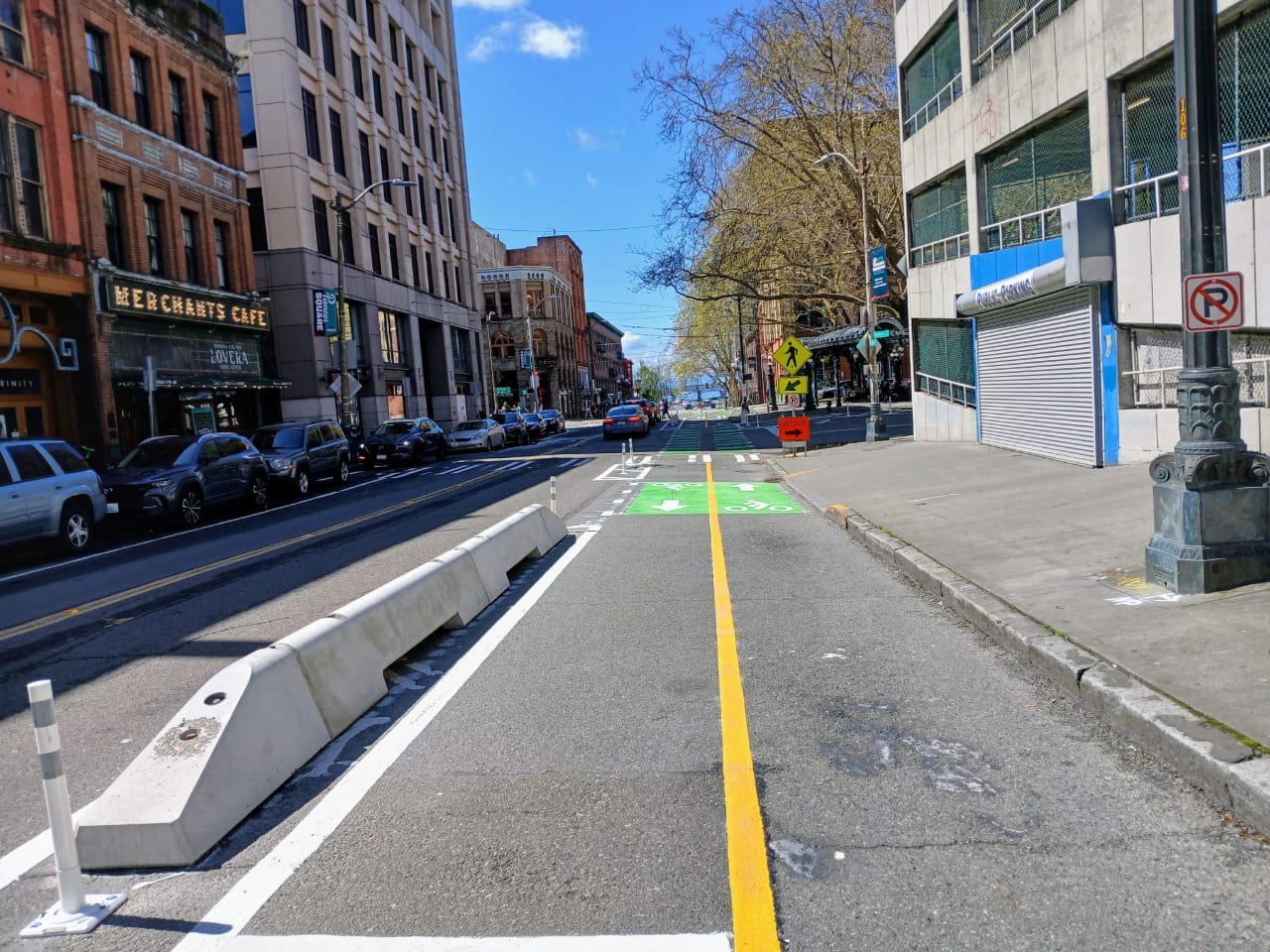
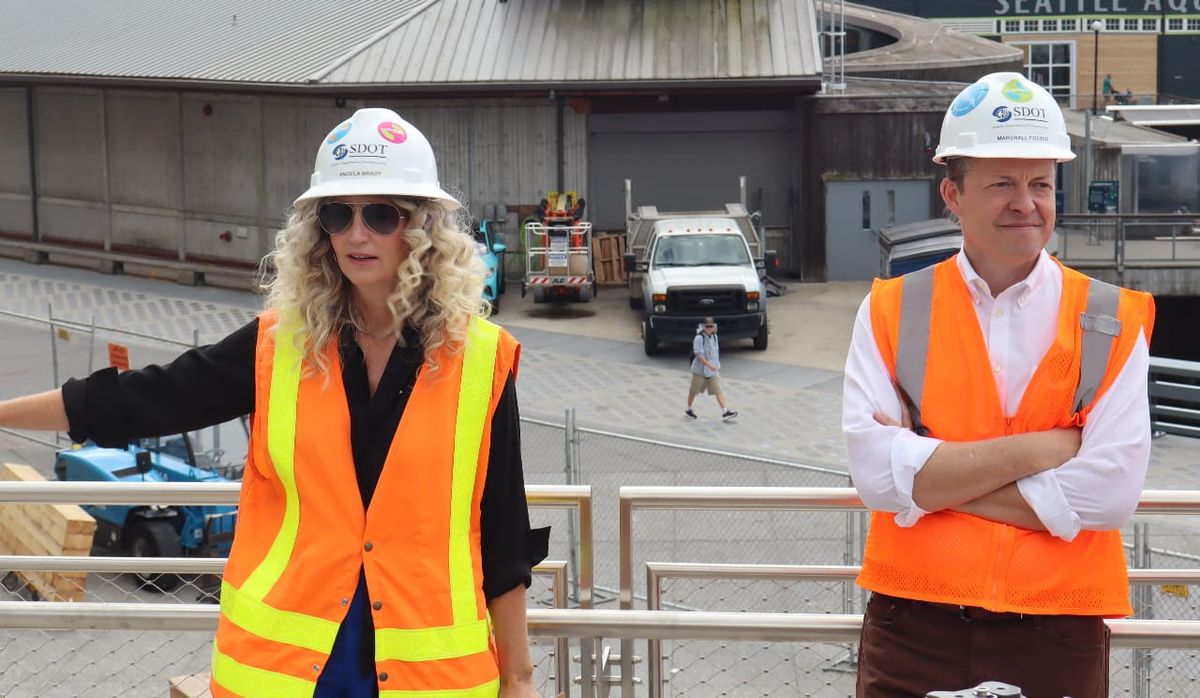
An audit is unlikely to result in a fully overhauled Vision Zero program – the power to make significant strides in safety ultimately rests with Katie Wilson. Notably absent from the table with Nemani last week was Angela Brady, who Wilson tapped as interim SDOT Director as one of her first moves on the job in January. So far, there are no signs that the administration is racing to hire a permanent director for the department, even with bold ambitions for transportation in the mayor's office. But that hire will likely be the most impactful lever that Wilson will pull when it comes to transportation policy implementation.
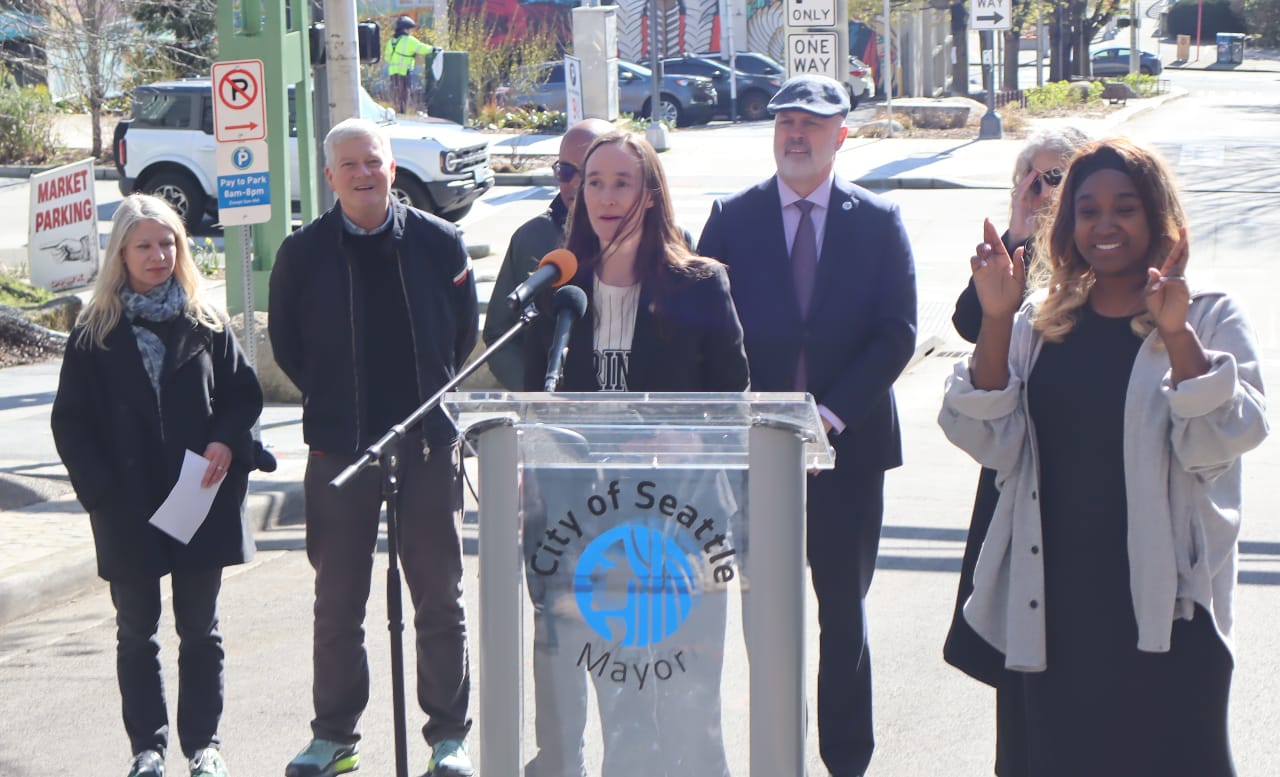
So far, there have been some minor decisions at SDOT during Wilson's tenure that have seemed to have deprioritized the issue of safety over other concerns. A last-minute adjustment to the Yesler Way bike lane removed motorist turn restrictions, to the befuddlement of cycling advocates. The removal of a proposed traffic diverter in a proposed "Home Zone" around John Muir elementary school in Southeast Seattle also raised eyebrows.
It remains to be seen whether these will prove to be aberrations in the Wilson era. Other projects do appear to be moving forward at full steam, like the Highland Park Way SW safety project and an overhaul of E Marginal Way SW in Georgetown.
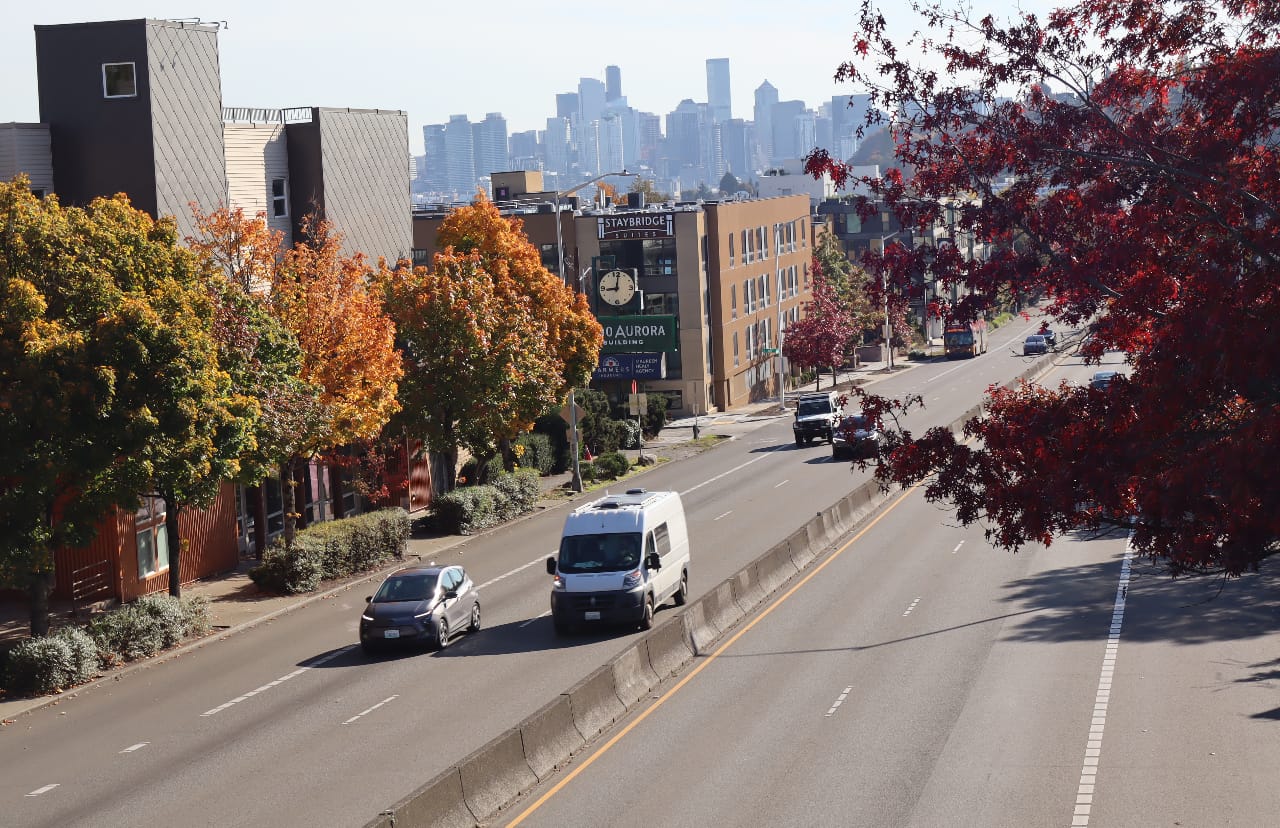
The biggest projects in the 2024 levy, including overhauls of Rainier Avenue, Aurora Avenue, Jackson Street, and MLK Jr Way S, are in design right now. No matter what a performance audit says, if the city can't find its way to execute well on those projects, maximizing safety under a mayor who likely has their back in a way that wasn't true of other recent City leaders, then the Vision Zero program really is doomed.
 Ryan Packer
 Ryan Packer