Seattle built a better affordable housing system. It just forgot to update the old one.
The City of Seattle is financing more housing than ever and yet it’s permitting less of it than at any point in a decade.
That might sound like a contradiction, but it's really a policy failure hiding behind a success story.
The success story is real and worth telling. Over the past several years, Seattle has built one of the best affordable housing programs of any city in the country.
The Housing Levy was renewed and expanded by voters in 2023. The JumpStart payroll tax has generated hundreds of millions for housing and community investments since 2021. Federal, state, and local funding streams have swelled the Office of Housing budget from $169 million in 2020 to nearly $350 million in 2025.
And there is the newest arrival: the Seattle Social Housing Developer, funded by Proposition 1A in 2025, which will soon receive their first payment of $115 million, exceeding everyone’s expectations.
Add it all up and Seattle is directing north of $460 million per year toward affordable housing.
This is the success story. Unfortunately it’s not the only story.
Upon a closer look, new housing applications in Seattle have fallen 88% from their 2020 peak. Issued permits are down 66%. Those permit numbers are apocalyptic, setting Seattle on a path to rising rents, foregone city revenues and lost construction jobs.
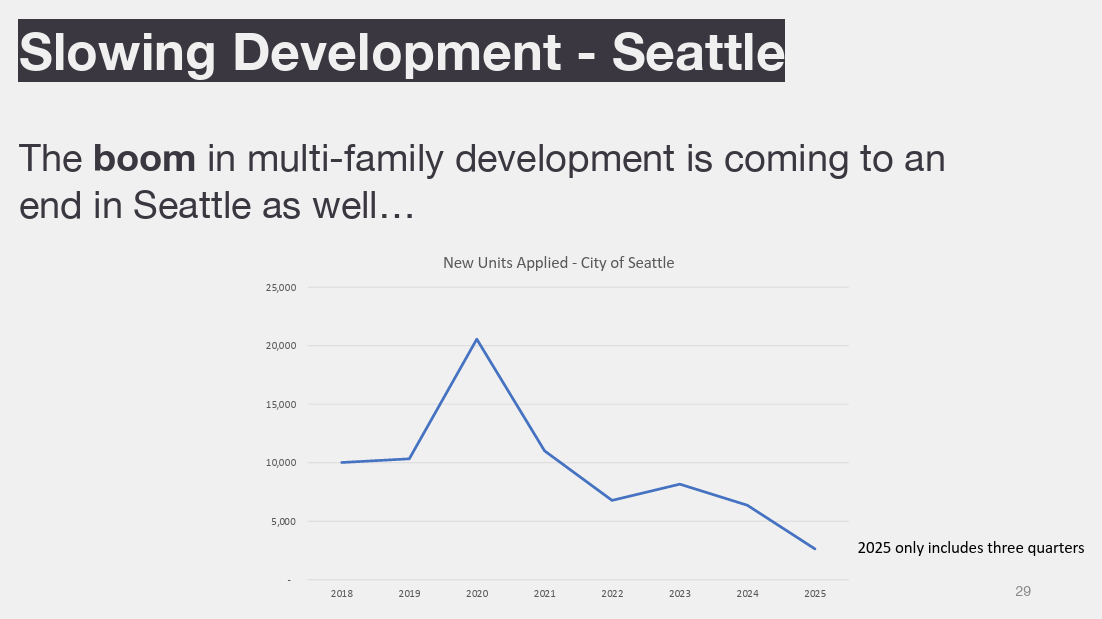
Permit applications lead construction by years. That means the visible shortage will not arrive until 2028 or 2029. By then, rents will already have risen and the power will shift back from tenants to landlords as supply of new homes tightens and options evaporate for renters.
A city investing more than $460 million a year in affordable housing is simultaneously watching its housing production fall off a cliff. The money is there, the housing is not. Why?
For much of Seattle, the answer is the Mandatory Housing Affordability (MHA) program.
How MHA impedes homebuilding
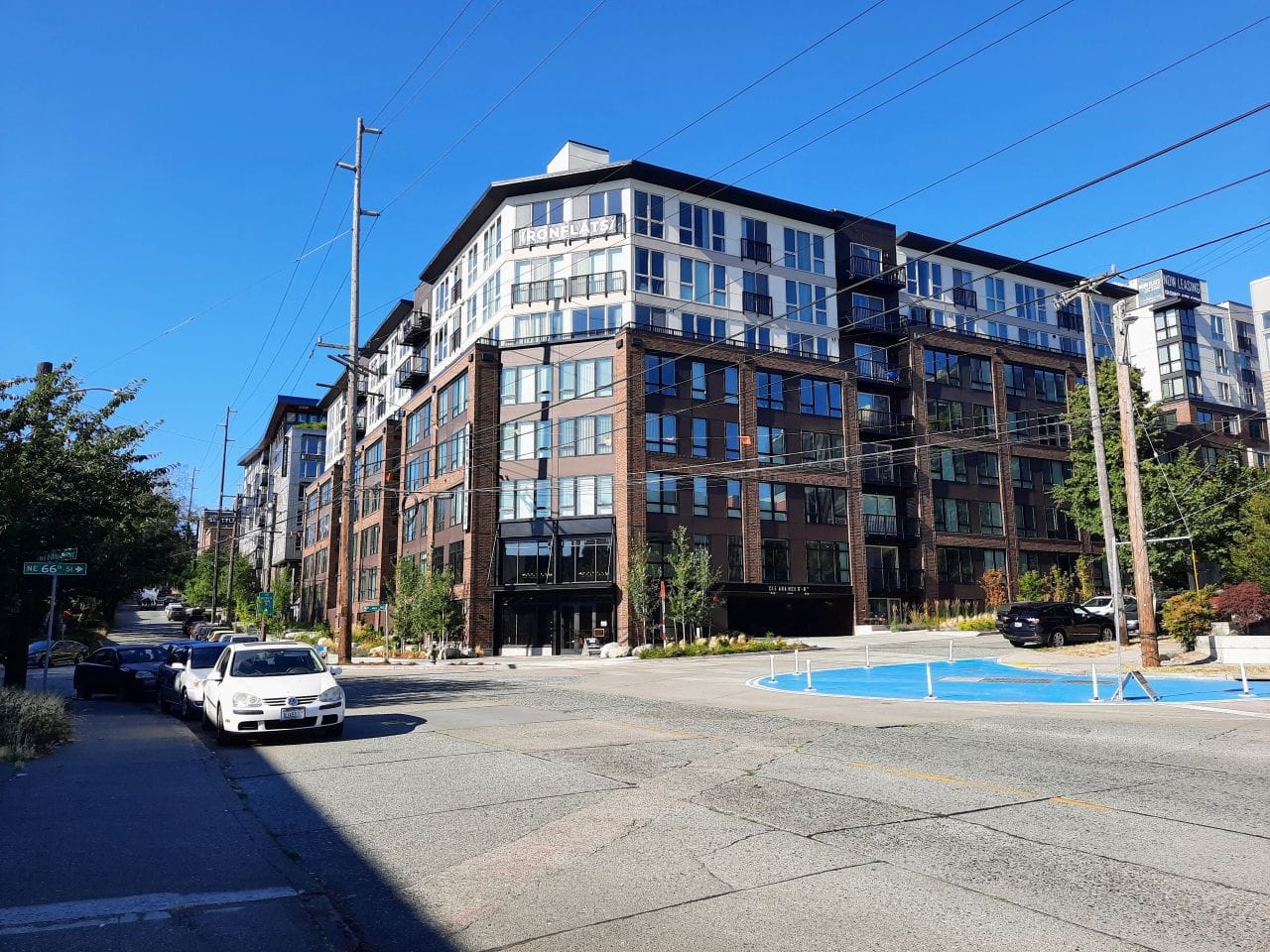
MHA is an inclusionary zoning (IZ) policy adopted between 2017 and 2019 that requires market-rate residential projects to either build affordable units or pay a fee. It was designed during an unprecedented building boom when interest rates were near historic lows and capital was abundant. In that environment, the logic of MHA was workable. The fee added cost, but capital was almost free so the margins could absorb it.
But even in unprecedented boom times the cost of MHA was not free. In 2023, researchers Krimmel and Wang from UCLA examined Seattle's housing market and found a 70% differential reduction in residential permitting within MHA boundaries relative to adjacent non-MHA blocks. Since MHA requirements only applied in areas that were upzoned and the City opted not to upzone the vast majority of single family zones during the MHA process, much of the city was exempt from the program, and that’s where builders focused their efforts.
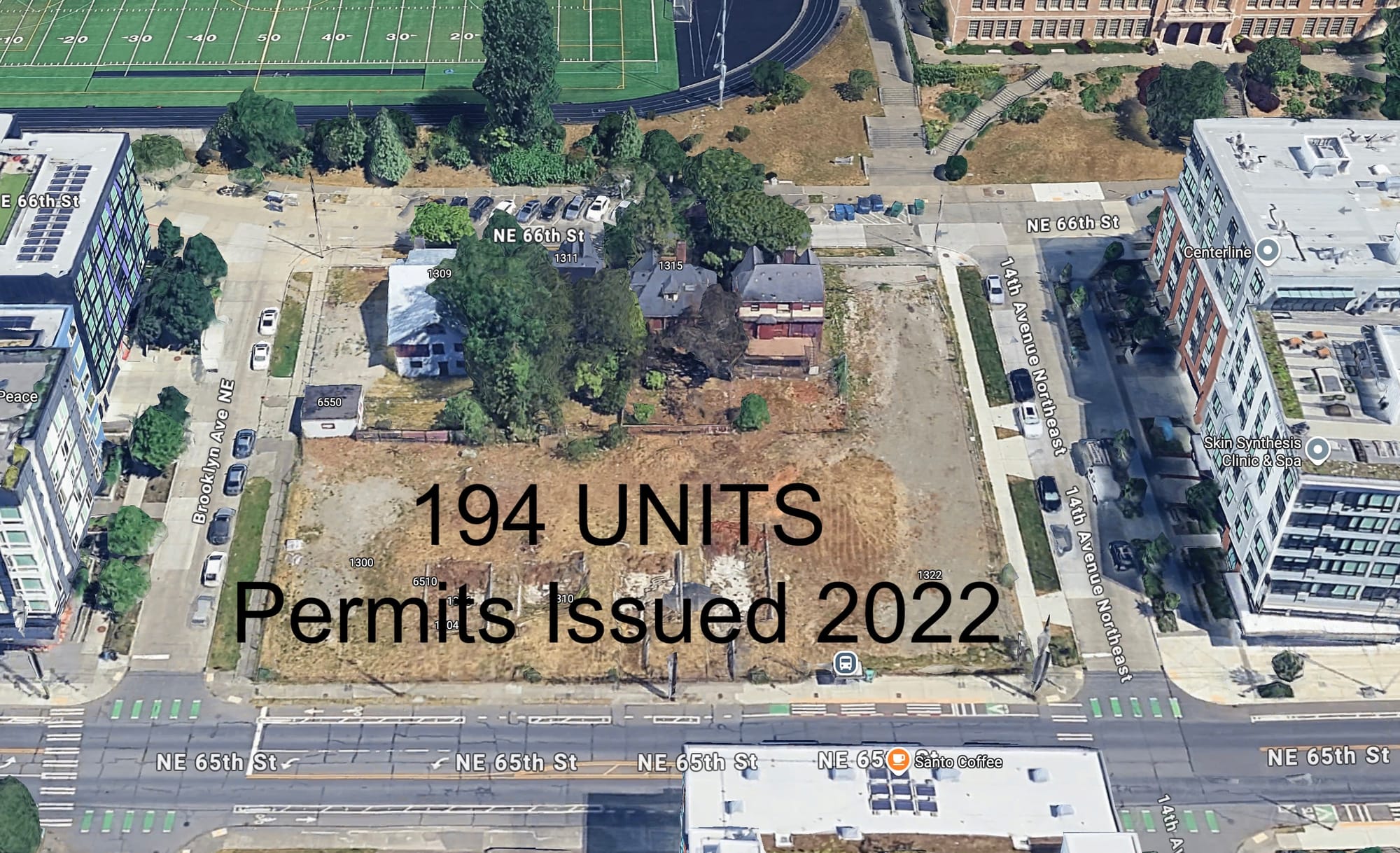
Put another way, MHA fees acted as a barrier that kept most new lowrise homes away from the very transit-rich urban centers where they were most needed. MHA’s suppression of new homes is not only a theoretical problem found in research papers. We have a real life example in Portland, Oregon. Portland implemented its own inclusionary zoning mandate in 2017 and a city analysis conducted in 2024 found that the policy distorted the housing market by creating a huge supply of buildings with 19 units, the exact threshold before the affordability (IZ) requirement applies, while the construction of buildings above 20 units plummeted
How many Portland homes were lost because an unfunded inclusionary zoning policy made buildings smaller than they should have been?
The damage to Portland's housing production was severe enough that in March 2026, the Oregon Legislature passed SB 1521, a landmark bill that banned inclusionary zoning policies that do not fully offset the financial loss incurred by the IZ policy.
Dan Bertolet, Senior Researcher at the Sightline Institute recently said this about MHA: “Seattle's MHA is an unfunded IZ. It blocks new homes until after prices rise, putting an invisible tax on tenants in older buildings. It would be illegal under the funded IZ bill just passed by Oregon. The city should fund it or ax it permanently.”
Bertolet has spent decades researching, advocating, and writing pro-housing legislation at the city and state level in Washington. When a policy has lost advocates like Bertolet, been undermined by researchers at UCLA, and been effectively banned by the state of Oregon, it is worth asking whether Seattle should still be defending MHA.
We’ve established that unfunded IZ policies like MHA block housing. But it’s important to take a look at what MHA is producing in return.
In 2021, MHA accounted for 57% of Seattle's affordable housing funding. It was the centerpiece.
Today, MHA represents just 7% of affordable housing dollars in Seattle.
That bears repeating. A policy contributing 7% of affordable housing revenue is functioning as a barrier to thousands of units of housing, millions of dollars in government revenue, and hundreds of construction jobs.
And here is the part that should trouble everyone: when units don’t get built, the city doesn’t collect an MHA fee. The $22 million Seattle has budgeted for 2026 only materializes if projects move forward. If MHA fees make projects unfeasible, that 7% becomes zero.
You cannot collect a fee on a building that was never built.
Funded IZ could fix MHA, but not everywhere
So what should we do?
In the lower density zones of Seattle's neighborhood centers, MHA should be eliminated outright. The UCLA data is clear: the economics of small and mid-scale neighborhood housing cannot absorb these fees. No floor area bonus or setback exception would make up for the fees charged at this scale of building.
The builders who work in neighborhood centers are often small developers and local general contractors, They don't have legal departments or compliance staff. For them, even a fully funded IZ adds paperwork they can't staff. The evidence is already in the permit data, small builders in these zones almost never choose on-site affordability.
The Urbanist is a nonprofit newsroom powered by reader support. Become a member, get perks, and support local journalism.
If we want our neighborhood centers to become vibrant, dense and walkable, we have to look at the evidence and be bold enough to "fund it or ax it." We cannot continue to discourage homes where we most hope to build them.
In Seattle's zones of higher density, the calculation changes. Midrise and highrise projects are built by firms with the administrative capacity to handle compliance. In these higher density zones Bertolet's suggestion is the right one: follow Oregon's lead and reform MHA to include property tax abatement that will offset the cost builders incur due to MHA compliance.
The upside of following Oregon’s lead is not abstract. Seattle has 11,800 housing units (more than $5 billion in total value) stalled in permitting right now, unable to move forward.
If we built just 12 of those stalled multifamily projects across Seattle neighborhoods it would produce:
- 2,350 new housing units
- 380 middle-income units
- 3,000 construction jobs,
- $37 million in local construction sales tax revenue,
- $10 million in permit and street-use fees to city departments,
All of that is currently frozen: the homes, the jobs, the tax revenue. Frozen by a policy generating 7% of affordable housing funding.
Seizing the moment for housing
The mayor has given us a mantra: taller, denser, faster. We have perhaps the most pro-housing City Council in Seattle's recent history. The political alignment to act on housing is real and it is rare.
But no amount of zoning changes or permitting reform matter if the economics of building remain broken. You do not get taller, denser, or faster by defending a fee structure calibrated for 2017 in a market that no longer exists. You get there by recognizing that Seattle already did the hard work of building a system to fund affordable housing, a piece of which now stands in the way of the homes it was designed to support.
We have solved the funding problem. Now we need the courage to realize our vision for a vibrant, affordable city. Fund MHA or ax it, and let's get back to building homes for Seattle.
Seattle YIMBY is composed of volunteer advocates who support the production of abundant, affordable housing and inclusive, sustainable communities in Seattle and across Puget Sound.
Learn more at: seattleyimby.org
 Doug Trumm
 Doug Trumm