A coalition of builders is seeking reforms to Seattle's Mandatory Housing Affordability program in hopes of aiding a sputtering housing sector, which they portray as at risk of lurching to a halt. The Seattle Housing Roundtable, as the group of nearly 30 developers calls itself, is urging policymakers to pass a deep reduction in housing fees for a duration of three years.
"Seattle’s new permits are down almost 90% from 2020, which sounds alarm bells for all of us who care about new housing production and urbanism," Ben Maritz, a developer with the firm Great Expectations and a member of the roundable, told The Urbanist. "We want to ensure Seattle has enough housing to become more affordable – not less."
The Mandatory Housing Affordability program, or MHA for short, came into existence in 2017, after protracted negotiations between builders, advocates, and City officials, under auspices of Mayor Ed Murray's Housing Affordability and Livability Agenda committee. Initially MHA only applied downtown and in the U District, but the program went "citywide" in 2019 after the City enacted upzones in urban center neighborhoods.
As a form of "inclusionary zoning," MHA's proposition was this: builders would now face affordability requirements when building apartments, condominiums, or commercial space, but in exchange the City granted upzones that enabled more units in taller buildings. Builders could either set aside low-income homes themselves within their new buildings for a duration of 75 years, or they could pay an "in-lieu" fee that went into the City's affordable housing trust fund, supporting nonprofit homebuilding elsewhere.
Most builders ended up opting to pay the fee.
MHA fees fall between $8 and $50 per square foot, depending on zoning type and location. An inflation rider in the legislation means fees have been rising steadily since 2019. To take the on-site performance option, developers typically need to set aside 5%-7% of new units as affordable, although requirements go as high as 10% or as low as 3% in certain rarer circumstances.
Dubbed a "grand bargain," proponents considered the MHA program a win-win allowing more housing while ensuring a new stream of affordable homes would come online across the city. While critics argued MHA amounted to a tax on new housing that kneecapped homebuilding, the staunchest supporters contended builders would barely feel the tax, positing that a "value capture" mechanism would offset costs by lessening the spike in land values that upzones would otherwise cause.
The Urbanist is a nonprofit newsroom powered by reader support. Become a member, get perks, and support local journalism.
Initially, MHA proponents appeared to be correct, as housing production continued to hum along and the City accrued more than $300 million in MHA fees to fund affordable housing from 2017 to 2023. Over the last decade, Seattle was one of the fast-growing big cities in America, and it also led the nation in affordable housing production.
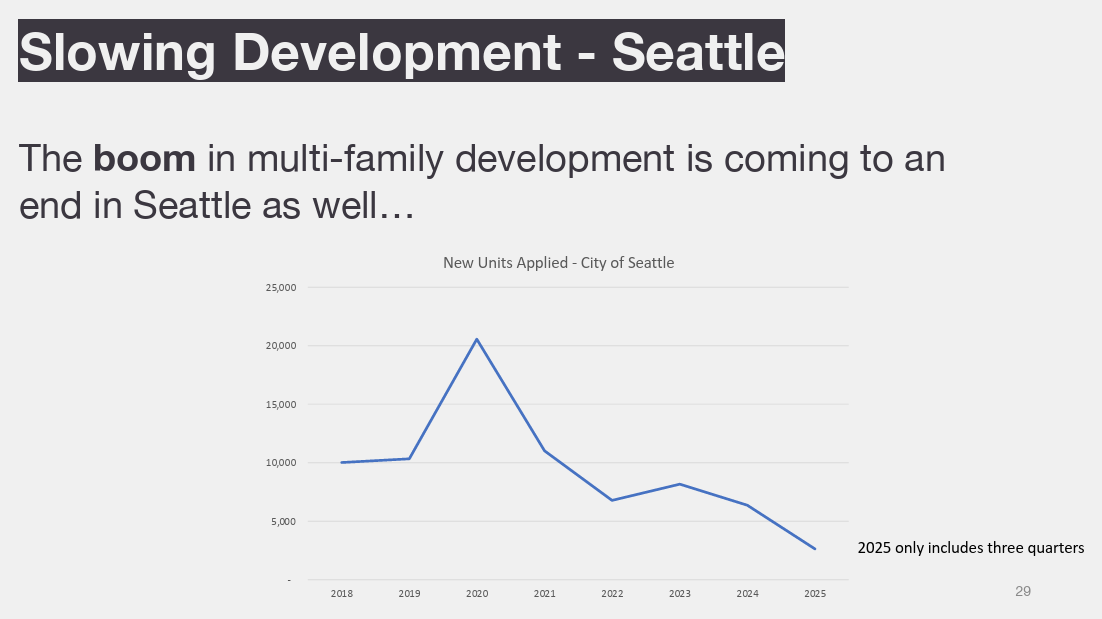
After a hot start, though, MHA fees are down sharply in the last few years, and housing starts are plummeting in Seattle. Permitting activity collapsed to a decade-long low of fewer than 2,000 units permitted in 2025. That 2025 total was down 88% from the 2020 peak of 17,400 units permitted. In 2025, builders paid an estimated $25 million in MHA fees, down from peak of $74 million in 2021, and the City projects collections will be even lower in 2026.
The Seattle Housing Roundtable expects that downward trend to continue, unless the City takes action to lessen building costs. Even with lower fees, the City could net more money through the greater volume of projects going forward, said Ian Morrison, a land use attorney with McCullough Hill, a law firm whose founder, Jack McCullough, helped negotiate the original "grand bargain" agreement.
"Using the city's own data, there are over 125 apartment and taller projects that are in the pipeline that have gone through design review, that have gone through their master use permit, that have a building permit, right?" Morrison said. "So that's almost 12,000 units that are already in the pipeline. So super. Design review reform doesn't help them. These projects are stalled. Over 70 of them, almost 8,000 units, are close to building permit."
The reasons for the housing industry stalling out are many, with high interest rates and rising costs for construction materials and labor big factors. While local officials cannot control interest rates or material costs, they do set building fees.

To kickstart some building momentum, Seattle Housing Roundtable is proposing "Housing Accelerator" legislation that would reduce Mandatory Housing Affordability fees by 90% this year, followed by an 80% reduction next year and a 75% reduction in 2028. Construction permits and site work must start within 36 months of start of accelerator period to qualify, according to the proposal.
At the end of the three-year period, the hope is that the City would have a permanent reform ready. One idea that some housing advocates have kicked around as a fix is funding inclusionary zoning with a tax break, like Oregon recently authorized.
The group has remained focused on the three-year tax holiday, rather than lobbying for the city to reform the program's permanent parameters. That being said, they did offer one reform that they suggest makes sense both in the near-term and long-term. Namely, they want the City to charge the MHA fee when a building gets its certification of occupancy, rather than when it gets its construction permit.
"Paying the MHA fee at the start of a project means that it comes out of the early project cost, often before obtaining construction financing," Maritz said. "MHA fees are often $3 million to $6 million, or more – and if a developer can’t afford to pay that, projects won’t get started. A shift in the timing will allow more projects to get started, and the change in timing does not change the total fee amount. It’s a logical policy solution that the City should have moved forward with a long time ago."
Without the fee reductions, builders are saying very few projects will pencil out as feasible to build, with absorbing the fees impossible under current market conditions.
"It’s not possible to just eat the fee and attract investors," Maritz said. "Housing providers have pulled every lever in their control, and they’re desperate to get projects started. If they aren’t building, then they’re at risk of collapsing. At this point, most builders are only looking to cover their overhead and staffing costs to make it through this stretch."
Builders say they need to get some projects moving soon or they are at risk of another bevy of contractors and developers going belly up, like happened during the 2008 housing crash.
On the flip side, the roundtable pointed to a case study of 12 stalled projected that could have an enormously positive economic impact on the City – if they could be resurrected with the accelerator program. Together the 12 projects account for more than 2,350 homes that would pay more than $37 million in construction-related sales tax and support 3,000 construction jobs, they said. In addition to paying upwards of $10 million in MHA fees even at the reduced rates, the 12 projects would also pay $8 million in permitting fees to the Seattle Department of Construction and Inspections and $4 million in street use fees.
"If these 12 projects proceed with the housing accelerator, they alone exceed the projected MHA budget for 2026," the Seattle Housing Roundtable wrote in a presentation slide, which noted they also bring more than 380 moderate-income units set aside via the Multifamily Tax Exemption program.
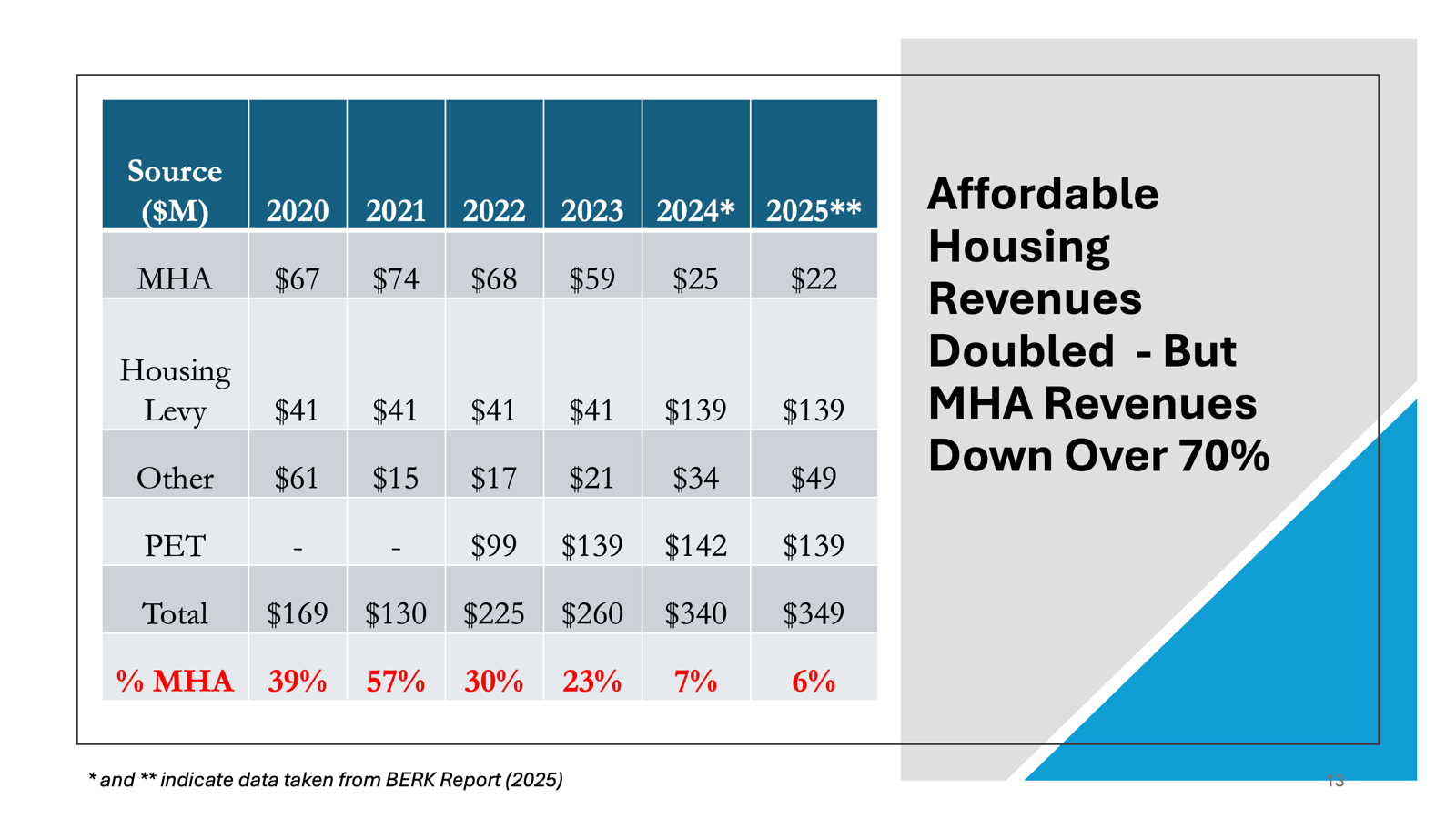
The passage of the Jumpstart payroll expense tax (PET) in 2020 and a much larger Seattle Housing Levy in 2023 means that the City's affordable housing funding streams are also much more diverse and less reliant on MHA fees. Estimates from the City's consultant BERK found that Seattle raised nearly $350 million for affordable housing in 2025, with just an estimated $22 million coming from MHA. This stands in sharp contrast with 2021, when a majority of funds raised were MHA fees.
The Housing Development Consortium (HDC), the leading voice for nonprofit housing sector in King County, has expressed openness to a temporary reduction in fees. The group's executive director, Patience Malaba, pointed out that nonprofit builders want strong market-rate production in order to achieve their larger aim of an affordable Seattle.
"We were strong proponent of MHA from the beginning," Malaba told The Urbanist. "We really believe deeply in the principle that new development capacity should help create affordable homes. It should bring a public benefit. So that's the frame that we're stepping into this conversation with. We're also very clear, though, that Seattle is in the midst of the really steep housing production downturn today, and there's a myriad of factors contributed to that, right. Interest rates are high, construction cost is high, but there is a lever that the city has locally, which we know must always be well calibrated. So we're open to an interim, time-limited recalibration to bring more homes online."
The Urbanist is a nonprofit newsroom powered by reader support. Become a member, get perks, and support local journalism.
That does not mean that HDC has bought into the specific fee cuts that the roundtable has sought, or shares the same long-term vision for program reforms.
"At HDC, we have a deep commitment and duty to defend affordable housing revenue," Malaba said. "MHA has been a meaningful funding source, and the prospect, of course, of reducing those obligations even temporarily, do raise concerns, but we've got a responsibility, collectively, to ensure that we have more housing production in the city, and that's the nuance that we hold in coming into that conversation."
The consortium appears ready to get behind delaying MHA fee payment to the certificate of occupancy, as another means to spur housing projects, especially in ailing townhome sector.
"We are fully in support of moving the MHA payment to the certificate of occupancy," Malaba said. "We just believe that that would reduce the financing risk and continue to support development of townhomes. And I think the data shows that there's a clear need for us to move that payment timeline."
The housing accelerator appears to be drawing considerable interest from the Seattle City Council.
Councilmember Eddie Lin, who chairs the Land Use Committee, told The Urbanist that he believes MHA is due for a recalibration.
"I just want to make it crystal clear that I support the goals of MHA." Lin said. "I support inclusionary zoning or inclusionary housing, and so by no means should this be seen as a desire to get rid of MHA permanently. In my opinion, MHA should be updated from time to time to address [...] current conditions, and MHA is one of those where it was never intended to be a static thing."
Lin highlighted a desire to address issues with Lowrise 2 (LR2) zones becoming fairly unbuildable with the interplay of limited zoning allowances and high fees. Before MHA went into effect, LR2 was enticing tons of townhome development.
"Certainly, when we are upzoning the entire city, we need to take a look at it to make sure we got it right, especially in those LR2 zones, which now basically are this very similar to Neighborhood Residential," Lin said. "If we don't address MHA and those LR1 and LR2 zones, either through upzoning them to something more akin to LR3, or to addressing those fees, it seems like we're just going to push the development out of those zones into Neighborhood Residential [zones]. And that is an unintended consequence that we need to address."
At a press availability on Monday, Council President Joy Hollingsworth similarly backed the idea of a three-year MHA holiday.
"We have a great dashboard that I love, which shows the amount of permits that are being issued and how many housing units being built. We're at a really low point right now in Seattle with building," Hollingsworth said. "That MHA fee three-year reduction to jumpstart stuff, I think, would be a huge win for the building community."
At the same event, Councilmember Rob Saka also said he was open to tweaking MHA to ensure homes were still getting built, though he did not directly endorse the housing accelerator proposal, saying he hadn't seen the specifics.
The Seattle Housing Roundtable has framed the proposal as something that could send a powerful signal from a new mayor, spurring investment in homebuilding from hesitant national equity partners. Builders says investors have a herd mentality and getting a couple cash cows to charge could set off a stampede that heads off Seattle's looming housing downturn.

Ray Connell, who is Holland Partner Group's Seattle managing director, argued that enacting the housing accelerator legislation could also reset some of the preconceived notions that funders outside of the state have about Seattle's new mayor. While locals may be aware the mayor is a pro-housing urbanist after the campaign she ran, some national lenders appear a bit fixated on the socialist side of her identity.
"This kind of signals to the market, the broader market, that the city is open for business, and the mayor actually wants housing built," Connell said. "And so, when you start to make those signals, it only takes about three deals to realize: well, hey, how'd they get a project started there? Oh, because the mayor of Seattle reduced fees. Well, hold on, I thought they were anti-housing. No, she's actually pro-housing and she's actually an urbanist. And she wants to have dense, walkable communities… And all of a sudden this thing starts to catch fire."
Wilson has not yet taken a position on the housing accelerator proposal, though she has espoused similar end goals.
Mayoral spokesperson Sage Wilson told the Seattle Times the administration is looking for “creative solutions” to the supply slowdown and is working with “both market rate and nonprofit housing developers to identify policy options to build more housing, expand affordability, and ensure Seattle can be a welcoming place to people of all incomes and backgrounds.”
The Seattle Housing Roundtable made the case that the MHA fee recalibration could be key to the Wilson administration finding success with their ambitious plans for "taller, denser, faster" growth plan, which is predicated on a wave of apartment construction in soon-to-be upzoned transit corridors.
 Doug Trumm
 Doug Trumm