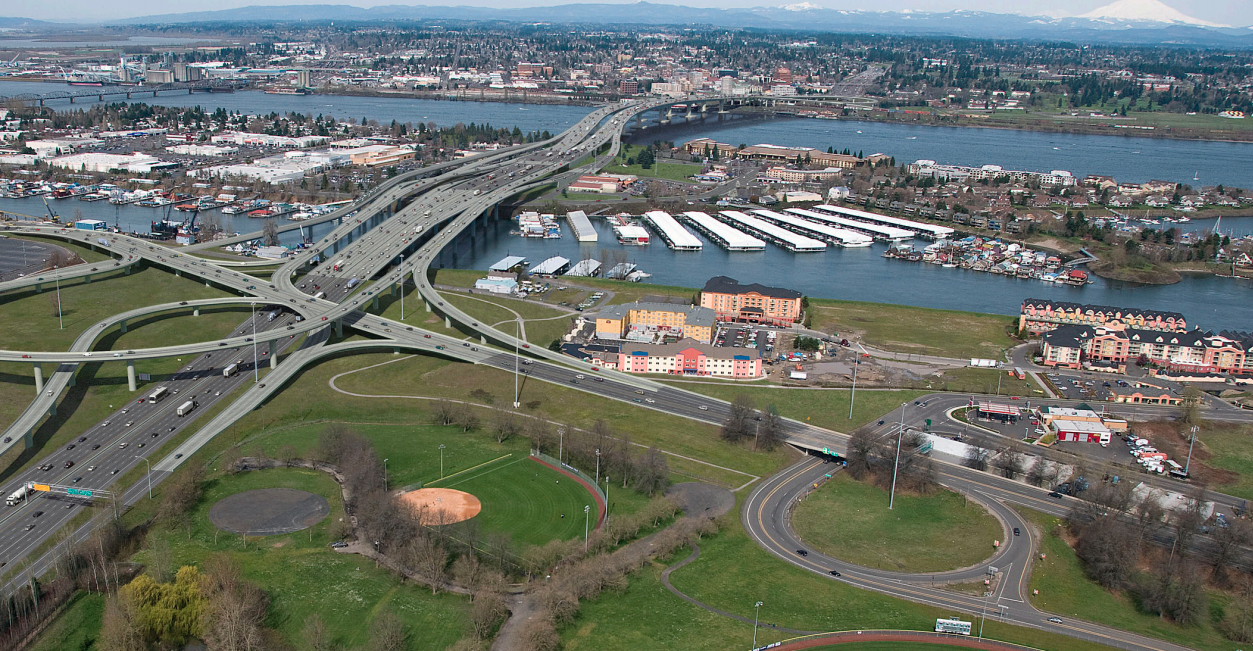
Ryan Packer, Amy Sundberg, and Doug Trumm of The Urbanist newsroom preview the session now underway at the Washington State Legislature in Olympia and break down the huge setback that the I-5 Interstate Bridge Replacement project was just dealt. A massive cost jump is pushing the budget near $20 billion, firmly in highway boondoggle territory.
Ryan recently covered a myriad of housing bills working their way through Olympia. Bills allowing smaller elevators and scissor stairs could make midrise buildings more feasible to build. The hosts discussed the pros and cons of legislation allowing residential construction in commercial zones in mid-sized (and up) cities, which was requested by Governor Bob Ferguson, but perpetuates a corridor urbanism approach that focuses apartments near crash-prone, polluted highways.
The bills we referenced include:
- House Bill 1175 – Neighborhood cafes
- HB 1443 – Allows Mobile Dwelling Units on all Residences
- HB 2228 – Legalizing Scissor Stairs
- Senate Bill 5156 – Legalizing Smaller Elevators – Sightline Institute has a video explainer for more info.
- SB 6002 – Regulate Immigration Officials Access to License Plate Readers – Read Amy Sundberg’s article for more.
- SB 6026 – Requiring Mid-Size Cities to Allow Residential in all Commercial Zones.
Plus, Amy and Doug recounted their first interview with Seattle Mayor Katie Wilson since she’s been installed in office. And the crew talks about their go-to parks for false spring reveling.
This episode of The Urbanist Podcast was edited by me. Episodes also air on KVRU 105.7 FM radio Thursdays at 4pm, on a once every two weeks cadence, give or take. Thank you to Crystal Fincher and Shannon Cheng of KVRU for their assistance producing our podcast.
Episode Transcript
[00:00:00] Ryan: Hello and welcome to the Urbanist Podcast, a show touching on the biggest headlines at The Urbanist, and offering a deeper look from the reporters breaking the stories as an independent reader supported publication. The Urbanist has been covering the Seattle metropolitan region since 2014. We do advocacy journalism for better cities.
You can find us at theurbanist.org. My name is Ryan Packer. I’m a contributing editor here at the Urbanist, and with me is the rest of our newsroom publisher, Doug Trumm
Doug: Hey Ryan. Good to see you.
Ryan: And reporter Amy Sundberg.
Amy: Hey, everyone. Great to be here.
Ryan: Every couple of weeks the Urbanist Podcast will recap the biggest headlines happening around the region and take you beyond the stories on the site. This week the Washington State Legislature convened for its whirlwind 60 day legislative session.
There’s many topics they’re trying to tackle, the budget, transportation, housing, and policing among them. And we’re gonna go ahead and start running down what’s happening at the legislature, over the next few weeks as they try and get bills advanced, during their first big deadlines.
Amy, what are the things that you’re tracking right now?
[00:01:12] Amy: I am tracking so many things. I have this very long list. It’s not even a spreadsheet because I’m not organized. But one of the main things that legislatures are gonna be tackling this session is the budget, because they do have a budget deficit. So there are several bills around that effort to balance the budget.
Of course, Governor Ferguson has come out in favor of the Millionaire Tax, which we talked about last time, which would be an income tax on income over a million dollars. So it would not affect 99 point something percent of Washingtonians. It seems like he is less favorable towards other new revenue ideas. But that is not gonna stop some of the Democrats from bringing them forward.
[00:02:03] Ryan: Yeah, I know there’s a proposal from Shaun Scott, one of the most progressive legislators in the Democratic caucus, in the house in terms of a statewide payroll tax similar to the Seattle Jumpstart Tax. Have you seen that get any early attraction in the first few days, Amy?
[00:02:20] Amy: I haven’t heard much about it, although it does have many sponsors, which is promising. I know that Governor Ferguson said he was, quote, not a fan end quote of this idea of a statewide payroll tax. But, Representative Scott has the idea that a lot of the money that this would generate would go towards backfilling some of the expenses that the state will incur because of the Trump administration’s changing of policy.
So it would help with education. It would help with healthcare, and other really important priorities like that. Another interesting thing is, as a Seattleite of course, is that if we had a statewide payroll tax, I don’t know that we’ve seen a lot of capital flight from Seattle, but if it were statewide, of course no one would have any incentive to leave Seattle and go elsewhere in the state, which I think is an interesting thought.
[00:03:20] Ryan: Doug, you’ve been watching The Urbanist ramp up its legislative coverage over the years. How is this session working out so far. I know it’s only day, day three, but in terms of past sessions and what, what are you tracking?
[00:03:33] Doug: Yeah, it feels like a little bit of a odd session, especially for a short session. They have a lot of budget problems to dig out from under, with a multi-billion dollar deficit. Normally they’re dealing with the budget in the long session, but when this problems spill over to the next year, then they’re still dealing with that.
So it seems to have robbed a little bit of the ambition, but obviously if they get their framework for a millionaires income tax, that would be a big accomplishment, even if it’s something that doesn’t start collecting money until 2029. We’ve never had an income tax in our state and it’s starting to become very difficult to grapple with some of our budget issues without one.
But there’s still obviously going to be some bills moving. This week we had a piece from you that was laying out okay, like, here’s the housing bills that are moving. And I thought that did a really good job of, showing there’s still impactful bills here, more on the margins or on the edges. It’s not like the big sweeping zoning bills that we saw over the previous years. But it’s these nitty gritty bills that will hopefully help builders actually take advantage of that zoning. So we saw a number of those bills focused on more affordable building methods. And that includes scissor stairs, elevator reform, and things like that, that could help, you know, make sure that there’s not like these unforced errors here, that makes building untenable.
[00:05:05] Ryan: Yeah, I think what I said on the site in my legislative preview was they tackled the elephant in the room, which is our inclusionary zoning and our parking mandates, and things like that. And now we’re getting into the, the thousand paper cuts that make housing more expensive, you know, requirement to have two sets of stairs and you can’t make them consolidated together like with a scissor stair building.
It’s very wonky, very wonky stuff. The elevator issue got a lot of attention last year in terms of the ways that the US isn’t a big outlier. The U.S. and Canada are a big outlier in terms of requiring every elevator to accommodate a, a lay down stretcher, which paradoxically leads to a lot of buildings being built without elevators or without redundant elevators.
So when one breaks down, you have to use the stairs. And so I think that one’s gonna get a lot of attention. I think it generated a lot of controversy among the firefighter community and the very powerful elevator unions, which people don’t really, I think, know too much about, that there are very, very small number of unions that control who’s able to maintain all of the elevators in the US and it’s a little bit of a mafia in terms of the very controlled situations and the standards that are in place. We talked to the bill sponsor. He thinks he’s gonna take a little bit of a retreat of a position, kick it over to the State Building Code Council to make the really big decisions, which I think is gonna disappoint some people who are hoping for bolder action on that.
But I think it ultimately might be the only way that we’re gonna be able to get that across the finish line.
[00:06:41] Doug: Yeah, and it is super wonky. The elevator reform bill is Senate Bill 5 1 5 6. For those who wanna track its progress or weigh in on, on the state site, we’ll include a link in the podcast notes. But you know, the elevator pitch, see what I did there, for that bill is that by requiring such large elevators, we basically get no elevators, in many, many smaller projects in particular where they may not be required.
In Europe we see, and in Asia, for that matter, we see buildings going in, they have these smaller elevators and they actually have them. So there’s a much higher number of elevators per capita in those places. So we’ve regulated ourselves into an absurd outcome where, we want these elevators, but because we’re requiring gold plated version that fits a a large stretcher, we’re not getting it.
So it’s hard to argue with and maybe this new approach from Solomon will bear more fruit where it’s not dictating from the state legislature, but punting to the, the building council to, to do, so hopeful for that. And then the scissor stair bill, if you’re wanting to look that up, is, is House Bill 2228.
And similar reasons there. By requiring not more efficient stairway design, we’re just using more of our building space for hallways and stairs instead of housing. And obviously if we’re in a housing crisis, that that should be our priority.
[00:08:04] Ryan: Yeah, and there was one more splashy bill that the governor actually proposed, got put forward through Senator Emily Alvarado outta West Seattle. It would essentially require all major cities, I think over 30,000 in population to allow residential uses on commercial properties. So, strip malls, big box stores that are underutilized would be required to let developers build multifamily and they couldn’t require ground floor retail. So that’s a little bit of an interesting bill. I’d be curious for your thoughts on that, Doug and Amy, in terms of where we’re encouraging housing development.
I think it’s a little interesting. A lot of the capacity, like in Seattle is already in these places. We’re not really seeing people build there. Aurora is pretty much zoned for residential, but it’s not becoming… people aren’t really redeveloping these big sites to build housing now. It’s not clear to me whether this is gonna be a big change. And there’s the issue of a lot of these areas that are zoned for commercial zoning are along highways and in the areas of the cities where you wouldn’t necessarily wanna live. And so there’s an environmental justice aspect to this.
I kind of see this as one element of this very popular idea right now, coming up in certain elements of state government, which is like corridor urbanism, where we’re gonna only change the areas of the cities that people don’t really like and kinda leave the nice neighborhoods alone.
[00:09:43] Amy: I think it’s really tough too, because as you said, it is an environmental issue and it’s a health issue, right? In terms of pollution, and what that does to the body over time or as a child. And in terms of desirability where people would prefer to live, where they can afford to live, are they pushed into less desirable locations because of what they can afford?
And then at the same time, we have so little housing, right? And so I think there’s the, the push to try to get more housing however is possible, even if it means instituting this corridor urbanism. So I think a big question is how, how do you push back on that? Or how do you make sure that it’s balanced so that you allow as much housing as possible, but allow it also in more places.
[00:10:34] Doug: Yeah, I, I think it’s necessary but not sufficient. We, we just need to put housing in places where people actually wanna live, has got to be more of our policy going forward. But that doesn’t mean we shouldn’t do this when we’re in the midst of a crisis, and some of these strip mall areas and commercial corridors, hopefully aren’t quite so polluted road, backwater places.
But many of them are. And the 30,000 cutoff is interesting ’cause many of the places that come to mind for me are in those smaller cities, the Mercer Islands of the world. And they won’t be affected by the bill. At least, unless they change that population threshold.
The corridor’s approach is something that’s popular with Challenge Seattle and Chris Gregoire, the former governor of Washington, someone who’s, who’s very close with the governor, someone the governor said he has on speed dial, and is a great conduit for him. So, he jokes that housing, housing, housing are his top three priorities and he’s trying to do things and then this was a requested bill from him.
But, it still seems like a bill that’s maybe a little behind the times. It’s something we still need, but we gotta be thinking about the next steps about how to get housing off of those busy corridors where people don’t actually wanna breathe the air or have their kids play outside.
[00:11:51] Ryan: Yeah, or just get better at converting those corridors into places where people are safer and wanna spend more time. I think that’s a big question about this. We recently wrote about a proposal for State Route 99 through Snohomish County, which is gonna be subject to the new Complete Streets mandate, that was passed in 2021, requiring biking and pedestrian facilities to be evaluated for state highways.
And so, if you’re gonna be creating a place that has bike lanes and transit lanes and is a little bit more of a pleasant corridor, but I haven’t seen necessarily a political will behind more intense treatments to actually make these places more walkable neighborhoods.
[00:12:36] Doug: Yeah, I live three blocks off of Aurora and it makes a huge difference. Granted, a benefit of there being a hill there as well. But, I think if we’re only focused on those first few blocks, that’s not gonna really be that desirable of housing, that healthy of housing. And your point about these strip mall conversions being trickier than people think is well taken, ’cause there’s plenty of those on the map that we’ve been hearing about forever but haven’t fully happened. Whether, whether Northgate, which I think will happen eventually, or Totem Lake, some of these big malls that, that haven’t been converted yet. Even though, you know, there’s been huge civic dreams and big numbers in their planning schemes counted on for those.
[00:13:16] Ryan: Amy, I know there’s a number of public safety bills that you’re tracking. What are the top ones that, that people should know about?
[00:13:24] Amy: Yeah, one of the things I am interested in is whether the state is finally gonna move on the public defender problem, which we’ve reported on in the past. And basically there just aren’t enough public defenders in the state of Washington and they’re also working very long hours. They’re not very well paid. And so the State Supreme Court basically made new caseload standards to try to help make it more tenable. But those caseload standards mean they have to hire more lawyers, so it’s going to cost more. And Washington State is unusual in that right now the state doesn’t really contribute to the cost of public defense, which is a constitutional right.
So the question the last few years has been, is the state gonna step forward and take some of that expense on, of course, with a budget deficit, nobody wants to. So, it’s an interesting question. I know Senator Jamie Peterson said last week at the state legislature preview for media that he was more interested in not having the state get directly involved in funding, but instead lift the property tax cap for counties, which is something that we’ve also talked about before. So that basically counties would be able to raise more money through property taxes in order to pay for public defense. So it’s gonna be interesting to see which avenue they choose to take, or if they kick it down the road another year, which is what they’ve been doing so far.
Another bill that I’ve been following and will be following closely is the automated license plate reader bill. It is sponsored by Senator Yasmine Trudeau. It is trying to establish some rules around the usage of these license plate reader cameras, that we have been covering for the past year or so, that have a lot of data privacy issues.
The most concerning reporting I think over the last year has been that we’ve been able to tell that many law enforcement agencies have been sharing their data with ICE, and ICE-related immigration activities. And also there was a report of the data being shared for a Texas law enforcement agency was looking for someone who had been seeking an abortion. So, data had been shared in that case as well. So, we, we know about these few cases, but in general we think that probably there’s a lot more going on that we don’t know about. This bill is trying to put some safeguards around the data. It’s still in progress. It’s supposed to have its first hearing towards the end of January.
So, there are still some outstanding issues as to what the bill will actually say, but it’s something that I’m following very closely.
And that’s SB 6 0 0 2, I believe, if people wanna track that. And I’ll be doing a deep dive analysis of exactly what’s in that bill and you know, also how it could be made stronger and better.
[00:16:34] Ryan: And so obviously that bill is a direct response to what we’re seeing happening in the federal government, in terms of ICE behavior. Are there any other bills that you see the legislature putting forward to just directly respond to the pretty egregious behavior that we’re seeing at the federal level right now?
[00:16:53] Amy: Yeah. The other one that’s getting a lot of press is the mask ban for law enforcement bill, which the governor has spoken about many times. Like I’ve seen people seem in general to, to have a lot of enthusiasm for it. I think it’s already had its first hearing. I don’t see any reason why it can’t be passed relatively quickly.
I’m a little bit, maybe less. It’s not that I don’t think it’s a good bill or even a good idea, but I feel like we don’t know exactly what effect the bill will have in practice. And it seems kind of insufficient and I’m a little bit worried that we’ll have a quick pass of this bill and then not do anything else.
But there’s a similar bill that passed in California, and there’s currently legal action around that. So, once that case resolves, we’ll have a better idea of what this bill would actually do in practice here in Washington. But right now it’s kind of in limbo in terms of whether or not it would be able to be enacted, how it would be enforced, who would enforce it, right?
Who’s gonna go up to ICE agents and be like, actually, you can’t be wearing the mask. Would it be local law enforcement? Because I think that could be a problem.
[00:18:07] Ryan: Yeah, I know Portland is also considering a bill like this right now. But it sounds like you think it might be a little bit more symbolic than anything.
[00:18:15] Amy: I mean, we’ll see, I think it really depends on the court case. And yes, it does feel a little symbolic. And, like I said, I don’t think it’s a bad bill. I do think that there’s some value in, in stating one’s beliefs firmly. If, if that’s what the bill ends up achieving, I don’t think that’s nothing.
But I also would like to see more urgency from our lawmakers. And I don’t want anyone to be lulled into a false sense of security.
[00:18:44] Ryan: Great. Well, like we said, there’s only 60 days in the session, which is very short. You know, I think it is clear that there are no budget years anymore. Every year is a budget year with everything that’s going on in the federal government. So it’s interesting to see that we’re just kinda going with the flow in terms of the 60 day session.
The governor could call an emergency session anytime he wanted to, but we’re giving ourselves a very condensed timeline to get these very big proposals across the finish line. I think the first deadline is early February for committee bills. And so we’ll be tracking all of those and seeing what ends up falling by the wayside due to that, that short timeline.
[00:19:25] Doug: Yeah. Ryan. One bill I was curious about circling back to housing a little bit, was the mobile dwelling units bill, House Bill 1443. I know that’s getting pushback from the Association of Washington Cities, which they often push back on housing capacity bills. But, do you think it has an actual shot, and how big of impact could that be?
[00:19:46] Ryan: I think that bill definitely has a lot of potential. It’s a holdover from last year, so it’s already been kind of considered a little bit. So we might see some, some clear movement, since people already know what they’re, they’re dealing with. I think it’s seen as a very easy win in terms of letting people do what they want with their property.
If they want to build a very cheap relative to a lot of other types of housing, essentially accessory dwelling unit, except it’s on wheels. But like you said, there’s some concern, mobile homes fall in a different category of tenant protections in Washington, and so it’s not clear who’s in charge of ensuring these things are up to code, whether they can be inspected, how cities are able to deal with these if there are problems. And so I think that’s an interesting element.
Over the past couple years we have seen opposition from AWC to a lot of bills that wasn’t able to stop it. You know, parking reform was pretty opposed by them. Middle housing at one point was, was not really their favorite bill, but they, they were able to get across the finish line. So I’m interested to see whether they kind of are able to put their foot down and say this is too much for us.
[00:20:58] Doug: And is it mostly a age in place expand your family kind of bill? Or is it being framed as helping with the homelessness crisis, like getting cheap units out the door quickly?
[00:21:08] Ryan: I think it’s more, more just like giving people different options. I don’t see people proposing like a, you know, 50 unit MDU development or something like that. It’s like if you have a backyard and you want to be able to do something cheaply and efficiently with a utility hookup, not a full sewer connection, it’s a good option.
[00:21:29] Doug: Well, another big development early this year that has massive budget implications for Washington State is the interstate bridge replacement project, which is an I-5 bridge to between Portland and Vancouver, Washington that has been on the wishlist of highway builders and lawmakers for decades here.
And, you know, it felt like it was inevitable at a certain point, but then it turns out that there’s new budget estimates that are way larger than initially thought. Ryan, you broke this story, at least in this region. I know City Observatory got their hands on the data, but walk us through what, what happened here?
[00:22:10] Ryan: Yeah, so this is essentially the biggest highway project in Pacific Northwest history. It is framed as a bridge replacement, but the scope has long been more than that. Five miles of expansion of I-5 to add two lanes, which they’re calling auxiliary lanes, seven interchanges and ramps and all this, as well as, you know, a bike walk path and a light rail extension of the existing yellow line, a MAX line.
So, this has been slowly advancing. The two bridges that carry I-5 over the river are very old. You know, everyone’s concerned about what’s gonna happen. But they’ve been trying to jam all these different elements into this project. It was already the most expensive highway project in history, and now the cost estimates are anywhere from $13.5 to $19 billion, depending on whether they’re able to do a fixed span instead of a movable span bridge that lets boat traffic through.
Washington and Oregon had already put forward a billion each for this. And they had gotten some pretty big federal grants. Patty Murray and Maria Cantwell teed up a grant program in the 2021 infrastructure bill that was essentially just for this project, really big bridge projects, giving them a very large amount of money.
But, even with that, they only have around 6 billion assembled and that includes tolls. And so, there’s not a whole lot of extra spare change in either states’ budget, especially Oregon, which is in really dire straits right now in terms of where their transportation budget is. They’re probably gonna repeal their transportation package that passed last year, which was very modest.
And so have start over from square one, and so a lot of people are questioning whether this project is gonna be able to move forward at all.
[00:24:03] Amy: One thing that really struck me about this story was that it only came to light that the budget had ballooned so much, because of a public records disclosure request that somebody made. What was going on with that? Why? Why the secrecy.
[00:24:19] Ryan: Well, to provide the benefit of the doubt answer. It’s a very large project. There’s like dozens of different individual elements that they have to cost out and do their rigorous analysis. I think even if a final number wasn’t available, the fact that you’re in the 13- to 15-billion-dollar range is like something you should give people a heads up on.
They spend around two years just being like, ‘we’re gonna have these cost estimates soon, but costs are going up, so you should be prepared for that.’ And without this, we were gonna probably go through another legislative session without this information. And so it’s a big issue to get your head around.
And like I said, it’s unclear whether the two states are gonna be able to come up with any additional money for this.
[00:25:07] Amy: Saying that they can’t find any additional money is, is there enough money to replace the bridge even and just take out everything else, or what would be another way forward?
[00:25:19] Ryan: Well, that’s what Jake Fey, the chair of the House Transportation Committee in Washington told me last week.
[00:25:26] Doug: And that’s a pretty big step for Fey, I believe, because he’s been one of the bigger proponents for keeping these highway expansion projects on the dockets and framing them as necessary even when they do sneak in some this expansion, if I’m remembering correctly.
[00:25:43] Ryan: So Fey said that they have enough money to replace the bridge, knock the old ones down, just do a very minimal replacement project, but that’s not what the scope of this project is, and it hasn’t been for many years. And so they are trying to reuse the environmental documentation from the previous iteration of this project, which was pretty much the same thing, 10 lanes.
It’s not clear to me at least whether you can just pull that out and just do this one little part. The light rail has gotten a lot of attention. It got called on Antifa Superhighway during the last congressional race in that district, which was the famous Joe Kent, Marie Gluesenkamp Perez race.
I think it’s part of the project. You have a high capacity transit component. They looked at doing bus rapid transit. They settled on light rail, but like that is in there. So the question of whether you just phase that, do it later. It seems like you’re gonna have to redo your environment documentation, and we’ve been working on this for years. And it’s just not clear whether we’re gonna have to derail the entire thing. I don’t, I don’t see how we get to. And, the intense irony is that for years transportation advocates in Portland mostly, as well as some on the Washington side, sustainable transportation advocates, I should say, have been saying: ‘right size this, it’s too bloated.’
And now we’re at the 11th yard line and only because we are having a huge cost overrun are, they kind of saying: ‘Hey, maybe we need to right-size this.’
[00:27:17] Doug: Yeah, it, it only when their back is against the wall, for sure. I think the light rail’s a little disappointing in what they had envisioned. It sticks to the freeway, but obviously for multimodal advocates, it’s at least a foot in the door to be like, well now we have the crossing.
We can look at expanding it later or figuring a way to maximize its value later, even if it’s not ideal places for transit-oriented development.
I do think that in the longer term, there’s all these dreams about high speed rail, and this process has not inspired hope in that, maybe if we had started from scratch, we would be talking about how to make a high speed rail ready bridge instead of half-ass light rail ready bridge.
Because it doesn’t feel like a huge win to really have. Relying on that old environmental study is also leaving you with 1990s or 2000s priorities. Now the dream’s a lot bigger, and this bridge isn’t gonna solve the I-5 transportation pinch in any stretch of the imagination, even with those extra lanes through Clark County. But high speed rail would be something that would scale and would meet travel demand in this corridor to a large extent. So yeah, they have to figure that out.
And, the other thing that really struck me about this story was the extent that the US Coast Guard, again, is creating huge roadblocks to local projects that are really important. We saw this come up in 2022 when Sound Transit was trying to deal with the Ballard Link light rail planning. They wanted to do a bridge over Salmon Bay to get to Ballard. And then the Coast Guard comes in and says, you need 205 feet of vertical clearance because it came out later through our reporting that they wanted to make sure super yacht industry had a, a good foothold in Seattle, I guess in the other side of the bridge.
That’s why you need whopping 205 feet of clearance even when the George Washington Bridge, which carries 99, was what sound transit had been working with as the amount of clearance they could provide. And you could do that with a fixed span, but it becomes astronomically more expensive to try to do 205 feet of clearance with a fixed span or if you’re adding a movable bridge, it’s also expensive.
That’s what we see here with the Columbia River being a major thoroughfare for freight traffic and they’re the Coast Guard’s pushing them to go higher and that’s adding a lot to the budget.
[00:29:45] Ryan: Yeah, I mean, it’s part of a larger issue where our standards are totally different than they were during the era when we were building a lot more things. Like, I just think of, speaking of light rail Ballard Link, the sizes of the stations for Westlake, something like five times as big as the existing Westlake Station, even though, we already have the exact same type of thing that we already would wanna build, but we can’t build it that small because the standards are totally different now 40, 50 years later.
Exactly the same way that the bridges that exist now, you couldn’t build those today. And so in part, transit and highway projects are both subject to this very different environment for permitting things. And, you know, I’m happy to say that it’s slowing down a highway project that was gonna make the climate worse, but it’s kind of an across the board problem.
[00:30:37] Amy: Well, and right now it might be preventing a highway project, but clearly it’s also preventing transit projects, right? Light rail or high speed rail that I think all three of us agree we really wanna see more of.
[00:30:50] Ryan: A hundred percent. I think it’s a big reason why the costs for transit in the US are so much higher than they are elsewhere.
[00:30:56] Doug: And the plans don’t connect either, right? Like you have this nice renaissance, or whatever you wanna call it, in downtown Vancouver. And they have this nice development and there’s this nice waterfront and then they wanna put a giant freeway bridge and interchange right on the edge of it. Like that’s not gonna help their downtown. That’s not going to promote more housing wanting to be there, more people to be in that housing. , So, figuring out how do you make your vision for your urban development match your transportation network? It feels like we let highways get whatever they want, and then everything else has to fit in between in the gaps.
[00:31:32] Ryan: Yeah. Legislators are now gonna be forced to deal with this. I’m tracking to see what they’re saying about this. I don’t ultimately expect any decision to get made because it’s in a holding pattern. But I’ll be curious to see where things go from here.
[00:31:50] Doug: Yeah, I would be surprised if they leave this in limbo, because one thing we’ve seen out of the playbook of these mega projects for highways is the project’s never done. It’s only broken into segments or put on pause and, and there’s this air of inevitability around them.
So I don’t think they’re gonna admit defeat, but they might have to put it on the back burner for a while.
[00:32:10] Ryan: Yeah, I mean, one of the things about this project is I’m worried about starting construction and then ending up running outta money in the middle of it. I don’t think people really realize how long the timeline is for this. They’re not expected to get done with this thing until the mid 2030s.
And it’s gonna be a very long time of construction if they end up starting this. So what happens if, even if they’re able to assemble funding and then costs go up even more, and they’re in the middle of this 12-year project? I think we saw that with the 520 bridge in Seattle a little bit, but it’s not really sustainable for us to keep working on the same project over and over again in terms of our budget issues.
[00:32:55] Doug: Yeah, it reminds me of how that the Tacoma section of I-5 the joke is it’s always under construction and they’ve finally got that to a place recently where everyone’s like, oh, there’s not construction there anymore. That could very much be the future for Clark County too, where it just becomes one of these 20 year stop and start projects.
[00:33:12] Ryan: Well, let’s turn our attention to back to the city of Seattle. Doug and Amy, you guys got to do a pretty cool thing and go to City Hall and talk to the new mayor, Katie Wilson, for an exclusive 45-minute interview. How did that go?
[00:33:27] Doug: Yeah, that was pretty fun. I don’t remember being up on the seventh floor of City Hall before. Bruce Harrell didn’t invite me, Jenny Durkan didn’t invite me. I don’t know how many more invites we’ll get, but it was cool to see. We got to go out in the little balcony there on the seventh floor and look down on the city.
And, definitely was a cool feeling to see that coming together, to see some new opportunities emerging. Obviously there’ll be a lot of work to actually seize those opportunities, but yeah, it definitely felt like both energy and also they got a lot of balls up in the air and they’re, they’re starting to try to juggle them all. Amy was that your impression as well?
[00:33:58] Amy: Yeah, there’s a lot going on here in Seattle. And I think it’s a heavy lift just to assemble a team and get started on things. That’s what we’re gonna be seeing is that beginning to get things moving, but it remains to be seen exactly how long that will take.
[00:34:16] Doug: Yeah, we’re sorry you missed it. Ryan, you came down with the flu that week and, and you were supposed to be there as well, but I’m sure there’ll be more opportunities.
[00:34:23] Ryan: Yeah, I was sad to miss it. I think a lot of people are watching for the Wilson Administration’s first moves. I think some people are surprised we haven’t seen an executive order or a big press conference yet. And you know, the comparisons to Zohran Mamdani are kind of hard not to draw. Obviously it’s a much bigger city government over there in New York City. But there have been a lot of policy rollouts. And so, what is your read? Do you think people are being a little too impatient? Or what?
[00:34:54] Amy: I think things take the time they take. So, I think if, if people feel impatient, that’s understandable because there’s a lot of urgency right now. There’s a lot of important things that need to be done. But also I think giving someone a little grace at the beginning of their term is fair.
I take your point too, that New York City is very different than Seattle. Just for starters, it’s a lot bigger, not just the city government, but just in general. I don’t wanna have expectations that are correlated to where we’re at.
[00:35:25] Doug: Yeah, I think it’s too early to draw any firm conclusions. I definitely think that they have some pretty big aspirations, and maybe our focus on some of those big items rather than having some splashy thing that they can do in the first few days. And they have the state of the city speech next month, and I think that’ll be when we start seeing the big stuff really getting pushed, hopefully. And, maybe it’s still ducks in a row time. But, yeah, some interesting stuff if you read between the lines, and we asked about Wilson’s vision for SDOT and both in SDOT and at, the Seattle Police Department, she’s working with people who had already been there. She did remove the SDOT director, Adiam Emery and replaced her with another senior staffer who was actually over at the Waterfront, Angela Brady, as we talked about, I think in a previous episode. But, we asked her about that, and she stressed the value of continuity, especially in a time of wanting to prep for the World Cup and wanting to get some things done immediately, not wanting a period of upheaval.
And her reasons are similar for keeping Shon Barnes, not wanting to rock the boat when hiring is finally recovered for the police department and wanting to keep some things moving and collaborations with the civilian CARE department. So that’s kind of a gamble that some of those folks who’ve been there a long time will, will come over to her side of things, and can actually carry out culture change even if they’ve been in that culture for a while.
I think it could work, but obviously there’s no guarantees. What are you feeling about the SDOT approach Ryan?
[00:36:55] Ryan: Yeah, the fact that she moved so quickly to replace Adiam Emery, who, to be clear, was an interim director, never got confirmed by Bruce Harrell as an intentional choice, you know, I think was a clear signal of the importance of that department. But she did face a limited universe of people who would be able to start that job on day one.
You mentioned that Angela Brady was at the waterfront, but she had been at SDOT before that and, and the Office of Waterfront works very closely with SDOT on a lot of projects. You know, it’s, it’s standalone department, but it is kind of within SDOT in some ways.
So I think, she’s clearly signaling that she has big intentions for that department. But I’m waiting to see what the fruit of that is. We’ve got this huge transportation levy, a lot of investments that were already in the pipeline, and so it remains to be seen what her stamp of change looks like.
I’m watching these big Vision Zero corridors and whether SDOT feels like they have a little bit more of a someone who has their back when it comes to making bold changes on these dangerous streets and not being afraid to reallocate space. But so far it’s only been a few weeks. So we don’t really have a whole lot of stuff to go off of.
Doug, I’m curious for your reaction to her talking about Sound Transit.
[00:38:17] Doug: Yeah, people seemed struck by the fact that she really emphasized regionalism in that answer. When I asked her about, how are you gonna approach these pretty weighty issues that Sound Transit. They’re deeply over budget on some of their long-term aspirations for expansion.
And also it’s just generally the operations budget’s costing more than they thought. So they have to get their house in order. No time for her to have an easy first few months here in her Sound Transit board gig. She’s immediately gonna have to go into what they’re calling the “enterprise initiative” to solve their long-term financial woes. But yeah, I think focusing on regionalism is something that is somewhat a break from her predecessor Bruce Harrell, who he was kind of a hands off as a member somewhat.
He didn’t have the most sterling attendance record, or he was there, but he didn’t say much. But there were some meetings where he really would have a big impact. That came up a few times, but one of them was like, once he had lost the primary, he suddenly wanted to be more out front on Sound Transit issues.
And that might’ve happened anyways, because that was sort of the topic of the day was how to find budget savings on the various lines, including Ballard Link and West Seattle Link. And that’s a politically fraught topic, but he had this press conference where he threw down the gauntlet and said: ‘we’re not cutting our projects. They’re too important.’
And, it wasn’t really regionalism that came across from that press conference. So, that seems to be one big difference. Katie Wilson is still saying: ‘well, we’re not really wanting to cut our projects. We don’t wanna cut any of the projects.’ But more of a collaborative olive branch approach where you’re saying well, let’s figure it out together rather than all back into our corner and beat our chest about how important our particular projects are and how great our cities are. But just look more broadly than that.
[00:40:00] Amy: I’ve been really interested in the debate about whether we should have one tunnel or two tunnels for light rail. So I was really interested that Katie Wilson just came right out and said that she thinks we need to tunnels, and it’s because of reliability of the system, right. Which certainly is a thing that we’re seeing in terms of the whole light rail kind of shuts down and you have to take a shuttle bus from one station to another station.
It’s often on the weekends and so people are trying to go out and have fun, see their friends, whatever. And it can be really difficult or time consuming to use the transit network. So I thought it was interesting that she didn’t hedge at all, so she seemed pretty clear as to where she stood on that issue.
[00:40:47] Doug: Yeah, she didn’t need time to get up to speed on that one. And that you’re right. That was a super interesting answer. And it’s very top of mind for riders right now because we are in the midst of a period of several weekend closures. The second weekend of January was one of those closures and it’s very disruptive.
And if you thought you were gonna count on light rail suddenly, the agency itself says it might take a half hour longer, maybe less if you figure out a bus route that’s an alternative. But, you know, it’s disruptive and conceivably if you had two tunnels, you wouldn’t have to suffer through that quite so badly.
[00:41:18] Ryan: Yeah, well the board set aside the two tunnel issue in December, right before Katie’s set to go on the board. I think we saw an interesting tactic from Dan Strauss who’s gonna be sitting on the board with Katie, more of a, I think a tactical decision, political, if you will, in terms of his framing of the second tunnel, which was, he used the analysis that Sound Transit produced to say: ‘Ballard would be fine without the second tunnel. We can get to Westlake connect to the rest of the system. The second tunnel is actually for all of you guys, for Everett, for Tacoma, for the Eastside, in terms of providing that redundancy. And so it was a little bit of a: Hey, if you guys think this is so important, then maybe you should pay for more of it.
I thought that was pretty interesting. I don’t know how far it’s gonna go. The second tunnel is very unusual in that it is paid for by everybody proportionally to the riders that are expected to use it. Ballard has the biggest amount of riders. It’s the most useful line in the ST3 program. But it is beneficial to all the systems. And so it’s an interesting way to calculate that because ridership is what you want. So it’s like kind of punishing the area of the system that is expected to generate the most ridership a little bit, a little bit backwards, I think.
So I don’t know if they’re gonna rethink that, but it does set up an interesting conversation about the payment. I don’t know that we’re gonna have a full reconsideration of the actual second tunnel issue. Now that we’ve kind of set it aside.
[00:42:55] Amy: One of the other things that’s gonna be really important for Mayor Wilson is standing up housing, in order to try to alleviate some of the homelessness problem. And, you know, she made a campaign promise to stand up 4,000 new units by the end of her first term. So 4,000 units in four years.
But she also is working against a clock, because of the World Cup that is coming in June and wanting to have a bunch of extra units, so that she can move people off the streets into safe and, more humane housing, as opposed to just sweeping them elsewhere in the city.
[00:43:35] Doug: Yeah, and she was very careful, as she has been in other interviews, not to set a specific number beyond the 4,000 for her whole four year term, which is probably good politics. I mean, we saw with Mayor Harrell what happens when you set a target and then don’t meet it, and then you just start making up new definitions of words to try to cover up the fact you didn’t do it, such as like, ‘well, we identified those units. We didn’t build them, but we identified.’ And that’s how he approached his 2,000 goal for his first year. But yeah, I mean, it’s a bold goal. Interesting that they both set similar goals. She actually doubled his goal, granted giving herself more time.
But it’ll be a big lift. She would stress that it was her number one priority, so she’s probably gonna move heaven and earth to try to make it happen. That wasn’t the only World Cup preparations though she had in mind.
[00:44:22] Ryan: Yeah, so that’s the emergency immediate housing moves. But there’s also the long-term zoning issues and whether she’s gonna be able to break Seattle’s longstanding zoning dichotomy of the single family home zones separated out from the apartment districts.
Doug, what was your kind of read on how she’s gonna be approaching the city’s zoning plan?
[00:44:47] Doug: Yeah, she mentioned that she wanted to lean on the supplemental environmental impact statement, which is something that emerged as something they need to do because they kept adding stuff to the plan late in the process. So, you know, she’s taking advantage of this phased approach where they’re gonna keep the stuff that’s already in process and has the environmental work, they’re gonna keep that moving. But, they’re gonna try to use the, the fact they have to do this supplemental EIS to add some new stuff on there, where it won’t impact the timeline for the other things.
So that was interesting. Definitely something she said in the campaign trail. And there’s a few different points in her interview where she said, ‘well, yeah, my position’s still the same.’ So, she’s definitely seems like someone who wants to hold to her campaign pledges. And just ’cause she’s gotten office and she’s seeing where things face obstacles doesn’t mean she’s gonna give up on them.
I think that’ll probably mean things like wider corridors along transit corridors where we’re allowing apartments or at least larger buildings than are allowed there currently. It could mean more neighborhood centers, which is our term for these new kind of mini urban villages that we’re adding around the city.
And Councilmember Alexis Mercedes Rink proposed eight additional ones. And, that seems like something that Wilson would support, although she didn’t say that specifically in this interview. Those are things that were told they had to go through the supplemental EIS, and it sounds like they wanna do that and maybe more. But I know, Rico Quirindongo, the director of the planning department of the city recently spoke to this issue too, and I know you were tracking that, Ryan. So what did he say about this as well?
[00:46:24] Ryan: Yeah, I think they were kind of on the same page. Very methodical approach to getting things lined up. They have a pretty packed work plan, on top of anything that the mayor would want to add on their plate. City council kind of overloaded the buffet during the comp plan process.
And they had to go back and say: ‘we’re gonna have to do a lot more review of these things.’ Parking, trees. Of course we have to do a lot of tree work always. And then the neighborhood centers and things like that. And so I think a lot of people have been pushing Katie to reopen the comp plan. It’s clear that’s not gonna happen. We’re gonna let the comp plan kind of implement itself. And then build on that. And so I think the pace is gonna be more methodical than a lot of people would want, but ultimately I think it makes sense.
[00:47:14] Doug: Another thing from the interview that seemed to jump out at our readers, at least based on what they were saying online, was when Amy, when you asked about the Office of Mass Engagement that New York Mayor Zohran Mamdani is rolling out, you asked if she was planning something similar, she just said, not imminently.
And then, then after the answer she kinda said, yeah, I’m just gonna be constantly compared to, to Mamdani, aren’t I? And you know, she was laughing as she said. So I think it was lighthearted and glib, but people were reading into that a little bit. Or maybe just thought it was funny as well.
But, I think that is a joke that was probably true that she’s maybe sick of hearing about it or it’s just getting ready to hear about it for four years. But yeah, definitely it’s tough when you’re, you’re held up against someone who’s sort of becoming a little bit of a internet superstar, whatever you wanna call him.
[00:48:00] Amy: Yes. She definitely was joking. And I think you know the reason that I asked that question is because I had heard her give an interview, I think right after she was elected, in which she talked about wanting to have a different strategy for communicating with the public with Seattleites.
And with her background as an organizer, she’s repeatedly stressed how she wants to bring that kind of philosophy and approach to the mayor’s office. So I was wondering if there was kind of more concrete plans there beyond, beyond what I just said. And when I was preparing for the interview, I was doing a little research to think, you know, what could that look like?
And it just so happened that Mayor Mamdani had just made this announcement about this new office, which I thought was a good example. And it’s about engaging more with communities. It’s about keeping in touch with the grassroots campaign that, that basically succeeded at getting him elected in the first place and keeping that alive and going for, you know, future campaigns, for future things that he wants to do that are big in the city, which I think is smart and strategic.
And then he’s doing stuff like, he’s having a rental ripoff, which there are hearings that they’re gonna have across the city of New York where New Yorkers can share their rental horror stories. And then Mamdani has promised that, you know, they’ll consider those stories and try to make policy to address some of those stories.
So I just thought these are creative ways to engage with the public and I wanted to know what her thinking was there. But I think the answer is we’re gonna have to wait and see.
[00:49:40] Ryan: Well, it sounds like we’re waiting and seeing on a lot of things. We’re gonna be keeping busy over the next couple of months with the Wilson administration getting going and the legislative session pressing on. Before we go, we’re kind of in the middle of a little false spring outside in Seattle right now.
It’s pretty nice. The sun is shining. I’m curious for what you guys, where do you head when you have the first sign of false spring? What is your first trip?
[00:50:05] Amy: I really love Lincoln Park. Of course, you know, I live in West Seattle, so it’s very convenient for me, but I like to go down to the edge, by the water. Lincoln Park’s kind of on a hill. So there’s the forested part up above. And then there’s this nice walk by the water and I just love to go and walk all the way down the water and then all the way back, I find it very soothing.
[00:50:28] Ryan: Yeah, I wish they could get that heated salt water pool open during the wintertime.
[00:50:33] Amy: Yeah, that would be great. There is a water slide, which I always get excited about, even though I don’t swim there.
[00:50:41] Ryan: It’s pretty fun. What about you, Doug?
[00:50:44] Doug: Yeah, I always love the [Washington] Arboretum. Tough to go wrong with the arboretum, and there’s such a wide collection of trees and plants there that there’s always something that’s, you know, beautiful or flowering there. So, I try to get there in, in multiple seasons, since it’s a relatively easy place to bike to as well, since it’s on the Washington Loop.
And not too far from me. So that’s the big one. I also love exploring Discovery Park, so I like Amy. I like the mega parks, in particular. But, yeah, I just try to get out in any way I can in the spring. What, what’s your favorite go-to one, Ryan.
[00:51:19] Ryan: Well, you kind of took mine too. I’ve definitely become a arboretum regular with the G Line heading right there, which is pretty great. But I guess I’m gonna go with the waterfront. Always happy to get down there, but when it’s a nice day, pretty, pretty excited to be able to have that on our front porch for downtown.
[00:51:38] Doug: and it keeps getting better too.
[00:51:41] Amy: We’re just so lucky in general here in Seattle, we have so many parks that I feel like whenever I get… I wouldn’t say I get bored of them, but if I am like, oh, I need a little change, I have like a huge list of options. And there’s the big ones, and then there’s so many little ones that I, I feel like I could spend the rest of my life visiting all of them.
[00:52:02] Doug: Yeah, I, I feel very lucky too. There’s always Green Lake, Carkeek, Golden Gardens. I try to keep it moving and on the waterfront, we are about to get a big refresh on the port side of the waterfront, in Centennial Park. So I just bike through there and it’s a pile of dirt right now. But you can tell that they’re getting closer to planting things and it being ready to show it out for the World Cup people. And then Seattleites for ensuing months.
[00:52:27] Ryan: Yeah, you’re right. I, I actually have been kind of avoiding that area subconsciously. I think I’m gonna be going down there a lot more once it finally gets, gets open.
Well, thanks so much for joining us here on The Urbanist podcast. Happy to come into your ear holes every two weeks. Hope you have a great day. And remember to get outside.