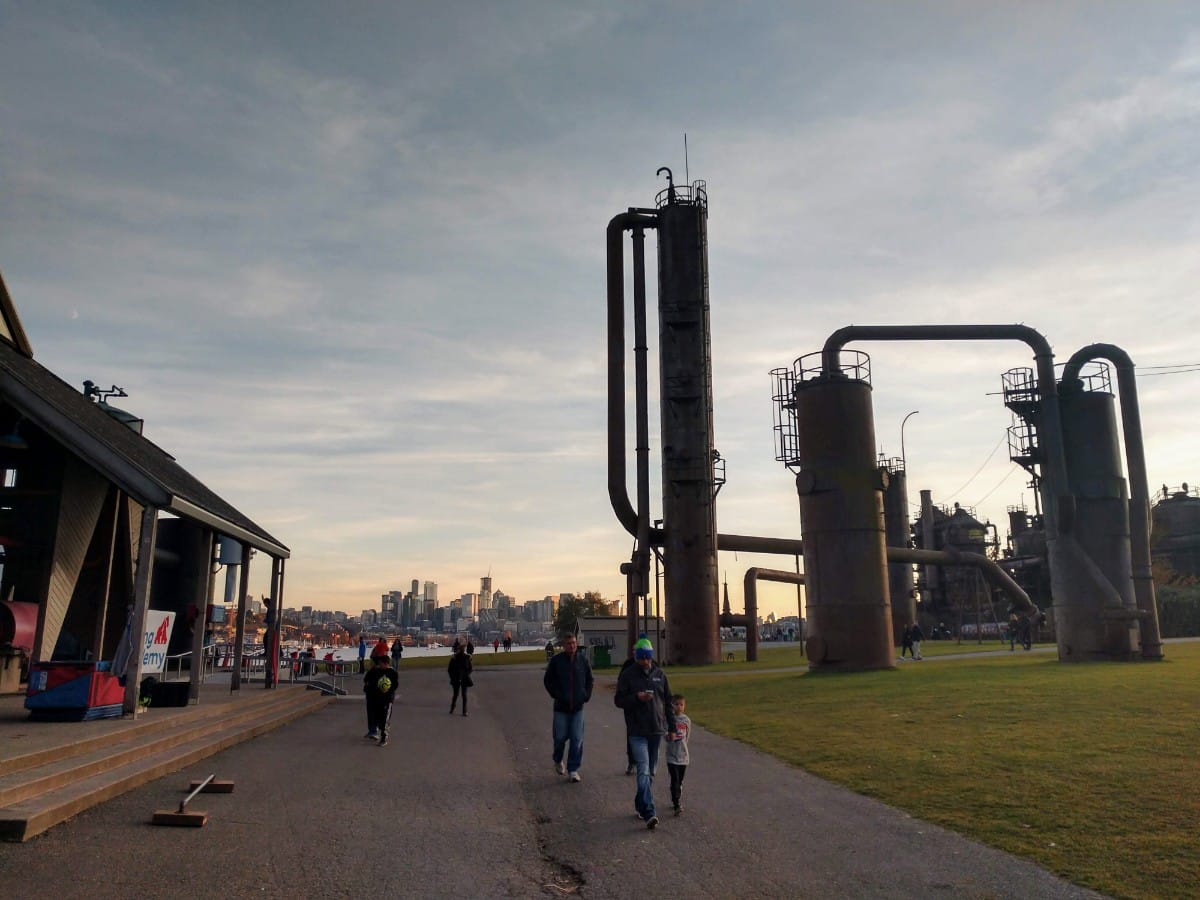
Seattle should extend summer park hours and increase programming to promote community and safety.
It’s nighttime at Gas Works Park. Surrounded by good friends and community, one can see the glow of LED props being spun and juggled, framed by the luminescent skyline of Downtown Seattle and reflected in the water of Lake Union. Music is playing, but it’s at a low enough volume that conversation can easily be carried without raising one’s voice. Fellow parkgoers are largely sober and in good spirits.
For flow artists, jugglers, and movement artists like me, it’s a special time to be connecting with those who share in their love of movement art – largely individuals with few options for the space and time necessary to hone their craft.
From behind comes the affront of a floodlight, immediately piercing the moment of shared company. A Seattle Police Department (SPD) vehicle approaches, the officers’ faces cloaked behind the onslaught of the light beam. Over an intercom, the group is told that the gates to the parking lot will be shut and locked, and any vehicles inside will be stuck overnight. No matter, as tonight’s visit was made possible by the Burke-Gilman Trail. The SPD vehicle carries on, as does the joy of the time found with friends on a jovial though peaceful Friday night.
Not 20 minutes later, the same SPD vehicle returns, this time with a more stern command: the park is now closing, and it must be vacated. Confused, parkgoers are looking around, surprised that this unique space and time in which the community can gather is now being dashed. Under explicit threat of arrest, everyone reluctantly gathers their belongings, makes quick goodbyes, and disperses. None in attendance can recall having been rudely dispersed in this fashion in the countless previous gatherings in this space.
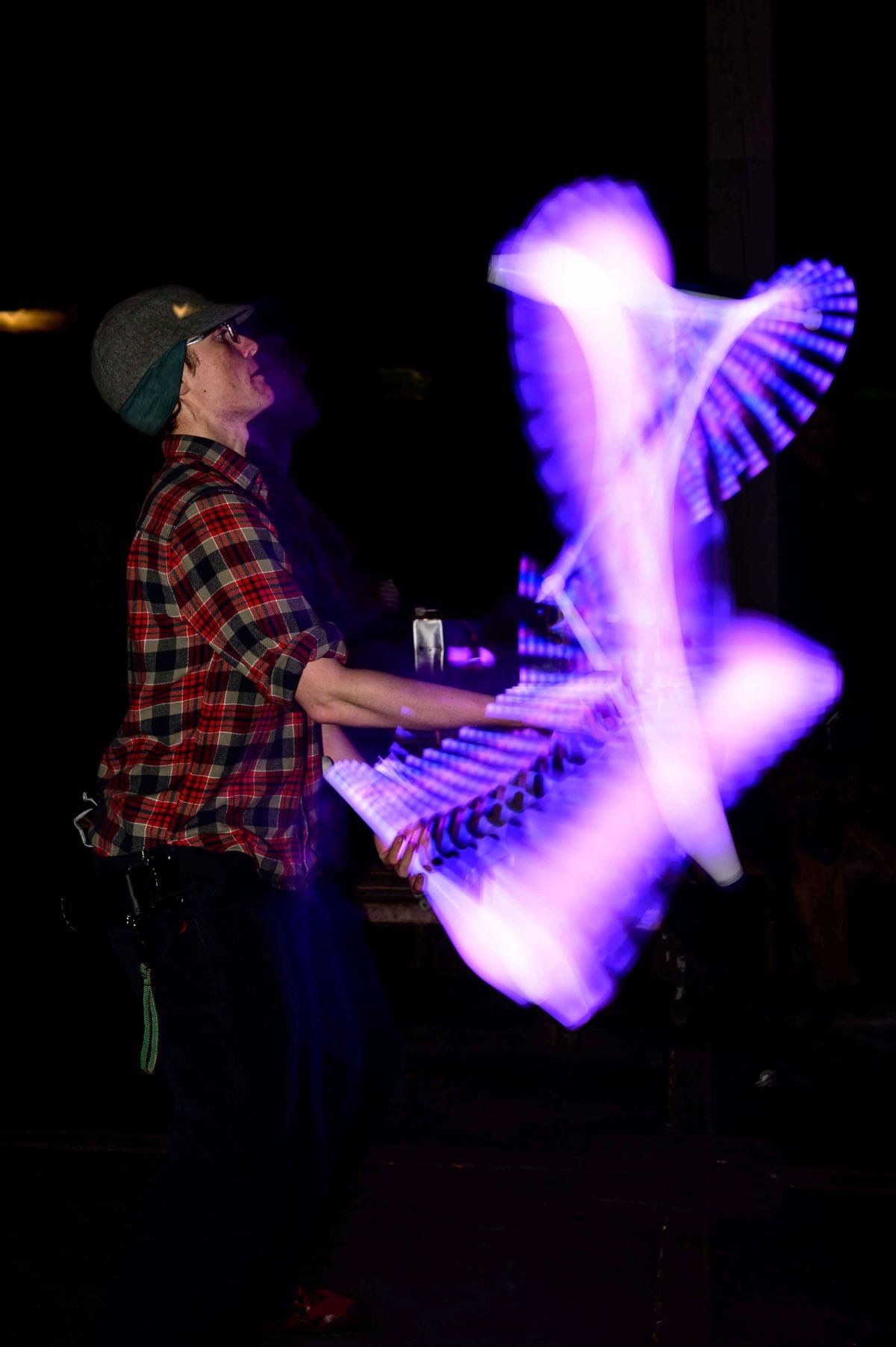
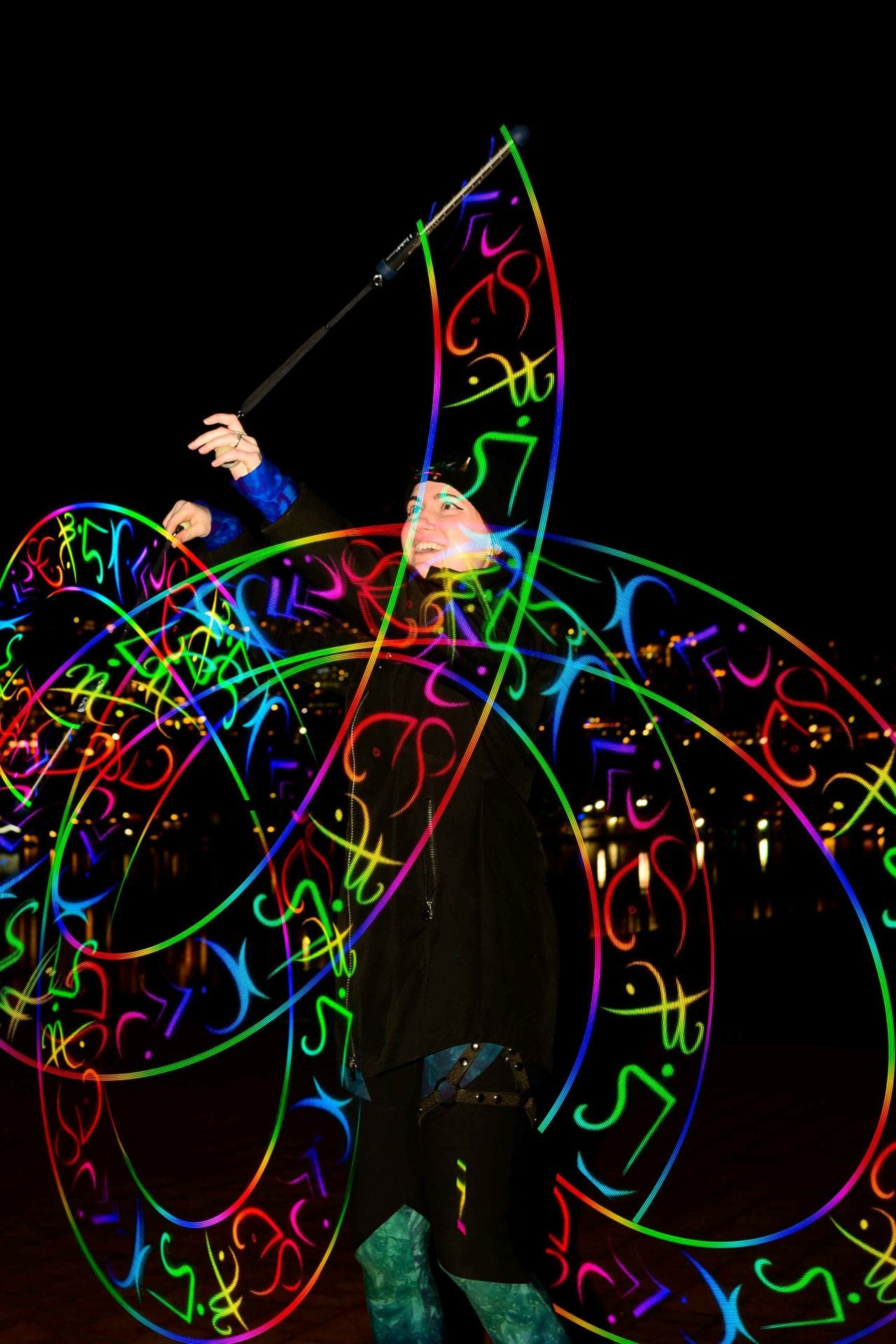
There had been no disturbance, no noise complaint, no altercations, no reason to be leaving the park, aside from the dictation of park hours – a reflexively imagined transgression. As a result, this peaceful gathering of artists, with already limited options for convening and practicing their art forms, has been cut short inexplicably.
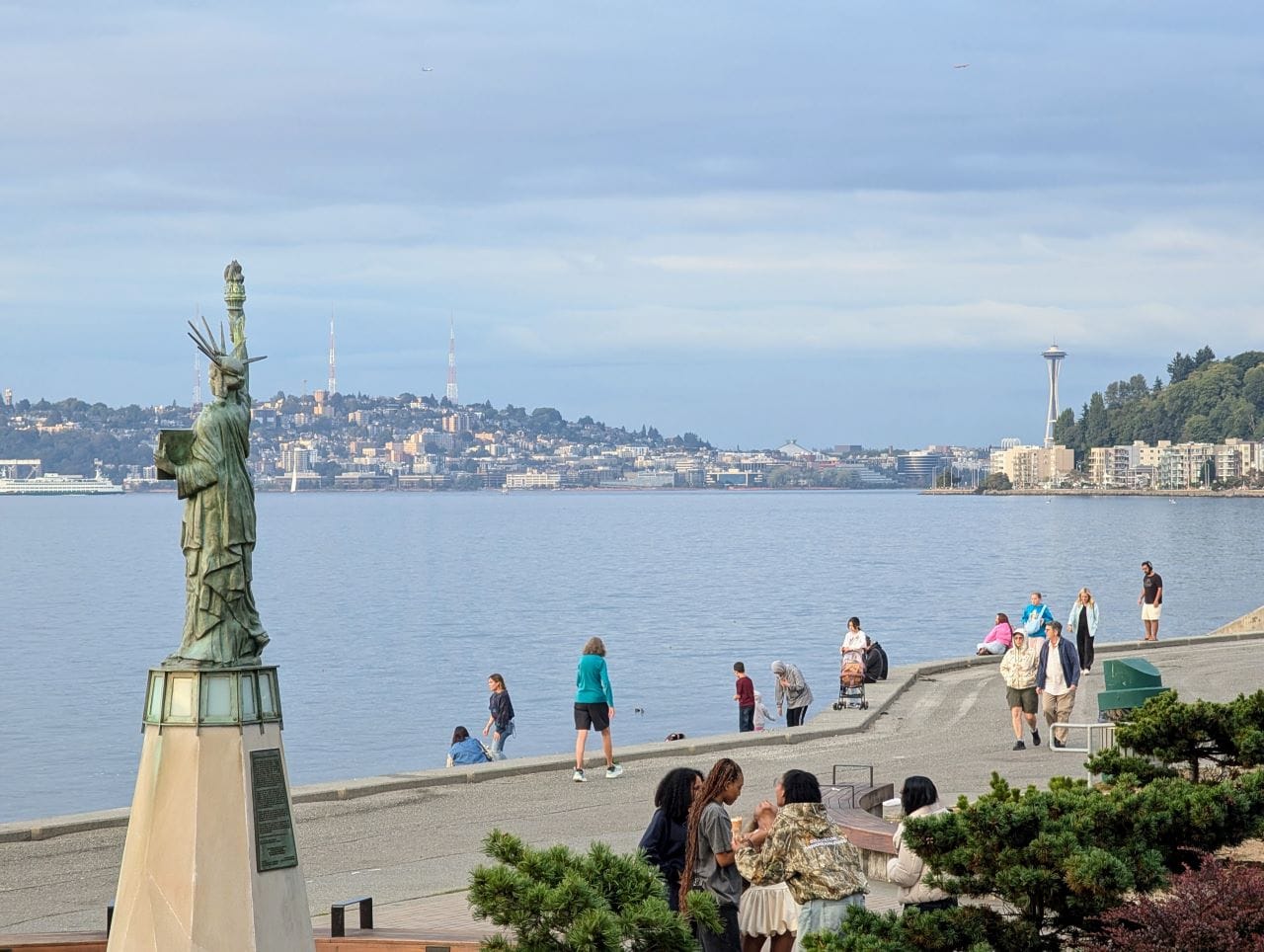
This is the sort of outcome delivered by the Summer Safety Plan implemented by Mayor Bruce Harrell’s administration, with strong support of District 4 Councilmember Maritza Rivera, District 3 Councilmember Joy Hollingsworth, and District 1 Councilmember Rob Saka. Announced in May 2025, the plan included earlier curfews at some of the most highly used parks in Seattle, including Gas Works, Golden Gardens, Magnuson, and Alki Beach.
Alki Beach and Golden Gardens saw their respective hours shortened from 11:30pm to 10:30pm permanently for summer months, Magnuson boat ramps saw their hours permanently shortened to 10:00pm, and Gas Works saw its hours shortened from 11:00pm to 10:00pm for the summer months on a pilot basis. Other actions taken in the Summer Safety Plan include increased police patrols, new barriers for parking lots, and other, more minor adjustments.
The purported reasons for these adjustments in hours and police presence is an increase in violent crime and “nuisance activity” in the summer months.
Was an interest in public safety truly at the heart of these actions taken? Further, if public safety was in fact the good-faith goal of these actions, are they the most appropriate actions for these critical public spaces? While violent crime was mentioned as the motivating factor in the Harrell administration’s summer safety plan document, Councilmember Rivera’s discussion of this plan in her district’s July newsletter focused much more on “noise complaints” at Magnuson Park and Gas Works Park, with nary a mention of any instance of violent crime.
The summer safety plan reiterates its focus on a data-informed approach to its strategy. What does the data tell us? The only data cited in the safety plan document describe that “71% of community-generated calls happen during opening hours which are 7 a.m. to 9 p.m. This is especially true for assaults and thefts. In contrast, burglary calls tend to be more frequent before 10 p.m.” So far, the data does not support a surge in late-night patrols and shortened park hours.
Based on available crime data from the Seattle Police Department (SPD) dating from 2008 to September 2025, when this data was pulled, the rates of violent crime are not significantly different from that of the city at large. A breakdown comparison of crime rates by the four largest parks mentioned in the safety plan is listed below.
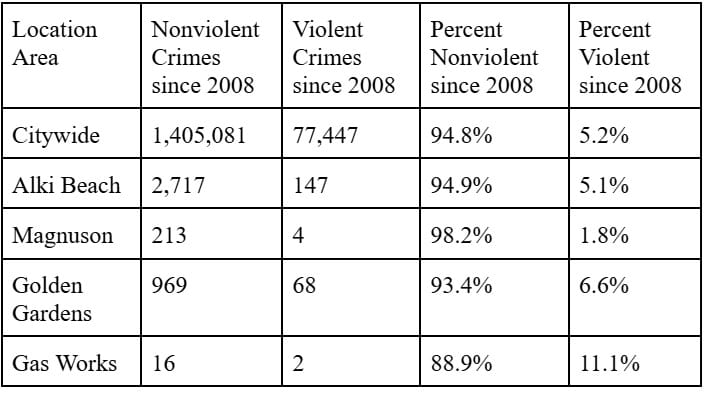
One of the glaring details of this information includes the high raw number of crimes to occur at Alki Beach, though it should be noted that the City broadly defines Alki Beach, capturing a fair amount of property extending blocks from the beach itself, including a large number of the neighboring bars and restaurants across the street.
A more detailed breakdown below shows the seasonality of crime at the above listed parks, compared with the city. Percentage rates are grouped relative to crime per park, i.e. a value of 2.0 in the column “Percent Violent Crime” for Golden Gardens in Summer signals that 2% of all crime to have occurred in Golden Gardens Park is violent crime in the summer months.
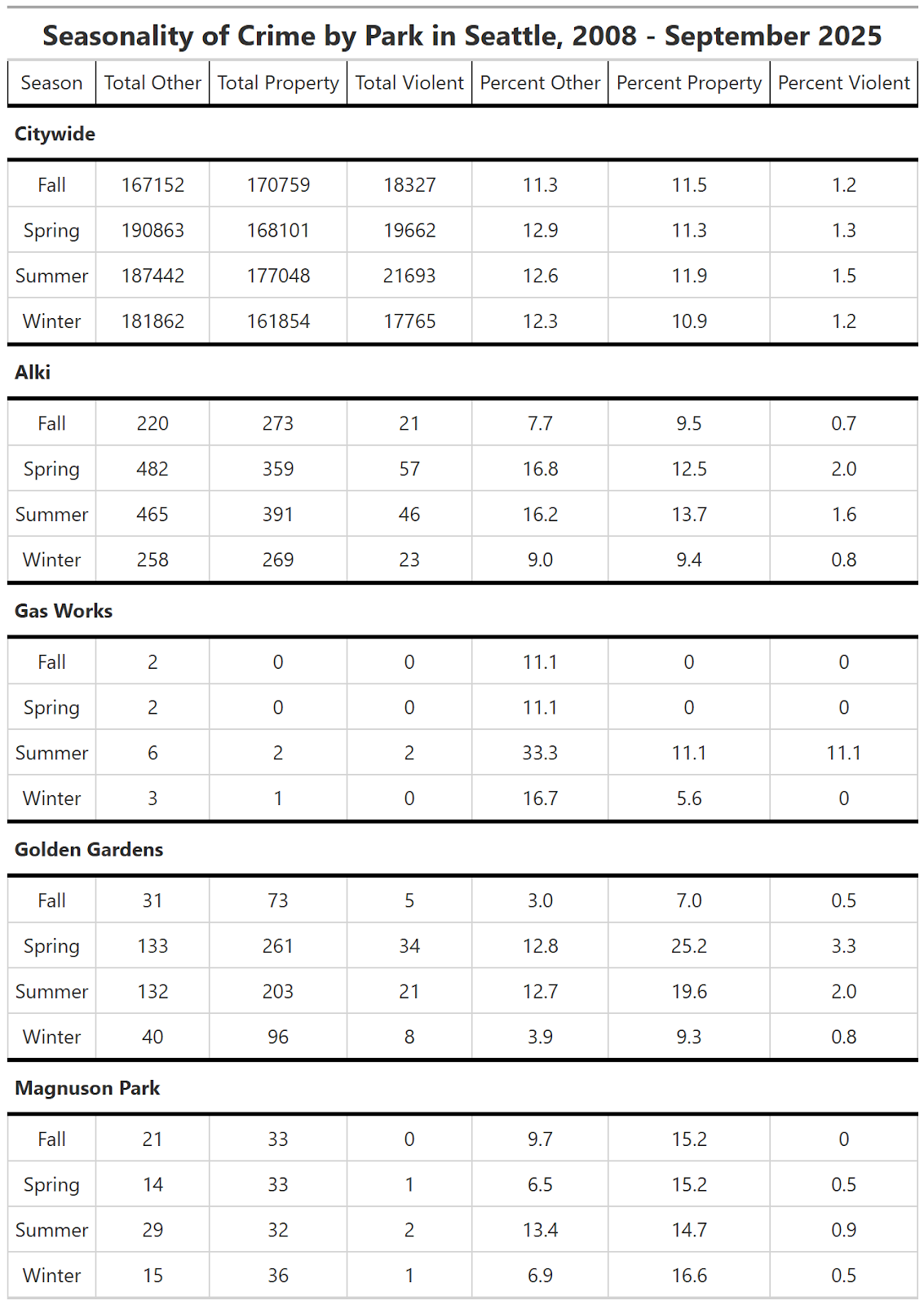
Out of the four largest parks affected by the Summer Safety Strategy, only two saw their violent crime rates peak in the summer months: Magnuson and Gas Works.
Gas Works saw only two incidents of violent crime since 2008 (significantly less than other parks), and only one of them occurred during nighttime. In fact, that nighttime act of violence occurred at 12:40am, well past even the original park closure hour of 11pm. With only 16 total crimes reported in the last 17 years, Gas Works appears a remarkably safe place, relatively speaking, with an exceptionally low incidence of crime overall.
It’s worth noting that Magnuson Park’s overall violent crime rate (1.8%) is well below that of the city as a whole (5.2%), even if its violent crime rate peaks in the summer months.
If there is not significant data to support additional police and shortened park hours, then why were they prioritized, particularly when there is greater incidence of violent crime elsewhere in the city?
Absent further data regarding police calls and non-criminal complaints, one can only look to the other broad category of activity cited as “nuisance activity,” in which the Summer Safety Strategy lists highly dangerous behaviors such as “excessive noise” and “lack of adherence to park hours.” Councilmember Rivera’s newsletters make frequent mention of noise complaints, signaling the priorities of city leadership in a more honest way than the purported reasons in the published Summer Safety Strategy.
Harrell’s spokesperson Callie Craighead has remarked that, at least with respect to Gas Works, police patrols are “not permanently stationed at the park.” The problem remains, still, that the policy of shortened park hours leaves the door open for selective enforcement, keeping alive the problems of biased policing and encumbered public access.
There are serious, even if unintended consequences for this ham-fisted approach, including needless friction between police and members of the public, as well as increased opportunity for bias in policing, stemming from unresolved racial disparities in SPD policing. When police resources are as limited as they are purported to be, then pre-emptive patrols in low-crime, high-income areas, such as Gas Works Park, are simply not prudent as is claimed.
The most striking downside of these shortened park hours, overlooked by policymakers and supporters of these actions, is the sterilizing effect of these actions on peaceful parkgoers and artistic communities that rely on nighttime access to expansive public spaces, such as Gas Works, for which there is negligible data to support increased patrols and early nighttime closures.
In what ways, then, can safety truly be bolstered in parks, if not by way of restriction and policing? One aspirational answer can be found in Los Angeles, where an initiative called “Parks After Dark” has utilized intentional programming in parks, as the name would suggest, after sunset, finding significant reductions in crime in addition to boosts in public health as outcomes for participating parks.
Further inspiration can be found in Paris, where, since 2019, about one quarter of the city’s parks remain open a full 24 hours during the summer months, supporting a variety of nighttime uses throughout the city’s public spaces. The program has been successful to the point of expansion in the six summers since the initiative began.
Many cities globally have positions specific to nightlife culture and activation, often informally called a “Night Mayor.” Even the City of Seattle’s Office of Economic Development holds a similar position, though the position’s purview largely excludes parks and the activation of public spaces at nighttime. Seattle’s reputation of innovation leaves an opportunity for experimentation, where the city’s concerns with public safety in parks at night could also be an opportunity to expand the use and activity of those same parks throughout the day and night.
In the timeless classic The Death and Life of Great American Cities, Jane Jacobs writes that “effective neighborhood physical planning for cities should aim […] to use parks and squares and public buildings as part of [the] street fabric; use them to intensify and knit together the fabric’s complexity and multiple use. They should not be used to island off different uses from each other.”
Parks thrive when they have a variety of uses facilitating nearly constant use by the public, enhancing the “eyes on the street” principle of community vigilance, popularized by Jacobs, that strengthens public safety far more preemptively than armed patrols do. When a variety of people are using or passing through a park or public place, their very presence is what goes farthest to prevent violence and to protect neighbors of that park.
Seattle’s parks and arts presence are among its greatest assets, as is the city’s ability to experiment, innovate, and set new precedents for governance and collective action. At a time when artists and artistic communities have faced dwindling opportunities to practice their crafts, their gathering spaces should be supported and uplifted, rather than squashed and sterilized.
Our path to actualized public safety in our parks relies precisely on our city’s ability to innovate and create, where historic paths to repeated harm must give way to safety grounded in accountability, transparency, and above all, community.
Seattle Parks appears convinced their shorter summer hours are popular with Seattleites. If the Parks department has not heard your voice, email them at pks_info@seattle.gov.