Washington state has a property tax problem. Actually, it has two, and the reason they keep going unsolved is that lawmakers have been treating them as separate issues when they are, in fact, the same problem.
On one side: local governments across the state are slowly being starved of the revenue they need to deliver basic services. On the other: homeowners and renters are already stretched to the limit, and any proposal to raise taxes feels politically toxic and, for many families, genuinely unaffordable.
These two problems appear to be in direct conflict. They are not. There is a path through, but it requires the legislature to do something it has so far been unwilling to do, which is address both sides of the equation at the same time.
Famously, Washington already has one of the most regressive tax systems in the country, relying heavily on sales and property taxes while lacking an income tax. Property tax reform is not just a housing issue. It is part of a broader reckoning with who bears the cost of funding public services in this state.
In 2001, voters passed Initiative 747, which established the current 1% annual cap on property tax levy growth for most local governments. The intent was to protect taxpayers from runaway tax increases. But more than two decades later, Washington's economy, population, and housing market have changed dramatically, while the revenue framework governing local government has not.
Local governments can only increase the revenue they collect from existing property by 1% each year, regardless of inflation or population growth. Inflation does not grow at 1% per year. Construction costs do not grow at 1% per year. Public employee wages do not grow at 1% per year.
The gap is real and measurable. Local governments across Washington have been forced to cut services, defer maintenance, and rely increasingly on voter-approved levies and bonds to fill the hole. Those voter-approved levies fall outside the cap, but they require elections, they are unpredictable, and they shift more of the tax burden onto homeowners in ways that are difficult to plan around.
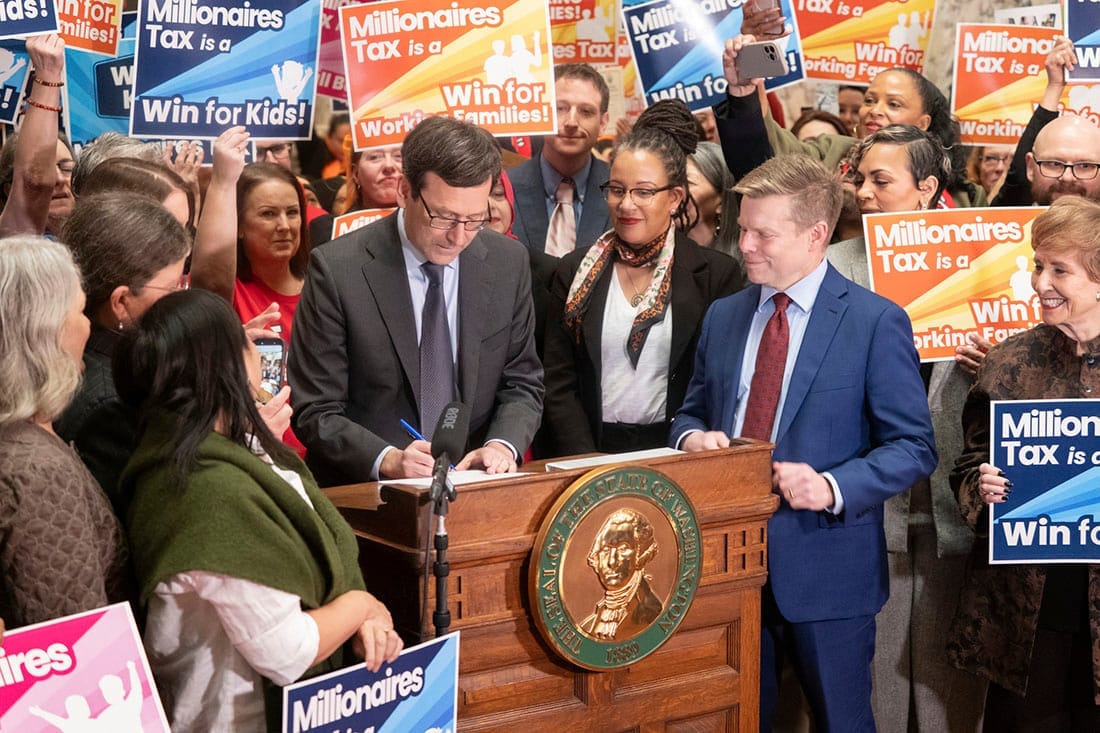
Across Washington, cities and counties are already warning that the cap will force reductions in public safety staffing, delayed infrastructure maintenance, and cuts to basic services in the coming years.
The Association of Washington Cities has documented this problem extensively. So has the Washington State Budget and Policy Center. This is not a matter of opinion. The 1% cap is slowly hollowing out the capacity of local government to function.
Last year, House Bill 2049 passed and was signed into law. But the bill that passed was not the bill that was proposed. Earlier versions would have allowed local governments to increase their property tax revenue by up to 3% annually, tied to population growth and inflation. That provision faced significant political opposition, and the legislature removed it before final passage. The 1% cap remains in place.
The reason the provision died is instructive. Increasing the cap without any accompanying relief mechanism means that homeowners, including seniors on fixed incomes, working families with tight budgets, and longtime residents in neighborhoods where values have risen far faster than wages, absorb the full cost of the increase. In a region like King County, where the median home value sits around $800,000, even a modest percentage increase in assessed value translates into hundreds of dollars in additional tax burden per household.
The legislature's caution was not unreasonable. But caution without a solution is just inaction. Washington cannot rely on the current 1% cap indefinitely. Local governments will continue to deteriorate. The question is not whether to fix it. The question is how to fix it without making life harder for the families who are already struggling to stay.
Most states already provide some form of homestead protection for primary residences, a provision that reduces the taxable assessed value of a home, providing automatic relief to owner-occupants without requiring them to navigate a complex application process or hire a professional to find savings they are entitled to.
Washington has no such protection. Our constitution treats a family's primary home the same as a commercial office building or a data center. That distinction matters, because a family's home is not an investment vehicle. It is where people live, raise children, age in place, and build the kind of stability that makes communities function.
This past session, both chambers had active proposals to change that. Senate Bill 5770 and its House companion, House Bill 2024, would have created Washington's first broad homestead-style exemption, exempting the greater of $100,000 or 60% of the county median home value from the state portion of the property tax. In King County, that exemption would have protected roughly $480,000 in assessed value from the state levy. Senate Joint Resolution 8203, the necessary constitutional amendment, passed out of the Senate Ways and Means Committee but never received a floor vote. Neither bill crossed the finish line.
A homestead exemption would modestly rebalance the property tax system by recognizing that a primary residence plays a different role in the economy than investment property or commercial real estate. The constitutional path is difficult. It requires a two-thirds legislative vote and subsequent voter ratification. It is not impossible. It is the right thing to do, and the legislature has now had multiple sessions to act and has not.
Over the long term, Washington may also want to explore land-value-focused taxation that encourages housing production and discourages speculation and sprawl. But even within our current system, the legislature already has the tools to make meaningful improvements. It has simply chosen not to use them.
Any property tax reform that focuses exclusively on homeowners is incomplete, because renters pay property taxes too. They just pay them indirectly, through their rent. When property tax costs rise for landlords, those costs get passed through. When property tax burdens are relieved, there is no guarantee that relief reaches tenants.
In Seattle and many parts of King County, renters now make up the majority of households. That is why the third piece of this package matters.
Senate Bill 5771 would have enhanced the Working Families Tax Credit to account for the property tax burden embedded in residential rents, providing up to $300 in additional annual tax credit relief for eligible low-income renters, indexed to inflation beginning in 2027. It also stalled without a vote.
An enhanced renter credit is not a perfect solution. But it is a direct, targeted mechanism that acknowledges a reality most property tax debates ignore: in a region where the majority of Seattle households rent, a reform that only helps homeowners is not a reform at all.
Washington keeps failing to solve this problem because it keeps debating these three things separately. The cap increase loses its protection mechanism. The homestead exemption stalls over constitutional complexity. The renter relief bill waits in a queue disconnected from anything larger. In most states, these elements function together as part of a single system: revenue growth for governments, structural protection for homeowners, and targeted relief for renters.
This past session, the legislature had all three pieces in front of it at the same time. SB 5770 and HB 2024 would have created the homestead exemption. SJR 8203 would have enabled it constitutionally. SB 5771 would have extended meaningful relief to renters. This was the closest Washington has come to having a complete, coherent property tax reform package on the table simultaneously. The legislature let it pass without acting.
Raise the cap in a responsible way. Pair it with a constitutional homestead exemption for primary residences. Attach meaningful renter relief. That combination creates a more predictable system for local governments while protecting the households most vulnerable to rising costs. It does something none of the individual proposals can do on its own: it gives local governments the revenue they need to function, while ensuring that the people least able to absorb higher costs are shielded from the full impact.
This is not a radical idea. It is how most states with functional property tax systems are already structured. Washington is the outlier, and the cost of that outlier status is being paid every year in cut services, displaced families, and a legislature that keeps returning to the same impasse.
The path forward is not theoretical. The bills have been written. The need has been documented. What is missing is the political will to treat these three reforms as what they actually are: one problem, one solution, and one overdue decision.
 Amy Sundberg