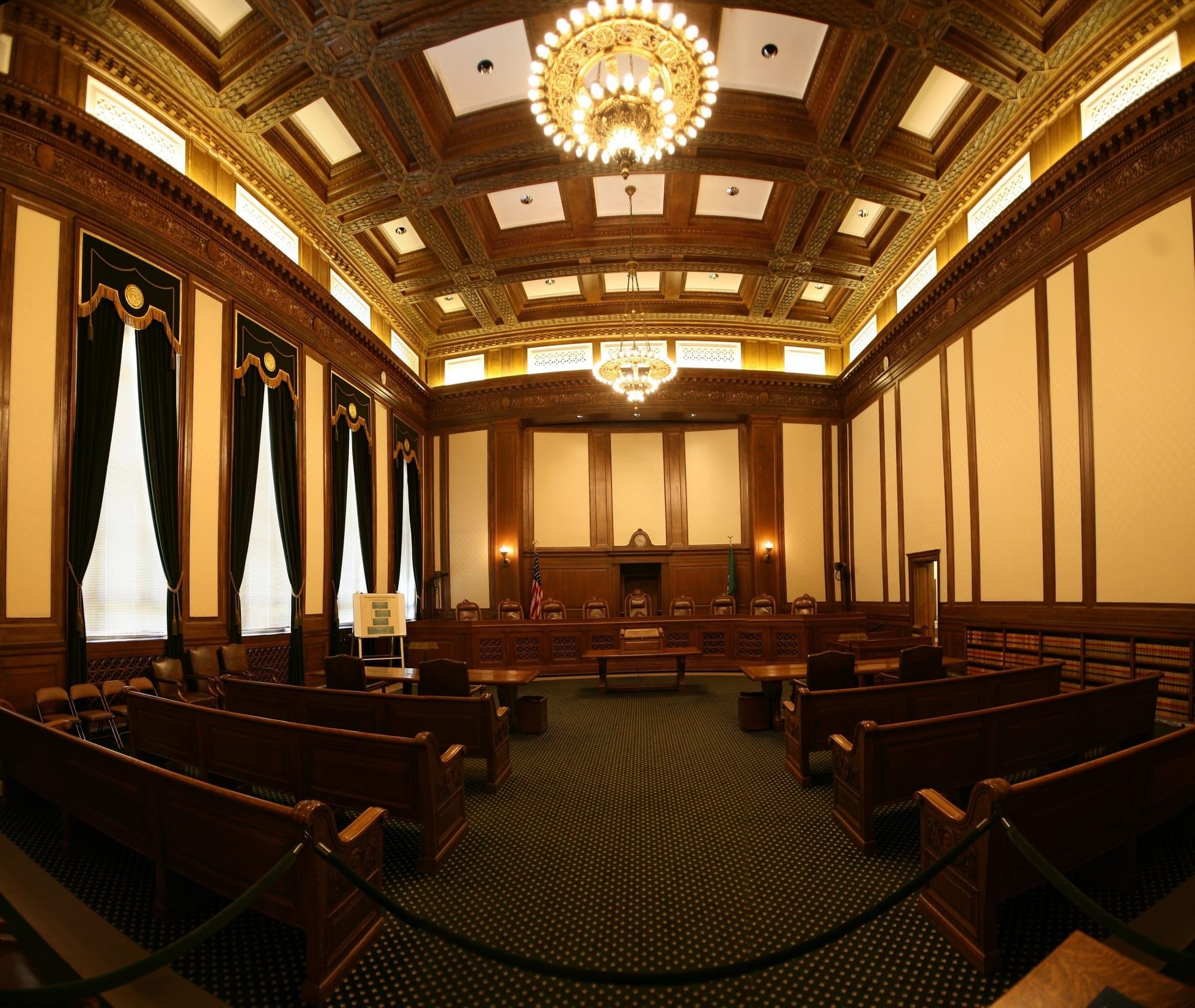
This November, Washingtonians will cast their ballots for five Washington State Supreme Court justices. Due to a rush of retirements (both forced and chosen), five of the nine total seats on the court are up for grabs this year, representing a majority of the court.
The current state Supreme Court is considered to be one of the most progressive in the nation, and it is also one of the most influential, with a study from 2007 finding it second only to California in the number of its followed decisions (decisions it made that at least one other out-of-state court followed). The recent 2021 decision in State v. Blake, striking down the state’s drug felony possession law, was discussed all over the country and continues to have ramifications today.
“Our state Supreme Court has been one of the strongest, most visionary Supreme Courts in the country,” said La Rond Baker, the legal director for the ACLU of Washington. “It has led the way in diversity, and it has led the way in really protecting the rights of Washingtonians in many of their rulings.”
In an unusual move, the court released a letter in 2020 acknowledging the role they had played in “devaluing black lives” and upholding the importance of those in the legal profession “dismantling systemic racism.”
“Another area where our state Supreme Court has been groundbreaking is on trying to address institutionalized implicit and explicit racism within the criminal legal system, and trying to create tests and ways in which to protect against the legal system being used as a tool of racial oppression,” Baker said.
The Court began this project in 2018 by adopting Rule 37, which aimed to eliminate both intentional and implicit racial bias in jury selection, the first such rule in the country. Several other states have since adapted the rule for their own use.
In the present day, the state Supreme Court can act as an important protective force against a capricious federal government launching repeated attacks against established civil liberties.
“Particularly with a frankly rogue president violating constitutional norms and laws, with a U.S. Supreme Court that seems often all too willing to let the president do what he wants and violate constitutional norms and laws, the state Supreme Court in Washington is a critical bulwark of the rights of Washingtonians,” said Adam Glickman, secretary-treasurer of SEIU 775. “I’m particularly thinking about more vulnerable people in Washington State, thinking about immigrants, thinking about members of the trans community and LGBTQ community more broadly, thinking about low-income people. The Washington Supreme Court has some ability to protect the rights of people in our state.”
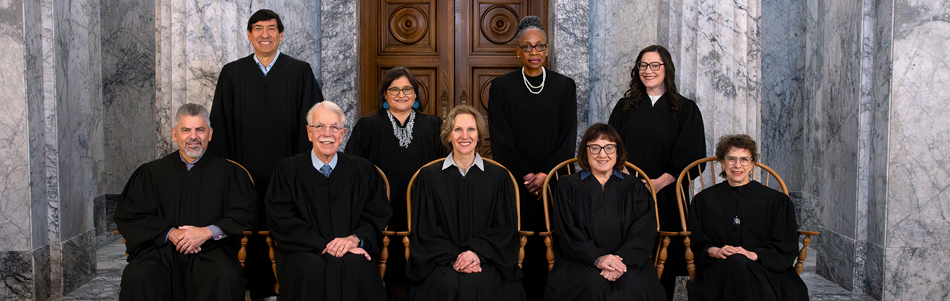
The Court is tasked with upholding the civil liberties protections that exist in the Washington State Constitution, many of which don’t exist in the U.S. Constitution. For example, Washingtonians enjoy much greater privacy from government intrusion than is provided by the Fourth Amendment, and Washington has determined that cruel punishment is not acceptable, whereas the Eighth Amendment requires unacceptable treatment to be both cruel and unusual.
That being said, the State Supreme Court hasn't always been as bold in its rulings when it comes to issues around taxation and economic justice.
Earlier this month, Rob McKenna, a former Republican Attorney General of Washington state, along with the Citizens Action Defense Fund filed a lawsuit against the newly passed ‘millionaires’ tax that would impose a 9.9% tax on incomes above $1 million.
The lawsuit against the millionaires tax will likely go in front of a state Supreme Court shaped by this November’s election. The suit will call into question the famous 1933 state Supreme Court ruling in Culliton v. Chase, which established that income must be taxed uniformly at 1% and at the same rate as property, effectively putting the kibosh on a state income tax for almost a century.
In 1932, a voter initiative proposing a graduated state income tax passed with 70% of the vote. A Democrat was elected as governor, with both chambers of the state legislature also controlled by Democrats – the same situation in which the state finds itself now. In 1933, stymied by both the state government and the will of the voters, Washington conservatives turned to the courts to stop the income tax.
At stake is whether history will repeat itself on the tax question in 2027: whether Democrats will finally be able to more effectively address Washington’s upside down tax code, which ranks as the second most regressive in the nation behind only Florida. In addition to providing tax relief, new revenue for the state could provide free meals for students and better fund education, improve transit service, build more affordable housing, and provide greater access to health care, all while federal funding for such projects is being slashed.
Other cases that might be heard by the state Supreme Court in upcoming years include two cases regarding the public defense crisis in the state and cases that are seeking to further expand privileges and protections provided by the state constitution. If either initiative on the ballot this year threatening the rights of transgender youth were to win at the ballot box, the state supreme court might also eventually rule on the laws’ constitutionality.
The vast majority of lawsuits and criminal suits happen in state courts and rely on state law, not federal law, underlining the power of the state supreme court in Washington’s legal landscape.
Dark money in the supreme court races
Big money has become a real factor in state Supreme Court races in recent years, with the Brennan Center finding that in the 2023-2024 cycle, more money had been spent in these races across the country than ever before. In 2025, over $100 million was spent in a race for a single seat on the Wisconsin state Supreme Court.
At the same time, dark money – political contributions shielded from normal public disclosure rules by being funneled through 501(c)(4) nonprofits and other shell organizations – has surged since the Citizens United ruling in 2010.
With so much at stake, with Washington’s five state Supreme Court seats up for grabs this fall, a huge question is how much money, and particularly dark money, might be poured into these races.
Of the five positions up for grabs, the one least likely to be a contested race is the seat held by incumbent Debra Stephens, who has sat on the Court since 2008 and has no declared opponents at this time.
Another seat is being defended by Colleen Melody, who was appointed to the court by Governor Bob Ferguson at the beginning of the year to replace retiring justice Mary Yu. Melody used to be the Chief of the Civil Rights Division in the Washington State Attorney General’s Office and worked under Ferguson. She is being challenged for the seat by conservative Scott Edwards, who previously challenged the state’s capital gains tax and an income tax in Seattle.
The position 3 seat is being vacated by Raquel Montoya-Lewis, which means no incumbent advantage. It is shaping up to be a three-way fight between conservative Mason County Superior Court Judge David Stevens (recommended by the state Republican party), moderate Division 1 Court of Appeals Judge J. Michael Diaz, and progressive King County Superior Court Judge Jamie Hawk. Stevens has cited Antonin Scalia and Samuel Alito as his judicial heroes.
The other entirely open seat, Position 4, is being fought over by moderate King County Superior Court Judge Sean O’Donnell, progressive Division 1 Court of Appeals Judge Ian Birk, and attorney David Shelvey, who, on his campaign website, makes a bizarre analogy between the Tyrannosaurus Rex and the kangaroo to discuss circumstantial evidence.
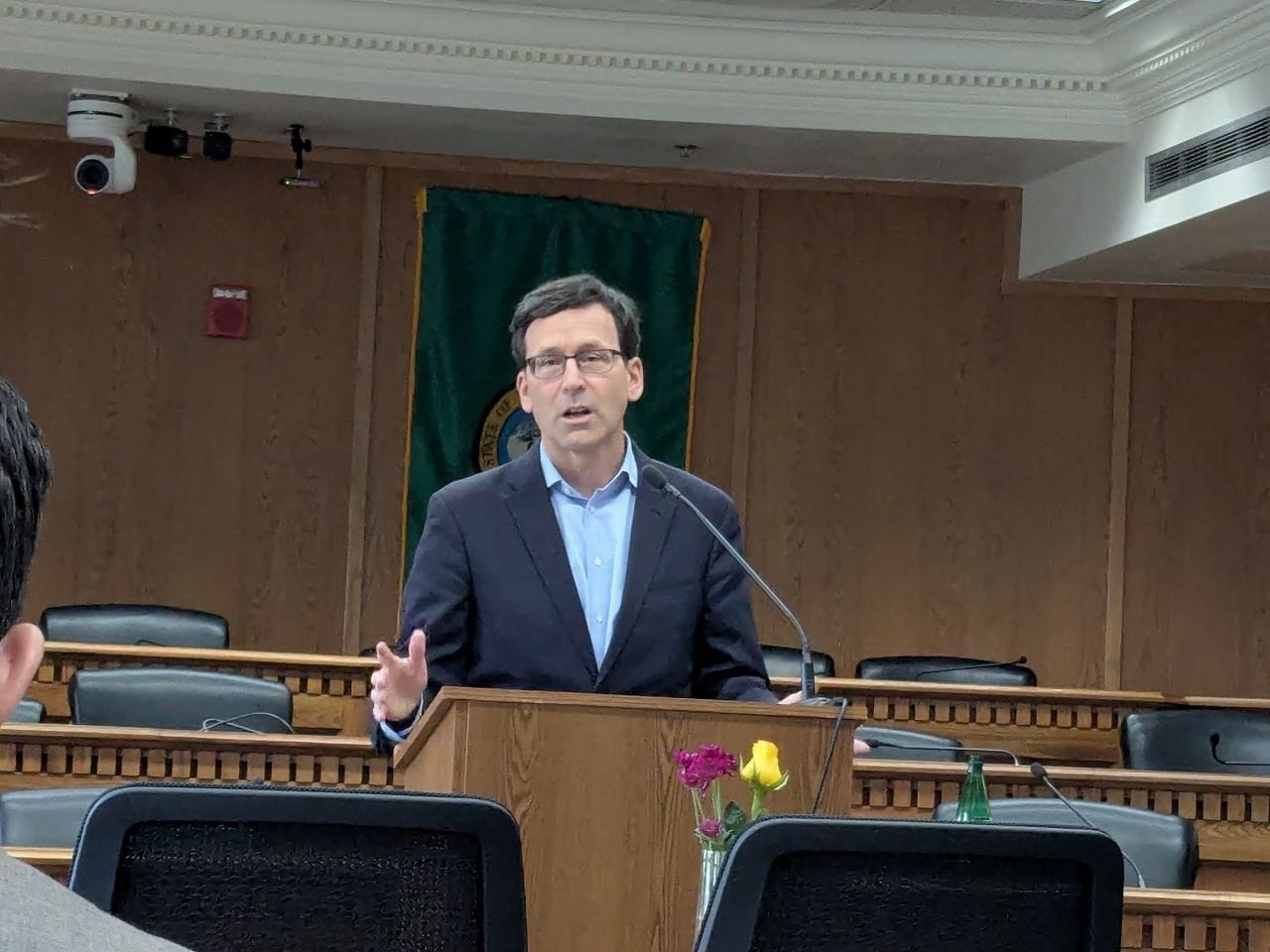
The last seat, Position 5, is currently held by new justice Theo Angelis, who was a partner at the mega law firm K&L Gates before Ferguson appointed him to the court this April. He is being challenged from the left by Thurston County Superior Court Judge Sharonda Amamilo and from the right by former Federal Way Municipal Court Judge Dave Larson, who narrowly lost the state supreme court race in 2024 to Sal Mungia.
This year, Republican horror at the millionaires tax could lead to increased dark money spending to elect more conservative judges in Washington State.
“There are certainly conservative and Republican forces, led by Rob McKenna and others that are out there, you know, raising a lot of money and recruiting and promoting conservative candidates for the state Supreme Court,” Glickman said.
The Citizens Action Defense Fund is a legal advocacy group that sits under the umbrella of Project 42, a conservative advocacy group that sports conservative donor and organizer Brian Heywood as one of its founders. Other projects underneath the Project 42 umbrella include Heywood’s initiative machine Let’s Go Washington; the Center Square – a media project tasked with telling news “from the taxpayers’ point of view;” the Washington Policy Center, a conservative think tank with ties to the Koch Network; and Full Court Press, a relatively new dark-money group focused on recruiting and supporting suitable judge candidates in Washington.
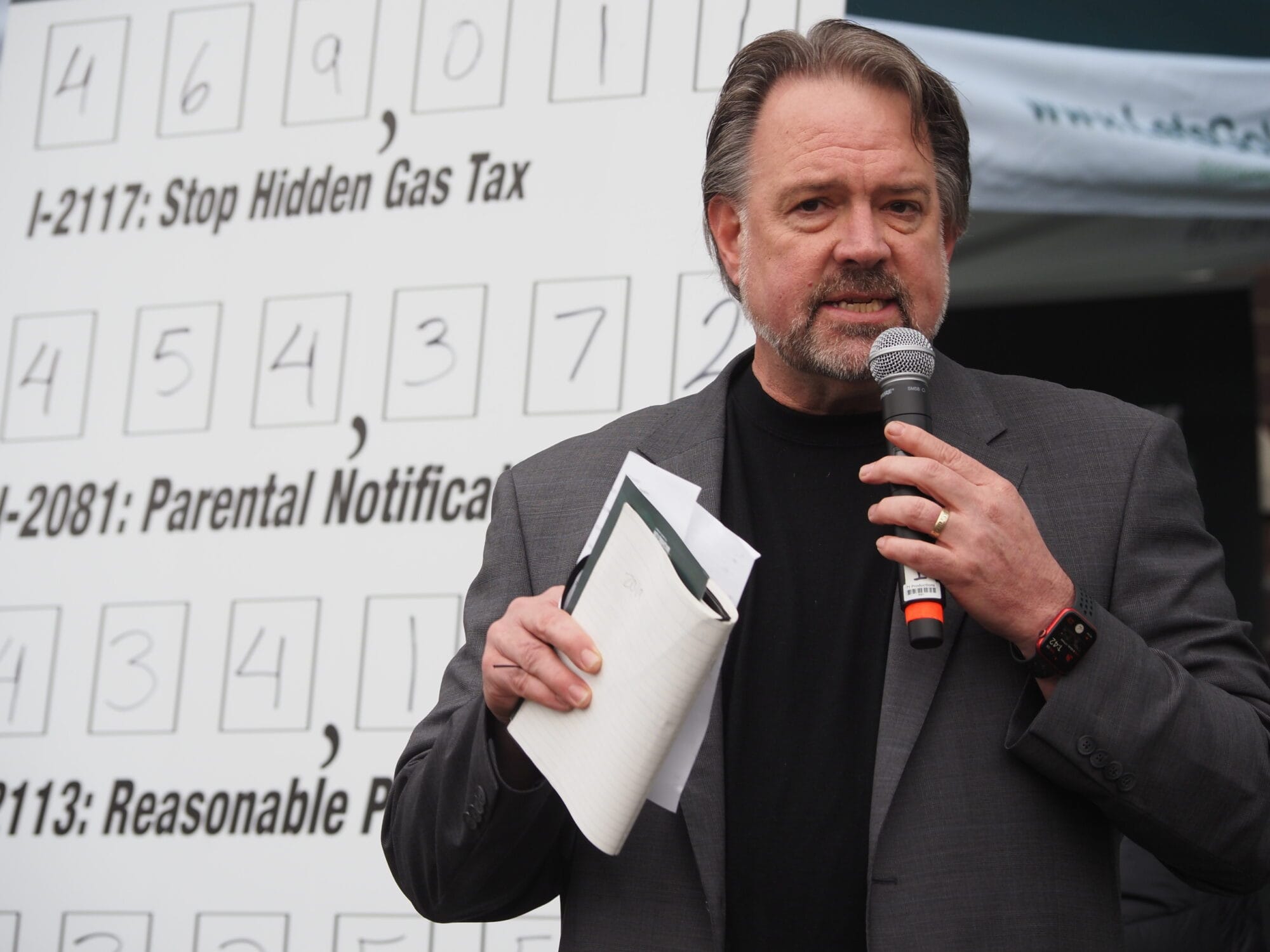
McKenna, who is the lead counsel on the challenge to the millionaires tax, is also the chair of the board of Full Court Press. Tim Kovis, the executive director of Full Court Press, has participated with the Federalist Society, a conservative and libertarian legal organization that holds sway in shepherding conservative judicial nominees to appointments across the country.
“Washington Democrats know that dark money interests led by mega-millionaire hedge fund manager Brian Heywood are doing everything they can to undo the progressive victories we have secured over the past 18 years,” said Shasti Conrad, chair of the Washington State Democratic Party. “With five of the nine State Supreme Court seats up for election this year, voters will determine whether our state will elect justices who will continue moving us forward on tax fairness, protecting our clean air and water, championing reproductive freedom and civil rights, and contending with new threats and opportunities from artificial intelligence.”
Ties to Full Court Press
Two of this year’s state Supreme Court candidates – Sean O’Donnell and Dave Larson – appeared on a now deleted “prospects” page of Full Court Press’s website last year. The page says these candidates were invited to participate in Full Court Press’s campaign training due to a “facts-based approach” to their judicial philosophies.
The Urbanist asked both candidates about their association with Full Court Press and their relationship with McKenna.
“Many people support me because I want partisan politics out of the judiciary, so it is easy to understand why the people who desire to maintain their power over the judiciary want to paint me in a negative light,” Larson wrote.
Larson said that he agreed to participate in Full Court Press because he agrees with their mission and believes they are committed to providing support for potential judges who want to remove politics from the courtroom, regardless of their political persuasion. To back this up, Larson wrote, “In 2024, FCP assisted a black female superior court candidate in Snohomish County and a gay male superior court candidate in Pierce County.”
Larson said he got involved with Full Court Press in 2024 before McKenna was the lead counsel on the millionaires tax case and that he knows many political actors in addition to McKenna.
The state Republican party recommended Larson as a candidate in this year’s race. When asked for his comments on this, Larson said in an email: “As noted, the judiciary belongs to everyone of all political persuasions and is supposed to be politically neutral, so I am seeking support across the political spectrum, including democrats, republicans, and lesser-known parties.”
Larson said that while he joined the Federalist Society 41 years ago, he has not renewed his membership.
On the other hand, O’Donnell told The Urbanist he has no affiliation with Full Court Press and asked for his photograph to be removed from their website once he became aware of it. He said that he agrees with the philosophy expressed by Full Court Press for judges to endeavor to rule impartially and based on the facts, not ideology, and notes that this is actually a fundamental duty of every judge.
O’Donnell said he has never been associated with the Federalist Society.
McKenna appears to be a fan of O’Donnell, having donated $500 to O’Donnell’s campaign this year. Other recent political contributions from McKenna include to Sara Nelson for her Seattle City Council campaign in 2025, to Reagan Dunn for his King County Council campaign in 2025, and to Nick Brown’s 2028 campaign for Attorney General.
O’Donnell said he knows McKenna as an active member of the legal community, but that a modest campaign contribution will not impact how he would rule on any particular case. While O’Donnell could have refused McKenna’s donation, such a decision could have also invited ethical questions and conflict of interest concerns in its own right.
In the past, O’Donnell has served under both Republican and Democrat officials. He served as Republican Senator Slade Gorton’s legislative aide in 1995, providing constituent services. He also served as a legal intern in Democrat Christine Gregoire’s Attorney General’s Office, worked as a Special Assistant United States Attorney under the Obama administration, and worked for many years under Norm Maleng (who ran for governor as a Republican) when he was the King County Prosecuting Attorney.
These state Supreme Court elections tend to be more opaque for voters, because they are nonpartisan and the candidates are not allowed to say which way they’d rule on specific issues due to ethical rules. Instead, candidates are more often judged by a combination of their endorsements and their record of past cases and legal experience.
The Urbanist is a nonprofit newsroom powered by reader support. Become a member, get perks, and support local journalism.
In the case of the recent Ferguson appointees, observers tend to assume he wouldn’t have chosen anyone he knew would oppose the millionaires tax, which he supported and signed.
Larson is on the record as being opposed to the recent state Supreme Court decision to uphold the capital gains tax, which may shed some light on his opinions about taxation.
O’Donnell has been more careful expressing his opinions on taxation. Looking at past rulings as a judge, O’Donnell has upheld the state’s strong labor protections and the constitutionality of firearm removal laws.
But O’Donnell has also been critical of the state Supreme Court’s recent ruling that reformed caseload standards for public defenders. He did not think the Court should adopt the new lower caseload standards, and instead suggested the court convene a taskforce to study the matter. He also suggested the possibility of mandatory public defense pro bono work for Washington lawyers.
O’Donnell testified in front of the state Senate Human Services, Re-entry & Rehabilitation Committee in 2019, speaking against a bill that eliminated a court order exception that allowed youth to be placed in detention for non-criminal offences. Before its elimination, this exception was used more often in Washington than in most other states, and led to youth being put into detention for problems like truancy.
O’Donnell has been endorsed by a slate of more moderate Democrats: former Governor Christine Gregoire; former Seattle Mayor Bruce Harrell and current and former Seattle Councilmembers Bob Kettle, Sally Bagshaw, Tim Burgess, Martha Choe, Sara Nelson, and Mike O’Brien; most of the King County Council; and sitting state Supreme Court Justice Helen Whitener.
His opponent, Birk, on the other hand, has been endorsed by former Governor Jay Inslee; six current and former state Supreme Court justices; a bevy of progressive state legislators including Jamie Pedersen, Emily Alvardo, Noel Frame, Rebecca Saldaña, Liz Berry, Darya Farviar, Joe Fitzgibbon, and Shaun Scott; and King County Executive Girmay Zahilay and King County Councilmember Teresa Mosqueda.
Seattle Council President Joy Hollingsworth opted to endorse both candidates.
However moderate O’Donnell may be, the fact that he appears to be both McKenna’s and Full Court Press’s preference might continue to raise eyebrows.
Tensions will continue to mount in this year’s state Supreme Court races, which many believe will be the most consequential elections in the state.
“Washington Democrats are constrained by campaign finance laws on how we interact in elections to the Supreme Court, but we will not allow Brian Heywood, Let's Go Washington, the Washington Policy Center, or their puppet organization Full Court Press to prevent our state from leading the country in the progressive policies that make Washington state the best place in the country to live, work, and raise a family," Conrad said.