The clock is officially ticking for the City of Bainbridge Island's long overdue growth plan, after the Washington Department of Commerce sent the city a letter last week containing a laundry list of items where the city is falling short of requirements to plan for housing under the Growth Management Act. Commerce sent the letter as part of its first wave of reviews of select local growth plans under the 2025 Housing Accountability Act, giving Bainbridge 120 days to make updates and adopt a compliant plan.
If Bainbridge's Comprehensive Plan still isn't aligned with state requirements when that clock runs out, the Commerce Department now has the ability to find the city out of compliance, a power that had previously been confined to the independent Growth Management Hearings Board.
Continued noncompliance could result in the withholding of state funding, along with a brand new provision in state law: the so-called "builder's remedy." If triggered, Bainbridge Island would not be able to deny any permit for a housing project of any size as long as a certain percentage of the units are targeted at low- or middle-income households. The builder's remedy has yet to be triggered in Washington State.
Thanks to the Housing Accountability Act, other Washington cities and towns could also see a builder's remedy unlocked over the coming months, including Beaux Arts Village, Brier, Carnation, Darrington, DuPont, Gold Bar, and Woodway. But Bainbridge Island is by far the largest, with more residents than all other seven jurisdictions combined.
Among the biggest areas where Bainbridge Island's plan was found to fall short: the city currently lacks capacity for enough housing to accommodate its two-decade growth target, and is also not in compliance with requirements to "make adequate provisions" for housing needs across different income levels. Those same requirements, which stem from a 2021 state law, are what got the City of Mercer Island into hot water, prompting City officials to look at increasing housing capacity and being more intentional with affordable housing programs.
"Commerce has found the city of Bainbridge Island’s housing element promotes a variety of residential densities and housing types through multiple goals and policies," the letter, which explicitly cites the Mercer Island order in a footnote, stated. "However, we have found that the city’s housing element does not plan for and accommodate housing affordable to all economic segments of the population because it does not clearly demonstrate how the city has identified sufficient capacity and adequate provisions for housing affordable to all economic segments."
Bainbridge will also need to update its development regulations around emergency and permanent supportive housing, as well as co-living housing, to align with other recent changes in state law.
For months, Bainbridge has been eyeing a June 30 deadline to adopt its overhauled growth plan, spurred on by the potential loss of state funding. But as that internally-imposed deadline approaches, a clash is set to take place between a faction of the Bainbridge Island Council that would be supportive of a broad increase in housing capacity within the denser town center of Winslow, and a faction that is vociferously opposed to that, arguing that subsidized affordable units need to be the priority.
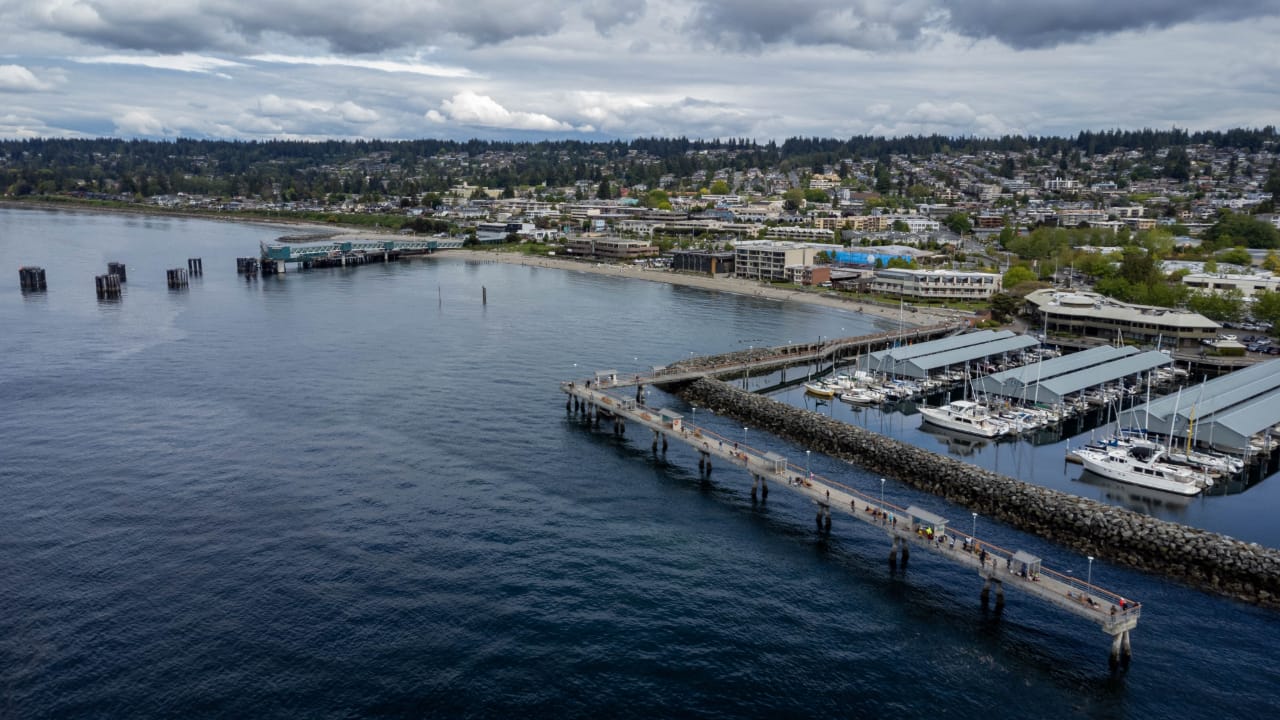
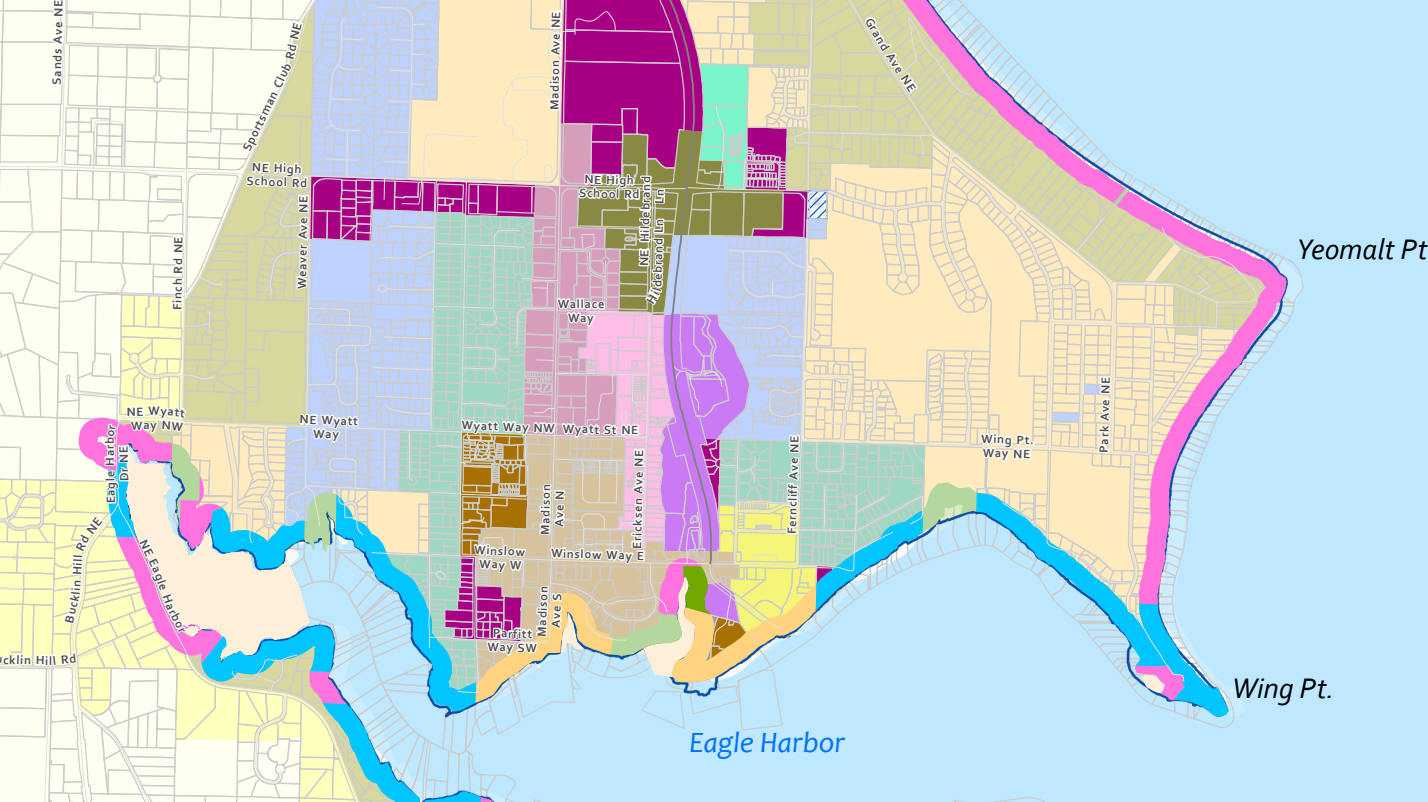
Over recent weeks, a scuffle at the Bainbridge Planning Commission has put that divide front and center, with some commissioners rebelling against a staff-developed proposal to broadly increase density by a modest amount around the state ferry terminal and along High School Road in North Winslow. Under the proposal, the allowed floor-area ratio (FAR) on those zones would increase to 1.0, which allows a two-story building only if it occupies just half of a lot. Currently, the FAR on High School Road is just 0.3, and 0.5 in the Ferry District.
While a motion to advance that staff recommendation failed at a Council meeting last week, so did a motion to hold the line against any base level capacity increases not directly tied to the provision of affordable housing. Councilmember Leslie Schneider represented the swing vote between those motions, with the battle lines otherwise fairly clearly drawn.
According to data from Redfin, the average price of a new home in Bainbridge is more than $1.5 million, with many children of current Island residents unable to return to the city they grew up in. Land use has been heavily constricted on Bainbridge Island, even in designated growth centers, but at Council meetings the idea of allowing more market-rate housing is frequently treated as a clear negative impact.
"The [future residents] we're talking about in this particular motion are not our affordable targets, these are market-rate housing. So let's be clear, it's not fair to the community for them to think that we are turning down the people who we most need to house right now," Councilmember Kirsten Hytopoulos said in voting against advancing the increase in base density.
"This is just straight market-rate upzoning," Councilmember Mike Nelson said of the same move. "And as the chair of the planning commission pointed out, it's just taking from sewer capacity and potentially water capacity without getting us the benefit to the community that the planning commission was trying to get."
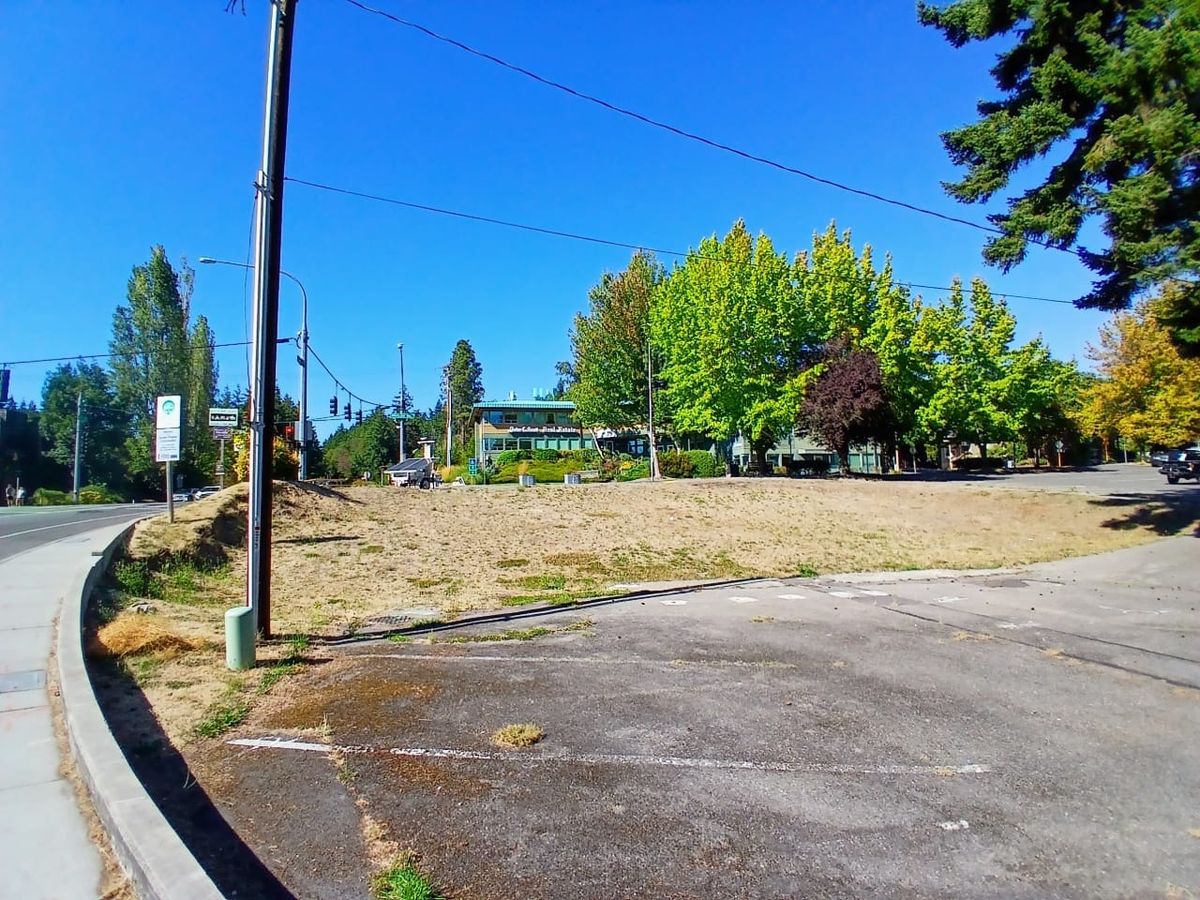
Nelson joined the council in January, after accusing other councilmembers of "pushing a plan to massively upzone Winslow and the surrounding area" during his 2025 campaign. Nelson, running on a "Keep Bainbridge Bainbridge" platform, also opposed moving forward with the 625 Winslow Way affordable housing development advanced by the City, which would see around 90 units of workforce housing built on a City-owned lot across the street from the Bainbridge Island Museum of Art.
That project, being developed by the Low Income Housing Institute (LIHI), is ultimately the poster child for the type of project that could advance if Bainbridge is found out of compliance and the builder's remedy is unlocked. In need of a zoning change to move forward, it was stopped in its tracks by an appeal under the State Environmental Policy Act (SEPA) that only recently was resolved, causing LIHI to miss out on the most recent round of state funding that represents a core component of the building's financial plan.

Bainbridge Island is set to attempt to get its Comprehensive Plan across the finish line without Planning Director Patty Charnas, who retires on Friday. Charnas's retirement comes in the immediate wake of the departure of Bainbridge Island City Manager Blair King and City Attorney Jim Haney, with Public Works Director Chris Wierzbicki also recently announcing his departure on the same day as Charnas.
The ball is now officially in Bainbridge Island's court, with state expectations spelled out very clearly when it comes to what is needed to be found in compliance with the Growth Management Act. But whether the City will be able to take that guidance and run with it – in the face of considerable opposition to the idea of zoning changes from Bainbridge residents – remains to be seen.
 Ryan Packer
 Ryan Packer