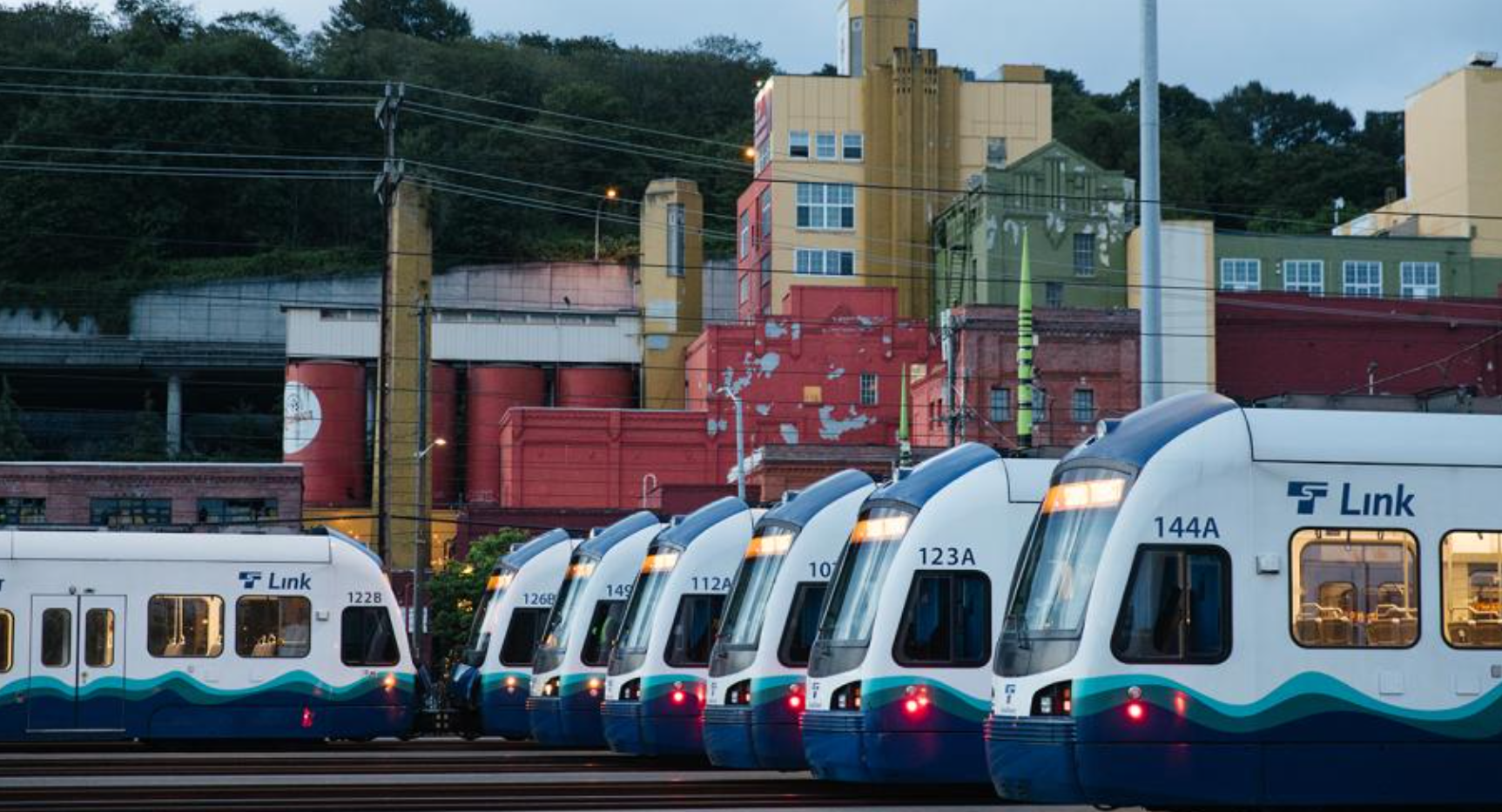
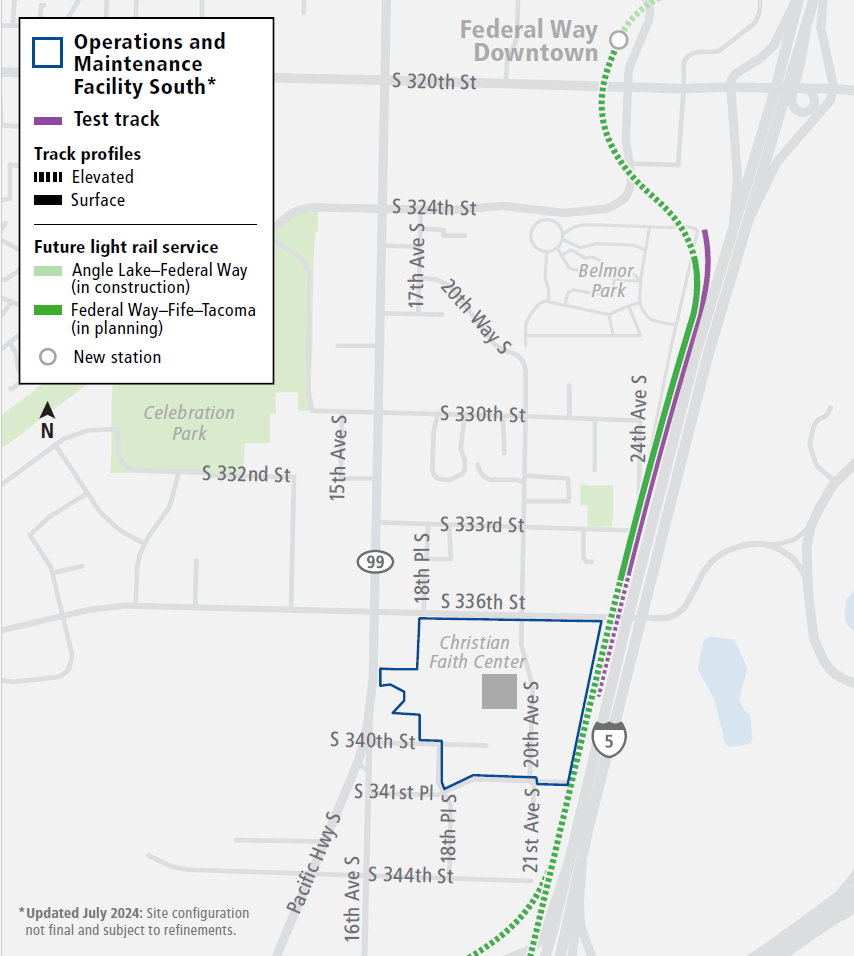
The Sound Transit board is poised to award a $350 million contract to advance the agency's next train maintenance base in Federal Way, a major component of future system expansion plans, to full design and pre-construction. Planned on a 70-acre site to the south of the 1 Line's current terminus in Downtown Federal Way, the new base is set to open by 2031 or 2032.
The base will be specifically designed to handle the next generation of light rail vehicles, which will add capacity to the growing network. Being designed by Siemens, these new light rail vehicles are set to be double the length of the existing Series 1 and 2 vehicles, a fact that will boost their passenger capacity by between 5% and 13% while at the same time saving Sound Transit around 10% on capital costs.
The Urbanist's Spring Member Drive is in full swing, now with a website redesign and offering ad-free reading for donors! Take advantage of membership perks and support local journalism with a monthly donation.
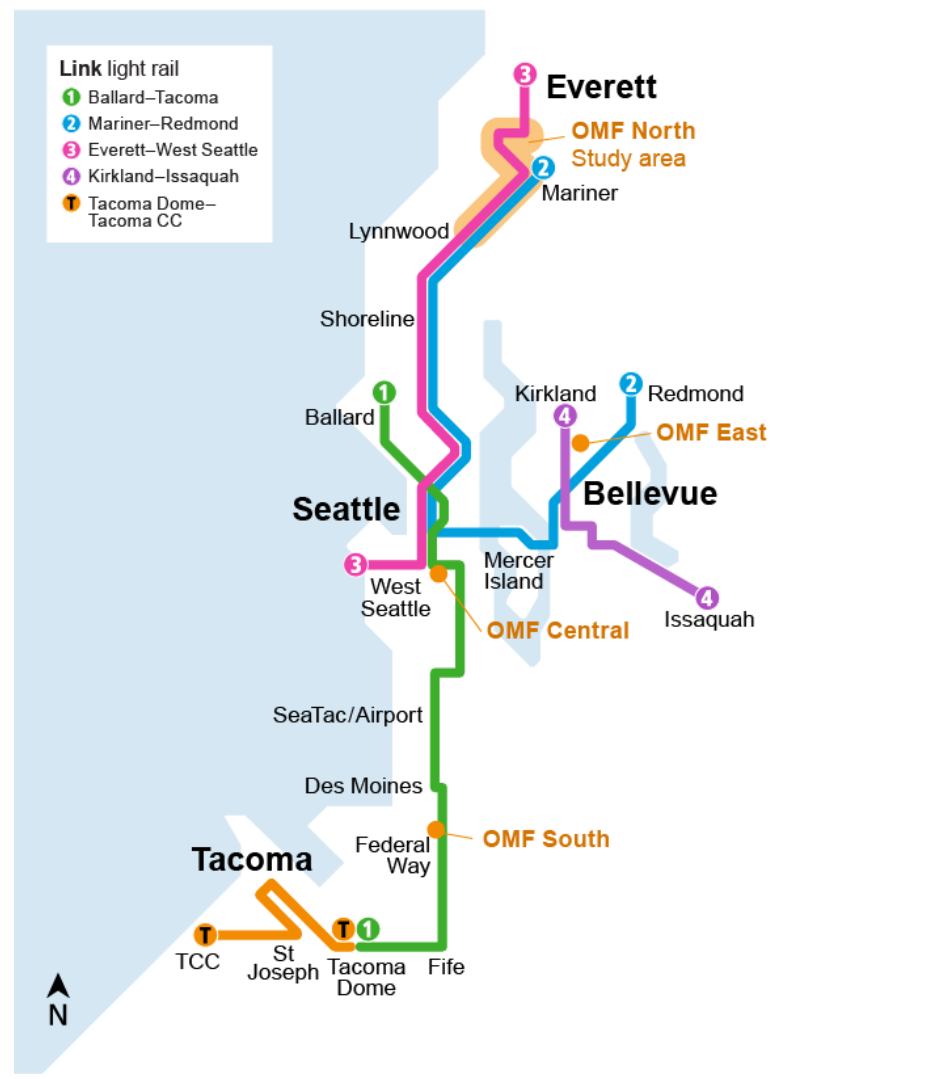
The Federal Way base will be Sound Transit's third operations and maintenance facility or OMF and will be dubbed OMF South in agency lingo. OMF South will include space for 72 Series 3 light rail vehicles.
If approved at March 26's board meeting, the new contract with Hoffman Construction would advance the OMF to full design, and take the project into pre-construction – preparing the site, improving nearby roadways, and starting construction staging. A full construction contract is expected to be approved in 2028.
In addition to vehicle storage and both light and heavy maintenance shops, the OMF will include a dedicated test track for vehicle commissioning along I-5. As the first test track planned in the system, this will allow Sound Transit to get new vehicles up and running more quickly, compared to the current system where vehicles have to be tested in the narrow overnight maintenance window.
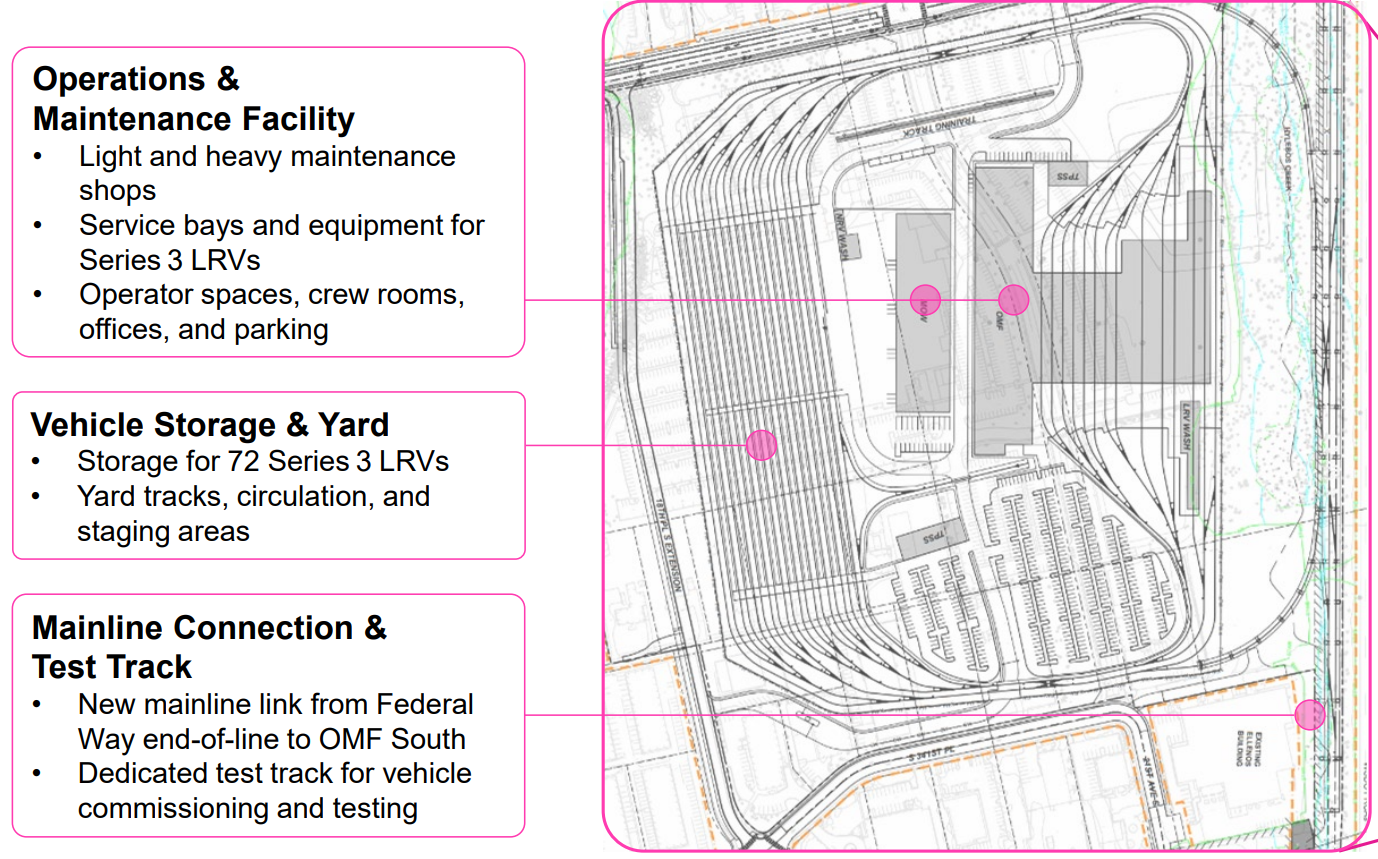
Selection of the site for OMF South was contentious, with officials in Federal Way opposing the site ultimately chosen by Sound Transit, home to the Christian Faith Center megachurch and around 70 residences, though most of those homes are being acquired to build trackway between the OMF and Federal Way Downtown Station which will ultimately carry passengers as part of the Tacoma Dome Link Extension.
The primary alternative to this spot was the former Midway Landfill, an option that would have come with significant headaches for Sound Transit and likely cost the agency 50% more to build. Sound Transit ultimately landed on the S 336th Street site after considering a third alternative further south, which would have displaced an Ellenos Yogurt factory – and a higher number of homes.
Hoffman's contract with Sound Transit is another first for the agency: a "progressive design-build (PDB)" contract. Under a PDB contract, Sound Transit selects one contractor to collaborate with on a final design, with the goal of ultimately sticking with that contractor through to a ribbon-cutting. In contrast with a simple design-build contract where one contractor designs and builds a project for a set price, PDB provides Sound Transit with potential "off ramps" as design advances – no final construction cost has yet been set as part of the agreement.
With this additional $350 million budget allocation, the total amount that the Sound Transit board has approved for the project will grow to $875 million.
Pegged as a $2.2 billion project, a major cost increase on the OMF South wouldn't be a surprise. Sound Transit staff signaled as long ago as late 2023 that the agency could end up being as much as $1 billion short on the facility, a fact that could have knock-on effects for other projects. But the structure of this contract is one tool that is intended to ensure those costs overruns are minimized.
"This is a new model that's focused on collaboration and allows us to advance cost savings opportunities and innovation while we advance the final design," Michael Morgan, Sound Transit's Executive Director for Capital Delivery, told the board's system expansion committee last week.
Utilizing progressive design-build was a reform recommended by Sound Transit's Technical Advisory Group (TAG), a group of outside experts that have guided the agency toward more efficient management of its largest construction projects.
The impact of this new OMF on job creation in South King County was a major talking point ahead of the unanimous vote to advance the contract to the full board. Morgan noted that construction is expected to result in 600 new jobs, performing a collective 4 million hours of work.
"I know this is an OMF South for the system, but as a Pierce [County] board member, I really see it as just one step closer to the gateway of getting light rail onto the Puyallup Tribe of Indians Reservation and into Pierce County," Fife Mayor Kim Roscoe said ahead of the vote.
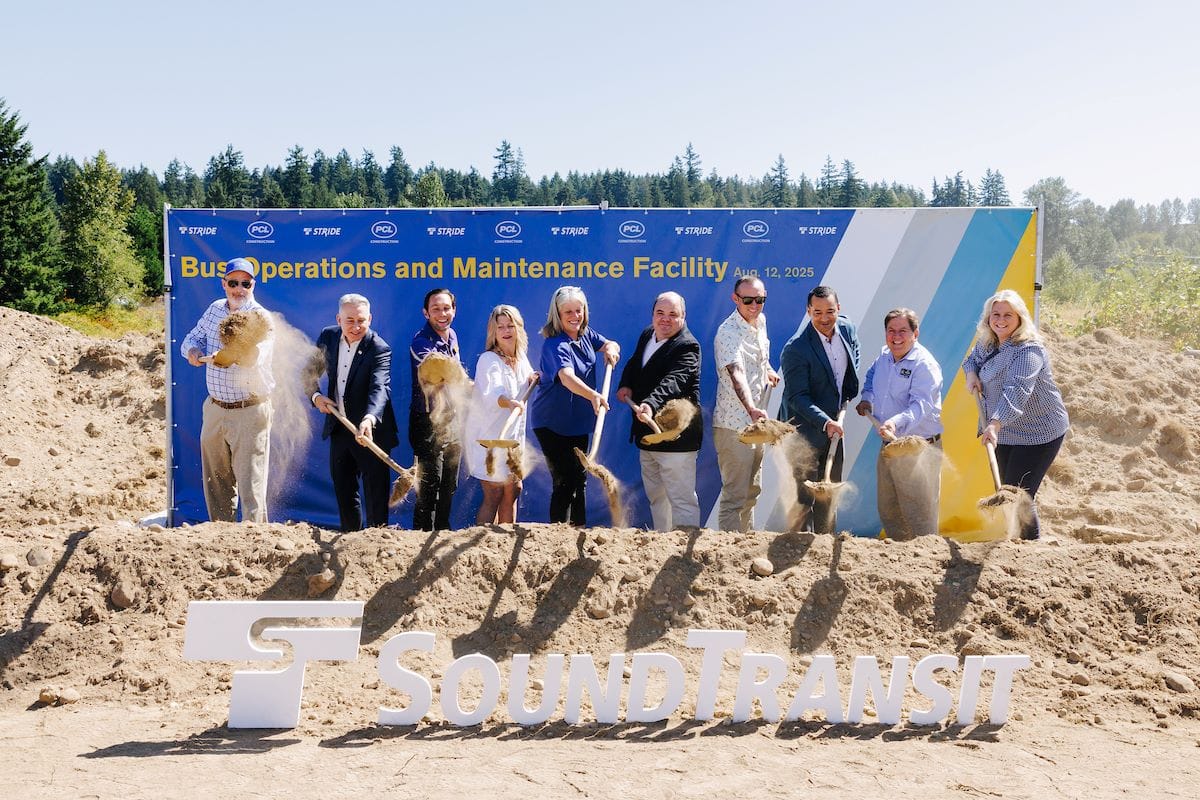
Work on Sound Transit's fourth OMF for light rail, set to be sited somewhere around Paine Field in Snohomish County, remains in early stages. Currently at 5% design, that project will advance along with the Everett Link Extension project, scheduled to start construction in 2030. Meanwhile construction is well underway on the new bus base intended to support the planned Stride bus rapid transit (BRT) network, in Bothell's Canyon Park neighborhood.
While all eyes are on the network's planned extensions, without new maintenance facilities that network won't be able to meet its full potential, and advancing the OMF South into full design is a major step toward that preparing for that future.
 Doug Trumm