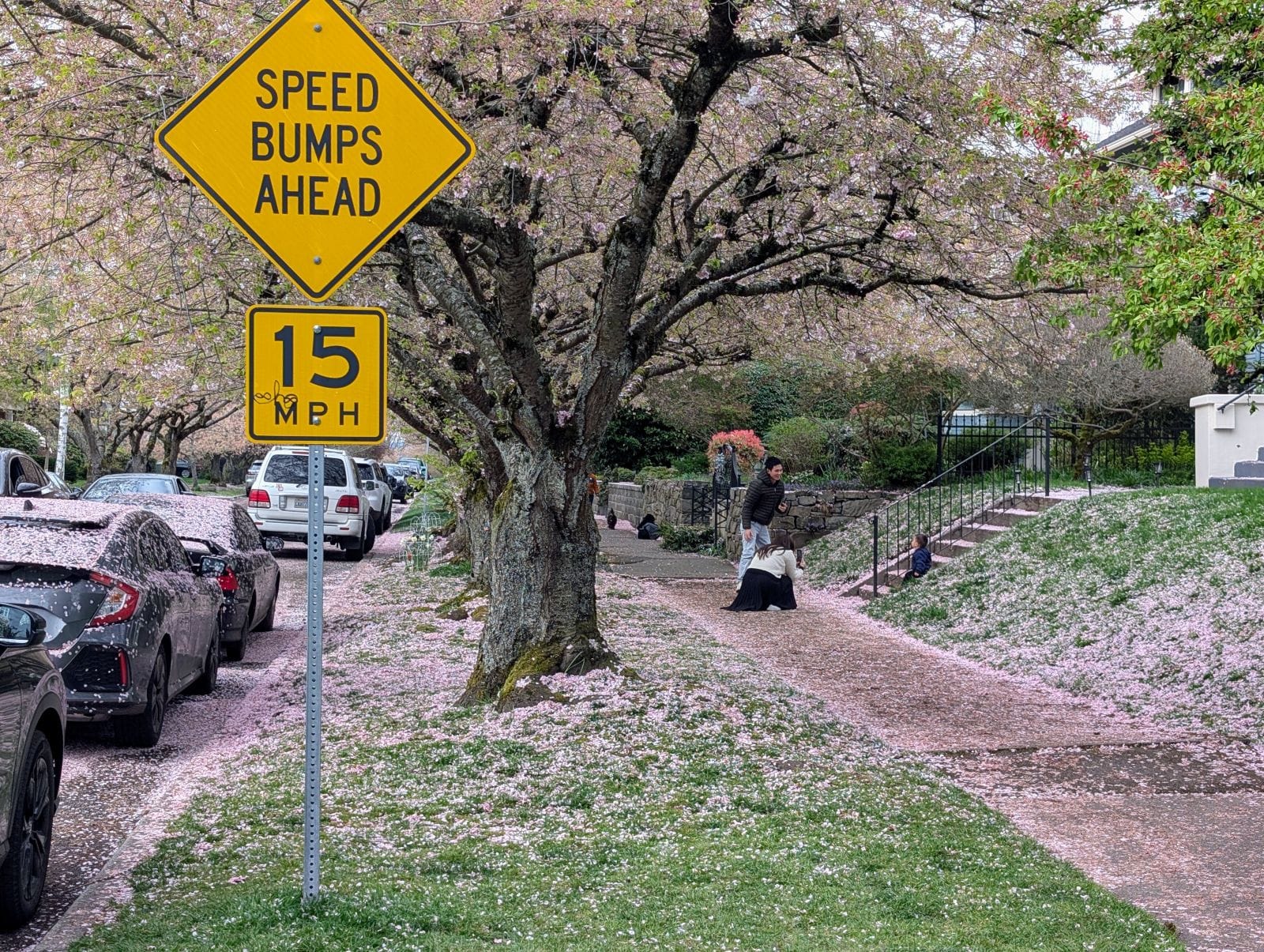
Sakura is upon us, and it's time to get out there, given the sun in the forecast Saturday. As a city rich with Japanese heritage, Seattleites are partaking in a long cross-cultural tradition of hanami or blossom viewing.
Last year, The Urbanist published an interactive map of all 44,000+ of Seattle's documented flowering stone fruit trees. This year we're back with an updated version that pushes the total beyond 45,000.
The additions were made possible thanks to better species accounting from the Seattle Department of Transportation, whose roads and right-of-ways account for 27% of Seattle's land.
What qualifies as a flowering cherry tree? First off, they’re members of the Prunus genus, a designation that encompasses cherries, plums, almonds, peaches, and apricots, and other stone fruits. Within this genus, a few varieties of cherry trees have been cultivated for their spectacular blooms. These include:
- Japanese cherry, Prunus serrulata: Cherry blossom cultivation has a long history in Japan, with evidence of early cultivars dating back to the 10th century. The ornamental Prunus serrulata species includes the famous “Kwanzan”, “Shirotae”, “Amanogawa”, and “Royal Burgundy” cultivars. There are over 11,000 Japanese cherries spread across almost every neighborhood in Seattle.
- Yoshino cherry, Prunus × yedoensis: A cross between Oshima and Weeping cherries. There are over 1,800 citywide, including the famous University of Washington (UW) Quad cherries as well as clusters along 38th Avenue Southwest in West Seattle and Beacon Avenue South in South Beacon Hill.
- Higan cherry, Prunus × subhirtella: Over 2,100 citywide, including several clusters on Phinney Ridge.
- Sargent cherry, Prunus sargentii: Over 400 citywide, including clusters on South Charles Street and South Dearborn Street east of Rainier Avenue.
The interactive map below shows 17,000+ flowering cherries and 45,000 Prunus trees across Seattle. At the top of the map, you can choose to view all Prunus trees or just the flowering cherries.
The zoomed-out map highlights streets and parks that have dense clusters of trees: click/tap on a street or park to focus in on that area, or zoom in to see details for each tree. If you’re in Seattle, you can also press the button on the top left to refocus the map at your current location. Make sure to zoom in your neighborhood even if it isn’t highlighted — there are probably still blossoms nearby!
The shades of purple indicate blossoms. (Nat Henry)
Seattle joins many cities across the northern hemisphere observes a spring tradition that is both natural and deeply human: our cherry trees bloom in concert, and people flood the streets to admire them. Blossom guides tend to direct wannabe watchers to a few well-traveled destinations, including the UW Campus, Washington Park Arboretum, Kobe Terrace, and Lake Washington Boulevard near Seward Park.
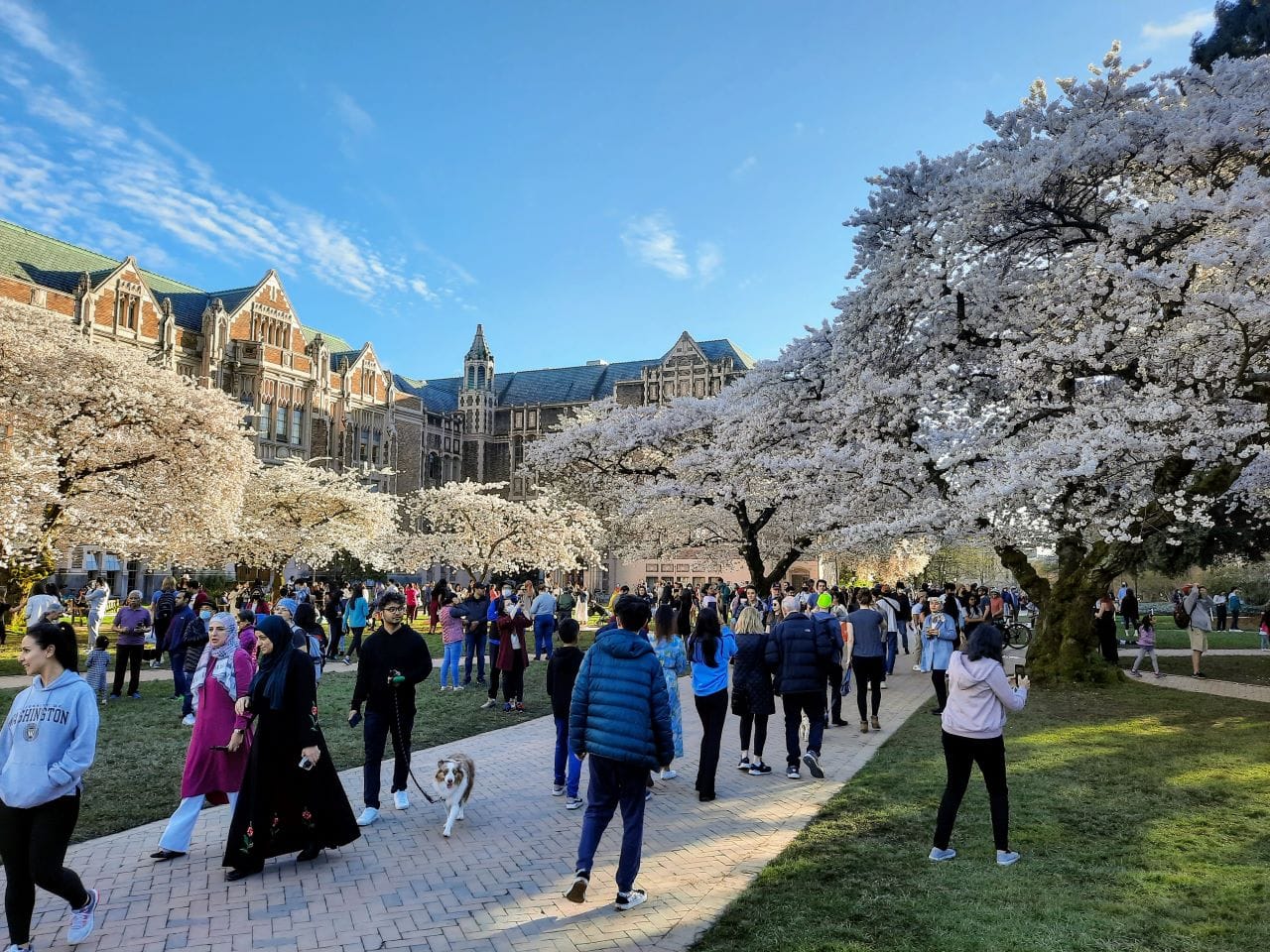
These spots are rightfully famous — and often clogged with traffic as the season peaks. But with blossoms popping up on seemingly every street, I wanted to know if there were any overlooked gems elsewhere in the city.
The answer was surprisingly hard to find, since there isn’t a central database for flowering cherry trees in Seattle. With an enormous amount of help from tree data stewards around Seattle, I combined records from five city and university databases to take a more comprehensive look at trees around the city. The result is the combined dataset above.
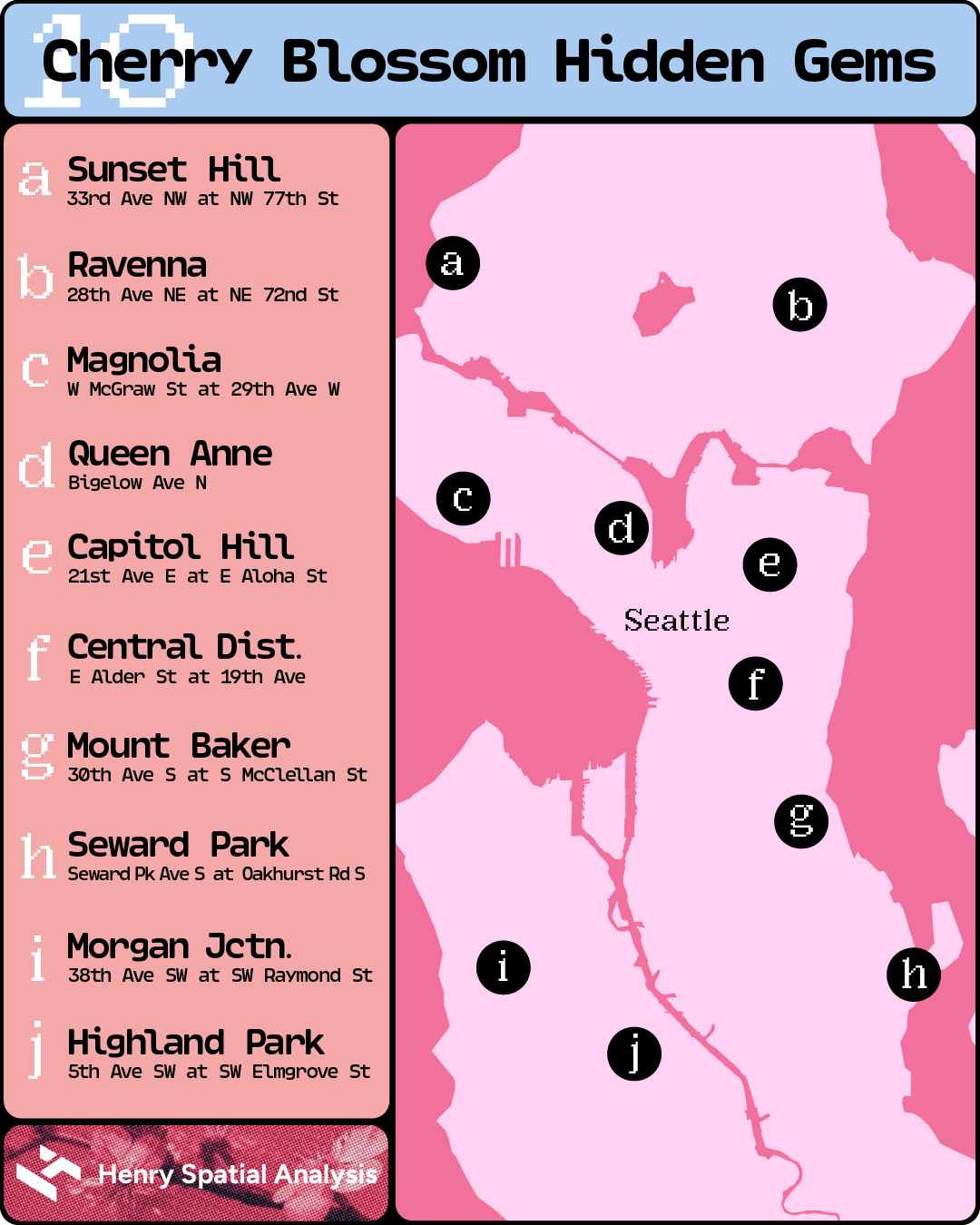
I also used this information to create maps highlighting some of the top hidden gems spots to enjoy blossoms.
Here are ten lesser-known spots to find flowering cherry trees around Seattle:
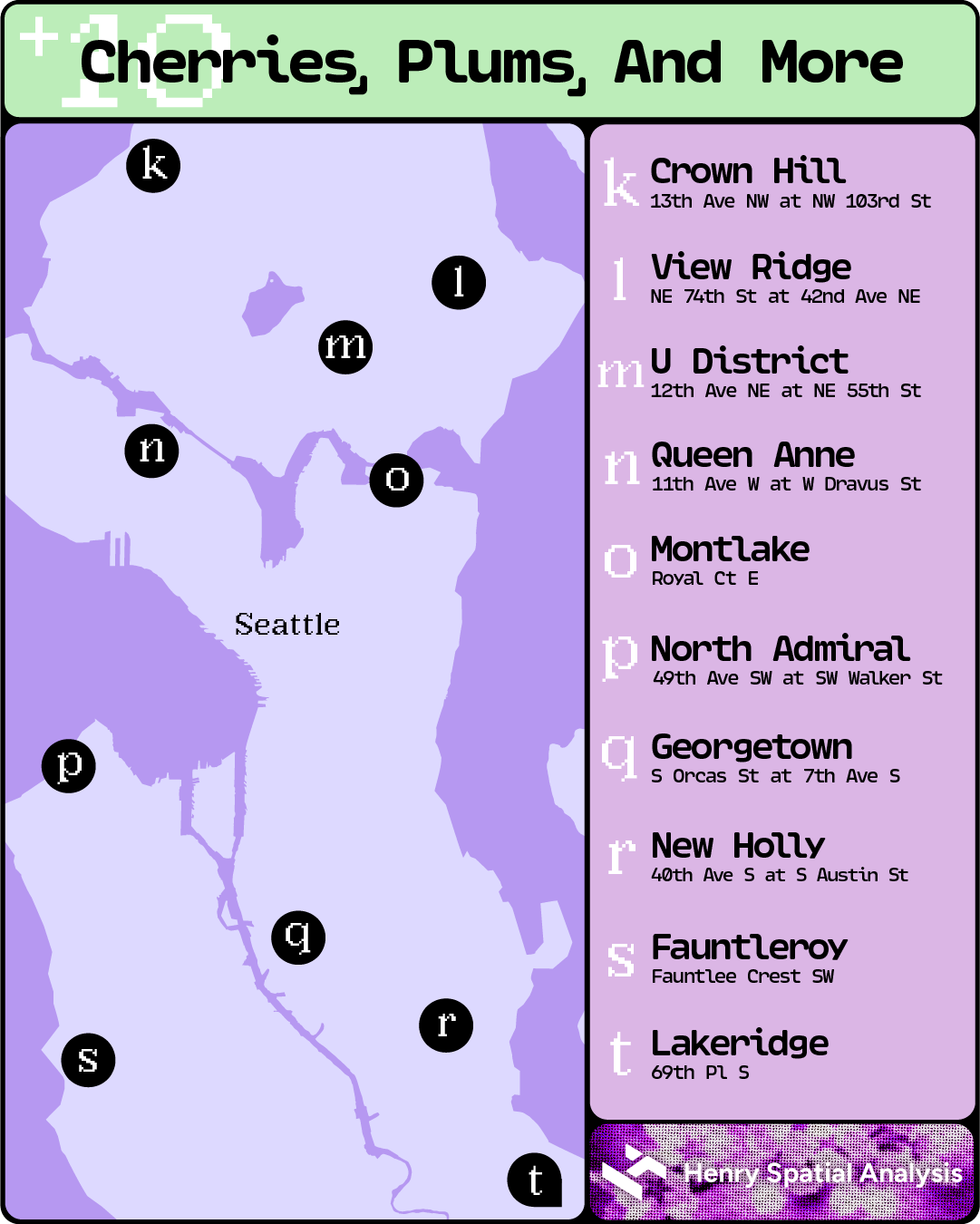
Other trees in the Prunus genus have blooms worth seeking out: notably, the Thundercloud plum (Prunus cerasifera ‘Thundercloud’) and Blireiana Purpleleaf plum (Prunus × blireiana) have spectacular pink and white blooms. Ornamental plum trees tend to reach full bloom slightly earlier than flowering cherries, so your favorite harbingers of “cherry blossom season” may not be cherry trees at all!
Finally, some trees in the combined data were simply labeled as Prunus sp. – these could be any species in the genus, but are most likely cherry or plum trees.
Here are ten more spots that are bursting with Prunus trees around the city:
The milder winters (like this year's) linked to climate change are pushing peak cherry blossom season later into the year, UW research has shown, though timing varies year to year. A cold spring (like we've seen recently) can push timing back further, but a warm spell could speed blooms up again. It can be an ephemeral phenomenon either way.
So what are you waiting for? Don't let the blossoms pass you by.
 Ryan Packer