Last week's Sound Transit board retreat will likely stand out in history for the moment that it became clear that bringing light rail to Ballard will be much tougher than originally anticipated, thanks to a significant long-term funding gap. The three different approaches put in front of the board all falling short of getting to Market Street, Ballard's key east-west artery, truncating the line at the Seattle Center or Smith Cove.
To differing degrees, each approach entails pushing multiple voter-approved projects farther out. Many transit advocates reacted to the news with frustration and anger at the fact that things had evolved to this point, nearly 10 years after the Sound Transit 3 (ST3) measure won at the ballot box.
To those hoping to get light rail to Ballard as soon as possible, the news that an already delayed opening had slipped from 2039 to a question mark was not especially encouraging or hopeful. But behind the headline news from last week is the actual purpose of the retreat itself: an attempt to get board members to start to come to something resembling a consensus on a path forward.
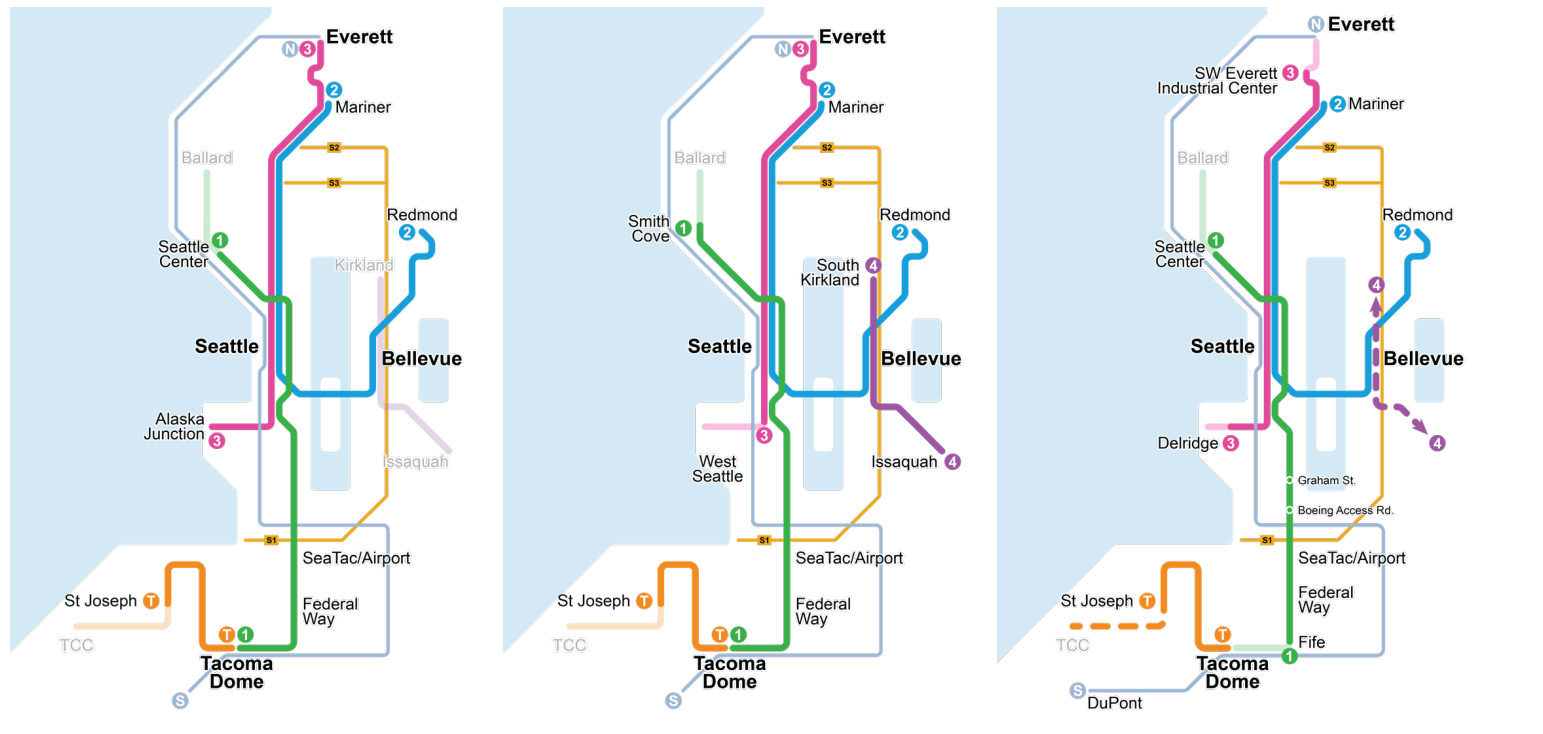
With votes happening as soon as May on a full recalibration of the ST3 program, here are some additional takeaways surfaced during the all-day session that do point toward what that path will be.
Yes, West Seattle Link is "shovel-ready."
With one of the three approaches to balance a $34.5 billion shortfall put in front of the board containing the option to "defer" construction of the West Seattle Link Extension, there was much discussion at the retreat about the implications of punting on the first ST3 project currently in the queue for construction. Much of this debate centered on whether West Seattle Link truly is "shovel ready" when construction isn't scheduled to start until 2027 or 2028.
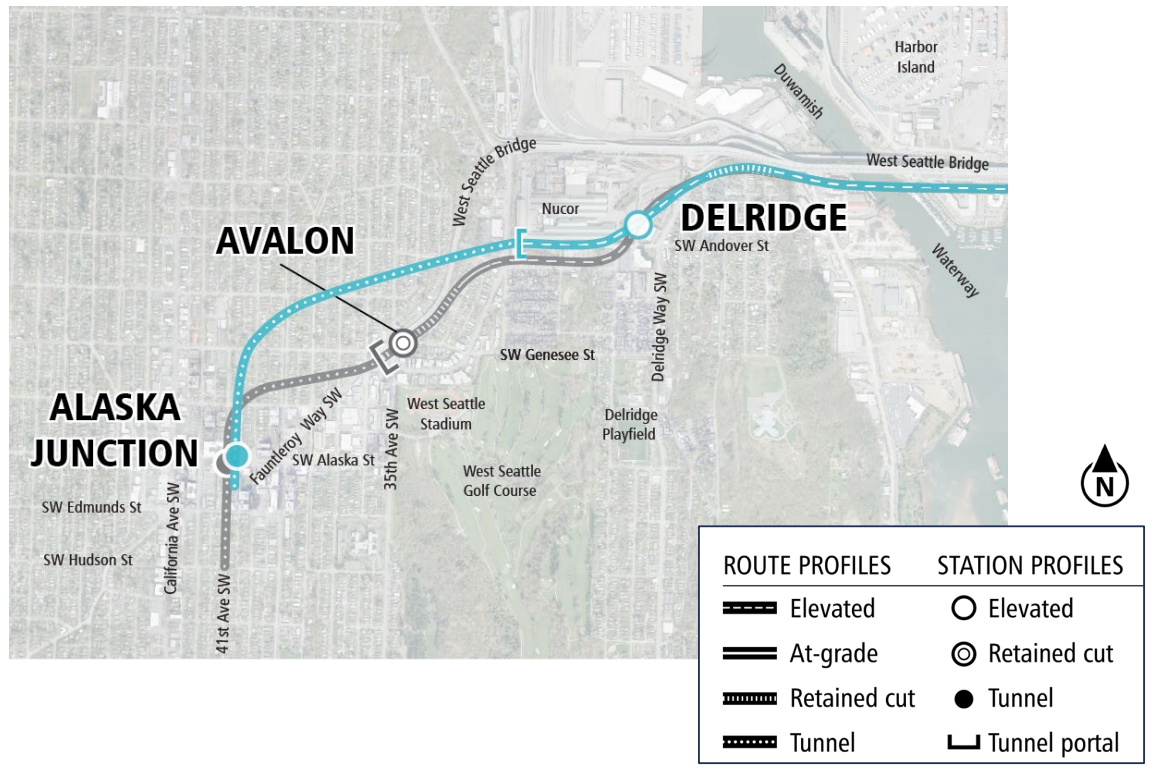
According to the Federal Transit Administration (FTA), a project is considered shovel-ready when its environmental review process has been completed (check for West Seattle) and if funding was advanced, construction could be commenced within 90 days. Sound Transit Deputy CEO Terri Mestas told board members at the retreat that West Seattle meets the second part of this definition as well, with the ability to start work on foundational elements of the project as quickly as that, even with full design yet to be completed.
Things did not look great for West Seattle when costs appeared close to $8 billion, but as design work on the line has progressed, Sound Transit has been able to unlock significant savings, with the total cost now hovering around $5 billion. Due to inflation, costs are only expected to increase as time progresses, so it's clearly beginning to sink in among board members that deferring a project that is literally construction-ready would be incredibly short-sighted.
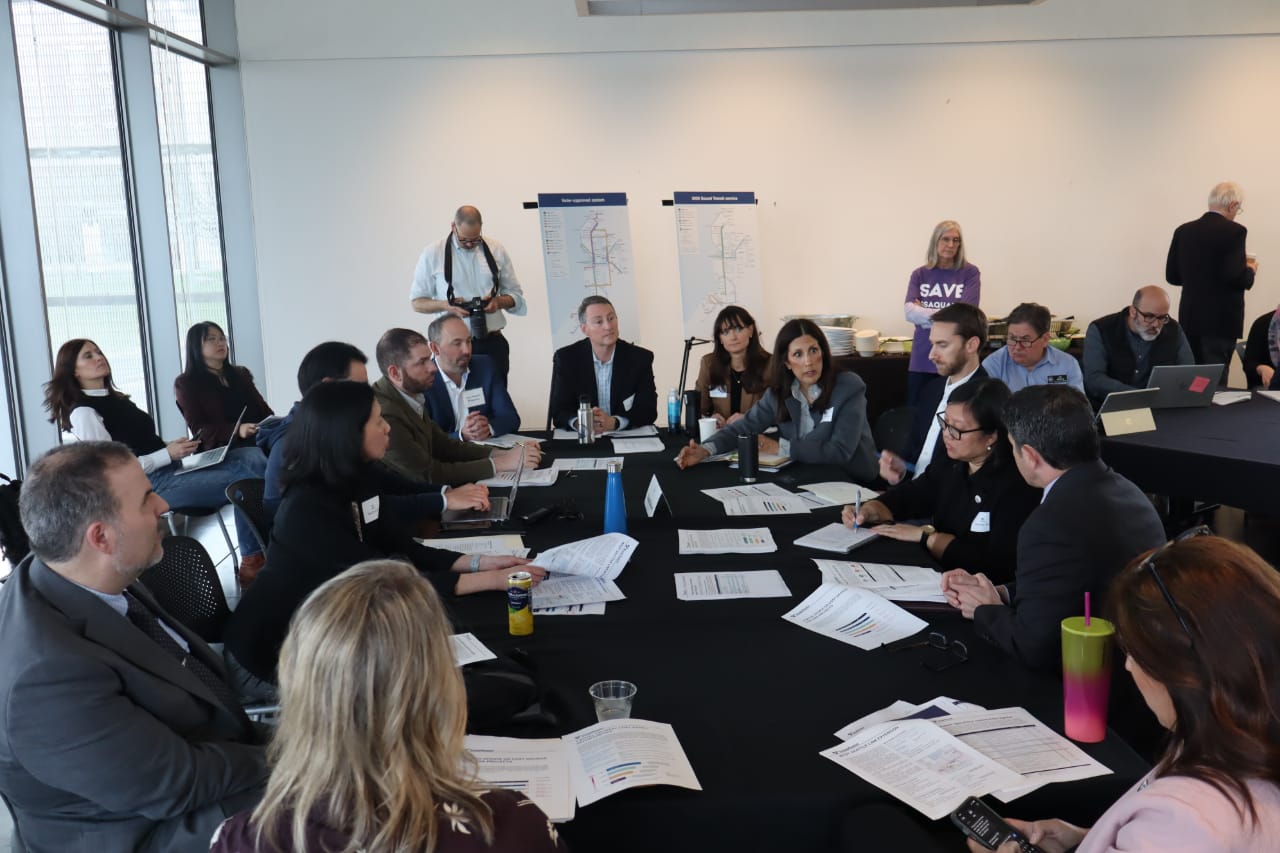
"The takeaway from this retreat, nor our decision in May, cannot be that we've abandoned any projects," King County Executive Girmay Zahilay said. "And so I think when a project is shovel-ready, it means building it. And so I want to put my voice in the ring for building West Seattle, which is shovel-ready, again, under the banner of advancing all projects."
But Everett Mayor Cassie Franklin is clearly gunning for West Seattle Link, in spite of the fact that there doesn't appear to be any danger of the Everett Link project being sacrificed to build West Seattle. On the contrary, prioritizing the regional rail "spine" to Everett and Tacoma appears to be one of the board's long-held bedrock principles.
"I still have a lot of questions about West Seattle. It is still not affordable, even with all of the massive cost savings and billions that we've cut out of that project," Franklin said, raising questions about the types of riders served by getting to Alaska Junction. "I think it's important to note that the median household income there is double what the household income is at the end of the line in Everett, and it also is far less diverse than other parts of our system."
Seattle Mayor Katie Wilson, who held her cards much closer to the vest compared with her City of Seattle counterpart on the board, Dan Strauss, was her most emphatic when discussing what she saw as the need to keep West Seattle Link moving.
"It's no secret now that I want to get shovels in the grounds on our shovel-ready project," Wilson said. "But I just want to say that the motivation behind that is not just that the project happens to be in the jurisdiction I represent. It's kind of the larger feeling that I think it's very important that we continue to demonstrate delivery to the public. I don't think that it serves any of us to not be doing anything visibly to the public, at least the next few years."
With Approach 2 essentially trading West Seattle Link for a project that hasn't even started planning yet – South Kirkland-Issaquah Link – that path looks increasingly unlikely.
Ballard Link planning delays had deep consequences
The fact that West Seattle Link is so advanced in planning is a major point in its favor during these deliberations; Ballard Link is not so lucky. Despite the fact that Sound Transit had initially moved the two projects forward in tandem, as the West Seattle Ballard Link Extension (WSBLE), Ballard is much less developed and currently only at 10-15% design, the advanced conceptual engineering phase.
One major reason for that? Station options added by the board after the publication of the initial WSBLE environmental review. After the release of that document in 2022, the board made it clear that the options included for Ballard Link weren't good enough, and a year later added five different stations options that hadn't been in the mix previously.
Some of the new options grappled with neighborhood pushback and engineering challenges, which were most pronounced in the Chinatown International District (CID), but also present in South Lake Union, where Amazon and other employers and landlords were leery of long construction disruptions. Late additions included the "North and South of CID" alternative proposed by Seattle Mayor Bruce Harrell and King County Executive Dow Constantine, along with new options in Interbay, Seattle Center, and Denny Way.
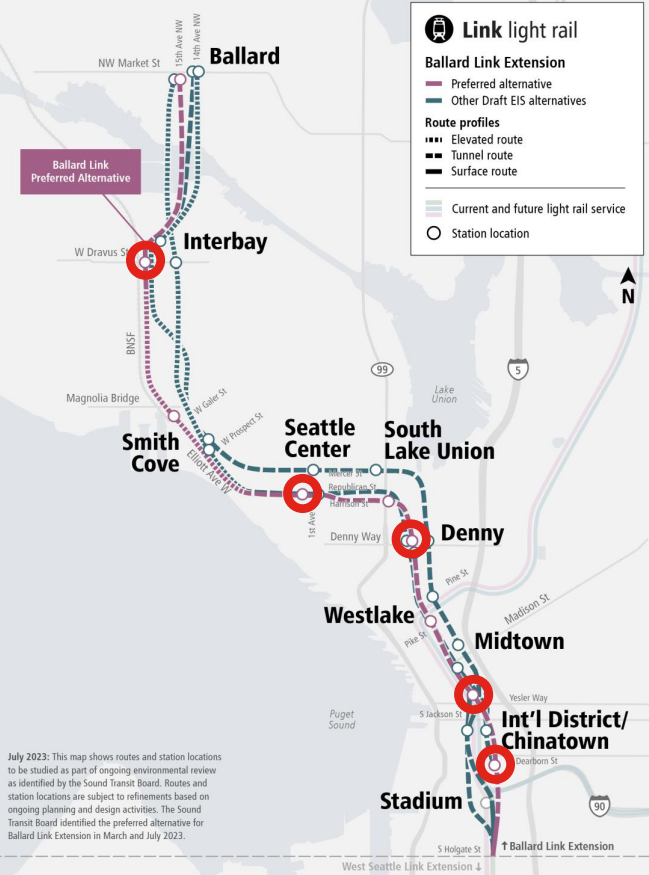
Notably, the one time the board held fast against additional planning delays to Ballard Link was in 2024, when they opted not to study additional station options near Denny and Westlake – changes requested by business groups concerned about traffic impacts from sustained construction at that intersection.
Ironically, those groups look poised to get their way after all, with Sound Transit almost certain to advance consolidation of the Denny and South Lake Union stations, shifting the Denny Way station away from the arterial right-of-way, reducing costs and construction impacts. On the flip side, the opportunity cost is abandoning a second station in one of the densest areas in the state, with good connectivity to the busiest bus corridor in the state.
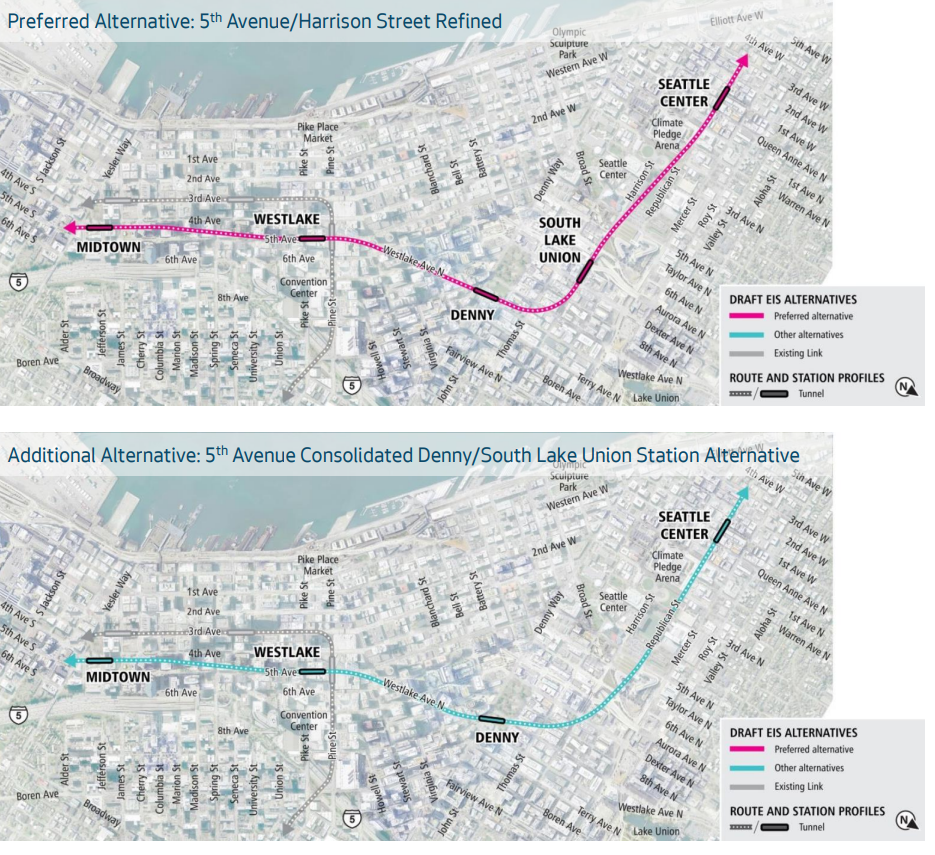
If West Seattle and Ballard had been able to advance on the same environmental review timeline, it's not certain that there would be a clearer path to getting to Market Street right now, but the cost-saving measures that have been unearthed for West Seattle make it more likely. Without developing things like tunnel depths and station designs further, the agency doesn't know where it would be able to cut costs, with major contingency costs still in place in budgets. A refined Seattle Center station that would save nearly $500 million is a big clue that there are major opportunities yet to be discovered.
Importantly, even projects that get deferred as part of board action this spring will still be developed to 30% design, allowing Sound Transit to uncover more savings – potentially putting the deferred stations back into the realm of the possible should additional revenue emerge. In other words, the work to cut costs doesn't grind to a halt on deferred projects.
Unlocking 75-year bonds would be impactful
Hanging over the retreat was a big setback at the Washington State Legislature this year, with the 60-day session ending just a few days before without action on Sound Transit's biggest request to lawmakers.
Sound Transit officials were very hopeful that the legislature would authorize the agency's ability to issue bonds beyond their current 40-year limit, in alignment with new federal authority to issue 75-year bonds under the Transportation Infrastructure Finance and Innovation Act (TIFIA). That move would allow the agency to get through a major financial crunch expected in the 2030s, but legislators – particularly in the state House – weren't on board.
At a press briefing held ahead of the retreat, Jessyn Farrell, Sound Transit's newly hired Executive Director of Government & Community Relations, noted that Sound Transit had expected to gain a $4 billion benefit from this new authority. Adding $4 billion back onto Sound Transit's balance sheet would likely make it much easier to get to Market Street, or advance any number of other projects, and the adjustment wouldn't have cost the state anything.
"That's significant, and that's just a policy change during the 20-year period," Farrell told reporters.
One major benefit of the 75-year TIFIA bonds? There would be no penalty for early repayment, allowing the agency to unlock a lower interest rate and then immediately start to exit the loan as soon as its financial pinch is alleviated.
Board member Hunter George, a councilmember in the Pierce County enclave of Fircrest, was the one to directly bring up up the setback, and suggesting that Sound Transit has some work do if it wants to win over legislators.
"Our experience in Olympia, honestly, it surprised me. My own legislators, who I'm friends with, one of who is my neighbor... I had no idea how angry those folks are at Sound Transit," George said, noting intense frustration from Pierce County, where voters did not get on board with ST3 a decade ago.
Jake Fey, the House transportation committee chair who played a major role in halting the 75-year bond bill this year, represents much of the City of Tacoma where the board held its retreat.
"Some of the anger I feel – some of it – is old anger that people are just hanging on to. They don't understand how much has happened. And I think that's a story that we've got to get out. Especially for the new folks, you need to understand how angry people are in the jurisdiction you're sitting in, and they they're paying those car tabs and they tell us all the time, it's never going to get to Tacoma. And yet I know it will," George said. "We've got some work to do to win hearts and minds. We need Olympia's help. They are not in the mood to help us. I'm just saying to the executive committee, this isn't just a Sound Transit government relations team problem. This is for all of us."
 Ryan Packer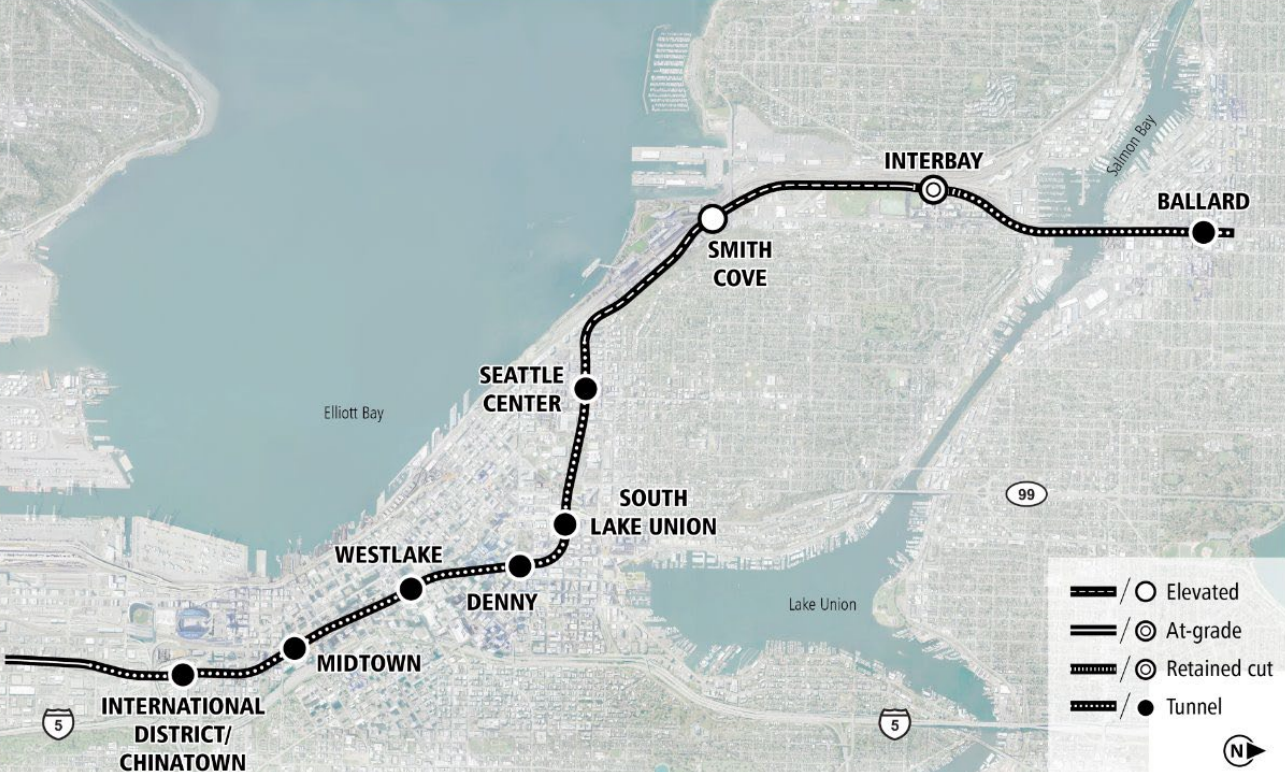
 Ryan Packer