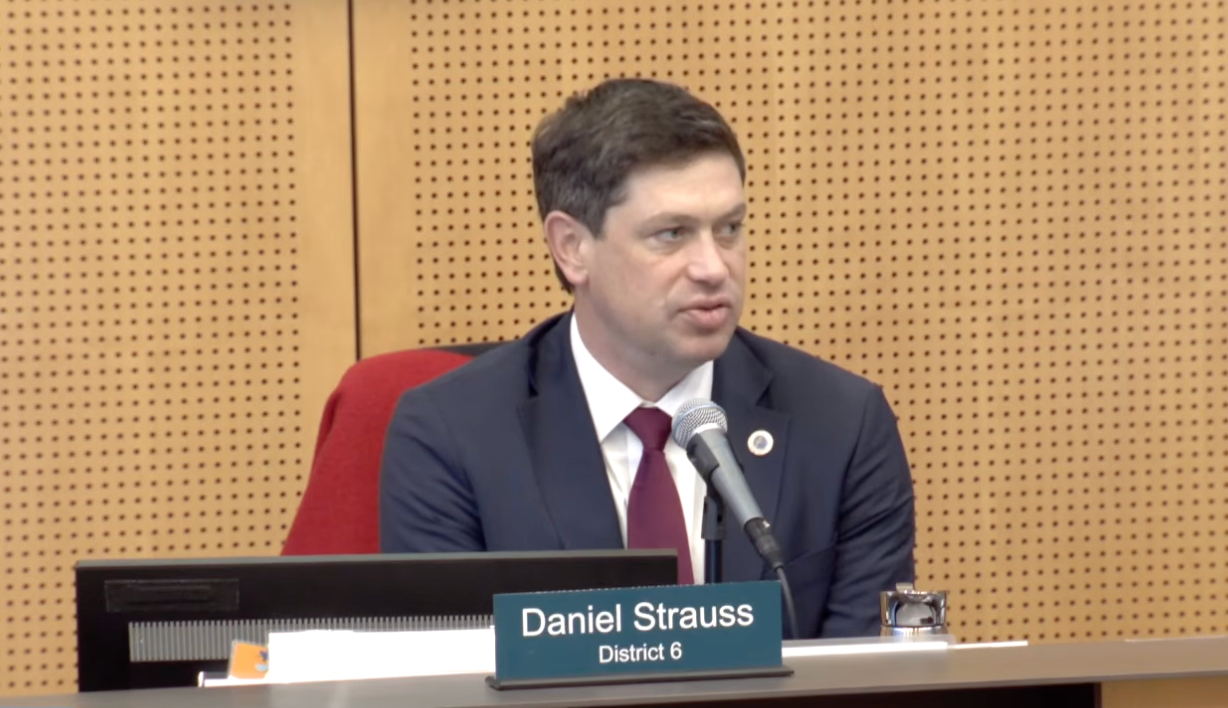
Facing a major fiscal cliff to the tune of $40 million over the next biennium, the City of Tacoma was forced to make sharp cuts to its 2027-2028 biennial budget, which the Tacoma City Council adopted in a unanimous vote Tuesday.
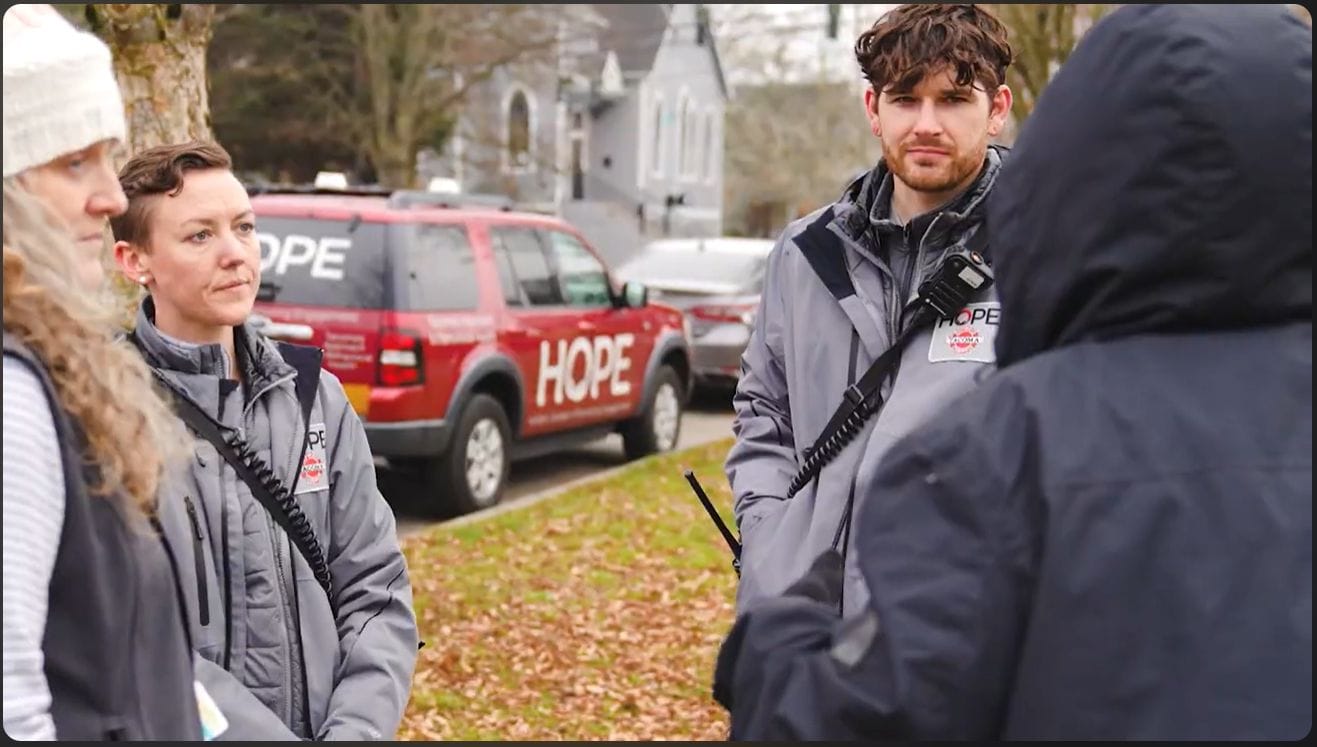
These cuts included eliminating more than 100 staff positions, 14 of which were filled, as well as cutting the City’s fairly new civilian co-responder Holistic Outreach Promoting Engagement (HOPE) team, and whittling down the police department’s community service officer (CSO) team.
Even though these cost-saving measures reduced the City’s 2027-2028 deficit back down to zero, this doesn’t mean that Tacoma is in the clear for the long term. The City still projects an $18 million budget shortfall by the time the next biennial budget rolls around. By the 2031-2032 biennium, the City will once again face a $40 million shortfall.
Public reaction to the decision to cut the HOPE Team, a program through the Tacoma Fire Department, was especially negative. Several members of the public, including a number of community activists and a representative from the NAACP, called for its retention and for the City to revisit how it dispatched the team. At least one member of the public said that they felt like the city was breaking the promise it had made in the wake of Manuel Ellis’s death in custody of Tacoma police officers in March 2020.
But civilian crisis response is not permanently off the table. The City introduced two amendments that put $150,000 towards a crisis response study and $400,000 toward crisis response and case management support. The latter amendment is meant as a bridge to sustain some capacity for crisis response between HOPE’s elimination and whatever team may replace it. The HOPE team had been budgeted at $4 million over the next two years before the cuts.
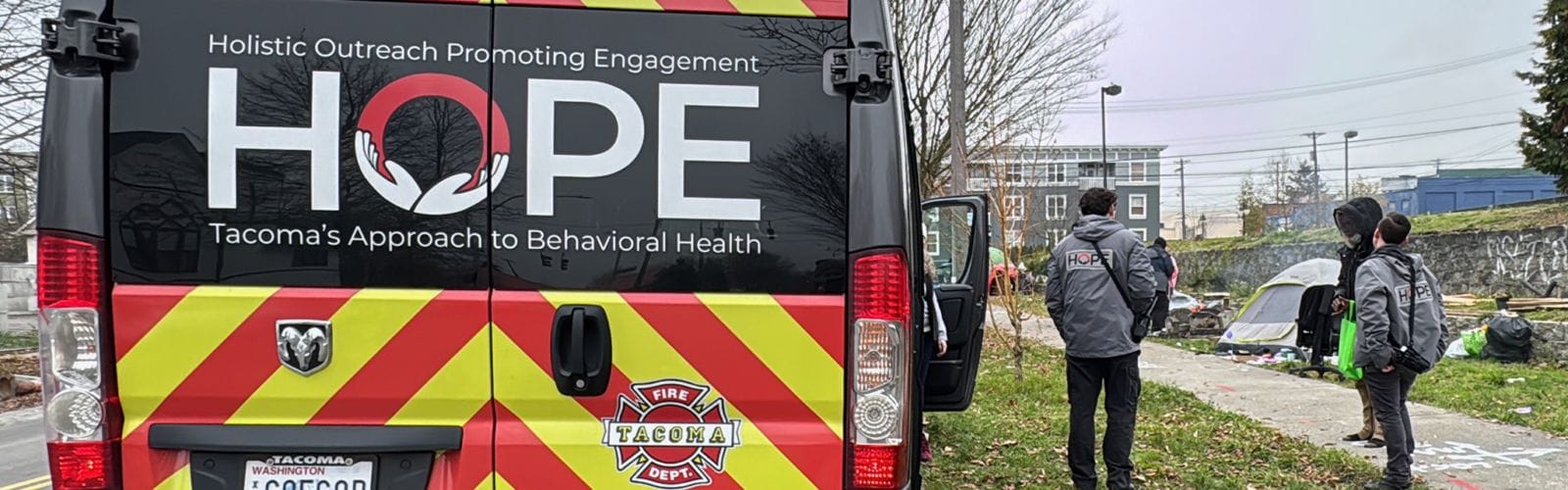
The city will also retain five of the 10 total community service officer positions through the Tacoma Police Department. These officers handle non-emergency calls. The City had initially considered entirely eliminating this cohort of officers.
Repeat structural deficits, difficult choices
“For years,” a slide in the city’s Oct. 27 budget presentation reads, “the cost of running the City has grown almost twice as fast as the money it collects.”
At that meeting — which served as the first hearing for the proposed biennial budget — the City’s finance director, Andy Cherullo, told councilmembers that the City had been facing a $40 million structural deficit in the General Fund. Without the proposed cuts, he continued, the structural deficit would grow to $75 million by the 2029-2030 biennium, and $106 million by the 2031-2032 biennium.
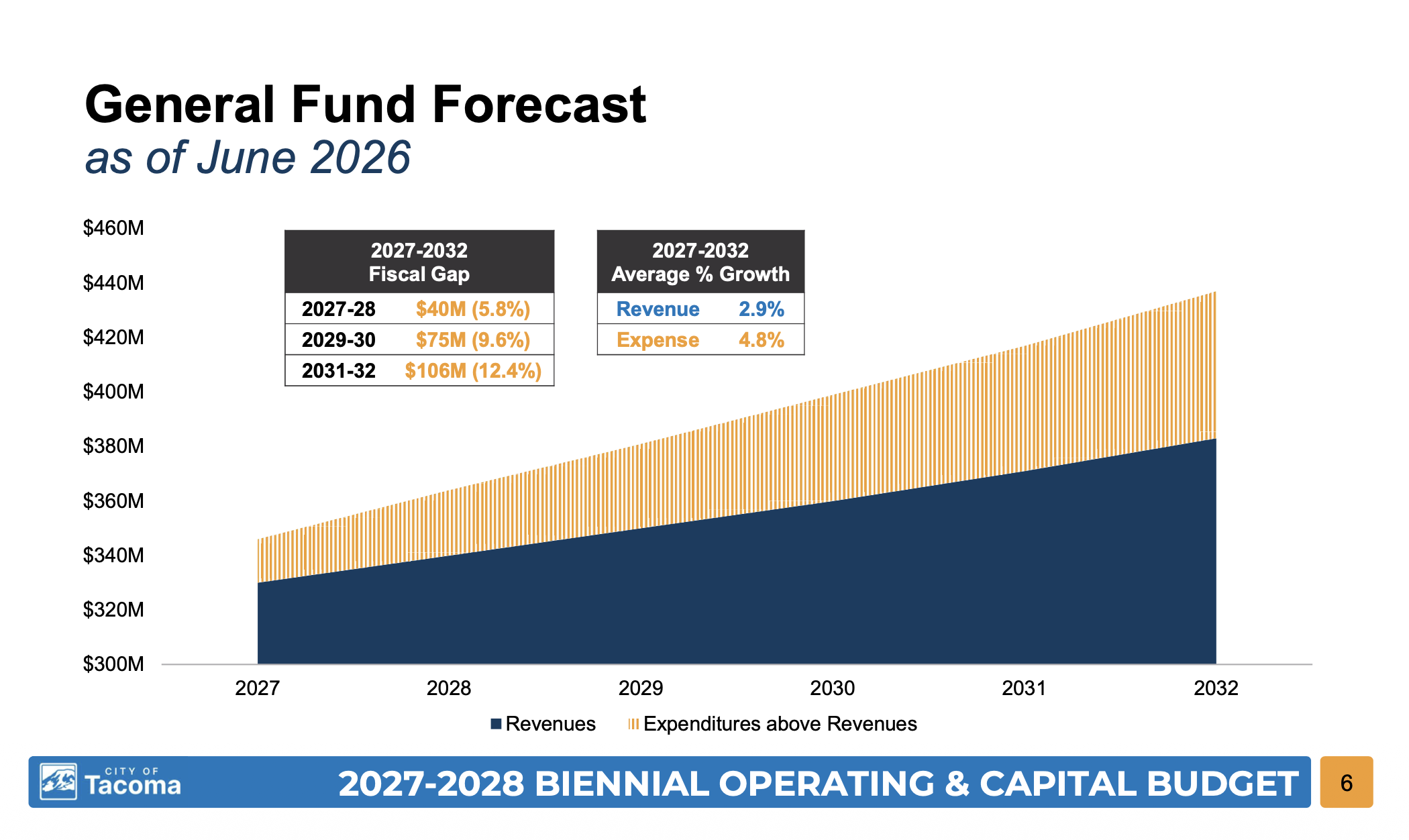
But this doesn’t mean the City is out of the woods.
“We are still projecting structural deficits in the next couple of biennium,” Cherullo said. “There are further hard decisions in the future for this City Council.”
The impending budget shortfall isn’t for lack of trying — and it isn’t an unfamiliar problem.
State law limits how quickly some revenues can grow. For instance, property tax levies can only grow at a rate of 1% per year.
“There’s no City expense that grows at 1% per year,” Cherullo said. “Just like our community members, the City is not immune to the higher inflation currently in the economy. We are also facing higher costs for fuel, supplies, and services. Benefits like health care are growing at double-digit rates, and there's general uncertainty related to what direction the overall economy will move that can impact other City revenues like sales tax and our business and occupation taxes.”
There is also an increasing demand for City services, and wages, benefits, and supplies cost more every year.
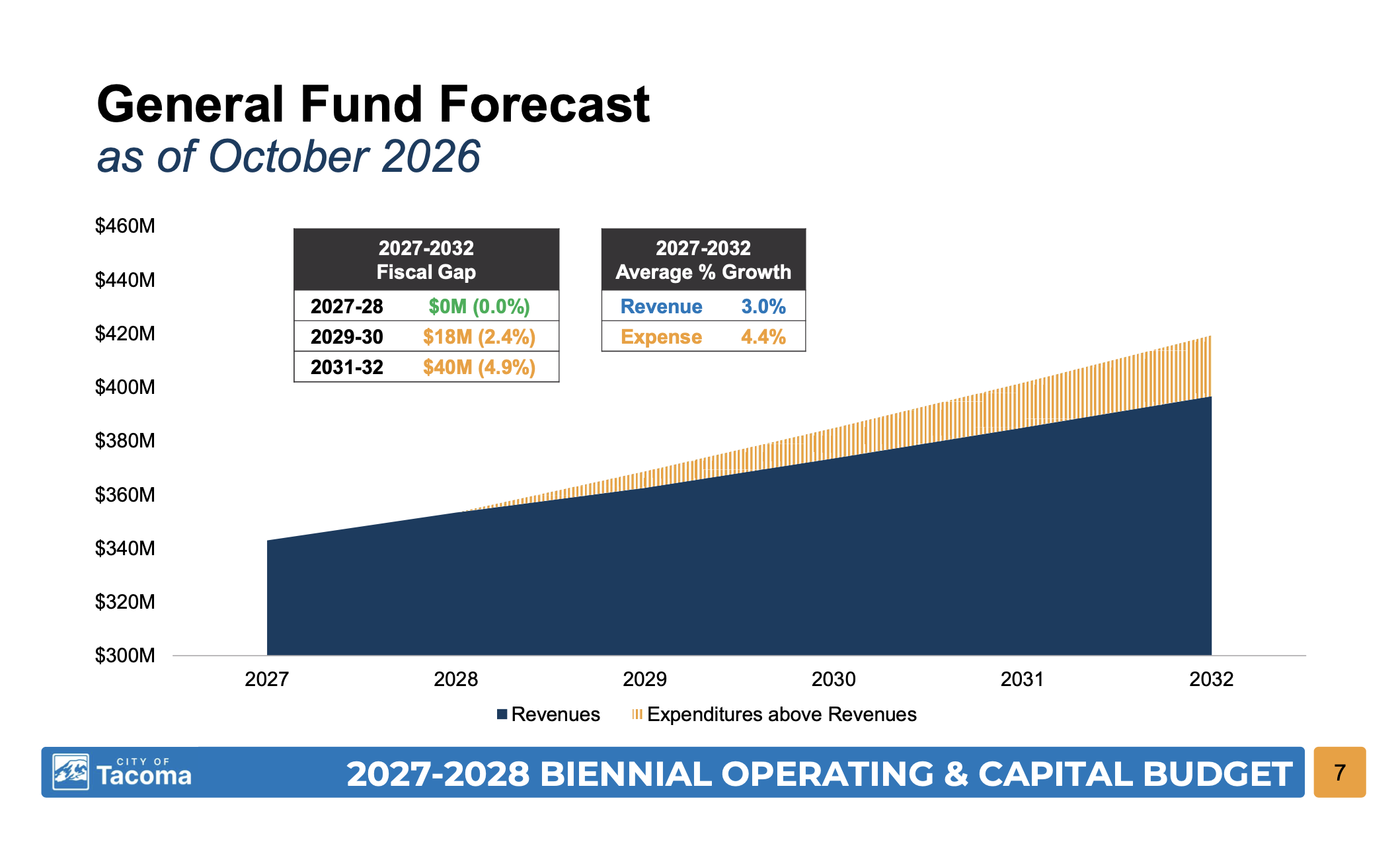
Together, this all creates a difficult situation for the City.
“Unless the state gives us more opportunities to have progressive revenue sources at the local level, we’re going to continue to have these problems year after year after year, and it’s been happening for the last 24 years,” Deputy Mayor Joe Bushnell said at the council’s Nov. 10 meeting. “So people are wondering, ‘Well why can’t the City be creative about these different things?’ It’s because we are struggling to fund basic services as it is. We can’t be as creative as we’d like to be because we don’t have the revenue sources or the options available to us from beyond our powers here.”
In passing the budget, Bushnell was also the only member of the council to acknowledge that the City had cut staffed positions.
“I […] want to recognize that through this budget, we eliminated 100 positions, and behind many of those positions were people, great dedicated staff doing amazing work on behalf of our community,” he said at the Nov. 17 meeting. “A hundred positions have been eliminated out of this budget, and I just don’t want us to lose sight of that fact, because that’s not actually a good thing, I think, for our city, because those are services that are not going to be rendered.”
City Manager Hyun Kim told The Urbanist in a later interview that cutting the 14 filled positions was not an easy decision, and that the City’s Human Resources worked hard to identify where it could keep staff whose positions were originally going to be cut. Prior to budget deliberations, a little more than half of identified positions were filled.
“[W]e got that number down to 14. […] We really did try our best to give as much advance notice to our employees that are impacted employees in those filled positions and that's why we gave the notice, we gave options,” Kim said. “We were not completely successful because as was mentioned last night by our deputy mayor, there's a human story here. We've got 14 individuals that will receive layoff notices in the coming days. It's one of the hardest things that I have to do in this job.”
In a later interview, Mayor Anders Ibsen told The Urbanist that, for the last several months, he has been having discussions with lawmakers and leaders from other jurisdictions about new legislation that could allow jurisdictions to find new sources of revenue and break out of the restrictive revenue-sourcing cycle that repeatedly forces them into difficult budget cycles.
Ibsen said that the state may be facing severe budget challenges, but that isn’t just due to the economy. It’s also because of the state’s limited tax code. In many ways, he said, that sets local communities up to fail “because we have revenue sources that are always going to decline relative to inflation. That's why we're always in cut situations. That's not sustainable or fair, and it needs to change.”
“What you're going to see cities like Tacoma push for in the legislative session […] as the legislature approaches the tax code, is to make sure we don't have a two-tiered system where the state passes unfunded mandates down to us [which] gives us local taxing options,” Ibsen said. “We don't want to just continue having local taxing options. We want to have tools, but we also want to make sure that we have a unified tax code that is a shared burden for funding core services like public education, public safety, homelessness, you name it. It has to be a shared approach rather than robbing Peter to pay Paul.”
Cutting the HOPE Team
The city initially created the five-person HOPE Team three years ago, following the 2020 Black Lives Matter protests and the death of Manuel Ellis in Tacoma police custody in 2020.
Tacoma promoted its HOPE civilian crisis response team in a January 2025 video, but the City defunded the program this fall. (City of Tacoma)
In justifying cutting the team, the City appeared to suggest that the HOPE Team had been underutilized in its three years in existence. A slide from the council’s Oct. 27 meeting states that the HOPE Team answered about three calls per day in 2026, that it was hard to staff, and that the team was only available for limited hours. City policy also requires police officers or firefighters on the scene for safety reasons.
The Tacoma Fire Department also initially put out an Oct. 27 joint press release with the Tacoma Police Department explaining the pending cuts of the HOPE and CSO teams.
Though both departments pulled the press release shortly after its publication, the departments stated in that press release that both teams had “struggled to maintain intended staffing levels and have never been adequately positioned to effectively serve the community” from the get-go. The departments said that the teams responded to just a “fraction” of service calls the department received.
“One of the primary goals of HOPE was to relieve traditional first responders to focus their duty on calls where behavioral health issues were not the primary need for service,” the joint press release stated. “In many cases, HOPE and CSO efforts have proven redundant. Nearly all HOPE responses, for example, have also required the presence of paramedics, police officers, or firefighters. In reality, 99% of HOPE requests have required traditional first responder co-response since July 2023.”
Public opposes crisis response cuts
But several members of the public argued that the HOPE Team — at barely three years old, with no studies showing its efficacy or lack thereof — was hardly getting a fair hearing, and that the City was cutting it prematurely.
“It’s accurate when everybody says that HOPE has been underfunded, understaffed, and underutilized, and I want to tell you that that is, in fact, your fault,” said Jonathan Pottle at the council’s Oct. 27 meeting. “Axing the HOPE Team is not an operational necessity. It’s an ideological choice, and it is a bad one.”
Both Theresa Power-Drutis, a longtime community organizer who works as the director of the New Connections re-entry program, and Barb Church, an environmental and community activist, told councilmembers that they needed to reconsider the way the HOPE Team is dispatched and accessible, rather than just eliminate it.
“If the team is eliminated, what happens? Police or fire will transport those in crisis to emergency rooms or shelters or jail. … However, shelters, jails, and emergency rooms do not provide resources for long-term mental health recovery,” added Calista Brown, another member of the public.
Like Power-Drutis and Church, Brown also suggested that the city “consider creative ways to enable HOPE’s operating at the capacity that truly meets community needs” and “how to offset ongoing understaffing, how to institute independent deployment.” She also highlighted that “police and fire have required co-response shutting down direct community access.”
“Review all the data that HOPE has collected so that the how and why of HOPE's effectiveness informs your decision to keep, eliminate, or truncate it,” Brown said.
“We have heard police officers say repeatedly that they are not trained to respond to mental health crises. […] A number of Tacoma police officers have described the HOPE Team as beneficial and stated they would like to see the HOPE Team expanded into late-night hours to be able to provide more extended support,” said Julie Andrzejewski, the co-chair of Indivisible Tacoma. “It's a cost-effective service. Eliminating it will result in greater costs, both human and financial.”
Gemini, a member of Tacoma Alliance Against Racist and Political Repression, seconded several other pro-HOPE commenters, and likewise underscored that the team didn’t even get a fighting chance. They also reminded the city of the financial cost of having no crisis responders.
“It’s kind of callous to talk about saving people's lives in the measure of dollars, but I understand we’re talking about a budget,” Gemini said. “I think we really need to think about how much money is spent when the police are dispatched to these crises. How much money was spent when SWAT was sent to Rhoda Butler’s house and shot her down and killed her? How much did that cost the city? How much did it cost the city to defend Manny Ellis’s murderers and pay out those murderers for the tunes of millions of dollars? […] We need to be weighing the real cost of police violence and [ … ] institutional violence against how much the HOPE Team costs, even if it was fully funded.”
During public comment at the council’s Nov. 10 meeting, Tacoma community member Nikki SnowKing member of the public who identified herself as Nikki reminded the council that it had made “an explicit promise to this community in the wake of Black Lives Matter and a call for accountability.”
“We were promised that Tacoma would fundamentally change its approach to public safety. You promised to invest in human-centered, non-police responses that protect rather than endanger our most vulnerable community members,” Nikki said. “The HOPE program is a direct realization of these promises. […] Dismantling the program is a clear retreat from the commitments that were made in Manuel Ellis’ name and to the Black and vulnerable communities of Tacoma.”
Ibsen told The Urbanist that “the promise that the city made was to keep Tacoma safe, while also partnering with the community to build on that trust, and the key behind that isn't the programs, it's the essence of what we're doing.”
He referenced the report from 21st Century Policing Solutions, and said that the City adopted several of that report’s suggestions. He also noted that the City’s budget prioritizes homelessness outreach, and that the City is invested in the recent Unified Regional Approach to Homelessness.
“Even though the City does not fund the HOPE program anymore, it's less about programs than it is about the protection of people,” Ibsen said.
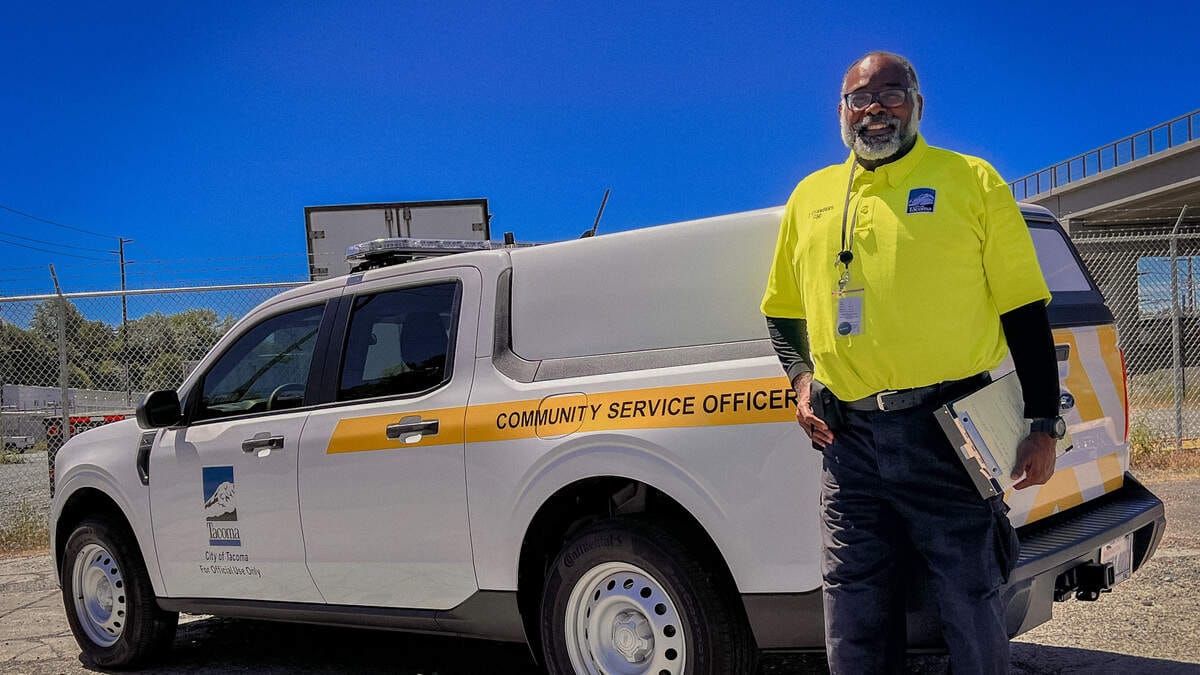
In contrast to the strong opposition to cutting the HOPE Team, no members of the public appeared to oppose the reduction in the police department’s CSOs. Several residents spoke against retaining any CSOs, with one stating that the program was “not an efficient use of funds.”
The new budget uses $1.75 million in one-time Public Safety Sales Tax special revenue subfund dollars to retain five CSOs with six-month council reviews.
“The strategy is to evaluate success,” Ibsen told The Urbanist. He added that the police chief and city manager would report “relatively soon” to the city council about metrics of success. “It could be called volume, it could be something different, but we want to make sure that […] we are basing our budget decisions on what works, on what actually keeps you safe, and what moves our city forward.”
Proposed amendments
The city proposed two amendments to fund a crisis response study and provide crisis response bridge funding. According to discussion at the council’s Nov. 10 meeting, the cost for the two amendments will be split among the General Fund, the Mental Health and Substance Use Disorder Fund, and money from the Opioid Settlement Fund.

According to the final ordinance, the study will be an “independent, consultant-led study to update the City’s 2021 Alternative Response Study, assessing current crisis services, gaps, and regional partnerships and recommending tiered, costed options for future crisis response.” Notably, the ordinance explicitly looks to widen the scope of crisis response from Tacoma-only to regional.
While that study is underway and until the City can put together a different response team, another amendment means to bridge the crisis response gap. The amendment creates an ordinance for “case management for behavioral health crisis response, intervention, and outreach for holistic, person-centered, and recovery-oriented care to people experiencing mental health, substance use, and co-occurring disorders.”
At the council’s Nov. 10 meeting, Kim told the council that he plans to return in January with existing City teams — specifically, Neighborhood and Community Services (NCS) and Tacoma Fire Department’s Community Assistance Referral and Education Service (TFD CARES) — “to come back to you and talk about where can we deploy this.”
“I think that is critical to this. And then, as we work towards that, my directive to staff would be essentially to make sure that we have a way in which we have reportable results to you all, because $400,000 is a lot of money — but it's not a lot of money,” Kim said. “So, as we are experimenting with this, I think there's a tandem play here to fail faster or succeed faster, because at the end of the day, we come back to Council. That's my plan there.”
Both Kim and Ibsen later told The Urbanist that the City will be using the budgeted study to thoroughly examine the City’s previous crisis response models and what officials could learn from them.
Kim said that the City would also start to think “outside the box” to “see if we can identify programs as well to compliment a program” at the City level.
“We know that our partners at Pierce County are also bringing online some locations for crisis stabilization in the coming months, and so we want to work in tandem,” he said. “The mayor and council spoke very candidly and earnestly about developing metrics to define what the next success would be even with a one-time program. So we'll be back with [key performance indicators] and measures to success.”
In the next several months’ efforts, Kim also said that he would “fervently support” what the City had heard “very loud and clear” from community members: “Any response, mental health response, acute stabilization […] requires more funding.”
 Ryan Packer