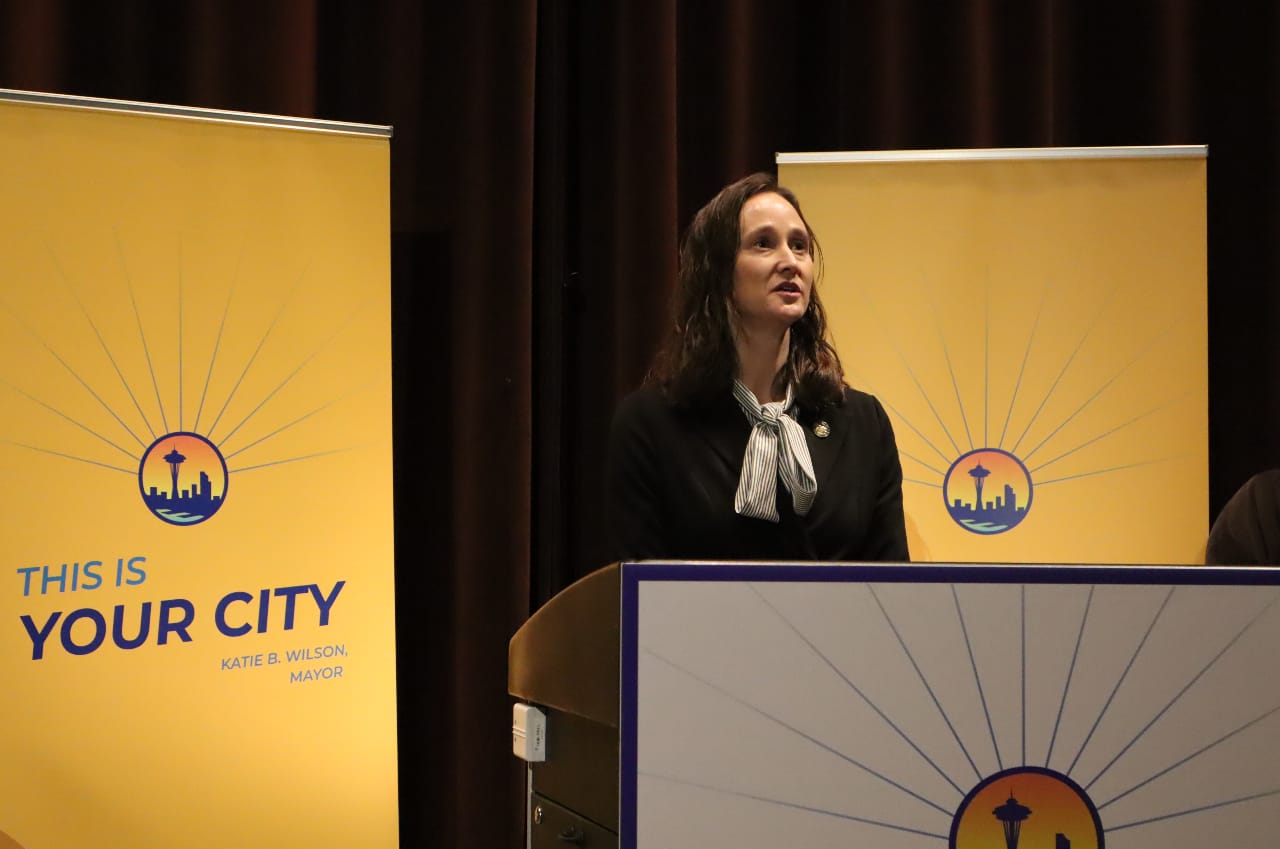
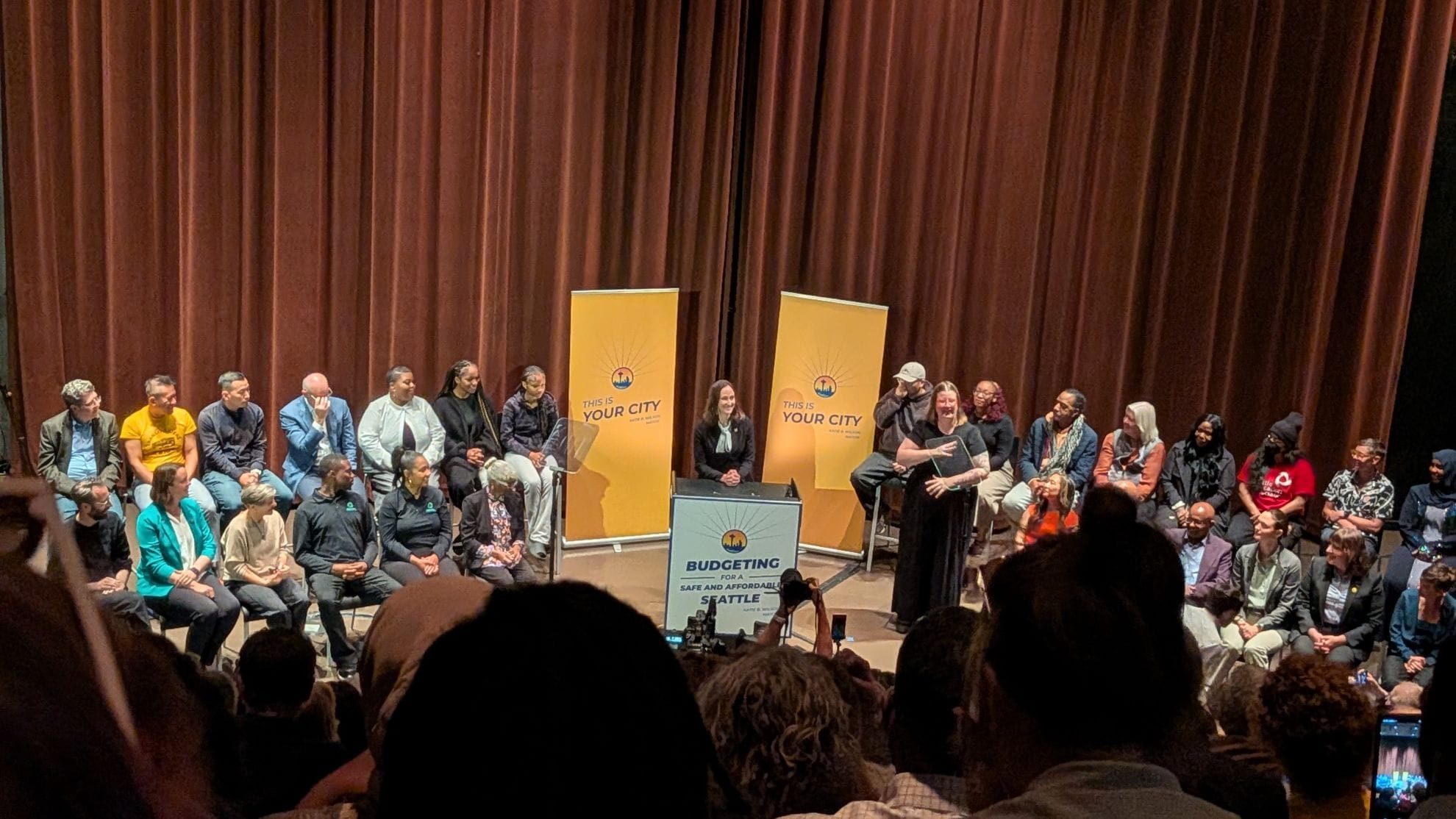
On Tuesday, Seattle Mayor Katie Wilson released the first budget proposal of her term, a $9.1 billion budget plan with a focus of “righting the ship.” Faced with a $175 million deficit in 2027, Wilson chose to balance the budget primarily through cuts and streamlining City operations. The proposal includes close to $50 million in spending reductions to the City’s General Fund and no new revenue.
The Urbanist's Fall Member Drive is in full swing! Support our work, read ad-free, and help us hit our goal for the member drive!
Meanwhile, while the Seattle Police Department (SPD) did take some minor cuts, its budget grew overall by $68 million, fueled by salary increases and other compensation in the most recent Seattle Police Officers Guild (SPOG) contract passed last December in the waning days of the Harrell Administration.
Public safety now consists of 53% of the more than $2 billion General Fund.
Wilson’s 2027-2028 budget proposal is the first since 2019 to show no budget deficit through 2030.
“For years, that deficit was papered over rather than faced head-on,” Wilson said in her budget speech. “That ends today. We cannot keep lurching from shortfall to shortfall, year after year. We cannot keep kicking the can down the road, because there is no more road.”
The mayor's speech is available via Seattle Channel.
Wilson’s proposed budget seems calculated to please the City’s business interests and quell the controversy that has courted her as a younger progressive female mayor. It is also in line with Wilson’s recent executive order to promote budget sustainability and efficiency of City services.
The Seattle Metropolitan Chamber of Commerce applauded Wilson’s budget proposal and its focus on public safety without adding new taxes.
In order to close the deficit, the Budget Office worked to align department budgets with actual spending and eliminated long-term vacant positions. They chose to scale back program expansions such as the Community Assisted Response and Engagement’s (CARE) first responder program, holding 14 positions vacant. They also reduced programs and once again made a large transfer from the JumpStart fund to the General Fund. Finally, they proposed a one-time transfer of $65 million from the Office of Housing’s 2026 budget to support 2027-2028 investments in affordable housing.
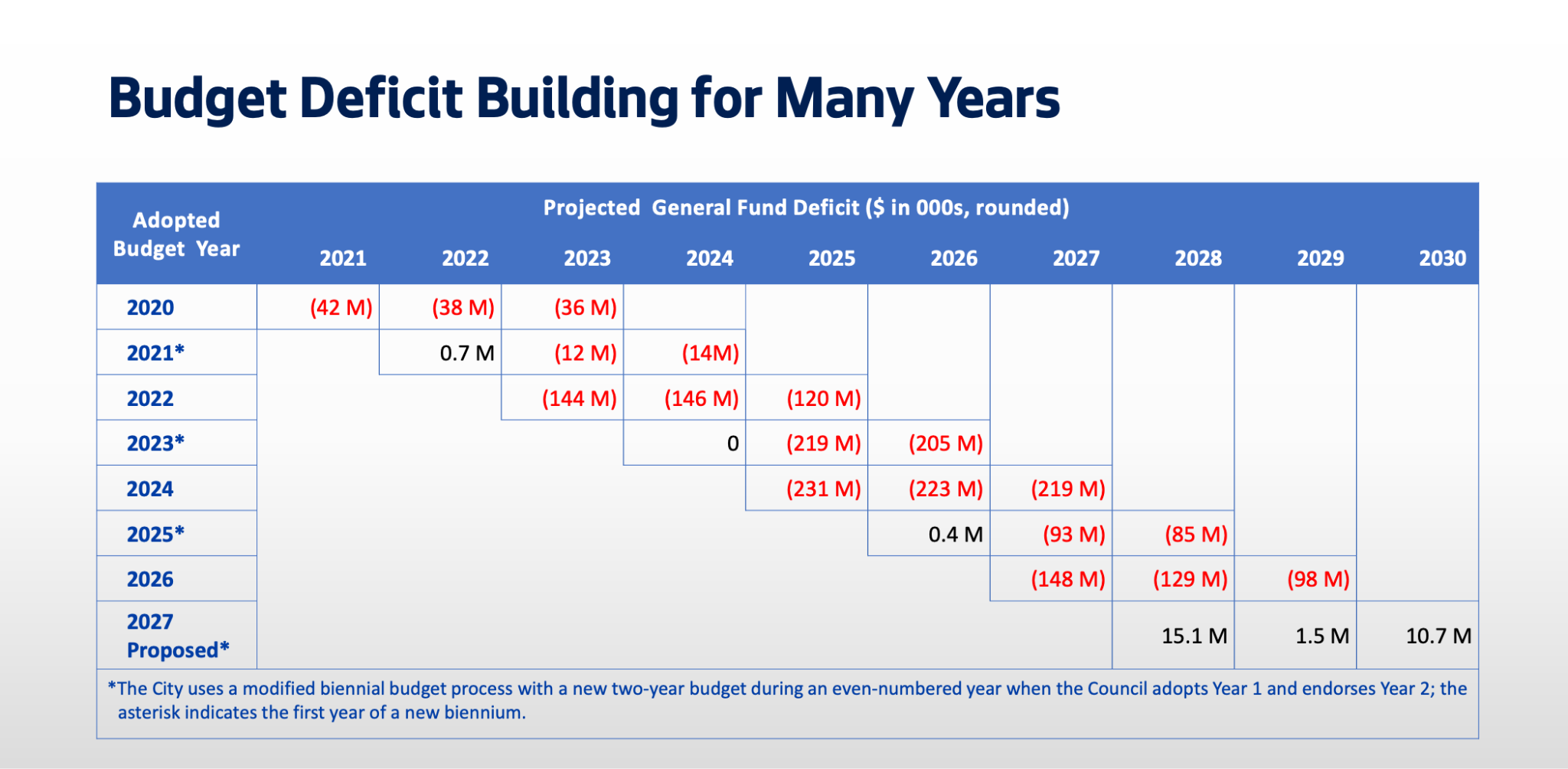
The Seattle Department of Transportation (SDOT) also has a projected $110 million three-year deficit in their fund that Wilson is working on bringing into balance.
“I will not pretend that is painless,” Wilson said about SDOT’s budget. “Some maintenance projects will experience delays, and my office will be working closely with SDOT to right-size projects to current resources and streamline effective delivery of these complicated capital programs.”
Wilson did not dip into any reserve funds to balance the budget, and the proposal makes the required contributions to the City’s rainy day fund, emergency fund, and JumpStart reserve account.
Most city departments are taking on at least some cuts, although many will still end up with larger budgets than they had in 2026 due to other investments.
Aside from eliminated positions, Wilson’s speech did not address specific cuts, but a press release from the Human Services Department gave a hint of the kind of departmental cuts being proposed.
“The proposed budget also includes reductions and changes to some HSD-funded services,” the press release read. “Several one-time investments are ending, some programs are proposed to move to other City departments, and some investments are being reduced where HSD identified opportunities to reduce duplication, changing needs, or other areas where resources could be redirected.”
Another example of a cut is a 50% reduction in the Collective Network Grant Program. Administered by the Seattle Office for Civil Rights, this program provides funding for community-led domestic violence response and prevention programs outside the criminal legal system. Legal involvement often backfires for or doesn’t meet the needs of domestic violence victims, and outside programs can offer a different avenue of support.
Of the 128 City positions being eliminated, 113 are not currently filled. The 15 that are currently filled include seven in the Department of Construction and Inspection, three civilian positions in SPD’s real-time crime center, two in the Department of Neighborhoods, two in the IT department, and one in the Office of Economic Development.
Although avoiding the human cost, eliminating unfilled positions isn't without cost, as it can result in more work for other City workers and slow down workflow.
The City will still end up with more total employees than it currently has, mostly reflecting new positions in utilities, a new division in the Human Services Department to oversee the homelessness contracts previously supervised by the King County Regional Homelessness Authority, and two new positions in the City Attorney’s Office relating to work around Extreme Risk Protection Orders and human trafficking.
In addition to the deficit, the City must cope with policy changes and economic instability caused by the Trump administration.
“This year, we are budgeting under conditions that are about as difficult as it gets,” Wilson said.
The Washington State Legislature has also been reluctant to give local municipalities more tools to raise revenue, leaving most cities and counties depending primarily on sales tax and capped property tax that hasn’t been keeping up with inflation rates.
Meanwhile, the increasing income inequality in the country increases people’s need for government services to help them afford basic needs like food, healthcare, and a place to live.
No new revenue
Since its passage in 2020, the City has relied heavily on the JumpStart payroll tax to maintain basic services. While the new revenue from the tax was originally intended to act as a stopgap for only a short time while the City recovered from the pandemic, use of the fund to assist with the expenses in the budget’s General Fund has become common practice.
Wilson chose to continue that practice, transferring $200 million (not quite half of its total expenditures) from the JumpStart to the General Fund. Without an additional revenue source, the only other option would have been more painful cuts.
In addition, Wilson proposed to shift about half of the cost of the City’s homelessness response to the JumpStart fund, adding another use case for JumpStart dollars. When the tax’s spending plan was originally passed, it was meant to fund affordable housing, the equitable development initiative, Green New Deal investments, and business development. However, under this proposal, more JumpStart dollars would be spent on homelessness response than on any other purpose except for affordable housing and backfilling the General Fund.
Perhaps most surprising in Wilson’s budget, given her history of advocating for additional progressive revenue for the City, was her decision not to propose any new revenue, or even outline new revenue proposals for the future.
“Right now, we don’t have good options to raise more progressive revenue that don’t also come with great risks,” Wilson said. “Our economy and especially our downtown are fragile. In that context, raising additional revenue through JumpStart is not the right move.”
Wilson said standing up a city-level capital gains tax would take several years to set up with the state, and other progressive revenue proposals either need further development or state authorization. While she voiced support for pursuing a capital gains tax, Wilson noted it offered no immediate budget help. A longer term goal for the administration will be using more of the Jumpstart tax revenue for the purposes outlined in its original spending plan.
Budget priorities
Staying true to her platform, one of Wilson’s priority areas in the budget is housing and homelessness response.
About a third of the JumpStart revenues will be used for affordable housing. Meanwhile, the budget calls for $183.5 million to be invested in the City’s homelessness response, including $37 million to create 960 new units of shelter by the end of next year. The proposal adds positions to enforce the new ban on tenant junk fees as well as money to enforce the Councilmember Dionne Foster’s new legislation preventing the unwanted solicitation of residential property.
The budget proposal adds funds for 2027 and 2028 (not ongoing) for rental assistance and other homeless prevention investments.
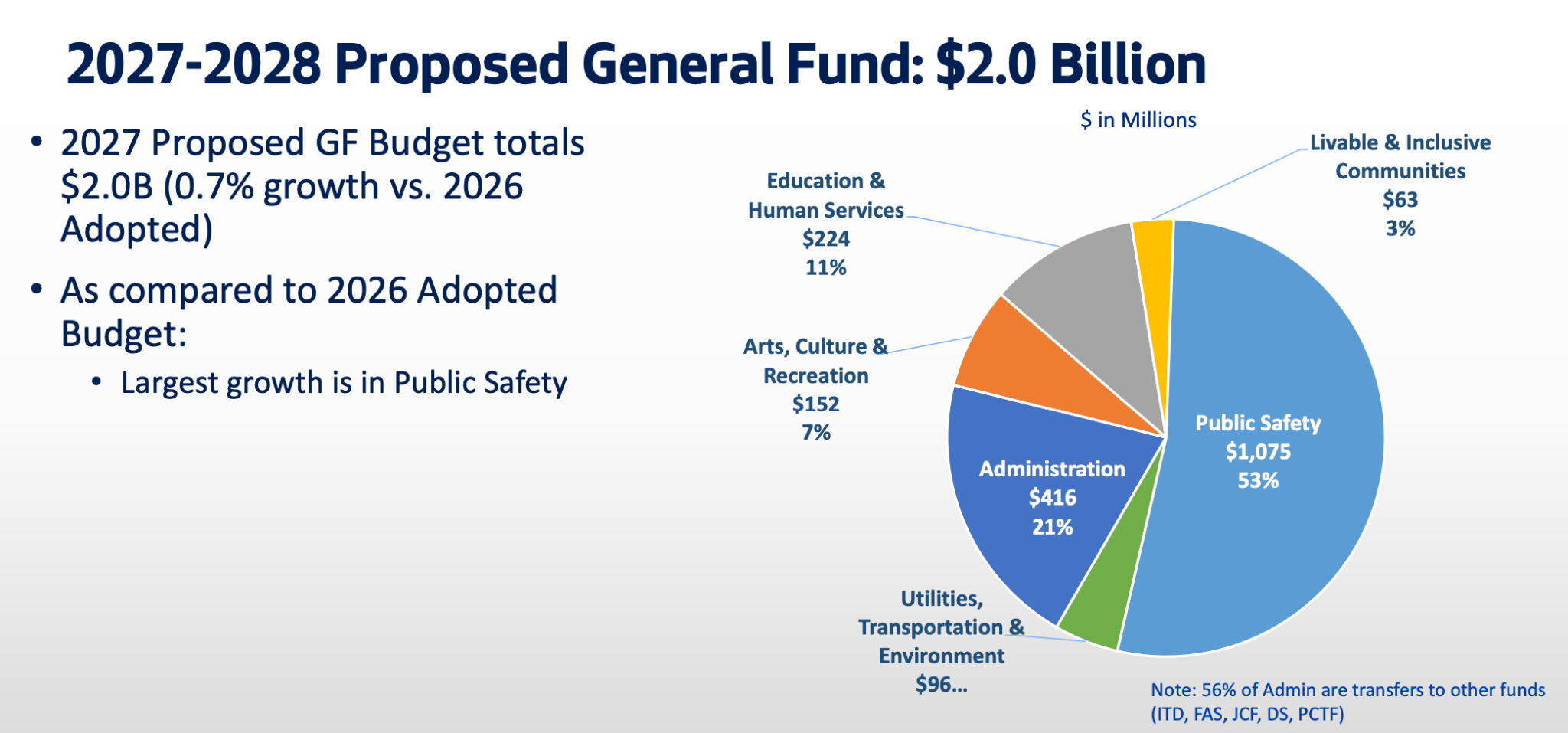
Public safety is another clear priority budget area. SPD will receive an additional $68 million in total, growing their budget to $556 million. This money will fund the salaries of 1,250 police officers, which is 66 more officers than Harrell funded in his last budget. As of the end of August, SPD had 926 deployable officers.
SPD is receiving a cut to its recruitment and hiring incentives budget, as well as losing three civilian positions within the real-time crime center (RTCC) out of nine that are currently vacant. However, the budget rollout provided no news of removing any of the very expensive command staff positions added by former Chief Shon Barnes before his departure.
While some responder positions within the CARE department will be held vacant, its response hours have been expanded to 6:30 am to 1 am. CARE responders have struggled with being underutilized, but in the last seven weeks, that utilization has suddenly improved to 80%, a change CARE Chief Amy Barden attributes to the expanded hours, although she also acknowledged a different sentiment toward the CARE team within SPD right now. The change in utilization seems to roughly coincide with the departure of Barnes and the appointment of interim Chief Andre Sayles.
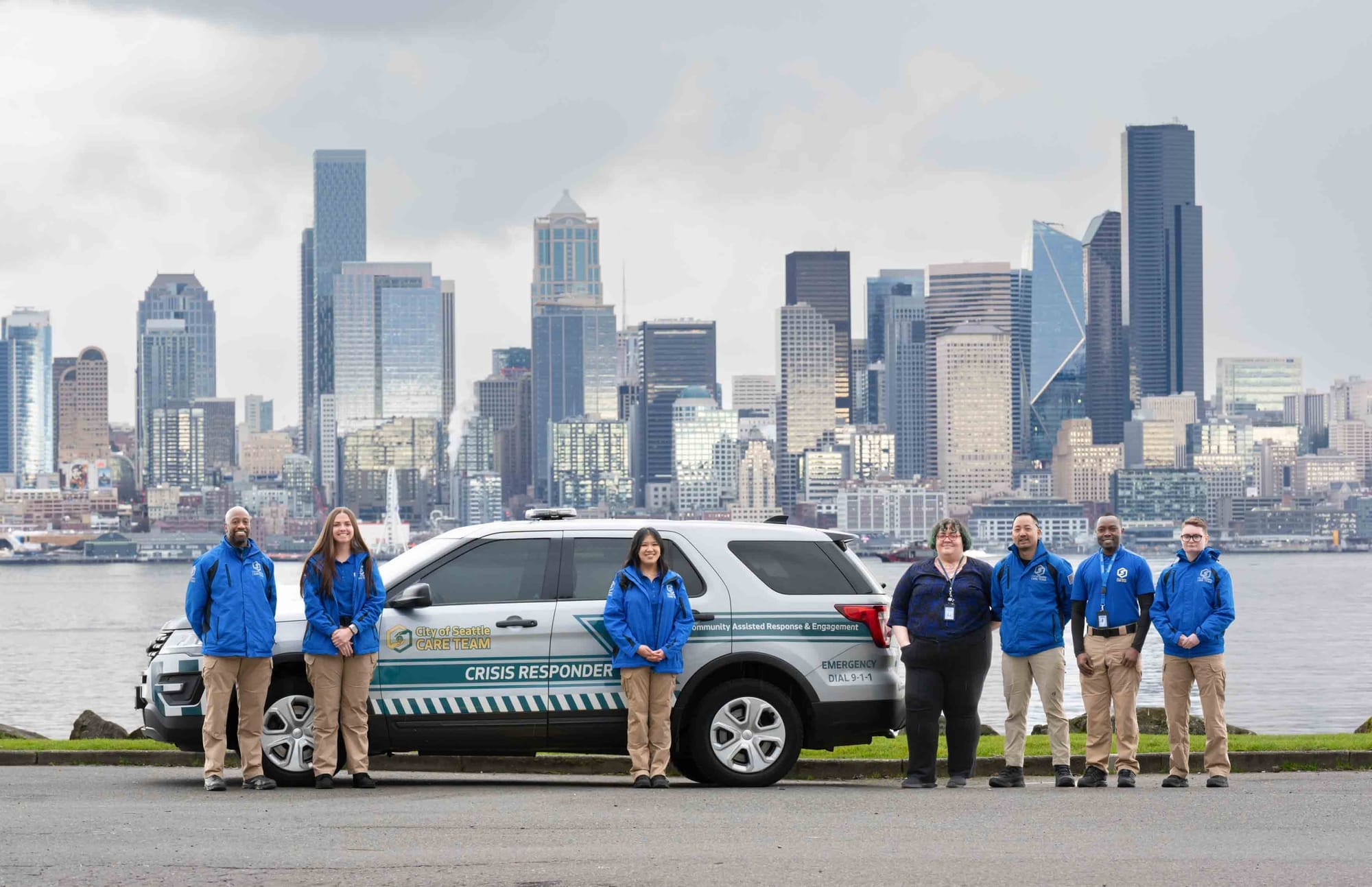
While some may question putting a hold on the CARE alternative response expansion just as its utilization rate is finally improving, Barden supports this budget move, noting that the positions under consideration are simply being held vacant, not being abrogated (removed entirely).
Seattle Center is also receiving some funds, including $500,000 in one time funds to be spent before the end of 2026 on weapons detection equipment, area fencing, support vehicles for campus security, and various safety and emergency training for crisis situations.
The budget also makes the investments called for in Wilson’s new gun violence prevention plan.
Meanwhile, in food access, the proposal makes one-time 2026 increases in food access investments permanent and ongoing. And the budget funds two new restrooms in parks and up to 10 new restrooms across the City, as well as four new restroom renovations at parks.
The budget proposal makes permanent a 2026 $4 million investment in the Office of Immigrant and Refugee Affairs for legal defense, rapid response, and workforce programs, as well as $500,000 to create a Queer and Trans Stabilization Fund to support organizations that help meet the emergent needs of community members facing increasing oppression for their gender or sexual identity in the Trump era.
Next steps
At this point, the proposed budget is handed off to the City Council, led by Budget Chair Dan Strauss. The council will hear from city departments, receive analyses of relevant issues, and propose any changes they wish to see.
While there isn’t much spare revenue lying around for additional council priorities, depending on the final revenue forecast on October 16, they may have a small amount of additional revenue to play with. Alternatively, they may find they have to close a larger deficit gap than anticipated, in which case it will be harder to put their individual stamps on the budget.
While the proposed budget fully funds SPD’s staffing plan, controversy around funding could arise, including around surveillance costs and the cuts to SPD and CARE, the latter of which have already been criticized by Strauss. (Note both SPD and CARE have larger overall budgets in 2027 than in 2026.)
Some councilmembers may be concerned about the 15 filled positions currently slated to be cut. And Councilmember Maritza Rivera will also almost certainly be trying to include her $417,000 biennial investment in a consulting contract with the National Network of Safe Communities to ensure her preferred route of gun violence prevention.
Meanwhile, some members of Wilson’s progressive base might have wished to see a bolder proposal, staking out new progressive revenue and investments.
The council is scheduled to take their final vote on the 2027-2028 budget on Friday, November 20.
Wilson and her budget team made some difficult choices when creating this budget proposal, but at the end of her speech, she still hit an optimistic note.
“I am choosing a budget that tells the truth about where we are, and still dares to point toward where we are going,” Wilson said. “We will run this government the way the people of Seattle deserve, with honesty instead of obfuscation, with care instead of convenience, and with the discipline to make hard choices without losing sight of who those choices are meant to serve. And then we will do more than steady the ship. We will set a course.”
 Amy Sundberg