
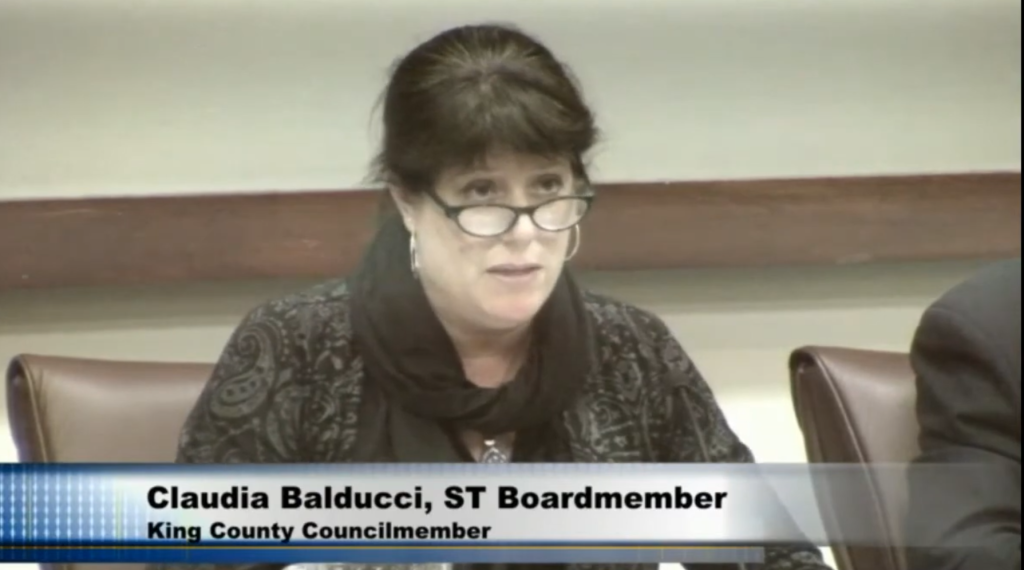
Claudia Balducci, the longest serving member of the Sound Transit board, was removed from her post as chair of the board’s System Expansion committee last week, just as the board prepares to fully reorient its system plan to address a $34 billion budget hole. Balducci, a King County Councilmember, had been leading that committee since 2018, but she will not even serve on the body tasked with making critical decisions about light rail extension projects going forward.
The power to propose updates to committee assignments rests in the board chair — currently Snohomish County Executive Dave Somers. Committee assignments had been set to remain in place through the end of 2026, under a motion approved last February. But with significant turnover on the board in recent weeks, including the addition of Seattle Mayor Katie Wilson, Tukwila Mayor Thomas McLeod, and King County Councilmember Steffanie Fain to fill newly opened vacancies, Somers took the opportunity to make broader changes to committee roles.
The new committee assignments were approved in an unanimous board vote Thursday.
Balducci will also leave the Executive Committee, a panel tasked with overseeing systemwide policies and procedures within Sound Transit. King County Executive Girmay Zahilay, who defeated Balducci in a bid to succeed longtime Executive Dow Constantine last November, will take her place. Instead, she will serve on the Rider Experience and Operations committee, currently chaired by Tacoma Councilmember Kristina Walker.
“I let the chair of the board know that I was willing to stay on through ’26 and he chose to go in a different direction. It was a surprise to me as well,” Balducci told The Urbanist following Thursday’s board meeting. “I understand the desire to spread leadership positions around. And, as you know, we’re going to shortly be announcing the opening of East Link — the full opening. We’re getting to a point where all of ST2 is done. So there’s some logic to focusing on rider experience… It wasn’t my first choice, but my approach has always been to make as much do as much good as I can in whatever chair I’m sitting in.”
Balducci is likely best known across the region as an advocate for the 2 Line, also known as East Link. First as a Bellevue City Councilmember and later as a County Councilmember, she stewarded the project through legal challenges and contentious routing decisions that at one point threatened to doom the prospect of bringing light rail to the Eastside.
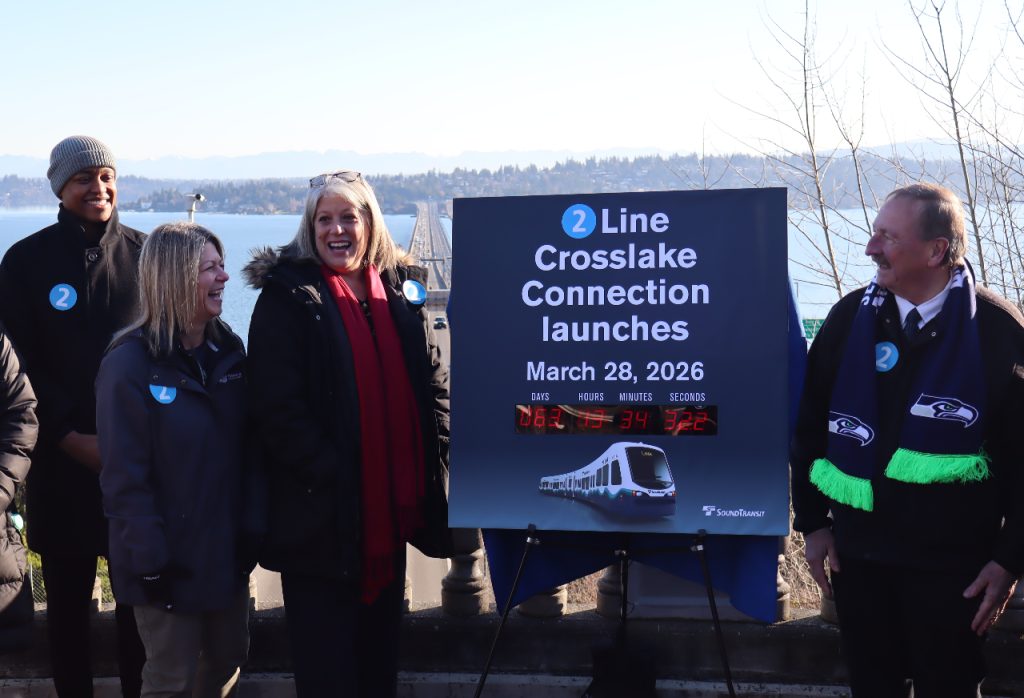
In 2022, when construction issues on the I-90 bridge looked likely to push an opening date back by several more years, Balducci led the charge to open the segment that was already complete in Bellevue and Redmond as a “starter line.” That initial line is now exceeding ridership projections, even before the full line opens across Lake Washington on March 28.
Thursday’s motion installed Redmond Mayor Angela Birney as the System Expansion Committee’s chair. Birney has served on the board for just two years, joining at the same time as Zahilay and Seattle Councilmember Dan Strauss. She also represents a part of the system that is fully built-out, with the Sound Transit 3 (ST3) package queuing no further additions in Redmond.
Now that he is King County Executive, Zahilay holds the most influential position on the board, appointing nine of the 18 seats on the board. The respective executives from the three counties composing Sound Transit’s district also rotate chair duties.
Over the months ahead, the Sound Transit board is set to update the ST3 System Plan — which hasn’t been revamped since 2016 — along with the agency’s Regional Transit Long-Range Plan and its Long Range Financial Plan, all in quick succession. Different issue areas will be handled at each policy committee, with the System Expansion committee next month poised to review the cost savings workplan that is intended to provide a path to building as much of the ST3 program as possible without cutting stations or system segments.
A planned board retreat this spring will see board members put forward potential scenarios for project adjustments, some that will likely dramatically change the current ST3 plan. Balducci, who has developed a reputation as a rider advocate, has often put forward ideas that are more out-of-the-box than many other board members, which have hewed to existing approaches and remained focused on building out the rest of the light rail system’s “spine” to Everett and Tacoma.
Last month, Balducci found herself in the minority at a board discussion around one such out-of-the-box idea: a proposal to build the Ballard Link Extension without a planned tunnel under Downtown Seattle. The second downtown tunnel had been intended to provide redundancy and augment system capacity, but it comes with a big price tag and siting headaches. Unlike other cost savings proposals that the board has looked at, Somers sent the proposal through his own Executive Committee and made clear that he thought staff analysis showed that it should be put to bed.
Despite Balducci making the case for not taking any ideas off the table at this stage, the board as a whole seemed to put the proposal aside, though the contention by some media outlets that the idea was wholly rejected likely overstates things.
It was certainly not the only time in her long tenure on the board where Balducci found herself advocating for a position despite being clearly outnumbered. In 2014, she was one of three board members to vote against siting the 2 Line’s operations and maintenance facility in Bellevue’s Spring District, arguing that the agency was taking valuable land that could be used for transit-oriented development off the table. More recently, she has been a voice advocating for keeping options for Seattle’s next light rail projects that will maintain a transit hub around S Jackson Street in the Chinatown International District, pointing to negative impacts to riders that could come from longer transfers.
In responding to several comments from members of the public at Thursday’s meeting dealing with the switch, Somers praised Balducci while declining to address the underlying change to committee assignments.
“I just want to echo some comments made earlier about Boardmember Balducci being a star player,” Somers said. “[She] has been, and will continue to be, a really critical part of this team, so thank you for all of your years as [System Expansion Committee] chair.”
Later in the meeting, Somers reiterated the fact that any boardmember can attend a committee meeting to weigh in on discussions, though they wouldn’t be afforded a vote if they’re not a member. Such a move is not typical, with committee meetings often struggling to get a quorum of their own members through the summer months.
In speaking with The Urbanist, Balducci expressed optimism about being able to influence the future of the regional transit system no matter what committee she serves on.
“You don’t need a gavel to have a microphone,” Balducci said. “I’ll still have a microphone I’ll still be talking about things I think we need to do.”

Ryan Packer has been writing for The Urbanist since 2015, and currently reports full-time as Contributing Editor. Their beats are transportation, land use, public space, traffic safety, and obscure community meetings. Packer has also reported for other regional outlets including BikePortland, Seattle Met, and PubliCola. They live in the Capitol Hill neighborhood of Seattle.