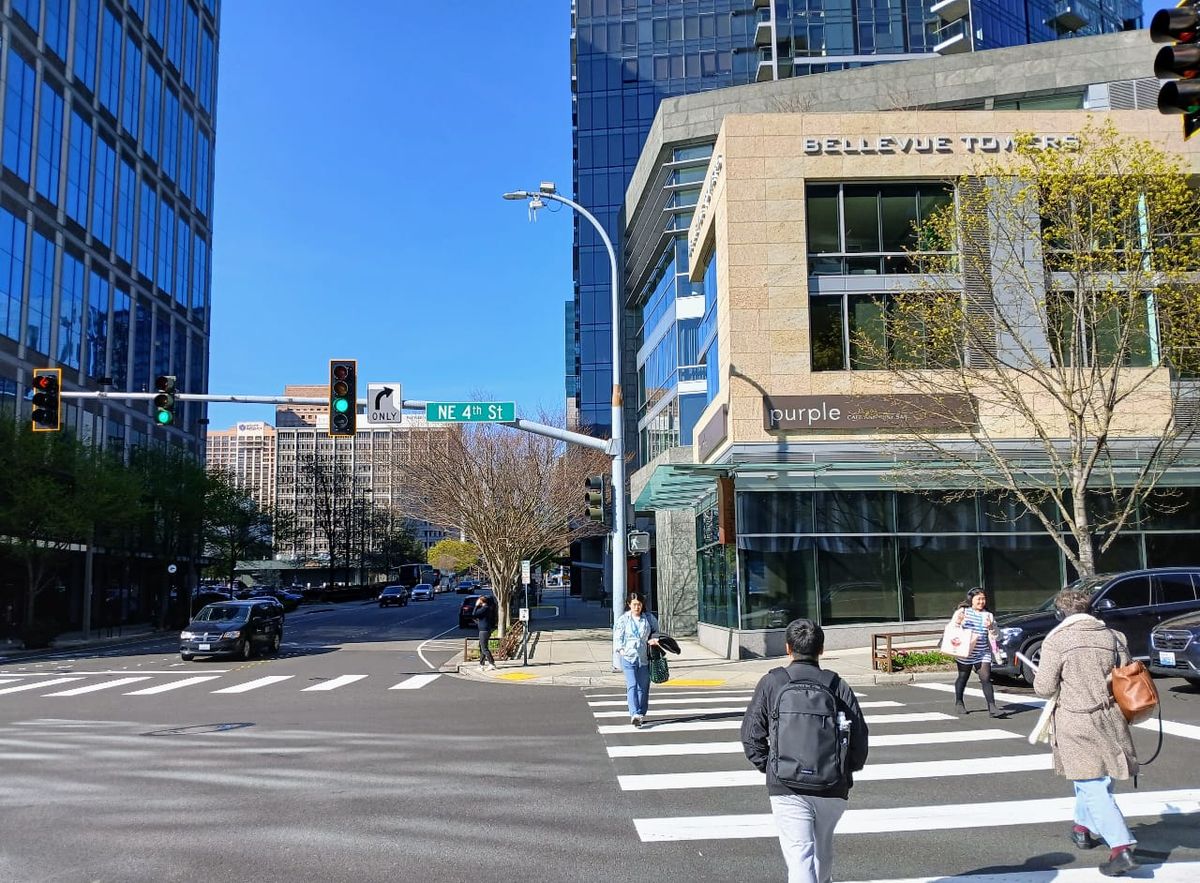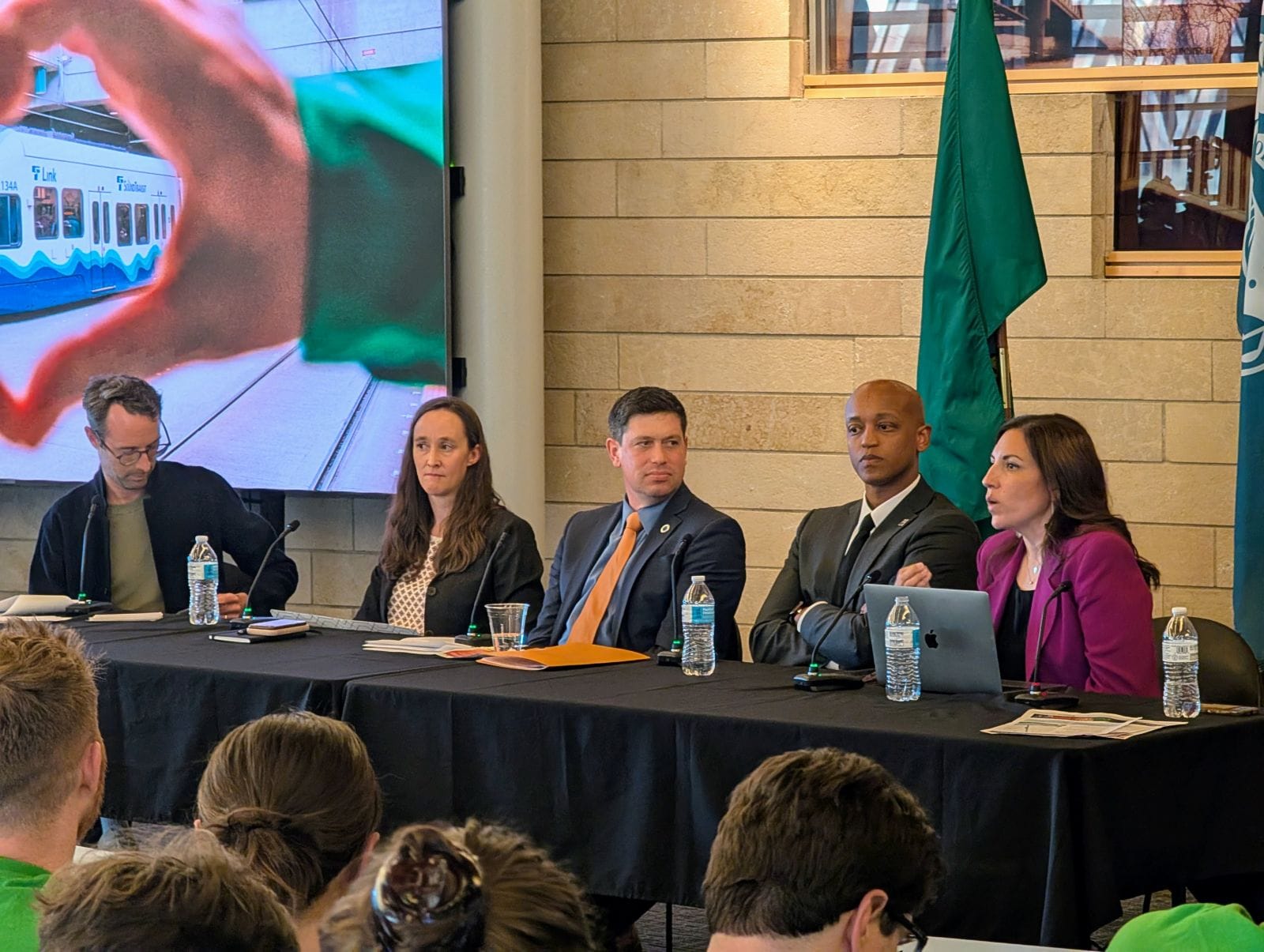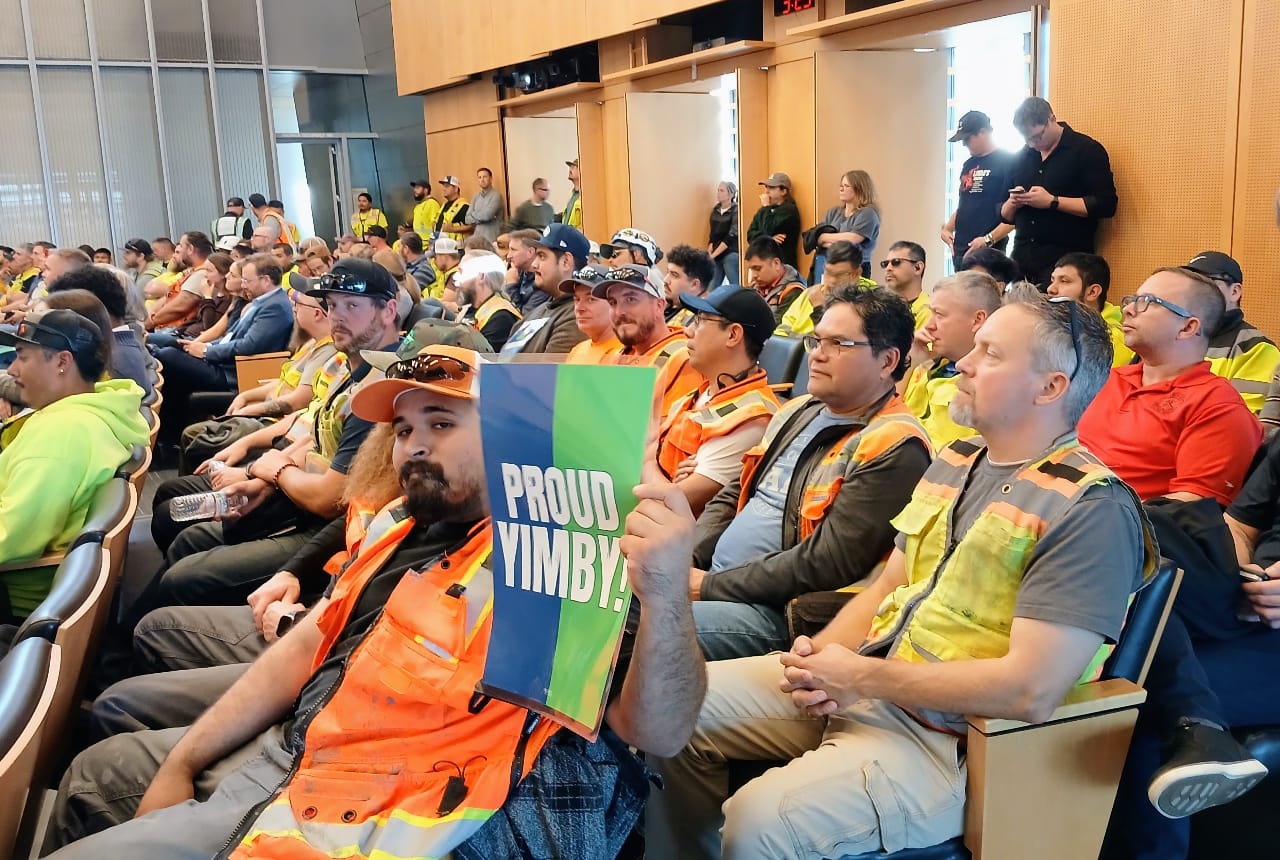
The City of Bellevue continues to pursue the idea of building a new pedestrian and bicycle bridge over I-405, connecting Downtown Bellevue and the Wilburton neighborhood, an area primed for significant housing growth. That work reached a crucial milestone this week, after city officials have scrambled to meet a state-imposed deadline to utilize a funding source poised to provide around 15% of the expected $200-$225 million cost of the entire project.
All five of the local government authorities required to sign off on Bellevue's use of tax-increment financing (TIF) have now given the green light. Those five entities are King County Library System, the Port of Seattle, Sound Transit, and the King County Council and its independent flood control district. The County Council's unanimous vote came Tuesday afternoon after some intense negotiations over specifics.
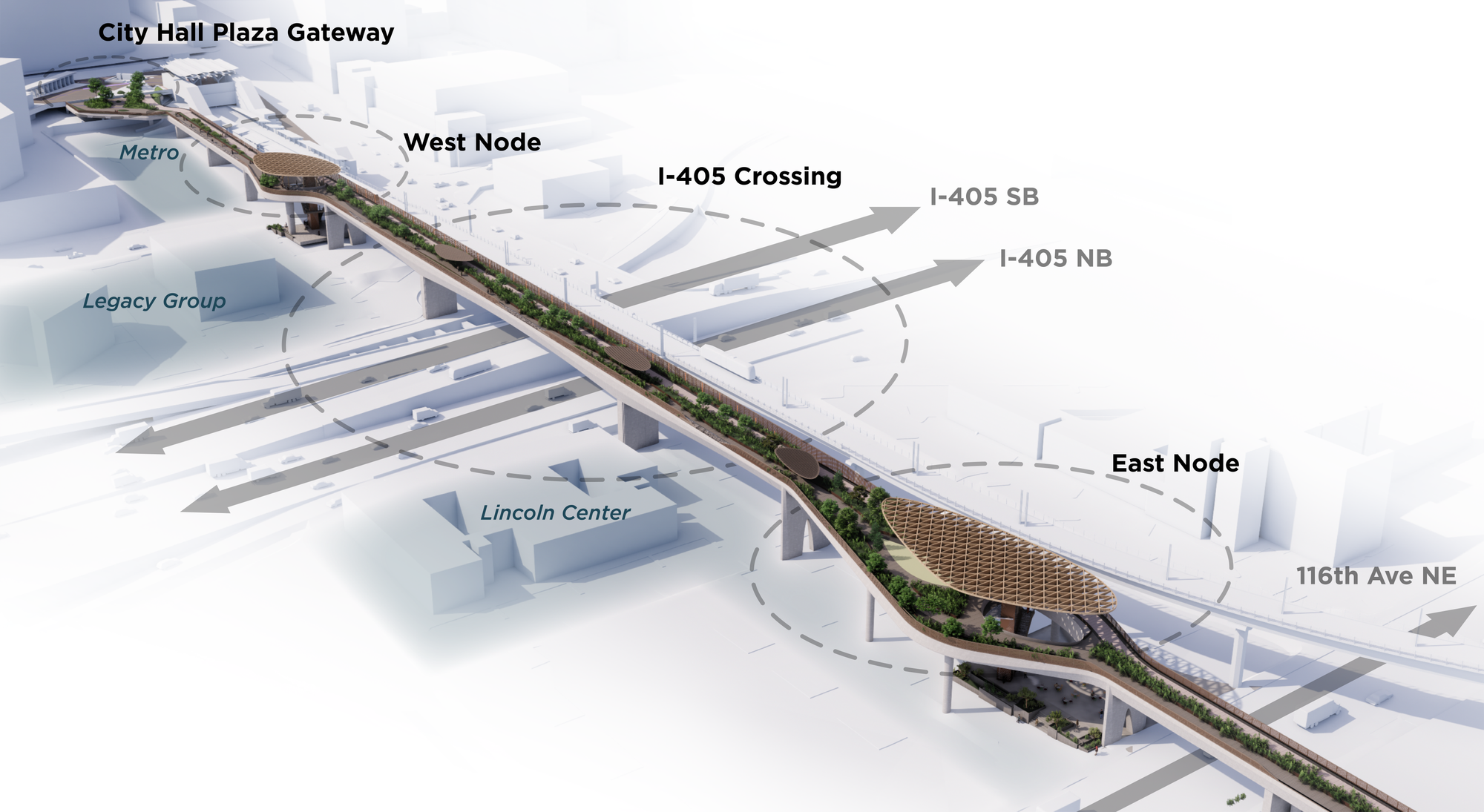
The Grand Crossing Connection is intended to be the capstone on a biking and walking corridor stretching all the way between King County's Eastrail in Wilburton and Bellevue's Lake Washington waterfront at Meydenbauer Bay Park. The new bridge would provide a path fully separated from cars, a welcome alternative to harrowing I-405 overpasses nearby. Bellevue is also hoping to create significant placemaking opportunities along the crossing, with new development closely stitched together with the bridge.
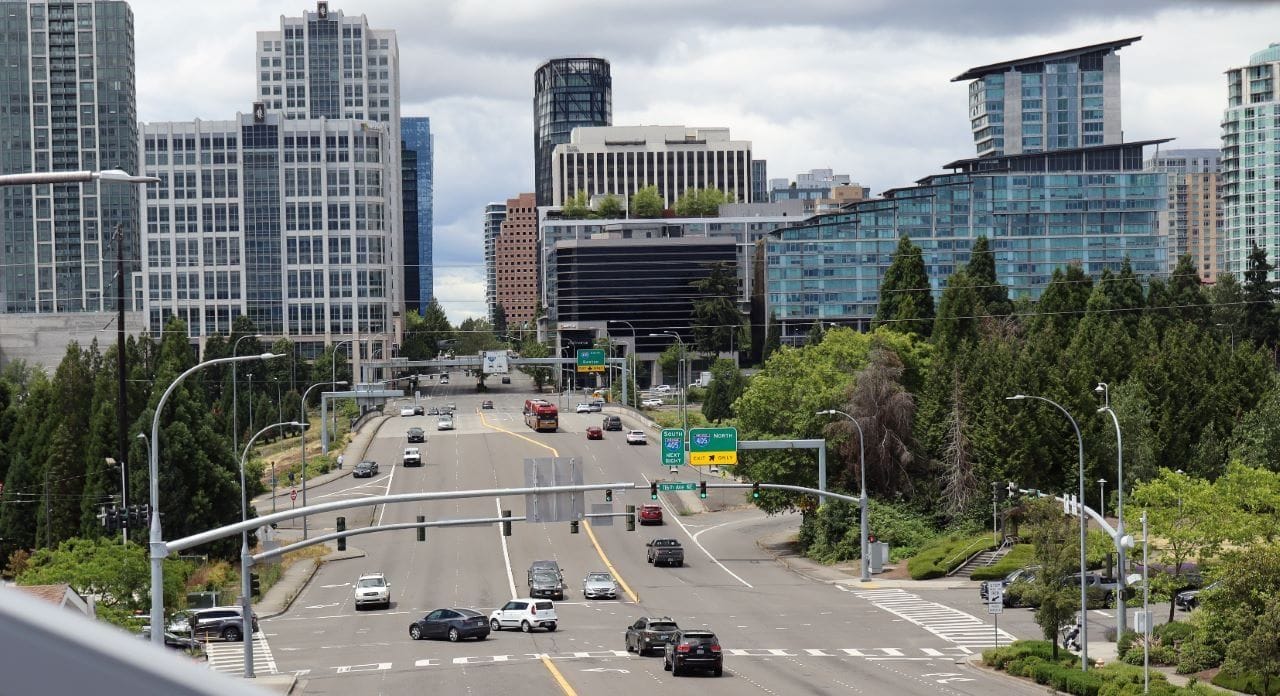
Last year, the City created a special Office of the Grand Connection to shepherd the project forward, with former Seattle permitting director Nathan Torgelson at its helm. If the full financing package can be assembled, Bellevue is hoping to fully complete the new bridge by 2030.
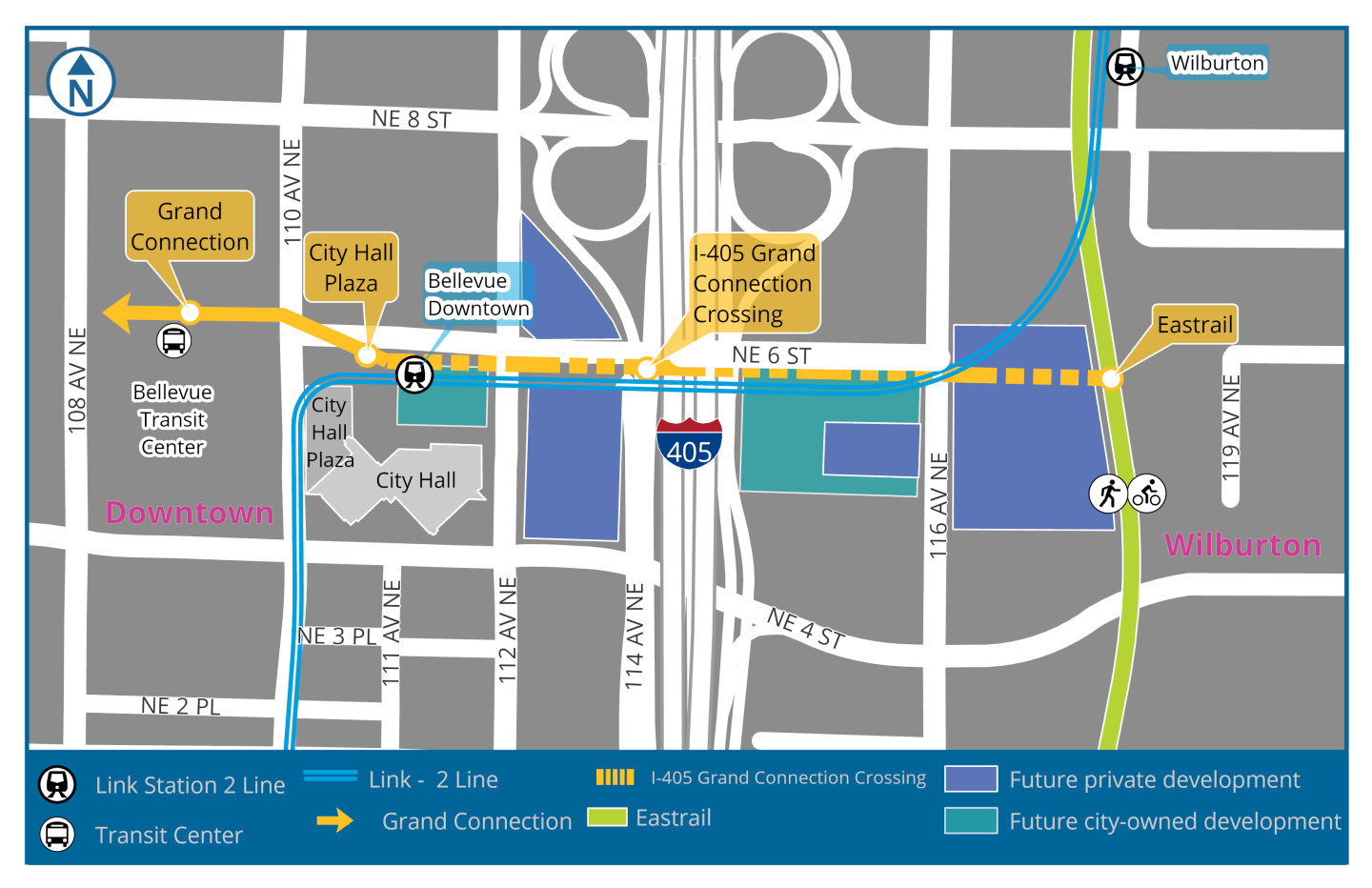
Bellevue's TIF plan would allow the city to tap into the expected increase in property values around the planned crossing as a way to pay for the new multimodal investment and economic development tool.
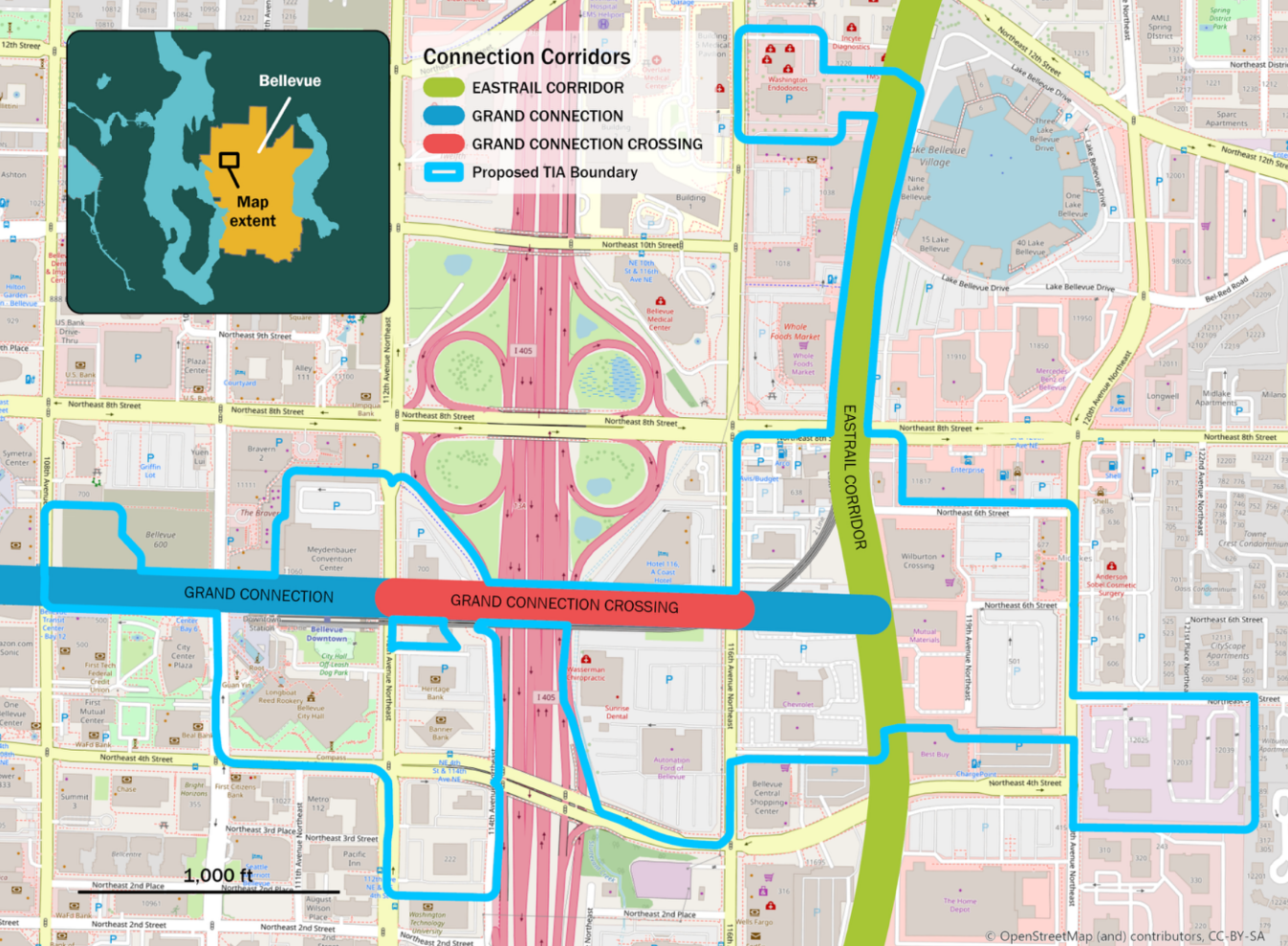
Here's how it works: Bellevue would establish a tax-increment area (TIA), focused directly around the planned highway crossing, directly to the north of the Sound Transit light rail guideway. Assessed property values inside the TIA would be frozen, with any increase in value over the subsequent 25 years going back to the City to pay back the debt issued to pay for the crossing.
Bellevue's proposed TIA explicitly includes several City-owned parcels expected to be redeveloped in the coming years, as well as key additional parcels where private development is expected to take shape. But the TIA excludes tracts where new apartment buildings or condos are expected to take advantage of the city's Multifamily Tax Exemption (MFTE) program, which takes taxable property values off the rolls on its own, cancelling out the benefit of inclusion in the TIA.
While a TIF represents a direct hit to property tax revenues across multiple levels of government, the investment attracted to the area by a pedestrian and bike bridge that doesn't currently exist is expected to make up that amount – and potentially more. Those investments will bring sales tax revenues, both from construction itself and the businesses that ultimately end up taking root there, which will also likely pay business and occupation (B&O) taxes to the City.
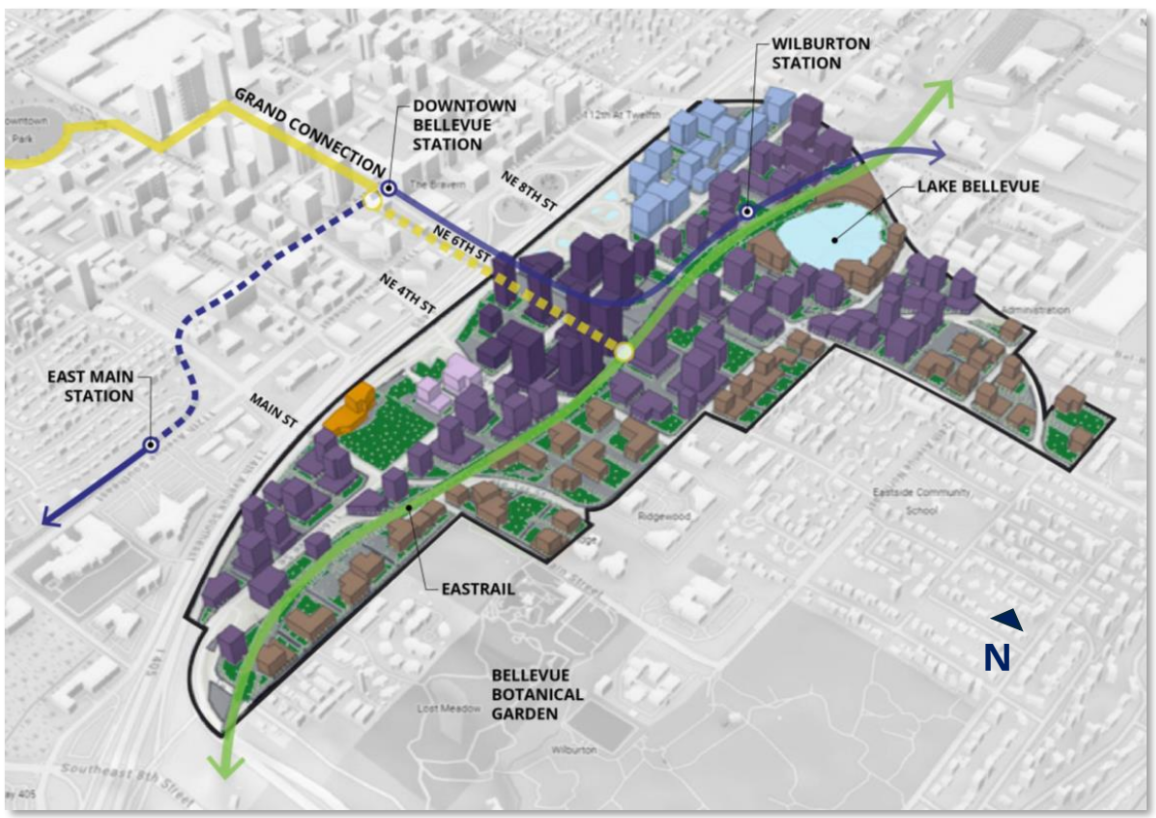
Thanks to zoning changes intended to unleash development in Wilburton more broadly, Bellevue is expecting to add thousands of new units of housing in the area over the coming decades, letting buildings grow as tall between I-405 and Eastrail as they're allowed to in Bellevue's downtown, with a more gradual transition on the other side of the trail.
"By providing a vehicle-free route for walkers and rollers, we are directly increasing the catchment area and safety for our East King [County] transit hubs," Redmond Mayor Angela Birney said ahead of the Sound Transit vote to opt-in. "The board has been asking staff to consider new policies that help us achieve our long term goals while also delivering on a robust transit network. This proposal put forward by Bellevue is a step in the right direction, showcasing creative funding solutions to meet our growing infrastructure needs, and time is of the essence."
TIF districts are tightly regulated by the state, and the legislature only granted Bellevue specific authority to pursue this revenue source for the Grand Crossing Connection in the 2025 legislative session. That authority stipulated that Bellevue needed to get buy-in and take action to establish the district by June of this year, pushing city officials to act fast.
"This is only a law that we've had available to us in Washington for a handful of years, and in a standard TIF process, or what I will sometimes call a unilateral TIF process, we know that has typically taken about 18-24 months to execute," Genesee Adkins, Bellevue's Deputy City Manager, said this week. "Knowing that we had less than 12, and with the additional requirement of getting a legislative action from each of the other taxing districts – who had never done something like that because it had never been a requirement previously – we knew it was a lot to bite off."
At Sound Transit, the idea of buying into Bellevue's plan was received in a relatively straightforward way. But officials at King County have been experiencing more heartburn over the idea, reticent to give up even a slice of scarce general fund revenue that's expected to grow over time as the tax base is kept flat.
Budget committee chair Rod Dembowski, lamenting that King County did not just include a direct contribution to the Grand Crossing Connection in the county's parks levy renewal in 2025, was one of the biggest skeptics.
"I just wonder if there isn't a more efficient way for the collective taxpayer to fund this specifically. You're paying interest costs for 25, 30 years, or however long you're gonna issue your debt," Dembowski said at a committee meeting last month, referencing the downsides of taking out of the county's general fund. "That's prosecutors, defenders, sheriff's deputies, jail guards. It's our most strained fund, and it's all about all we have for, mostly, for public safety."
In the end, the County Council gave itself two additional levers that could be pulled down the road: the County could "buy out" its portion of TIF revenues from a one-time fund source, like a parks levy, removing any obligation on the part of the general fund. Or it could raise property taxes ever-so-slightly across the entire county to account for the hit caused by the TIF. The County's contributions are also capped at $30 million, with a similar cap added to the county flood control district.
Not on the skeptical side, however, was King County Councilmember Claudia Balducci, who represents the district where this crossing will go, and previously served on the Bellevue City Council. All nine county councilmembers also serve on the flood control district board.
"Somebody asked the question earlier in one of one of the many meetings we've had at many bodies about this: 'What if this sets a precedent?' And my personal feeling is, I hope it does," Balducci said ahead of the flood control district's vote to approve. "I hope it sets a precedent that other parts of the county are able to take advantage of, because this is a tool that we haven't used in quite this way before, that can help unlock funding for major public amenities, which are needed in multiple parts of the county."
After receiving full unanimous votes from all five local governments, the Bellevue City Council is set to consider the final proposal later this month, beating the state deadline with only a few weeks to spare.
"The support from other taxing districts is a recognition of the value that the Grand Connection, and specifically the Grand Connection Crossing represents for the entire region. It's a recognition that the Grand Connection Crossing is truly a win for Bellevue and a win for the region," Bellevue Deputy Mayor Dave Hamilton said Tuesday. "More housing, more quickly, more transportation connectivity, more recreation, more jobs and more economic activity that enables us to do so much more for our community. The Grand Connection Crossing is an investment that I think is a nobrainer. It will have a tremendous payoff for our community for a long time to come."
 Ryan Packer
 Ryan Packer