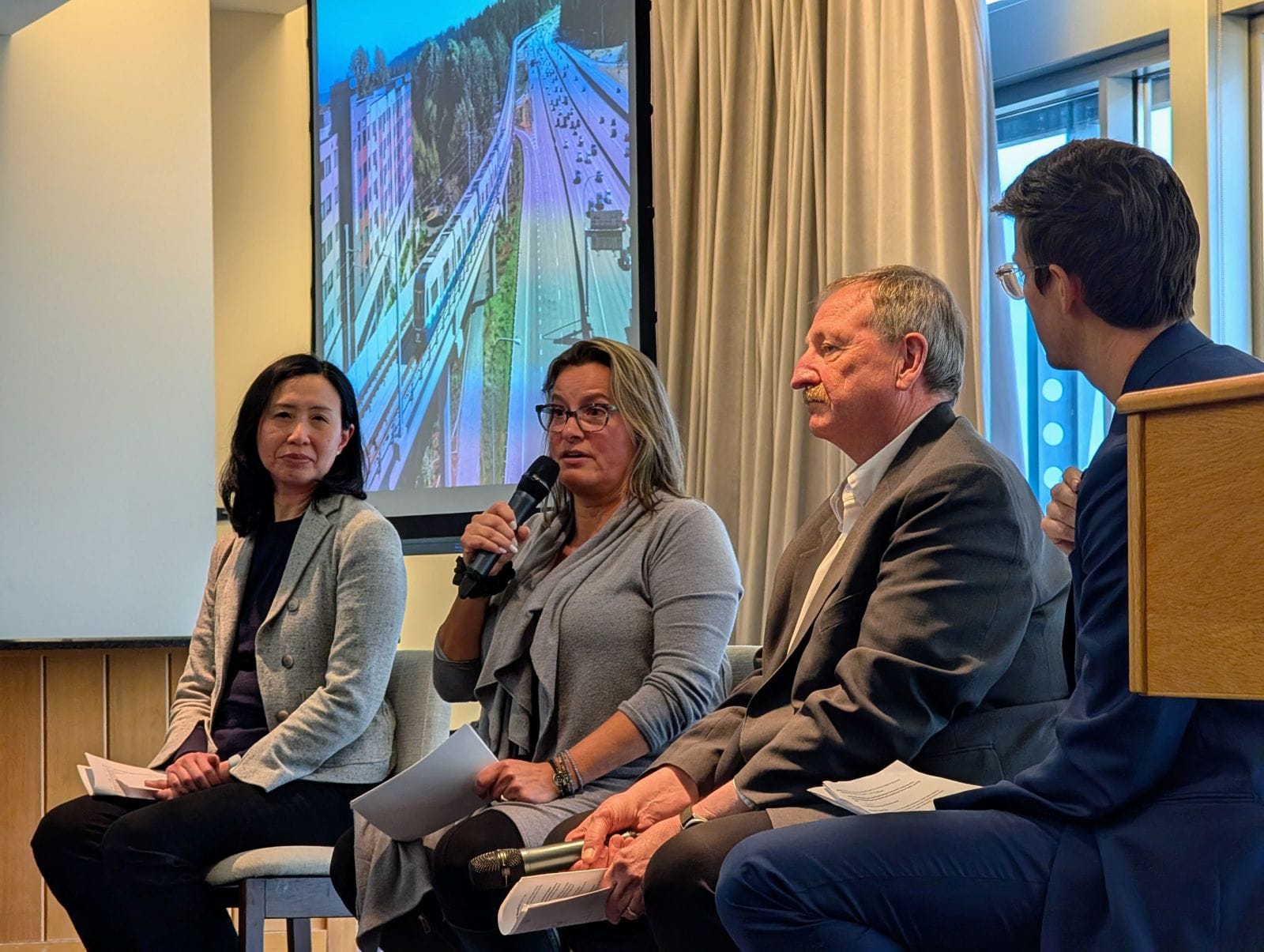
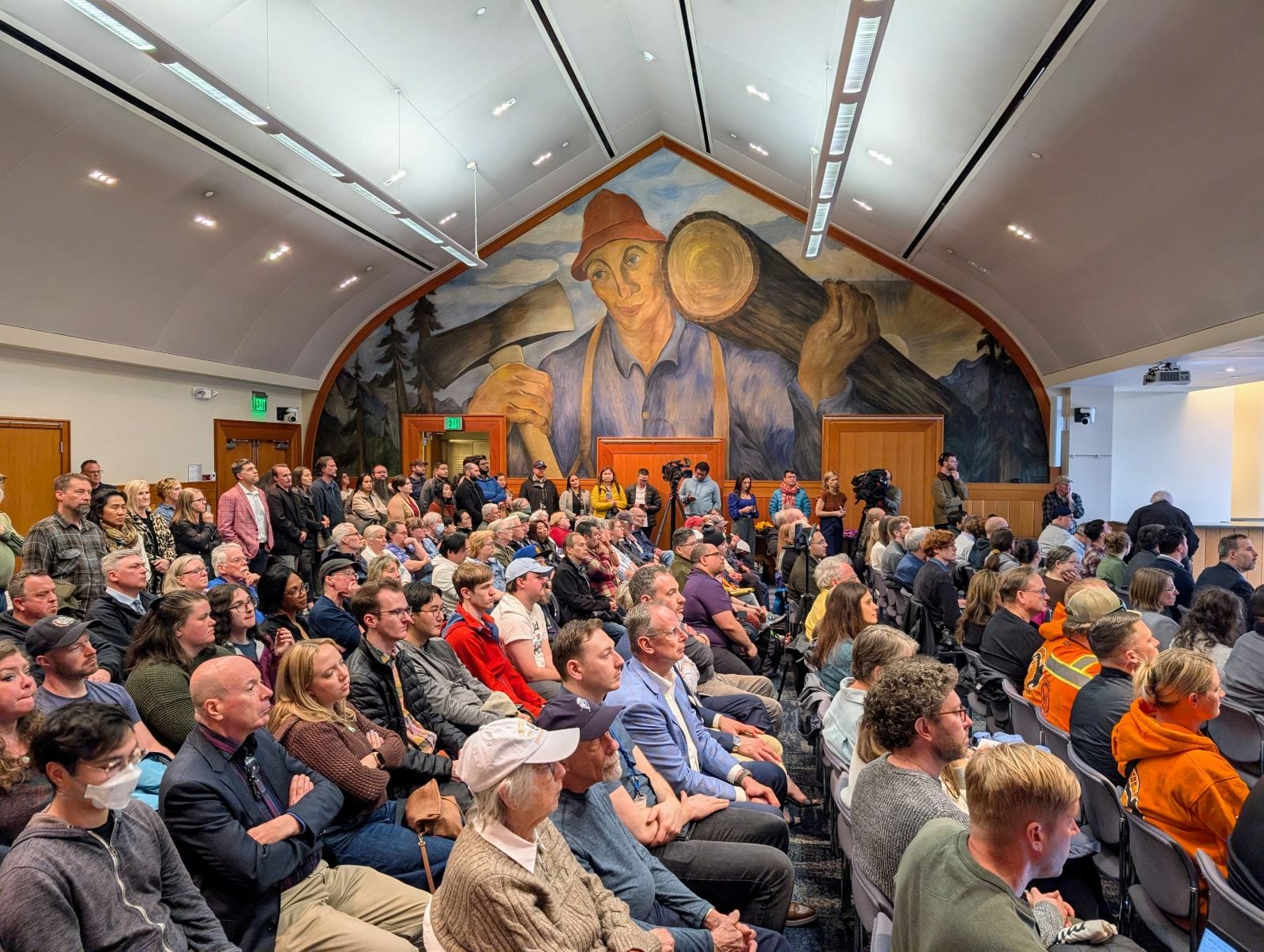
Last week on a rain-soaked Tuesday, Snohomish County transit advocates gathered at Everett Station to rally for the Everett Link light rail extension project, which they framed as affordable to build and able to proceed on its 2041 grand opening timeline. An axe-wielding lumberjack mural leered over the proceedings in the Weyerhaeuser Room, where Snohomish County Executive Dave Somers and Everett Mayor Cassie Franklin pitched the case for putting "finishing the spine" to Everett and Tacoma before other regional rail projects.
The agency will be realigning project schedules later this spring in the face of a $34.5 billion long-term budget gap to complete and operate the 116-mile light rail network promised to voters in the 2016 Sound Transit 3 (ST3) ballot measure. Repeating some variation of the phrase "finish the spine" more than a dozen times during the event, Somers and Franklin made it very clear where their priorities lie.
Last month, Sound Transit published three systemwide cost-cutting scenarios that all involved deferring stations in Ballard and Interbay, moving that segment from a projected opening date of 2039 to an unspecified question mark in light of the severe budget overruns in the Seattle ST3 segments.
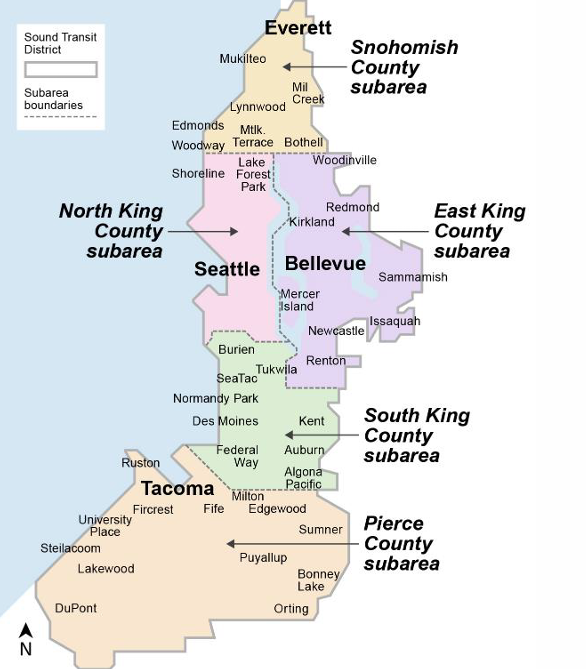
Somers, who chairs the Sound Transit Board and has been stewarding the scenarios through his Executive Committee, argued the agency faces no other immediate path forward with Ballard Link. But he did leave the door open to some solutions down the road, including running another ballot measure in the North King subarea, which includes Seattle, Shoreline, and Lake Forest Park. Some advocates have also pitched a ballot measure that would encompass all three King County subareas but exclude Pierce and Snohomish Counties.
Sound Transit is also working on cost-cutting measures, including station redesigns and more efficient track configurations, on top of potential financial solutions that could bring the agency more revenue. But transit advocates have been pushing the agency to get even more adept and consider potential changes like automated trains that could allow much smaller station footprints.

"None of those alternatives get all the way to Ballard. Most folks are not happy, but we're going to move forward with the entire plan," Somers said. "We're gonna say: here's what we can fund; here's what's affordable. Right now we can get to Seattle Center, but we're going to look in the future for ways to fund that. They could come up with local money. That subarea could have their own levy to finish the spine. There's options for state, federal investment or even private investment."
The Urbanist is a nonprofit newsroom powered by reader support. Become a member, get perks, and support local journalism.
Seattle leaders including Mayor Katie Wilson are likely to try and push for any interim terminus for Ballard Link to be shifted from Seattle Center to Smith Cove, reducing potential impacts to a busy cultural district and moving that terminus to a place that is more easily served by King County Metro buses.
Somers' comments suggest he's not currently interested in pursuing a regionwide ST4 ballot measure expanding upon ST3 in all subareas. But some Snohomish County and Pierce County riders may be interested in further rapid transit expansion, with many parts of their respective counties still poorly connected to rapid transit.
Keeping the Interbay and Ballard stations on the backburner would be a big concession to regional collaboration, with Sound Transit advancing the full Ballard Link line to 30% design while moving forward with the Snohomish and Pierce County expansions as soon as possible.
"So, we will keep those projects alive in the planning, but they will not be authorized for moving forward because we can't afford them right now," Somers said. "But it is important that we work together with the rest of the board members to say we're not writing you off. We're not pushing you off the edge of the table. We're going to find a way in the future, but not right now. Our priority is finishing the spine."
Sound Transit has projected significantly higher ridership for Ballard Link with between 132,000 and 173,000 daily riders compared to Everett Link's 27,100 expected daily riders. However, Ballard Link's budget has ballooned to more than $20 billion, while Everett Link's budget is a bit more manageable, hovering around $7 billion. A significant portion of the expected riders on Ballard Link would be using stations in Downtown Seattle, within a new rail tunnel being funded jointly by all of the Sound Transit subareas since it provides more capacity for the entire system.
Even at its inflated cost, the cost per rider is comparatively low for Ballard Link. Nonetheless, even King County Councilmember Claudia Balducci (who often flexes sophisticated transit planning chops) has acknowledged that cost per ride is very unlikely to be among the main metrics the board uses to make its decisions.
Everett Mayor Cassie Franklin echoed Somers' comments and was even more strident that her primary metric of success was getting Everett Link done, no matter the impacts to other segments in the system.
"We will know that the board got it right when we have light rail all the way to downtown Everett," Franklin said. "I will know that we have done it right if we complete the work to advance the Everett Link Extension and complete all stations – our Southwest Industrial station that is serving Boeing and aerospace and 35,000 people that work in that industry in that area and commute to work every day. When we are working in partnership with our beautiful Casino Road community and complete the station there in our Casino Road area to serve the families that are absolutely transit dependent in that area."
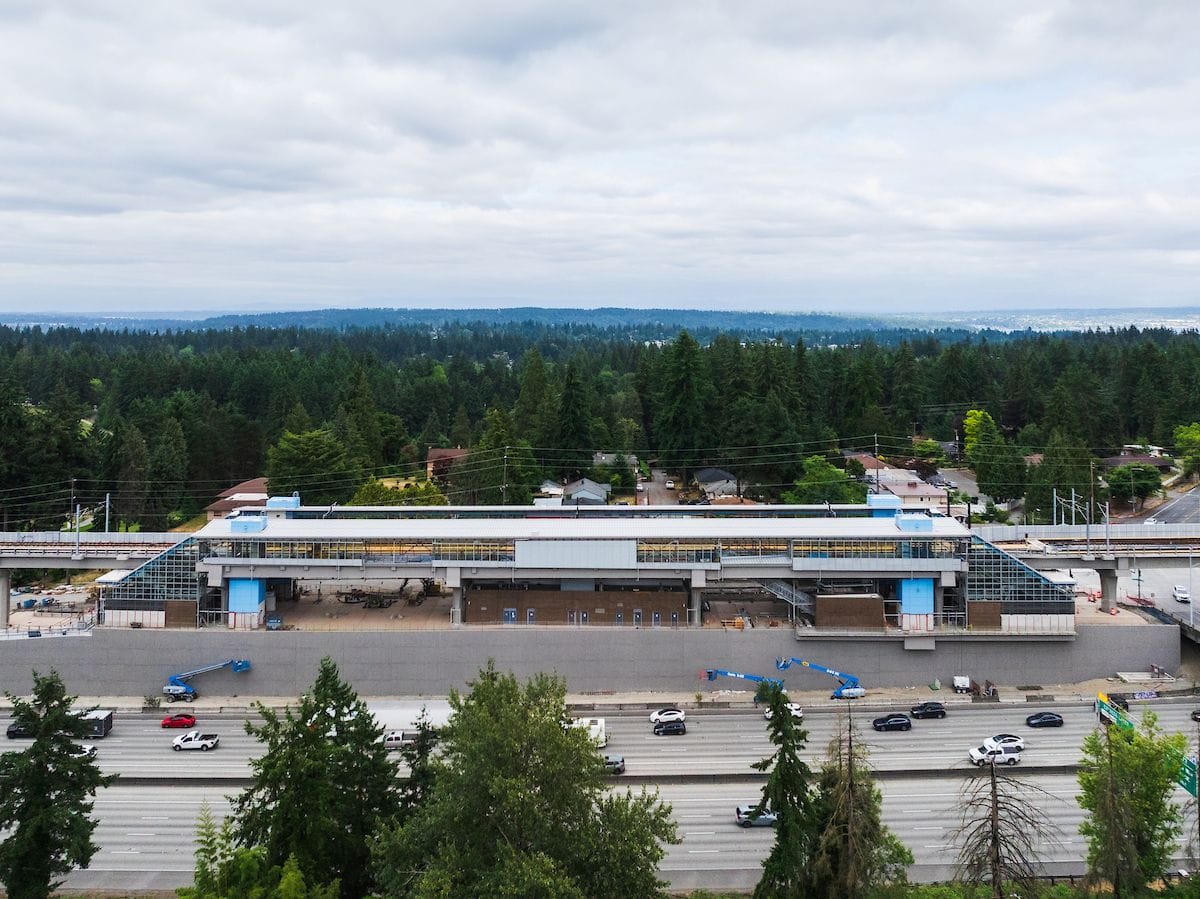
Rather than taking a direct route to downtown Everett, the extension takes a detour over to Paine Field, near Boeing's sprawling manufacturing campus. Franklin and Somers pushed hard for this alignment, arguing a stop near the fledgling regional airport and plane factory was worth a route that adding roughly nine minutes to trips over a route hewing to I-5 and perhaps a billion dollars or more to the budget. Longer-term booster dreams aside, the agency is projecting just 1,500 daily riders at the Southwest Everett Industrial Station.

"We're the county seat. Snohomish County is one of the fastest growing areas in the region, and we have one of the largest employers in the world in our backyard, right here in Everett," Franklin said. "There's 30,000 people that work where this light rail system is going to go to the Southwest Industrial Center and also Paine Field, and also our beautiful and growing South Everett Community and downtown, and every single one of those stations is vital for the system."
Even with the circuitous Paine Field alignment adding costs, Snohomish County still appears to be the subarea showing the least budgetary distress, in part because cost overruns on Everett Link have been more modest and the project is far enough in planning to identify significant cost-cutting measures. Ballard is still in an earlier phase of planning, with more preliminary designs, and unlike Ballard, Everett Link includes no tunnels and doesn't cross any major bodies of water.
The Urbanist is a nonprofit newsroom powered by reader support. Become a member, get perks, and support local journalism.
Sound Transit's board chair laid out the tough choices for Seattle, compared to the relatively straightforward path for Everett.
"If you go to West Seattle, as far as our numbers show right now, you can only get maybe as far as Seattle Center, headed to Ballard," Somers said. "If you don't go to West Seattle at all, you still can't get to Ballard. You can get, you know, a few more stations out. And that's affordable within the North King County subarea. So the plan that I will put forward, I've asked Sound Transit staff, it's got to be affordable, both at the system level and in the subareas. So we're looking to North King County to decide what they want to build. That's got to be affordable. We do the same thing in our subarea."
Somers hinted at his strategy for Snohomish County to get board votes in needs, saying they would align with the Pierce County delegation to put a pro-spine bloc together and peel off a few King County members to get a majority on the 18-member board of directors.
"So yes, the number one priority, as we've said, is finish the spine," Somers said. "As Mayor Franklin mentioned, we have three votes on a board of 18. Pierce County has five votes. So you have Pierce County and Snohomish County. And our interests are very similar. They want to get to Tacoma. We want to get to Everett. That's eight votes out of 18. So there's 10 votes that are outside our control. It is important, as we move forward, that we recognize we're all in this together. The ST3 package that was passed by the voters 10 years ago now is an excellent vision for the region. Every part of it has value."
Notwithstanding Somers' vote count, Pierce County actually has four members on the board – he may have still been counting Auburn Mayor Nancy Backus who lost her board seat in January, when King County Executive Girmay Zahilay opted against reappointing her. While mostly in King County, a small portion of Auburn sits in Pierce County. The 18th member is Washington state's top transportation official: WSDOT Secretary Julie Meredith.
The earlier ST3 projects out of the gates to start construction will take advantage of what little spare cash flow and debt capacity that Sound Transit is expected to have remaining by the mid-2030s. It's a challenging timeframe when Sound Transit will still be paying off loans for ST2 projects and early ST3 projects (such as the Stride bus rapid transit lines) as it is launching a handful of the biggest ticket ST3 projects. Earlier this year, the state legislature declined to get out of the way to authorize longer-term bonds, as the feds recently greenlit. Additional bonding authority would have lessened the cash flow pinch in the 2030s.
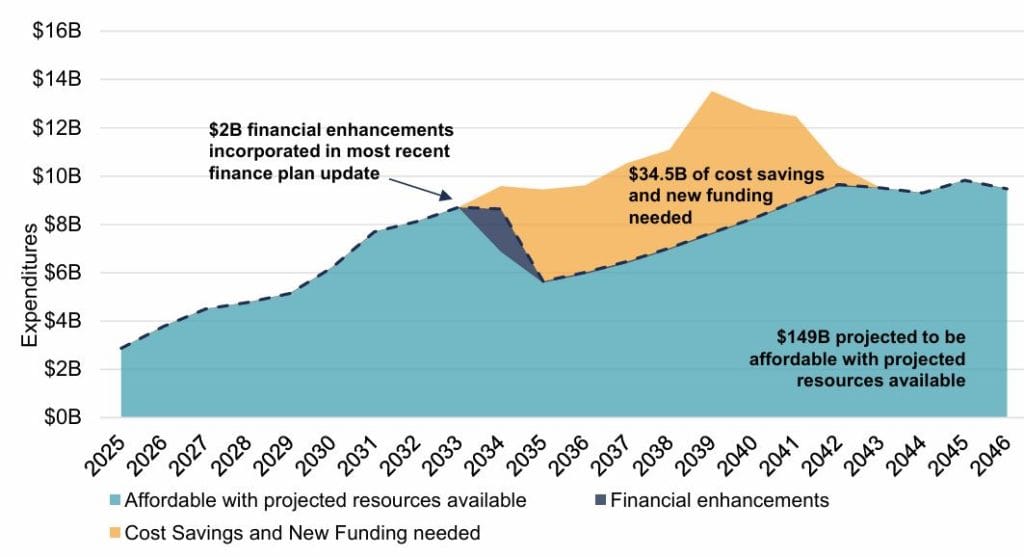
Outside of winning new revenue sources, the only path forward to keep all the ST3 projects on schedule is to shave off many billions in cost.
After the panel, The Urbanist asked Somers if the agency would explore converting Ballard and West Seattle Link to an automated light rail line with shorter trains and stations to save money, as proposed in an Urbanist op-ed by former Seattle Department of Transportation director Scott Kubly and consultant Trevor Reed. Somers granted automated trains are the future, but he said it would not be a factor in the realignment votes this summer.
"I think in the future, that's in our future. Yeah, it's a pretty big change, and it would require significant negotiations. And automation, you know, you need a whole system that we don't have in place now, and it's not funded," Somers told The Urbanist. "So, I know the agency had requested we maybe look at that, and I know there's some people looking at what, what such a system would look like and what it would cost. That's not going to happen between now and June."
It is possible the breadth of the proposal from Kubly and Reed, which would require redesigning West Seattle and Ballard Link stations to be much slimmer to take advantage of the automated light metro system, had not sunk in for Somers and many of his colleagues on the board. Smaller trains at higher frequencies could carry the same or greater capacity despite much shorter stations. Simply automating trains in the same-sized stations would not save nearly as much money, since digging the large stations is where much of the expense comes in.
Nonetheless, the openness to considering an automated light rail line could be the opening that advocates need to land their Hail Mary option to keep Ballard on schedule.
"We're not going to be building the whole system right away," Somers said. "And you could make alterations as you go forward."
While Seattle is in alterations mode, Snohomish County is full speed ahead on finishing the spine, with the clearest path of any subarea to get it done.
 Scott Kubly
 Doug Trumm