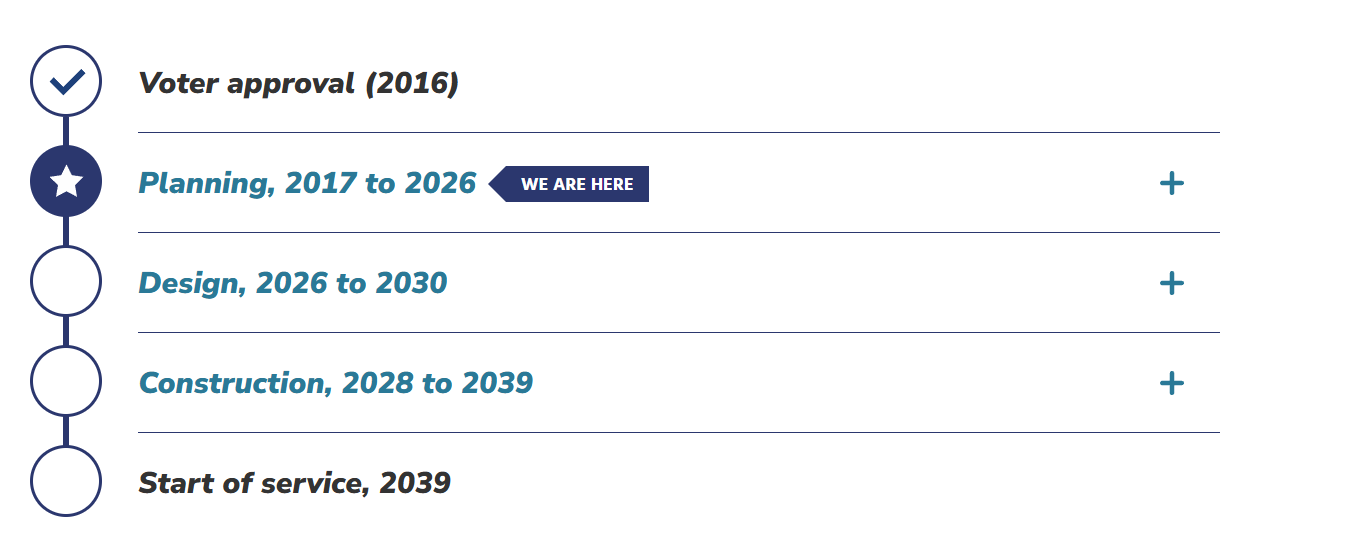
Sound Transit's $34.5 billion shortfall is placing light rail to Ballard and long promised stations like Graham Street on the chopping block, while phasing funded projects long into the future. Worse, these suffocating costs prevent addressing longstanding issues with the system that harm system reliability, efficiency, and equity goals – like separating at grade running in the Rainier Valley.
It doesn't have to be this way.
Sound Transit could save at least $15 billion by adopting international best practices and building automated light rail from Ballard to West Seattle. This reform would allow rail to get to Ballard by 2039, rather than decades later. This isn’t a fantasy technology and it’s not a shift that undoes a decade of planning work. This proposal is concerned solely with rail car design, signaling systems, and the savings achieved by reducing construction cost through more efficient operations.
The Sound Transit Board needs to direct CEO Dow Constantine to issue a Request for Information to railcar makers and systems integrators to gather the best ideas in the world to help deliver ALL lines promised in the Sound Transit 3 (ST3) ballot measure without delay. This recommendation is the product of dozens of interviews with former transit CEOs, project delivery experts, and engineering and design experts locally, nationally, and internationally. Several former U.S. Department of Transportation officials also provided input.
These findings are established in detail in our full report, which we shared with Constantine and Sound Transit staff over two weeks ago. We have heard no reply since.
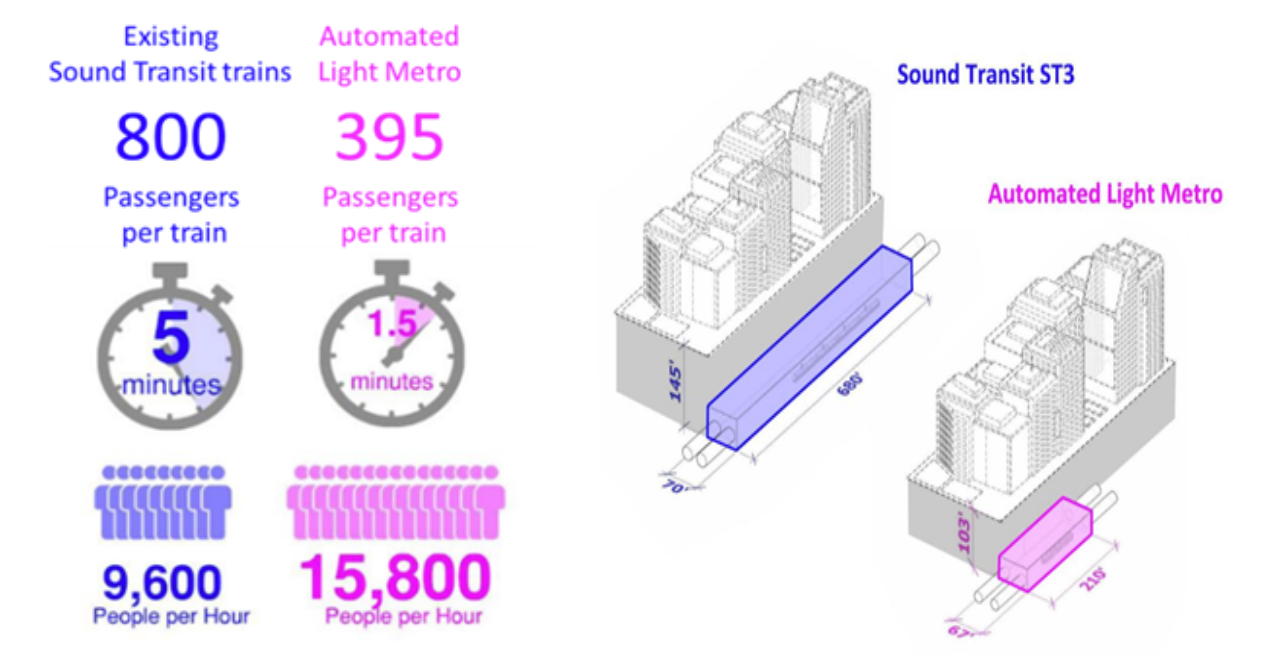
What we propose is shorter, much more frequent, automated trains, modeled on Copenhagen and dozens of cities around the world. Copenhagen’s newest line achieved 3.3 times the number of trains in one third of the space with 65% more capacity at one quarter of the cost compared to Sound Transit’s current plan. Automated operations are a mature technology – starting with Lille, France in 1980 and replicated in cities globally since including Vancouver, Montreal, Paris, and Rome.
We must stand up to those blocking smarter solutions.
Right now, some decision makers on the board and in agency leadership are choosing business-as-usual over proven alternatives being used by transit agencies with far more experience building rail. But they could take a different path: innovate in parallel, examining the opportunities to explore this better way alongside ongoing work. Instead, they're making empty promises about "future phases" and "someday service" rather than demanding the solutions our region deserves. Those who won't allow us to spend wisely and build smarter are the real barrier to getting to Ballard.
The solution is concrete and actionable: Sound Transit should issue a Request for Information to identify internationally proven approaches that deliver grade-separated transit within planned station envelopes while meeting capacity targets. Examine technical design, regulatory changes, federal funding implications, and infrastructure integration. And complete this work within six months to adjust without losing time on delivering the mass transit we want and need.
Show the Sound Transit Board that you won't accept the status quo. We need to build Ballard now. Support the Build Ballard Now proposal today at transportationreform.org where you will also find a full report laying out the case for automated light rail.

This proposal is the outcome of a return to first principles: “if there were no prior assumptions on Ballard and West Seattle extensions, what would we build?”
Before evaluating any alternative, we established five criteria that the proposal must meet or exceed:
- No delay in project delivery – this must not “reopen planning” of station and alignment decisions
- Better rider experience – more frequent and just as comfortable
- Equal or greater capacity – at least 9,600 passengers per hour
- Less disruptive – construction should be faster and disrupted fewer blocks and intersections
- Lower cost – a clear path to reduce project cost by 50% to match currently available funding
We looked at Copenhagen for inspiration for Sound Transit and the Puget Sound region to follow. Copenhagen has a transportation system that is emulated globally due to the quality of service it provides relative to cost. Its central city is a reasonable peer for Seattle: it is dense, old, and surrounded by water. Lastly, it has a comparable cost of living and is a democratic society with high transparency, public engagement, social, and environmental protections.
Their success is not through top-down authority at the expense of democratic norms or individual liberties. Most importantly, it has recent experience building world class transit.
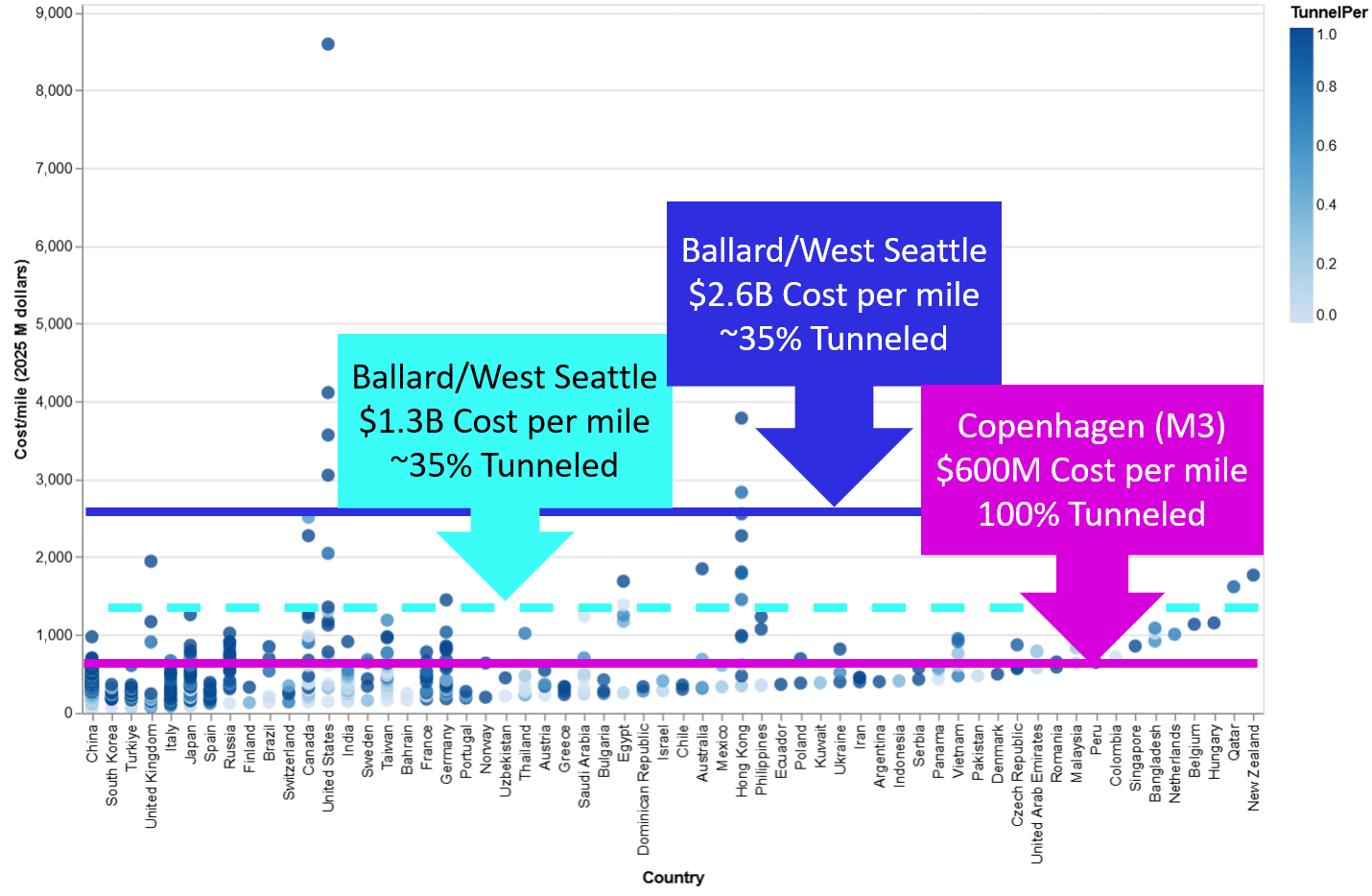
Sound Transit’s current cost estimate of $2.3 billion to $2.6 billion per mile for Ballard and West Seattle is surpassed globally only by much more complex projects in New York and Hong Kong. And, it is not more expensive by a small amount! Copenhagen built its most recent rail extension in 2019 for 75% less cost per mile than Sound Transit’s proposed West Seattle and Ballard project despite being 100% underground versus 35% and featuring 1.7 stations per mile vs. Seattle's 1.2.
How does Copenhagen do it?
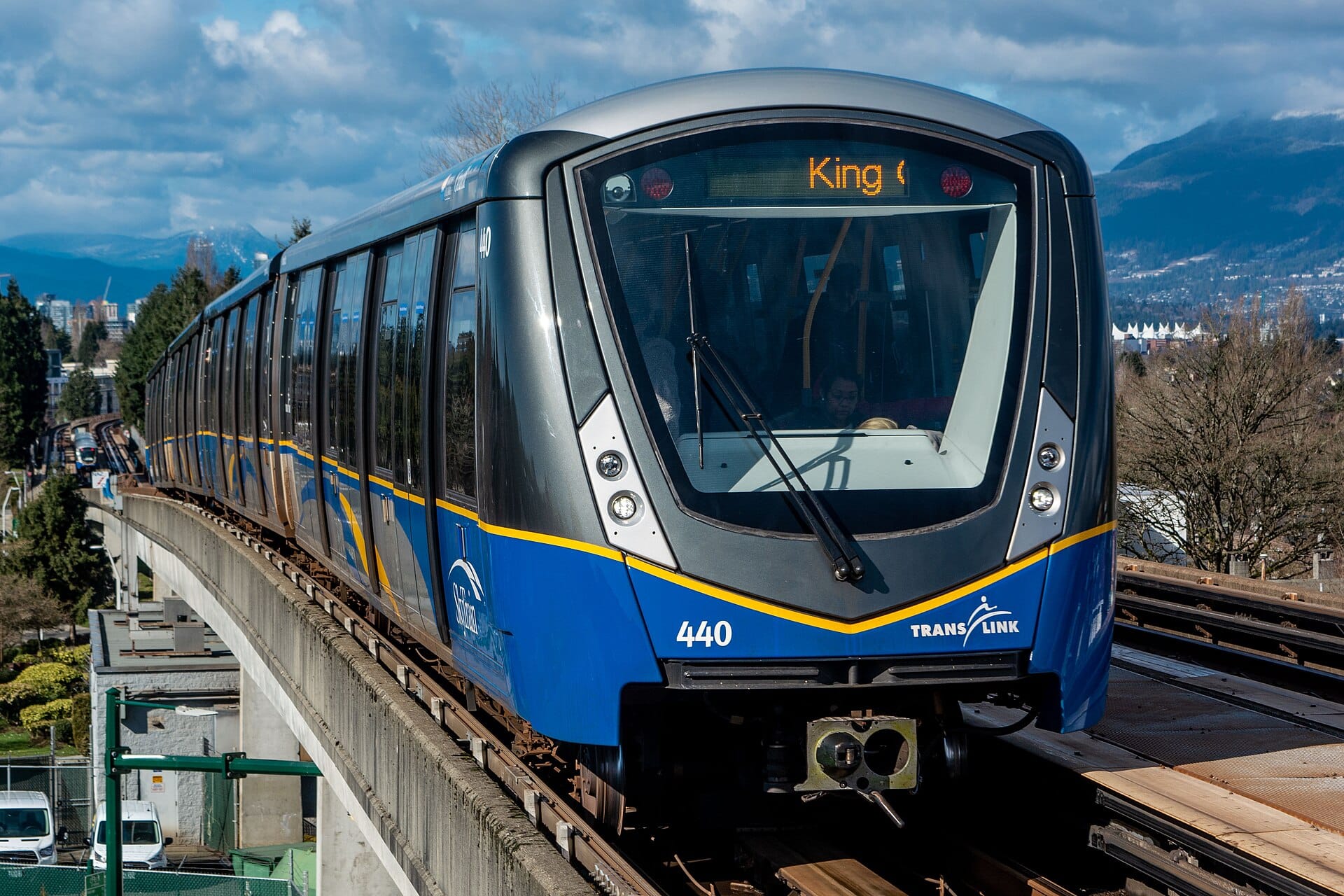
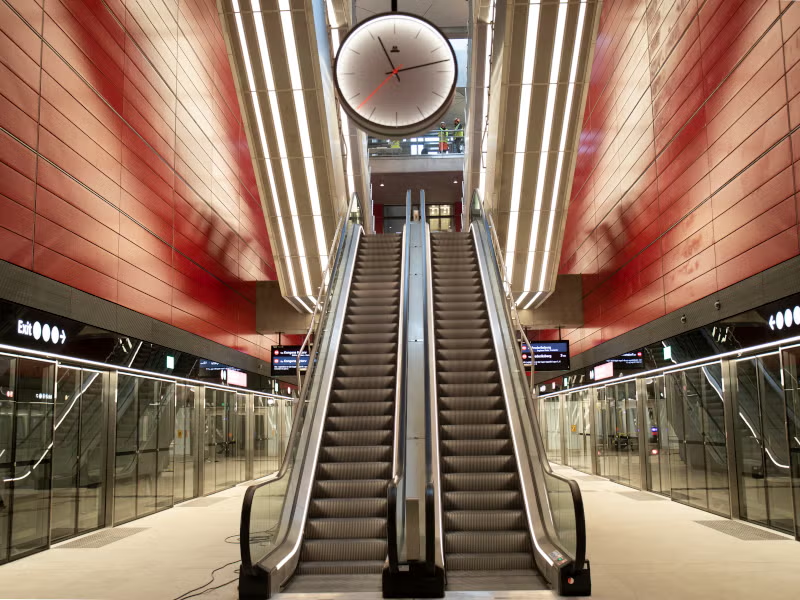
Copenhagen revolutionized global transport via the development of automated light metros or automated light rail (ALR), delivering the first of its four lines in 2002. The system has since expanded, with their most recent lines, the Copenhagen Metro Circle Line (M3) and Line 4 (M4), opened in 2019 and 2020, respectively. ALR’s low cost and high quality is now the global standard for new metro projects globally.
Copenhagen’s insight was deceptively simple. Automating trains allows for more frequent service, without raising operating costs. More frequent service means that shorter trains can deliver the same capacity as longer, less frequent trains. Shorter trains meant they could build shorter stations with less disruption at the service. Identical, modular stations reduced the amount of time and money spent on engineering and design. Stations are simple and functional with standardized approaches to placemaking, like colored panel inserts. The result is a system with significantly more capacity than Sound Transit proposes delivered at a fraction of the cost.
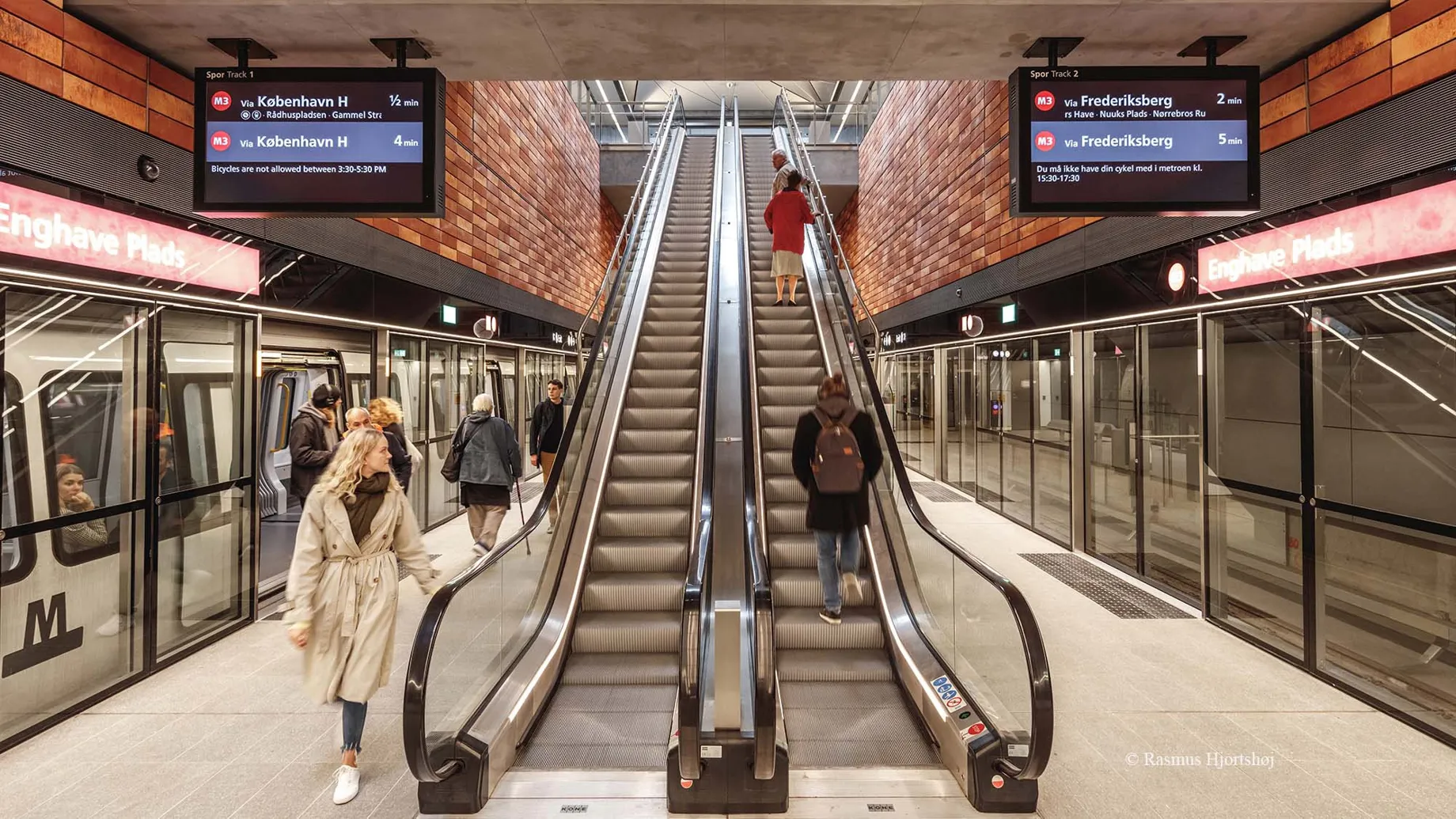
Copenhagen’s approach to operating strategy (small trains at very high frequencies) was developed in direct response to a need to reduce capital cost. Transportation has high startup costs but comparatively low operating costs. It functions like a utility - the expensive part is building the capacity, not providing the service.
The standard Copenhagen-style station is 210 feet long and 65 feet wide, compared to Sound Transit’s 680 feet by 70 feet. Smaller, easier to place stations, also enables shallower depths since construction can more easily avoid obstacles. Consequently, the standard underground Copenhagen station requires 90% less excavation compared to the proposed ST3 stations.
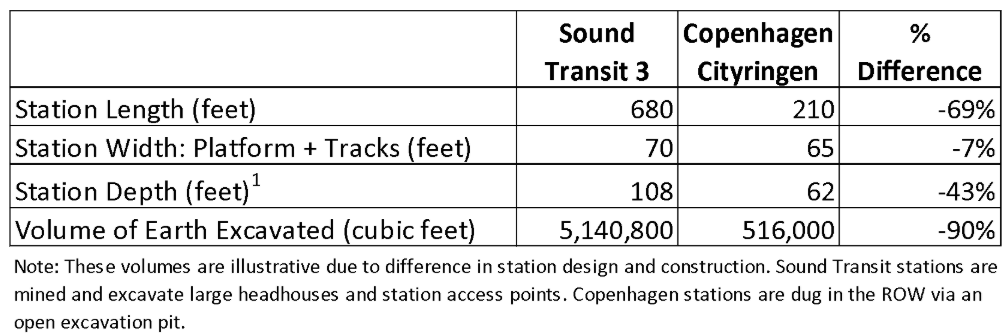
Reducing the scale and scope of construction enables work to be completed faster, at lower cost, and with dramatically lower impacts. For example, the standard city block in Seattle is between 300 and 400 feet, far shorter than the average ST3 station, but comfortably larger than a new Copenhagen Cityringen station. Since a station can fit within a city block, this means intersections can often go unimpeded and property seizures reduced.
Copenhagen’s magic can be summarized as:
higher frequency → shorter trains → smaller stations → standardization → less design complexity → less impacts = faster, cheaper, and a better rider experience.
Copenhagen's core insight is that maximizing the rider experience and delivering at the lowest cost are the same strategy – automation and standardization.
Overcoming opposition
There are three erroneous reasons why Sound Transit is not already pursuing automated light rail: funding, delay, and operations.
Old Political Assumptions: Regional funding is necessary to complete the second downtown tunnel.
The premise behind conventional light rail being the only choice for Ballard and West Seattle rests on a political financing choice, not technical necessity.
Sound Transit and regional leaders concluded the region needed a second tunnel through downtown to handle service to Ballard and West Seattle. But the “North King” subarea did not have sufficient funds to pay for the extensions and the tunnel.
Sound Transit’s subarea equity rules constrain how locally generated funds can be spent, allowing cross-sub area spending only when a project serves a defined regional purpose. By routing northbound trains from Tacoma to Ballard through the new tunnel, Sound Transit concluded that the Ballard and West Seattle project - now split in two - was regional, unlocking a 51% North King / 49% regional funding split.
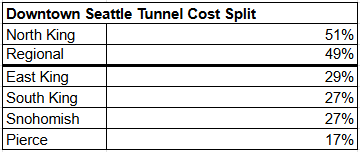
An automated light rail, by cutting project costs by more than half, eliminates the need for a regional cost share.
Fear of Delay: Switching technologies would reopen prior planning decisions
Delay is a four-letter word for every transit supporter, especially with West Seattle gaining momentum with its federal Record of Decision. That is why we propose pursuing a Request for Information for an operational change that does not deviate from existing routing and station box plans. By constraining the analysis to the footprint of what is already studied, the potential impacts are already captured since building smaller only reduces potential impacts.
Therefore, prior decisions would not be reopened and early works can continue since the same work will need to be completed whether an automated light rail is adopted or not. Furthermore, any early spending on property acquisition and utility relocation will benefit an ALR.
The Urbanist is a nonprofit newsroom powered by reader support. Become a member, get perks, and support local journalism.
We posed the following question to Beth Osborne, former Assistant Secretary for Transportation Policy at USDOT about the impact of changing technologies on National Environmental Protection Act (NEPA) review and the respective Environmental Impact Statement or EIS (response edited for brevity and clarity):
If a transit agency has a Record of Decision and they decide to shrink the station size but stay within the original footprint of the station they analyzed. What level of NEPA review would be triggered, if any?
Beth Osborne replied:
“Shrinking the station size should have no impact on the NEPA review. But the Federal Transit Administration applies NEPA overly-strictly and way more strictly than the Federal Highway Administration. Also transit agencies tend to freak out when their counsel says they could be sued. You can always be sued. The question is whether you can withstand the suit. And if you can show that the change would have no impact on the analysis then you should be fine. Sometimes that might require a quick refresh of the analysis to demonstrate and document, but that is not the same thing as reopening the EIS.
This also applies to the level of review. The number of times I see transit agencies do an EIS that should be an EA (Environmental Assessment) or an EA that should be a CE (Categorical Exclusion) is mind-blowing. They think it will protect them from a lawsuit. It will not.”
-Beth Osbourne, CEO of SmartGrowth America, former Assistant Secretary for Transportation Policy, USDOT
Flawed Operating Assumption: delivering Ballard and West Seattle jointly would negatively impact the regional spine.
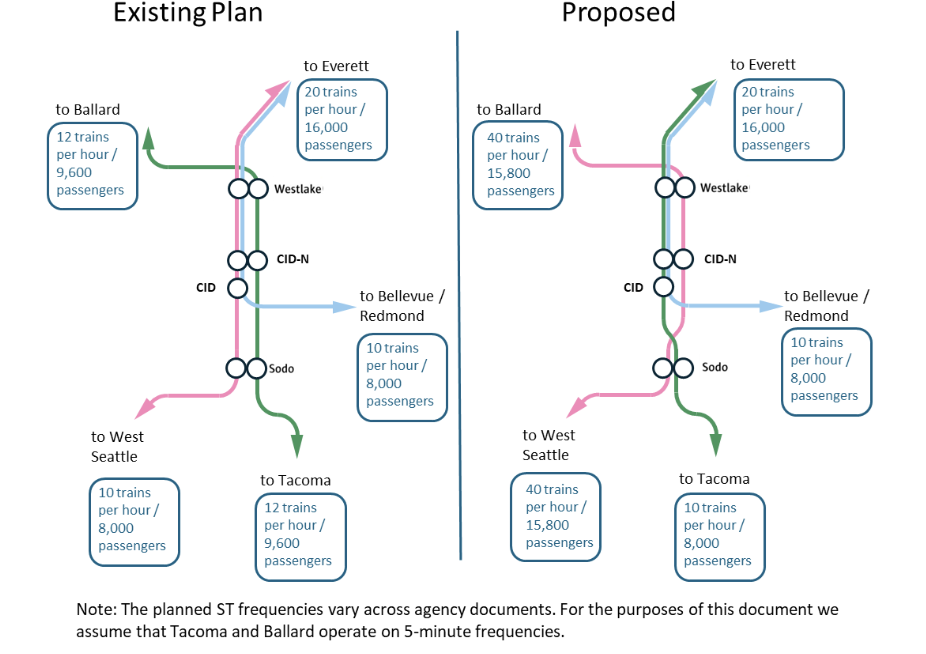
Service on the regional spine would improve by restoring the original operation pattern that the spine was designed to serve. The “spine” is the agency’s term for the planned 62-mile corridor from Tacoma to Everett, which some board members have identified as the agency’s highest goal. It is operationally infeasible to operate a single service the entire length. Therefore, operations must be split. The current plan executes this split by having trains terminate in Ballard, West Seattle, and Redmond.
However, prior to the inclusion of Ballard and West Seattle in ST3, Sound Transit published a conceptual operating plan in 2012 for a completed spine that turned northbound trains from Tacoma at Northgate and Lynnwood, and southbound trains from Everett at SeaTac. Pocket tracks, the feature needed to perform these maneuvers, exist at Northgate, SoDo and SeaTac. While they were value engineered out from Lynnwood, adding a pocket track is already an identified need for resilience and marginal in cost compared to savings enabled by an ALR.
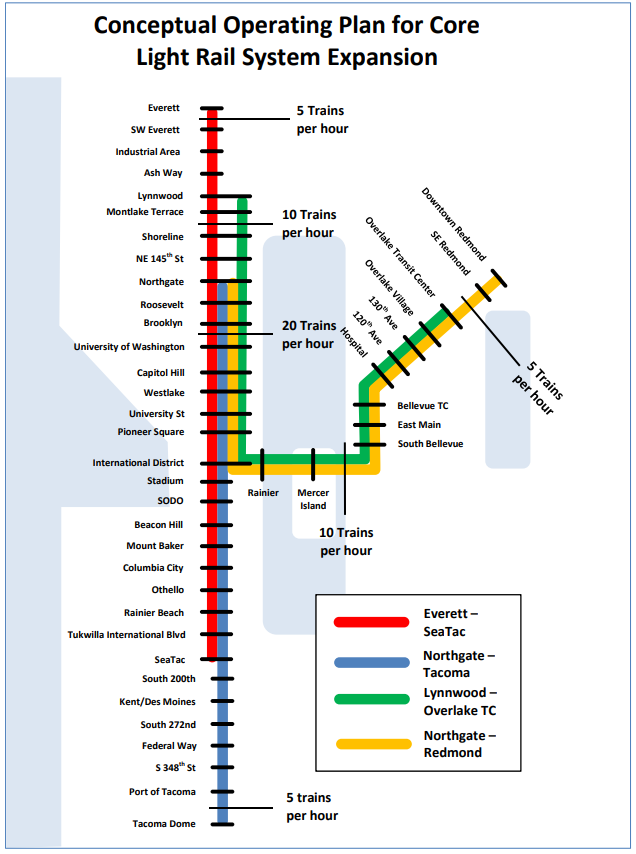
We propose a return to the operating plan that the light rail network was designed to serve. Critically, service in the core would increase since these service hours would shift from serving Ballard/West Seattle to remaining within the spine.
Since total service hours on light rail would remain unchanged under both proposals, that means all service between Ballard and West Seattle (40 trains per hour) would constitute an absolute increase over the current plan. Furthermore, with connection to the spine at SoDo, Pioneer Square, and Westlake, an ALR for Ballard/West Seattle would provide service redundancy to the often disrupted downtown tunnel with higher frequency and greater capacity operations. This redundancy will provide resilience and operational flexibility as Sound Transit addresses the downtown tunnel’s long list of needs.
Service on an ALR would represent an 25% absolute increase in capacity over the current plan, providing critical redundancy for the spine between SoDo and Westlake, while dramatically improving service both on the spine and between Ballard/West Seattle, as shown in the chart below.
Capacity and future needs
Costs of $2.3-2.6 billion per mile means the funds will not come free to build new lines or upgrade existing service for decades. Reducing delivery costs means more transit everywhere.
Critically, grade separating collision-prone at-grade segments in the Rainier Valley could be funded with savings from releasing the sub-areas from their contribution for the second tunnel. That means safety locally and reliability, speed, and frequency improvements regionwide. Currently, six minutes is the shortest headway possible in the Rainier Valley with trains running at low speeds and subject to disruption. Imagine four-minute frequencies, faster speeds, reliable operations, and no more carnage - that is true investment in regional connectivity and reliability on the regional spine. Additionally, Sound Transit can finally fulfill the promises it made in 1996 for stations at Graham Street and Boeing Access Road.
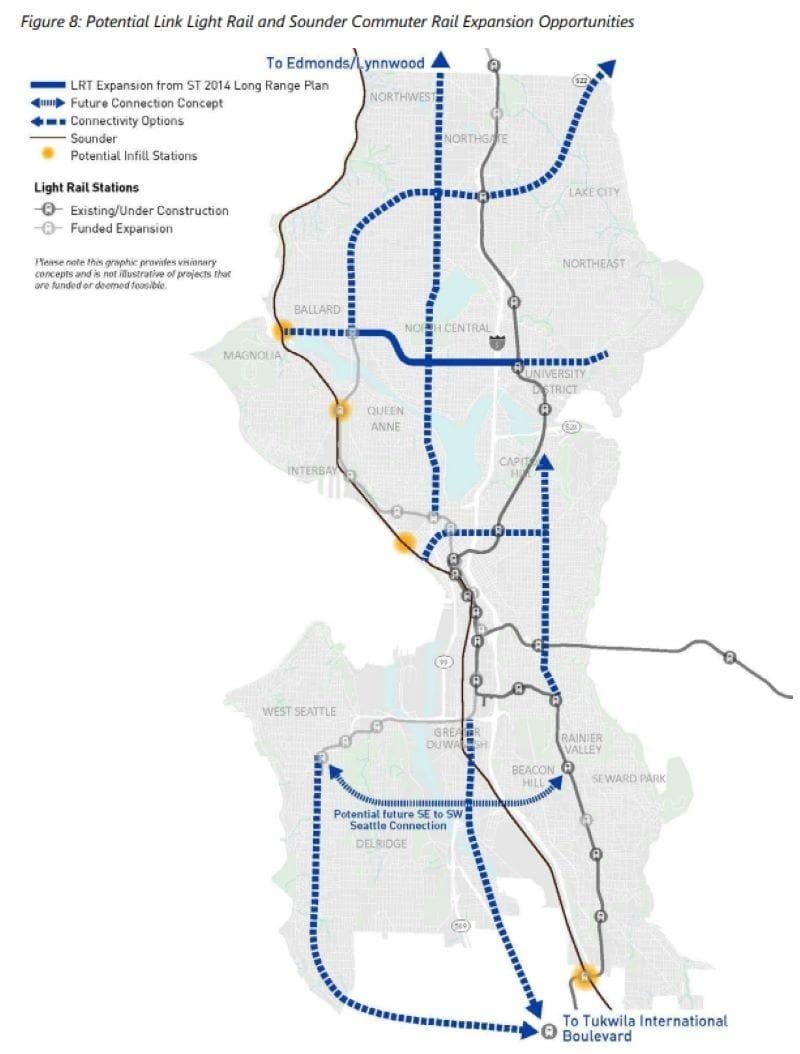
The vision maps we draw, like Seattle's Long-Range Rail Map below, will remain fantasy so long as we cannot deliver timely or cost effectively. This is our opportunity to set the launchpad for more transit by taking a page from world leaders and choosing to deliver better transit.
Adopting an automated light rail operating concept that follows in Copenhagen’s footsteps meets the five criteria we established at the outset of this inquiry.
- No Delay: Switching to ALR will not slow down Everett or Tacoma extensions and property acquisition and early utility work in West Seattle should proceed as planned.
- Better Rider Experience: Automated trains arrive every 90 seconds versus every 5 minutes for conventional light rail.
- Equal or Greater Capacity: 65% more capacity than current Sound Transit proposal
- Less Disruptive: ALR station construction limited to 1 block / 0 intersections per station versus 2 to 3 blocks / 1 to 2 intersections per station under the agency’s existing plan.
- Lower Cost: Construction costs are an estimated 77% lower than Sound Transit’s existing light rail plans, while being faster to build. Lowering costs creates opportunity to deliver more transit and improve current services.
Our region is at an inflection point. We have the opportunity to deliver better than promised to voters for Ballard and West Seattle, keep our commitments regionally, all while unlocking billions upgrading the system we depend on every day. Today, we face the real risk of never moving beyond the ST3 package. This is an unacceptable outcome. This moment of crisis must become a rallying point for deciding we will do better. By copying what works in dozens of cities globally, we can drive the delivery timelines and costs, making the visions we hold for universal high quality transit possible.
Please join us in striving to do better by asking Sound Transit to at least question whether a better project is possible.
This course of action carries no risk of delay, while potentially saving the ST3 program.
Click here to sign our petition and see our full report for more.
 Doug Trumm