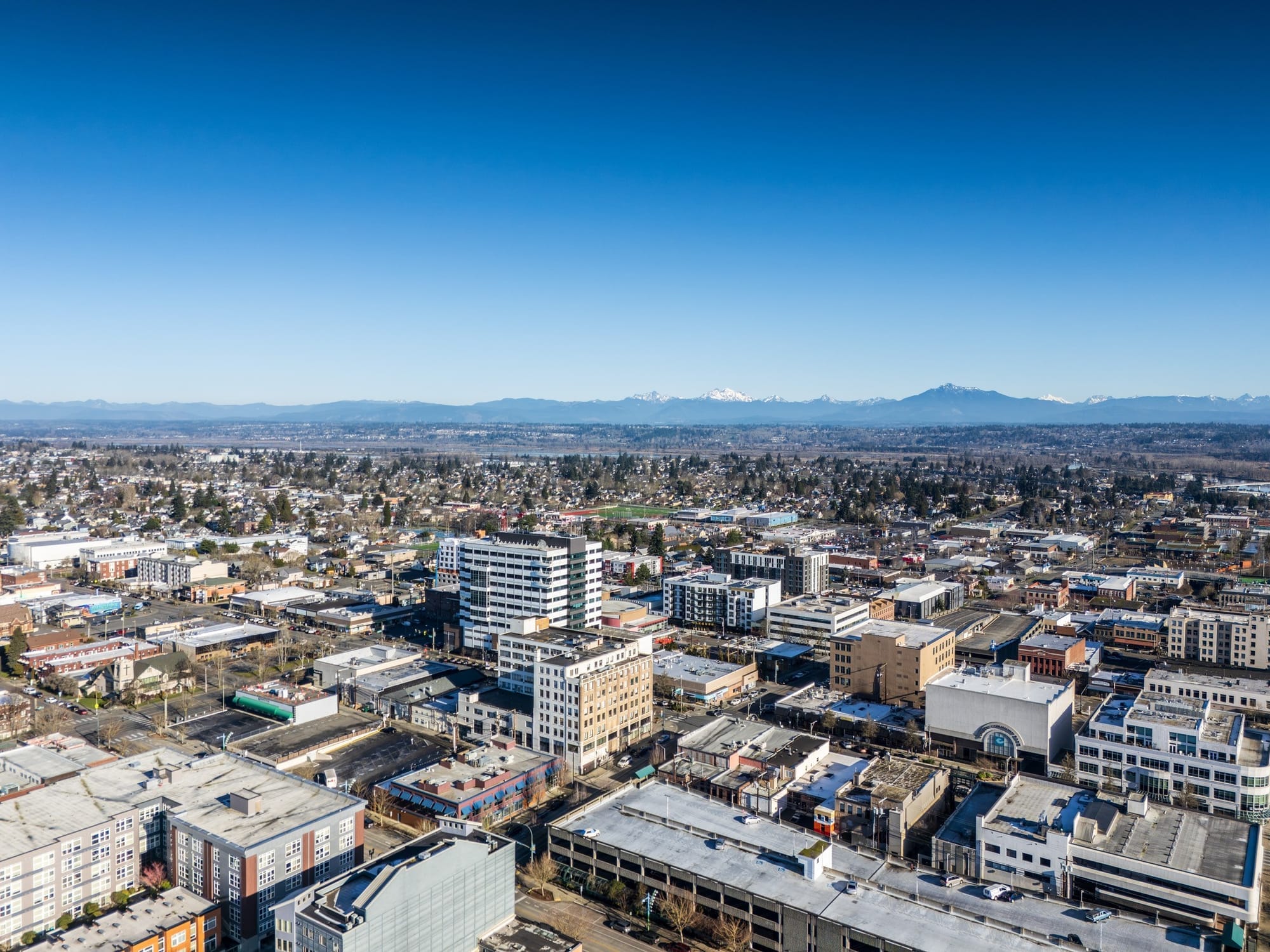
Two 2026 charter amendments are at the heart of a Republican megadonor’s plan to take over Snohomish County.
This autumn, at the same time that Washington voters will be deciding the fate of three destructive statewide initiatives from wealthy hedge fund mogul Brian Heywood, Snohomish County voters will face a slate of proposed changes to the county’s plan of government. The measures were submitted by a Republican-controlled, Heywood-aligned charter review commission.
They’re the centerpiece of a multiyear Republican plan to take over the government of Snohomish County, Washington’s third-largest jurisdiction… a plan that Democrats, progressives, and urbanists have yet to prioritize countering. This is Heywood’s other ballot play this year, and it’s one many people haven’t heard about.
There are five propositions in all. Two of the five have been explicitly engineered to help Republicans win elections and control the county’s fiscal trajectory, regardless of whether they ever win a council majority:
- Proposition 3 would make all elected county offices “nonpartisan,” including county executive and county council. Candidates would be precluded from declaring a party preference when filing for office or appearing on the ballot. That would make it more difficult for voters to distinguish Democrats from Republicans, because all they would see would be candidates’ names.
- Proposition 5 would require four of the five councilmembers to approve any councilmanic tax or an increase in its rate, creating an 80% threshold. Two councilmembers could block any covered tax increase they opposed. Republicans have long held two of the five council seats and, under Proposition 5, would enjoy an indefinite veto over these fiscal decisions.
Should these propositions pass, Republicans will be well positioned to execute the final stage of their takeover plan in 2027 and begin gaining control of Snohomish County’s government.
While 37 of Washington’s 39 counties elect their county leadership in even-numbered years, Snohomish and Whatcom schedule most of those same elections in odd-numbered years.
King County used to do likewise, but in 2022, voters approved a charter amendment developed by my team at the Northwest Progressive Institute and sponsored by Councilmember Claudia Balducci that began moving King County elections to even-numbered years.
Republican see chance to break long run of Democratic county leadership
Five men have served as Snohomish County executive since voters adopted the county’s first charter: Willis Tucker (1980–1992), Bob Drewel (1992–2004), Aaron Reardon (2004–2013), John Lovick (2013–2016), and Dave Somers (2016–present).
Every one of them has won election as a Democrat. In nearly half a century of charter government, Republicans have never elected one of their candidates to the county’s top job.
Somers cannot run again in 2027 because he is nearing the end of his third consecutive term and the executive is limited to three terms. Consequently, Snohomish County will have its first open race for executive since 2003, and multiple Democrats are known to be interested.
Republicans see a once-in-a-generation opportunity to exploit Democratic divisions and elect a Republican executive. With the Republican brand badly damaged by Donald Trump’s regime and its base’s embrace of White Christian nationalism, Republicans reckon they will have a better chance of gaining power in Snohomish County if candidates are barred from placing a party label beside their names on the ballot.
Hence, Proposition 3.
Republicans have already recently proven they can win a major county contest when there are no party labels next to the candidates’ names. In 2019, extreme right-wing candidate Adam Fortney defeated incumbent Sheriff Ty Trenary with 55.4% of the vote. Although Fortney’s tenure was disastrous, reformer Susanna Johnson only narrowly defeated him in 2023, 51.5% to 48.4%.
Neighboring King County is a deep blue bastion, but Snohomish is more purple. It usually votes Democratic, but its electorate is very different from King County’s. For example, King County leaders can send the voters they represent a levy in almost any election and be confident it has excellent odds of passing. Snohomish County leaders cannot do that. Sales and property tax increases are a tough sell in Snohomish.
The Republican Party already has a prospective candidate for executive with a countywide profile: Nate Nehring.
Along with Sam Low, Nehring is one of two incumbent Republican county councilmembers. Nehring is sitting on an eye-popping $359,673 in surplus campaign cash, according to Public Disclosure Commission data, and is well positioned to raise more because he has served as the Snohomish County director of Brian Heywood’s Future 42.
Nehring’s surplus cash cannot automatically move into an executive campaign. When a candidate switches to running for a different position, state law requires written permission from the original contributors, and approved transfers count toward each contributor’s limit in the new race. Nevertheless, the surplus war chest and the donor network behind Nehring are formidable assets.
Project 42, Washington’s own Project 2025 style conservative playbook
Future 42 is the connective tissue of this entire operation. It is a project of Project 42, a 501(c)(4) nonprofit that identifies Heywood as a co-founder. IRS records list Heywood as vice chair and secretary. A Project 42 event page says contributions are unlimited and donors are not disclosed.
The Cascadia Daily News reported that Project 42 seeks “durable conservative infrastructure” and chose Snohomish County because it considers the county politically competitive.
Future 42’s County Council scorecard targets general and road-fund property-tax increases, a housing and behavioral-health capital plan, critical-areas regulations, and other local issues.
Future 42 and League of Our Own Washington, another Heywood-backed group, say they recruited or trained more than 90 local candidates in 2025. Afterward, Future 42 claimed more than 60 victories, including an 11-of-15 “supermajority” on the Snohomish County Charter Review Commission.
With that supermajority, Republicans were able to send five charter amendments to voters. The two at the heart of the takeover plan draw from a familiar Washington Republican playbook: in 2008, future state senator and Bellevue Chamber CEO Joe Fain sponsored a successful county initiative to strip party labels from King County ballots, while in the 1990s and 2000s, Linda Smith and Tim Eyman hawked unconstitutional statewide measures designed to make state taxes harder to raise, which were followed by a number of copycat measures at the county and city levels.
What Republican Snohomish County leadership would mean
If Nehring wins countywide and Republicans later flip District 4 (or, alternatively, Districts 2 or 3, though those are much more Democratic), they could control both the executive and legislative branches of county government as of the beginning of 2028, assuming Nehring’s District 1 council seat was filled by another Republican.
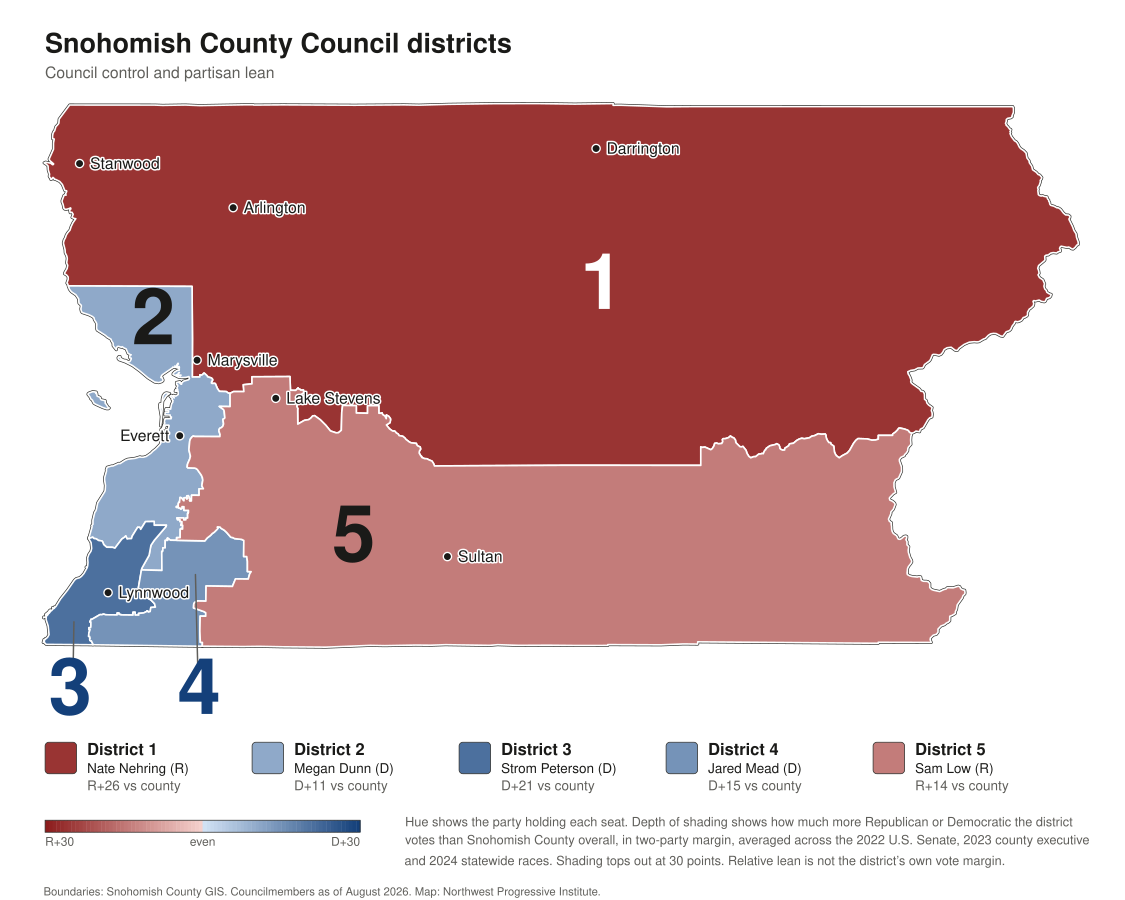
The consequences of this takeover would extend far beyond the county courthouse.
The county executive occupies one of Snohomish County’s three seats on the 18-member Sound Transit Board and chooses the other two representatives. State law makes those appointments subject to County Council confirmation and gives boardmembers staggered four-year terms. Winning the executive’s office therefore provides one board vote immediately and the power to shape the rest of the delegation as terms turn over.
Flipping the council would also give Republicans the majority needed to confirm those choices.
Readers of The Urbanist know how important the decisions made by the Sound Transit Board are.
The board chooses which alternatives receive environmental review, selects preferred alignments and station locations, adopts project budgets, establishes scope and schedule baselines, and approves major contracts.
Major decisions require a two-thirds vote, making a cohesive three-member county delegation capable of helping assemble — or deny — a regional supermajority. The board will exercise that power while attempting to close a $34.5 billion long-term funding gap.
The future of regionwide Sound Transit 3 (ST3) expansion, including Everett Link, will be affected by this year’s charter amendment votes and next year’s county elections. The board will decide what gets built north of Lynnwood, when it opens, where stations go, and how much of the voter-approved line survives the affordability crisis.
Community Transit (CT) will also be affected by the 2026 and 2027 elections. CT is an independent public transportation benefit area, not a county department, and its Board of Directors sets policy, approves the budget, and hires and supervises the agency’s chief executive. The county executive has no automatic seat and cannot dictate routes, fares, or service levels. But two of Community Transit’s nine voting board seats are held by Snohomish County councilmembers selected by the County Council.
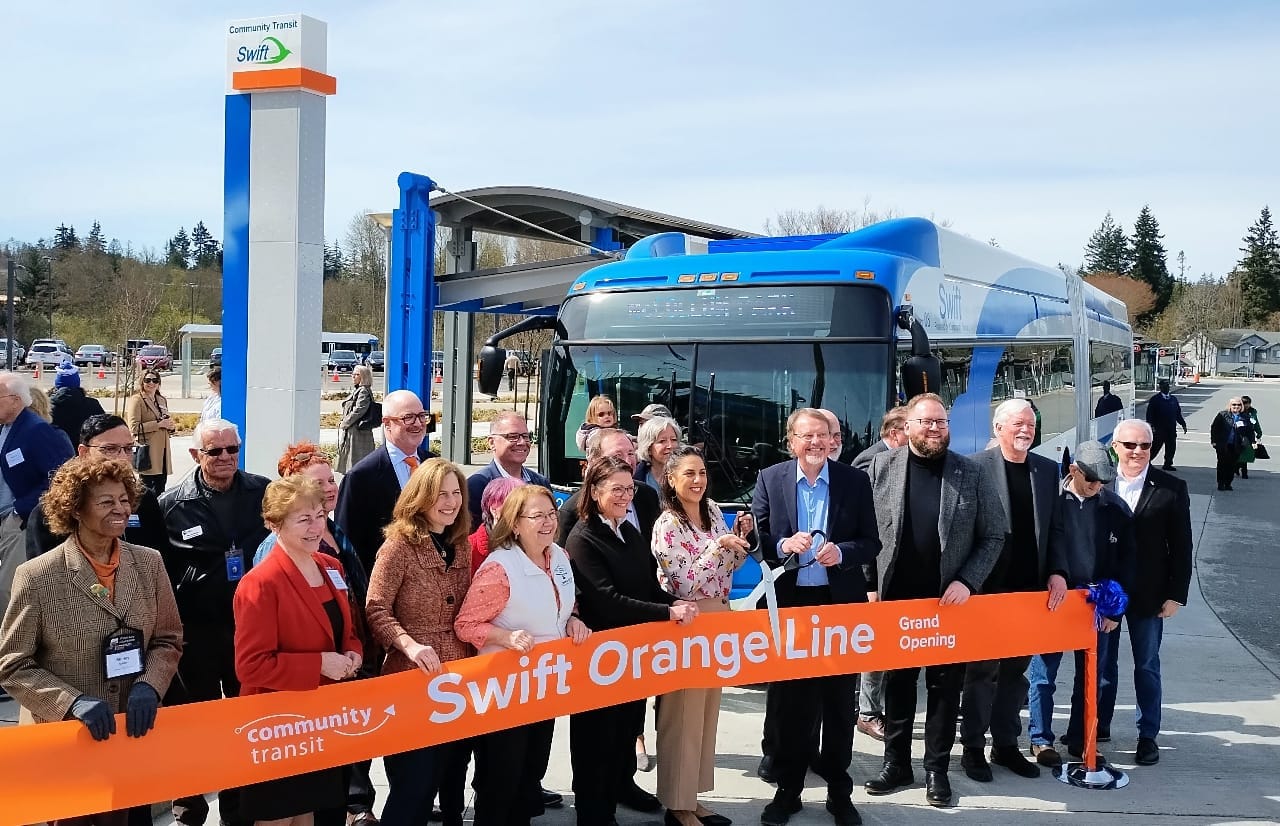
Those seats are currently held by Democrats Megan Dunn and Strom Peterson. Because state law says directors serve at the pleasure of the governing bodies that select them, a Republican council majority could replace Dunn and Peterson with two Republican councilmembers, gaining direct votes over Community Transit’s budget, service priorities, and capital program. The remaining seven voting directors are selected by cities, so the county seats alone would not provide control of the agency.
Even without controlling Community Transit, a Republican executive and council could shape the environment in which it operates. County decisions determine land use and road design throughout unincorporated Snohomish County, including transit-priority treatments, traffic signals, sidewalks and crossings that provide access to bus stops, and potential park-and-ride locations. Capital partnerships can also require interlocal agreements with county governments.
A Republican takeover would therefore give the party both two direct board votes and substantial leverage over whether county infrastructure helps or hinders fast, reliable, and accessible bus service.
Republican control would also put both sides of local land-use governance (making the rules and carrying them out) in the same party’s hands. The council adopts the comprehensive plan, zoning and development regulations, and operating and capital budgets. The executive supervises the departments that draft and administer those plans, process permits, maintain county roads, and deliver housing and human services.
Those powers will shape how Snohomish County accommodates extraordinary growth.
The county’s 2044 planning framework is built around countywide targets of 1,136,309 residents and 467,634 jobs. Local decisions will help determine whether that growth produces abundant homes in walkable, transit-rich communities or more displacement, sprawl, and car dependence.
The stakes are most concrete in the unincorporated urban core between Everett, Mill Creek, Lynnwood, and Mukilteo. The county is considering a Light Rail Community zone for 983 acres around the future Ash Way, Mariner, and provisional SR 99/Airport Road stations. The current proposal would establish a minimum density of 50 homes per acre, remove maximum residential densities, reduce parking mandates, and require 15% of units in qualifying developments to be affordable. Even if the council adopts those rules this year, the next executive and council will oversee their implementation and could revisit the development code.
County budgets and transportation plans determine whether growing communities receive sidewalks, safe crossings, bicycle connections, ADA ramps, parks, road designs that support transit, and the local matching dollars that unlock state and federal grants.
A Republican executive and council could prioritize roadway expansion and car throughput over safer streets and transit access; weaken affordable-housing and anti-displacement work; redirect resources from homelessness programs; or push more growth toward the suburban and rural fringe. The Growth Management Act and state housing laws constrain some choices, but they leave substantial discretion in county hands.
Nehring has already offered a concrete preview of how he would govern. In 2024, he proposed freezing the county’s general property-tax levy and paying for it through a sweeping package of budget cuts that would have reduced Sheriff’s Office budget lines by more than $1.07 million a year, imposed broad reductions throughout county government, and cut funding for public defense, court interpretation, juvenile electronic monitoring and nursing, Medical Examiner testing, parks maintenance, emergency management, and several county positions. Sheriff Susanna Johnson warned that the proposal could cost as many as 18 budgeted but then-vacant positions.
Proposition 5 is a complementary long-term play for Republicans.
Even if Proposition 3 fails and Democrats remain in charge, it would give Republicans an indefinite veto over revenue legislation. Beginning January 1, 2027, it would cover taxing authority the county already possesses but has not used, any new councilmanic taxing authority the Legislature grants later, and rate increases for covered taxes. Existing councilmanic taxes could be continued or renewed without the supermajority only if their rates did not increase. Fees, rates, charges, and special assessments would be exempt. The amendment has no sunset: unless voters amended the charter again, any two-member bloc could keep future council majorities from using covered revenue tools.
The timing is especially reckless. The county’s own 2027–2028 budget presentation says ongoing General Fund costs are rising faster than ongoing revenues, that the structural gap is projected to grow through 2030, and that the county already needs to reduce expenditures by at least 3% without new revenue.
Proposition 5 would not itself cut a service and it wouldn’t prevent voters from approving revenue increases. But it would unquestionably make raising revenue more difficult. County budget officials have already identified road maintenance, ADA ramps, transportation grant matching, housing-stability programs, parks, and environmental stewardship among the services that could be affected by funding reductions.
Dense, transit-oriented growth requires public investment as well as permissive zoning. A future council could have three votes to legalize more housing but still lack the fourth vote needed to tap a covered revenue source for the infrastructure and services that make growth successful. Proposition 5 would allow a two-member bloc to control the outcome despite not having been elected as the governing majority.
Propositions 3 and 5 are the opposite of technical amendments. They are integral parts of an organized political project built with Heywood-backed infrastructure and directed locally by Nehring.
We at the Northwest Progressive Institute are working to build effective opposition campaigns to these harmful amendments. If you are interested in powering the research needed to stop this takeover, we have a page on NPI’s website where you can learn more about our Snohomish County Matters campaign and get involved.
 Ryan Packer