Changes to state law intended to broaden access to more affordable types of housing are reverberating in some unexpected places, including within Puget Sound's smallest jurisdictions. Last week, the town council in Beaux Arts Village – population 310 – met to approve a slate of temporary zoning changes, under threat of state sanctions and prompted by the 2025 Housing Accountability Act. While the vote was unanimous, the meeting included plenty of hand-wringing about the path the town had taken to get to that point.
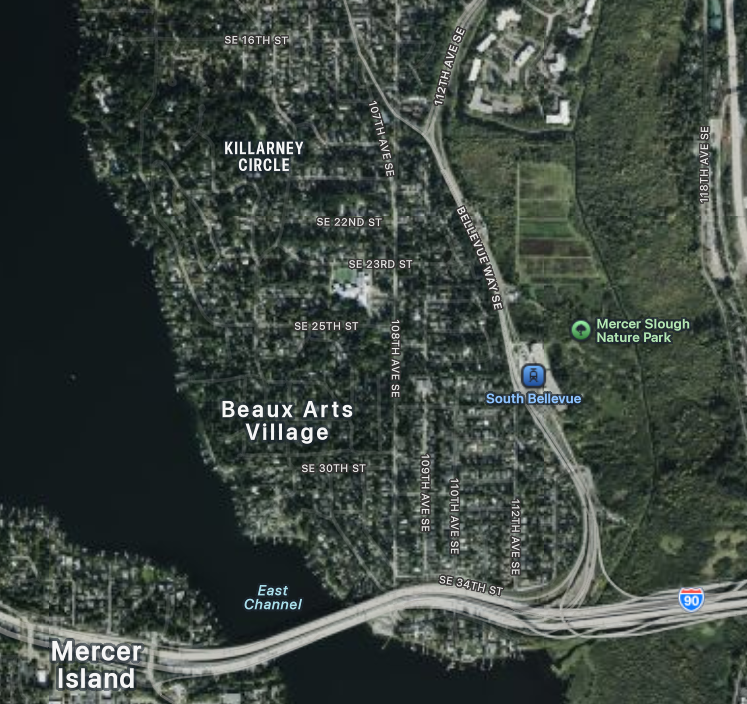
Clocking in at just 0.17 square miles, Beaux Arts Village is a town entirely ensconced within the City of Bellevue, a pocket of narrow, tree-lined streets where golf carts are more commonplace than apartment buildings. Founded in 1908 as an artist's colony, the town's initial boosters drew residents with advertisements in the Seattle Times touting the fledgling community as "an expedition into the realms of Utopia." The town's primary amenity is a 1,100 square foot stretch of beach, which only town property owners have access to as members of a separate, non-profit organization known as the Western Academy of Beaux Arts.
In 1954, Beaux Arts officially incorporated, to "protect the beach and the Village lifestyle," according to the town's website today. It had taken two years for Beaux Arts to reach the required 300-resident minimum necessary to be able to become a town, but just over seven decades later the population has only changed by six residents. Today, the median home value in Beaux Arts Village is $2.6 million.
In the decades since the implementation of Washington's 1990 Growth Management Act (GMA), the state-mandated growth plans in enclaves like Beaux Arts Village haven't traditionally been subjected to much scrutiny. But in 2025, the state legislature passed the Housing Accountability Act, empowering the Washington Department of Commerce to directly evaluate whether local jurisdictions are meeting the expectations laid out in state law when it comes to accommodating housing. Before that law was approved, the only avenue for a local Comprehensive Plan to be found inadequate was through a citizen appeal – though the state has sometimes taken the drastic step of making that appeal itself in extreme circumstances.
In January, Commerce announced that Beaux Arts Village had been selected as one of the first eight jurisdictions ever subjected to "selected review" under the Housing Accountability Act. As part of that review, agency staff have been tasked with determining whether all eight are in compliance with all aspects of the GMA, including new provisions that direct localities to plan for housing across different income levels – requirements that many cities have found vexing.

Beaux Arts' 2024 Comprehensive Plan was reviewed with a fine-toothed comb, and in June a preliminary report was issued to town officials that listed everything that needed to be adjusted to get into alignment with state law, in Commerce's view. That letter gave town officials their marching orders, and started the clock.
"We've been at it for nine months. We presented a Comp Plan that I think is in alignment with what everybody here will believe is keeping with what the village is, which has been much like the past three or four Comp Plans that we put together," Beaux Arts Councilmember Tom Stowe said Tuesday. "Commerce came in and shredded it, basically, and said that we couldn't do what we basically wanted."
Making room for...one home
Beaux Arts Village's share of Puget Sound's expected housing growth over the coming decades is not substantial. In fact, when King County handed out housing growth targets across all 39 cities and towns countywide in 2021 – an expectation of the number of new units to plan for through 2044 – the number was just one. Its neighbor Bellevue is planning for 35,000.
And yet the town's existing land use, intended to preserve a "tranquil, calm living environment" per the current Beaux Arts Village Comprehensive Plan, has presented certain challenges when it comes to growth plan compliance. Per a 2021 adjustment to the GMA known as House Bill 1220, Beaux Arts Village is required to plan for that one housing unit to be occupied by a household making 30% of King County's median area income or below – households that overall have the greatest difficulty finding housing.
30% of King County's median income is just under $40,000 for a family of two, and residents bringing in that little income cannot afford the single family homes that make up the vast majority of the town's housing stock, nor can they afford the backyard cottages that are allowed on those lots either.
To make it feasible to build at least one home that could be within reach to that future low-income household, Commerce recommended that Beaux Arts Village officials adjust zoning to allow some type of multifamily housing within their borders. Beaux Arts ultimately settled on the idea of creating a co-living "overlay." Co-living housing, also referred to as single-room occupancy (SRO) homes, provide the lowest rents even when built without any subsidy.
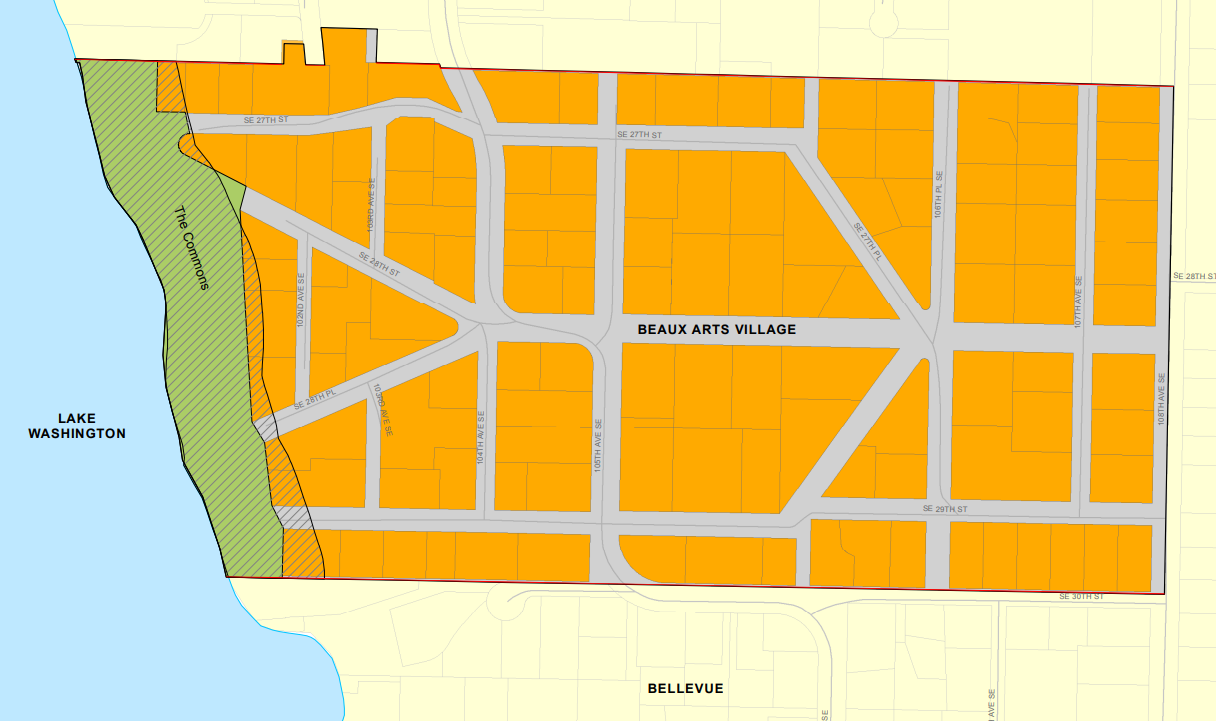
Though the idea of allowing six units of co-living housing just on one block of Beaux Arts Village was considered by the town planning commission, but counting on six property owners to build that specific type of housing would likely fall short of providing the necessary capacity. Instead, a proposal advanced that would allow co-living housing outside of the town's "erosion control hazard area" closest to Lake Washington.
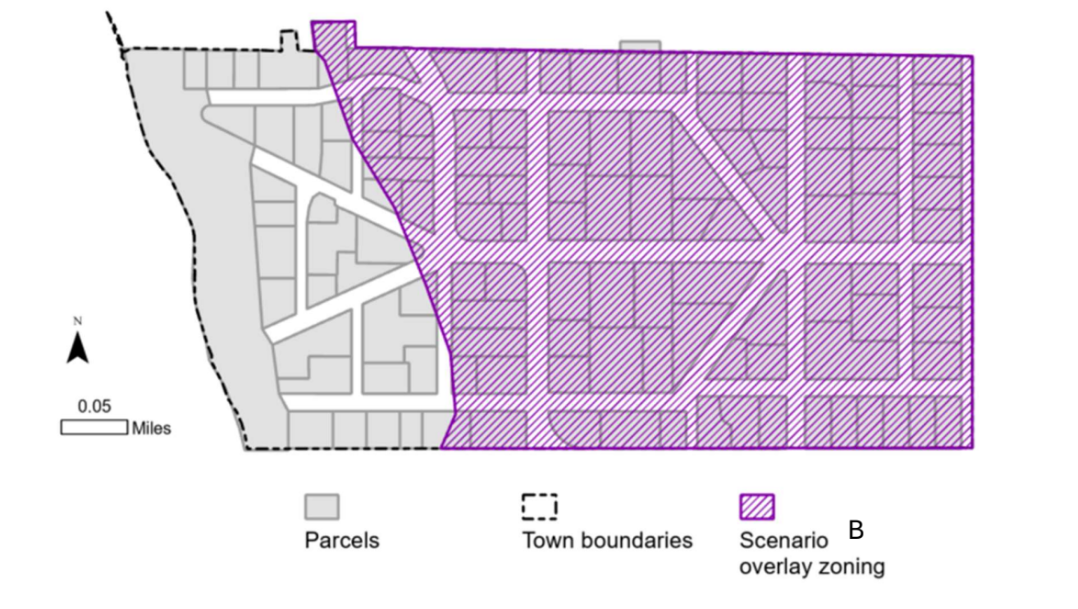
The Beaux Arts Village planning commission deadlocked 2-2 on the idea of scaling back Commerce's recommendation to allow six co-living units on all lots in the overlay, but the town council ultimately did scale that number back to four. The fewer units allowed in the overlay, the less likely that it is that any actual co-living projects will get built – an outcome that did come up Tuesday.
"If we think this is about somebody coming in and building, nobody is going to build this," Councilmember Stacy Saal said.
A crowded dining room
As a town of its size, there is no Beaux Arts Village town hall – just a town mailbox. Town council meetings take place in a rotating councilmember's home, which is how a dining room and adjoining kitchen was transformed into a public meeting room last week for the monthly town council. Twenty to thirty Beaux Arts residents packed into the space, standing in the hallway or sitting on the floor as their elected representatives debated town matters, including whether to get in compliance with state housing law.
The big incentive for councilmembers to act and adopt the interim ordinance, which will expire February 4, was the stick included in the Housing Accountability Act. In addition to being disqualified for some state grants, cities and towns deemed to be out of compliance with the GMA trigger what is known as the Builder's Remedy.
A brand new provision in state law, the Builder's Remedy requires the approval of any complete building permit – no matter whether the underlying project conflicts with the underlying zoning for the site, as long as certain requirements for on-site affordable units are met. Theoretically, this could lead to a ten story apartment building in Beaux Arts Village, as long as a subset of the new units are kept within certain rents.

"If we don't do this tonight, as you all remember, the consequence is we go out of compliance, and the low income builder remedy kicks in, and any low income builder comes in and can submit plans that totally ignore our zoning code, they can come in and build whatever they want," Beaux Arts Mayor Aletha Howes the crowd in attendance on Tuesday. "The only thing they have to follow is setbacks and tree code. Everything else is blown out of water."
So far no jurisdiction has actually triggered the Builder's Remedy, with Carnation getting fully into compliance earlier this summer, and Bainbridge Island going the same route as Beaux Arts and approving a temporary ordinance a few days after Carnation. But in Beaux Arts just as there was on Bainbridge Island, some voices pushed for a more oppositional stance against state review.
During Tuesday's public hearing, local resident Dan Bridges urged councilmembers to take a more adversarial position.
"Well-meaning councils and boards sometimes lose sight of the fact that public agencies, state agencies – who we trust, like our parents, right? – they're still political agencies, and they have an agenda and they have a point of view. That point of view is not always the correct point of view," Bridges said. "Having an outside [entity] of coming to advocate for us would be helpful. And I would suggest if you haven't done that yet, you might consider doing that and not simply accept what some state agency is telling you. Only a judge is the one who decides the law."
For now at least, Beaux Arts Village has deemed the path of least resistance to be compliance.
"It is not that we are not receptive of what we're hearing," Stowe told public commenters. "It's that we quite frankly are up against them to comply, or they're going to go over us and say you have no authority and allow whatever zoning or buildings they say under the code – under Commerce's interpretation of the code, which has not necessarily been ours – and we have pointed that out that we don't read the law the same way they do."
Pushing for change in Olympia
As one of the first jurisdictions being put under the Housing Accountability Act microscope, Beaux Arts officials expressed clear frustration at the process of state review over the past few months.
They're not alone in that frustration. When members of the Carnation City Council held a public hearing with the Department of Commerce in July, many of the same concerns raised in Beaux Arts surfaced – about staff time, not an insignificant issue for a small city or town, and confusion over the purpose of the new law.
"Is this supposed to be helpful for us?," Carnation deputy Mayor Jessica Merizan asked Commerce staff at that July 9 meeting. "Because it really seems like you've pulled a lot of staff time, and the point seems to be saving staff time because these types of errors are happening. It just kind of feels like this is a teacher double-checking work, and not necessarily, these are areas of the community, in the region that perhaps need support, and we're here to offer that."

In Beaux Arts Village, Howes directly referred to what the Commerce department had been tasked with doing as "overreach" and called the idea of the state forcing local officials to spend scarce staff time on that review as an "unfunded mandate" that she called "bullshit."
"I am still pursuing the legislative changes in the next session with [Representative] Zahn, [Representative Thai], and [the Association of Washington Cities] is still pushing the seven legal arguments that we brought to them, and the seven other cities are also pushing to get those changes," Howes said, noting the temporary ordinance's four-month duration. "So if something moves during that time frame, then we can amend. If something doesn't move and it goes to final...you know, we'll see how the legislative session goes in '27."
Meanwhile, five additional cities and towns – including Woodway, Darrington, Gold Bar, Brier, and DuPont – are still in the process of coming into compliance, work that was spurred on by the Housing Accountability Act. And then next year, a whole new slate of jurisdictions will be announced.
 Ryan Packer
 Ryan Packer