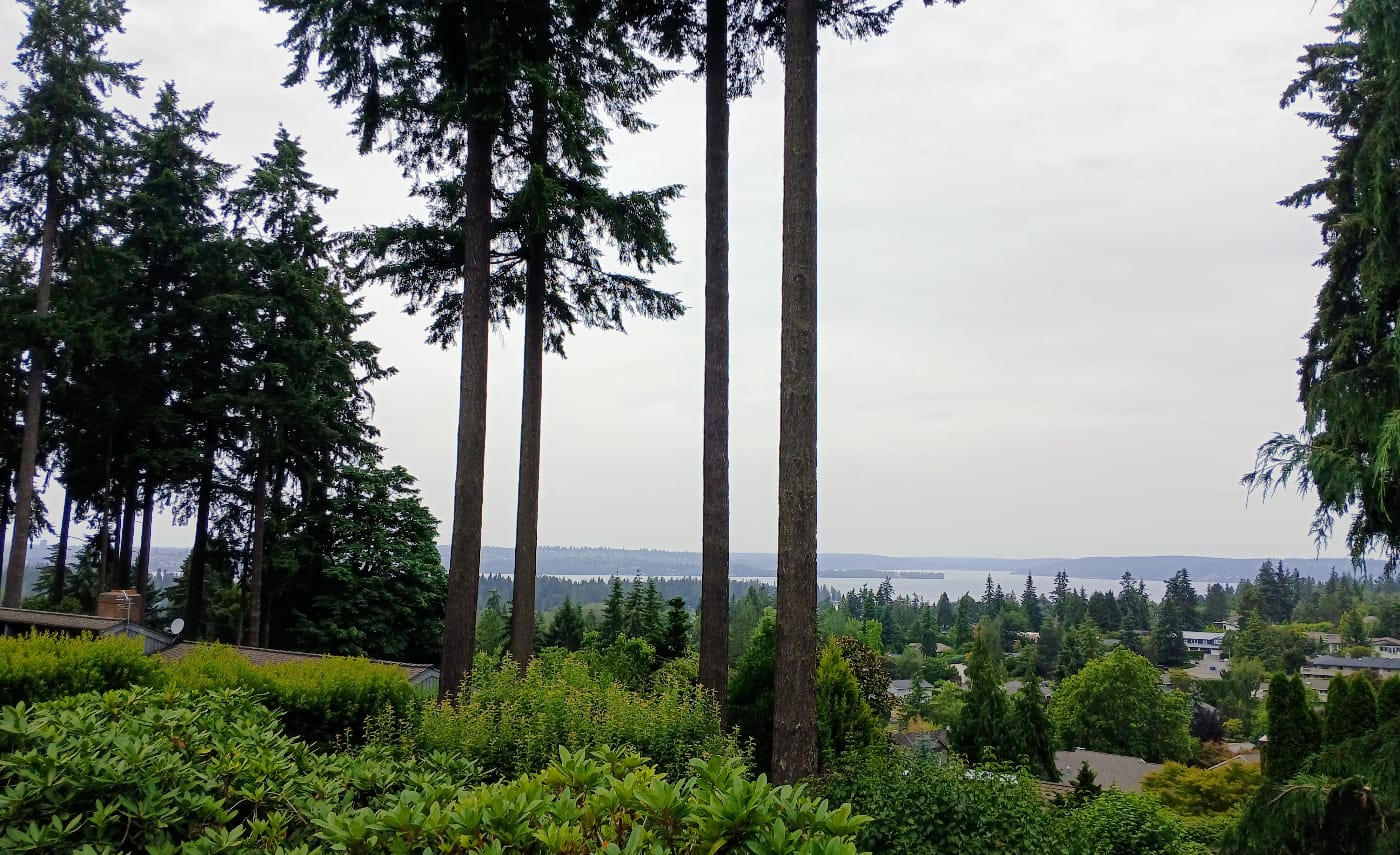
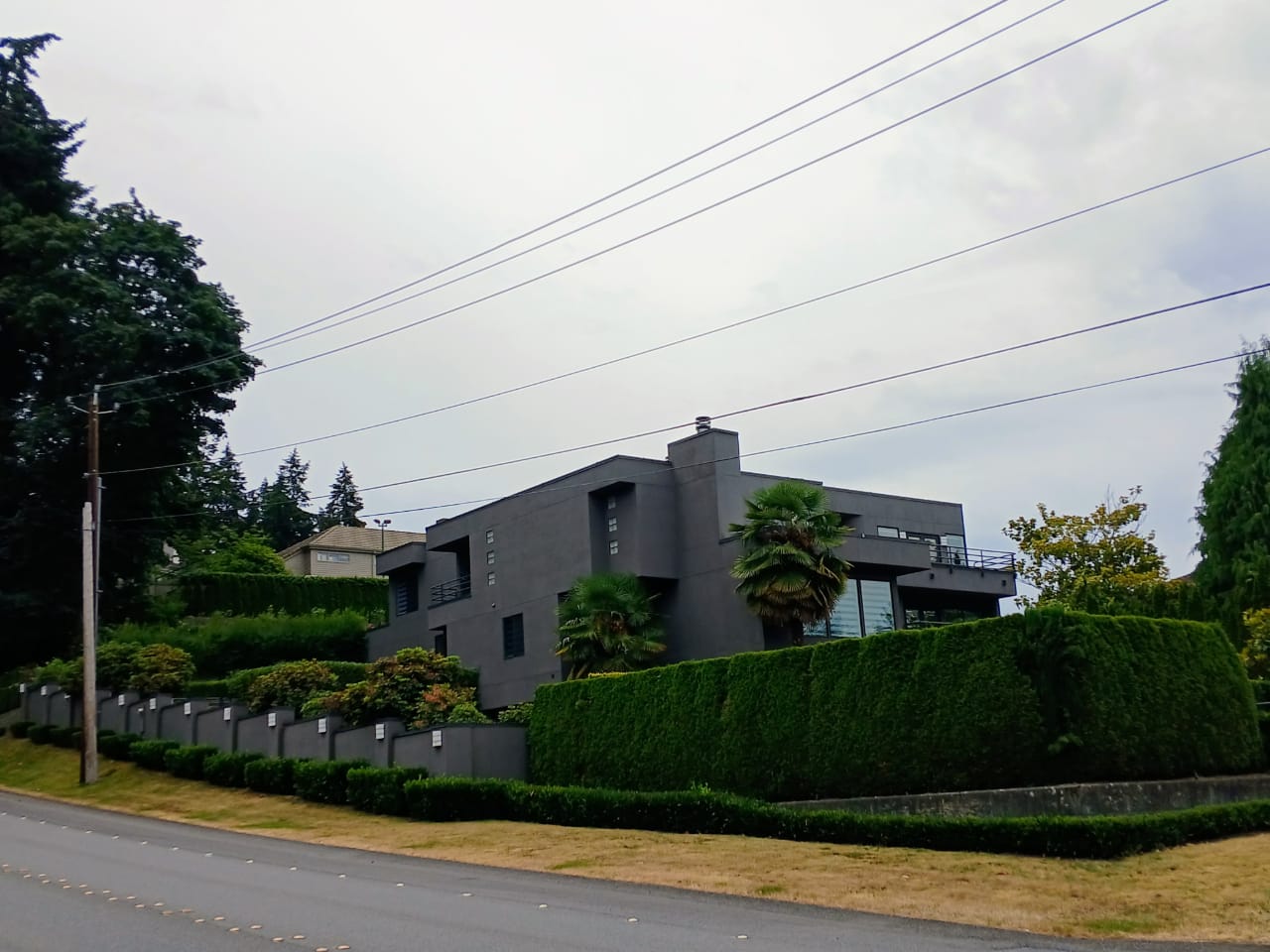
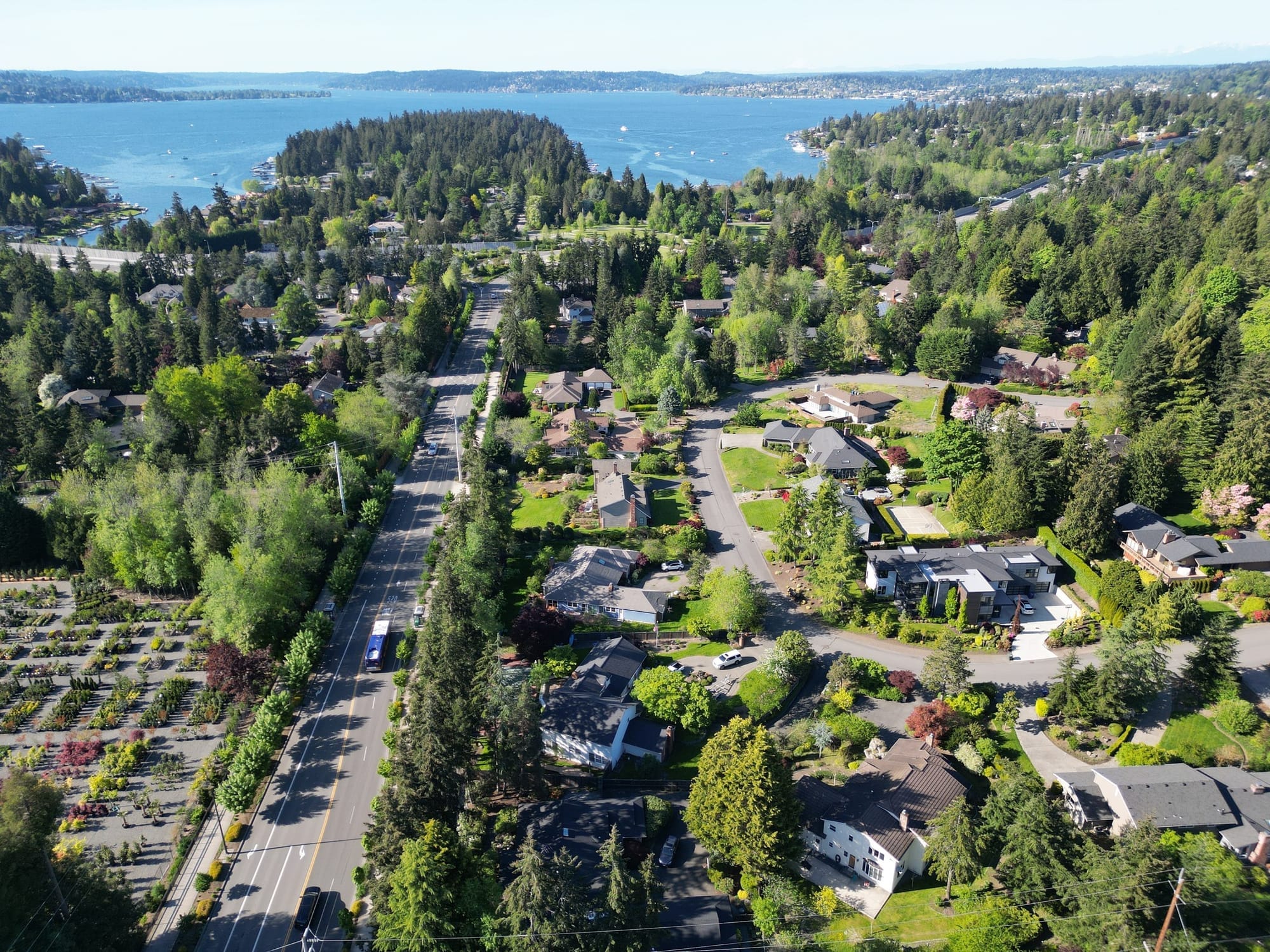
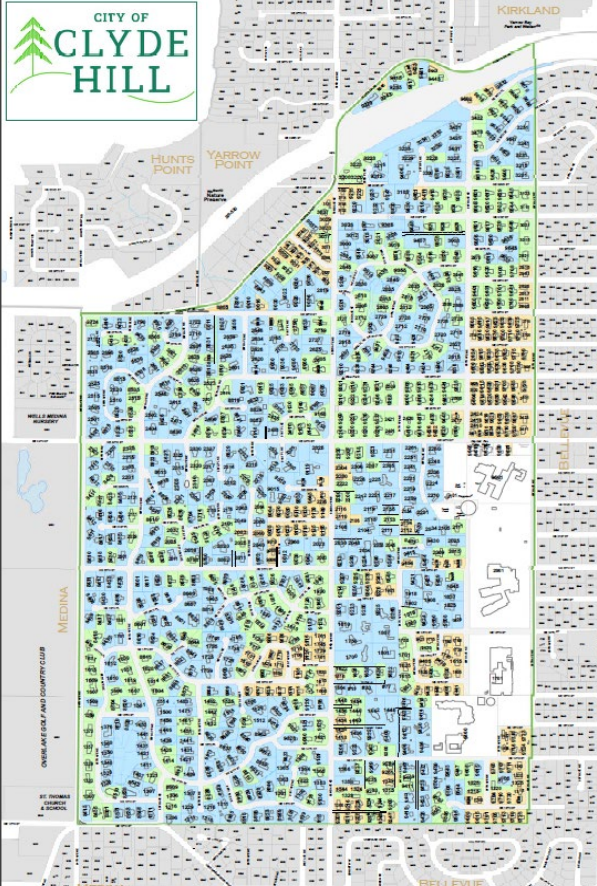
The tucked-away enclave of Clyde Hill is poised to create a new affordable housing incentive program, prompted by a legal challenge that city leaders have been attempting to settle for over a year. The modest tweak to its land use code, considered at a public hearing last week at the Clyde Hill planning commission, would grant property owners slightly more building rights in exchange for furthering the city's state-mandated affordable housing requirements.
Clyde Hill officials are set to sign onto this idea, slightly chipping away at the stringent zoning requirements that the city has touted for decades, in order to avoid a state growth board ruling that could potentially tear apart that armor even further. The adjustment illustrates the ways that relatively recent changes in state law continue to prompt even Washington's most exclusive jurisdictions to make moves to respond to a statewide housing shortage and affordability crisis.
The Urbanist's Fall Member Drive is in full swing! Support our work, read ad-free, and help us hit our goal for the member drive!
Last April, the land use advocacy nonprofit Futurewise filed an appeal against Clyde Hill's newly adopted Comprehensive Plan, targeting shortcomings that mirrored those alleged in the group's appeal of the growth plan in nearby Mercer Island. The appeal asserted that Clyde Hill had failed "to document programs and actions needed to achieve housing availability including gaps in local funding," responding to a 2021 law that requires cities to plan for future residents across all income bands, among other requirements.
If Clyde Hill is able to reach a settlement, it will avoid having to defend its entire growth framework at a hearing at the state's Growth Management Hearings Board.
"We haven't had that hearing yet because shortly after the growth board challenge was brought by Futurewise, we entered into settlement discussions with them, and have been trying to create a compromise where maybe they don't get everything they're asking for in their petition," Clyde Hill City Attorney Jeff Taraday said Thursday. "But we change at least some of what they want us to change, and then as a result of that, we avoid having to actually have that hearing before the board, which is costly and, as with any litigation, fraught with some amount of uncertainty."
For a small city like Clyde Hill, with a median income of around $483,000 and virtually no land zoned for multifamily housing, the idea of "making adequate provisions" for households making a fraction of that amount has been a confounding one. Through 2044, the city has been required to plan for 10 new units of housing, a modest target in scale, but all of those units are aimed at households making less than 100% of broader King County's area median income (AMI), with three of those units targeted at households making less than 30% of AMI – approximately $40,000 for a family of two. Those type of units only get built with significant public subsidy.
Under the plan that was forwarded to the Clyde Hill Council by its Planning Commission Thursday, property owners who agree to build an accessory dwelling unit (ADU) on their property that is rented to a household earning at or below 50% of King County's area median income for a period of 20 years would be able to increase structural lot coverage – the amount of space on a lot taken up by buildings – from the 30% cap currently in the code to 40%.
Alternatively, that 40% structural lot coverage could be achieved by paying a fee "in lieu" of building the unit, of a flat $400,000. Those funds would then be collected by the city and used to subsidize affordable units elsewhere, likely outside the city via A Regional Coalition for Housing (ARCH).
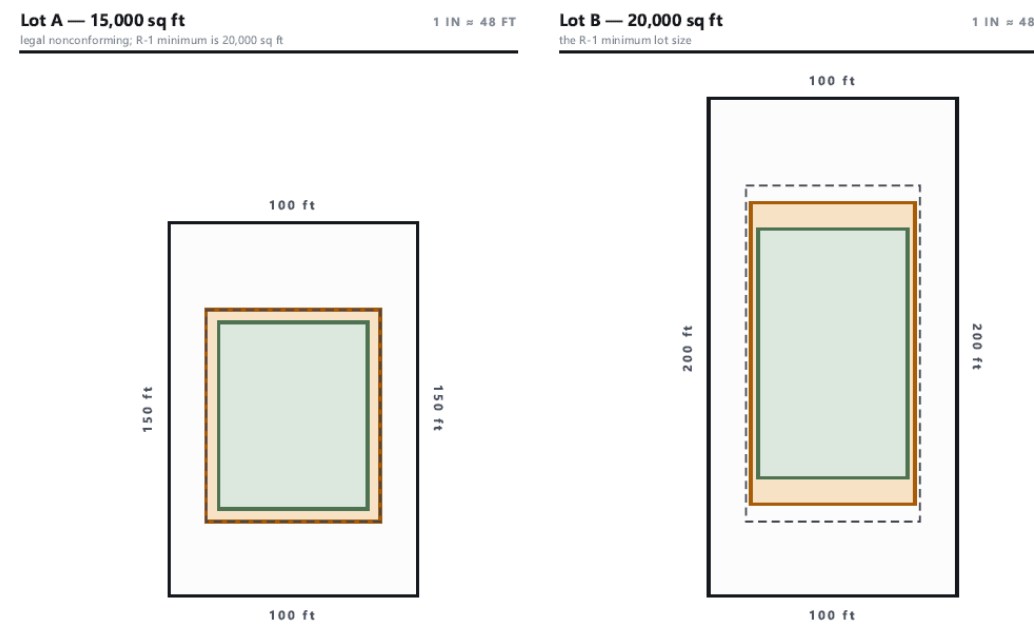
The initial proposal, presented to the planning commission in August, also had additional building rights in the package, including a decreased rear-yard setback (from 35 feet to 20) and a decreased side-yard setback (from 15 feet to 10) on lots larger than 1,500 square feet. In addition, detached ADUs would have been allowed to rise to 25 feet tall compared to the current 12 feet. But those provisions ended up on the cutting room floor, in large part due to concerns over potential impacts on neighboring properties.
"I would rather live next door to a house that is a little bigger than I thought it was going to be than I would live next door to a house that is now five feet closer to me," commission chair Jared Wheeler said last month.
After scaling back the program to only include lot coverage, the proposal now appears to be viewed as the type of pill that Clyde Hill can swallow to get into compliance with state law.
"I sympathize with the concern about people's views being affected, but the state has mandated that we do more for affordable housing, this isn't our choice, and it appears that the majority of the burden is going to fall on the people who choose to either move here and build or build new houses," commissioner Spencer Hamlin said during Thursday's hearing.
Clyde Hill policymakers admitted they would like to mandate protection of views for homeowners, but that they realize state law likely precludes that approach.
"I think that the view encroachment is not good, but it's something that the people with existing houses are going to have to shoulder and bear, essentially, as part of them also accepting that this is the consequence of the state law," Hamlin said. "How do we spread out, fairly, all of the costs of this? I don't want my view encroached on either. Nobody does, but I don't see a reasonable scenario where you could do this and mandate protection of views. You'd have to blow up our building code."
So where did the $400,000 number, which one planning commissioner referred to a a developer's "golden ticket" to build a larger house on a lot in Clyde Hill, come from? Clyde Hill City Administrator Heather Thomas-Murphy said that it was developed in conjunction with ARCH, and is roughly tied to the cost to build one unit of affordable housing in the region.
"There's a lot of variables around the dollar amounts, but in general, they said $400,000 would be a justifiable number," Thomas-Murphy said. "The question is, what type of unit are we building, and where are we building it? It's more expensive to build in Clyde Hill than it is in some of our neighboring properties, but they said $400,000 was a good start."
A motion to lower the fee to $200,000 died at last week's meeting for lack of a second.
Thomas-Murphy told commissioners that Futurewise had indicated "conceptual support" for the proposal.
"With settlement discussions ongoing, we're limited in what we can say about the City's draft," Futurewise spokesperson Cat Huber told The Urbanist, instead pointing to the public ruling against Mercer Island from last summer. "Since HB 1220, a city must identify land capacity for housing at each income level rather than in aggregate. Wherever a city counts on incentives or voluntary programs to produce that housing, the record must show how many units, at what income levels, or how much revenue those incentives can be expected to generate."
Futurewise sees its role as a "leading statewide public interest watchdog and legal steward of Washington's Growth Management Act" or GMA, which state lawmakers passed in 1990 to rein in suburban sprawl.
"Mercer Island's compliance filing, which is public, shows the kind of analysis that was put in that record," Huber continued. "That is the framework that applies to any jurisdiction's program, whatever form it takes. Futurewise continues to work collaboratively with Clyde Hill on solutions that meet GMA housing requirements and contribute to long-term community wellbeing."
Over its three plus decades of existence, the GMA has been relatively effective at limiting sprawl, but it's taken recent reforms to boost effectiveness at encouraging dense housing development within the urban growth boundary the law generated.
Clyde Hill is far from the only city getting nudged in this way. Futurewise is also negotiating a potential settlement with nearby Hunts Point, while the state's Department of Commerce remains in negotiations with Duvall after that city's Comprehensive Plan tried to sidestep many of these new requirements entirely. Meanwhile, the 2025 Housing Accountability Act created a new avenue of direct state review of housing growth plans, entirely outside of the Growth Management Hearings Board process.
The Clyde Hill City Council is expected to formally take up the affordable housing incentive program in November.
 Ryan Packer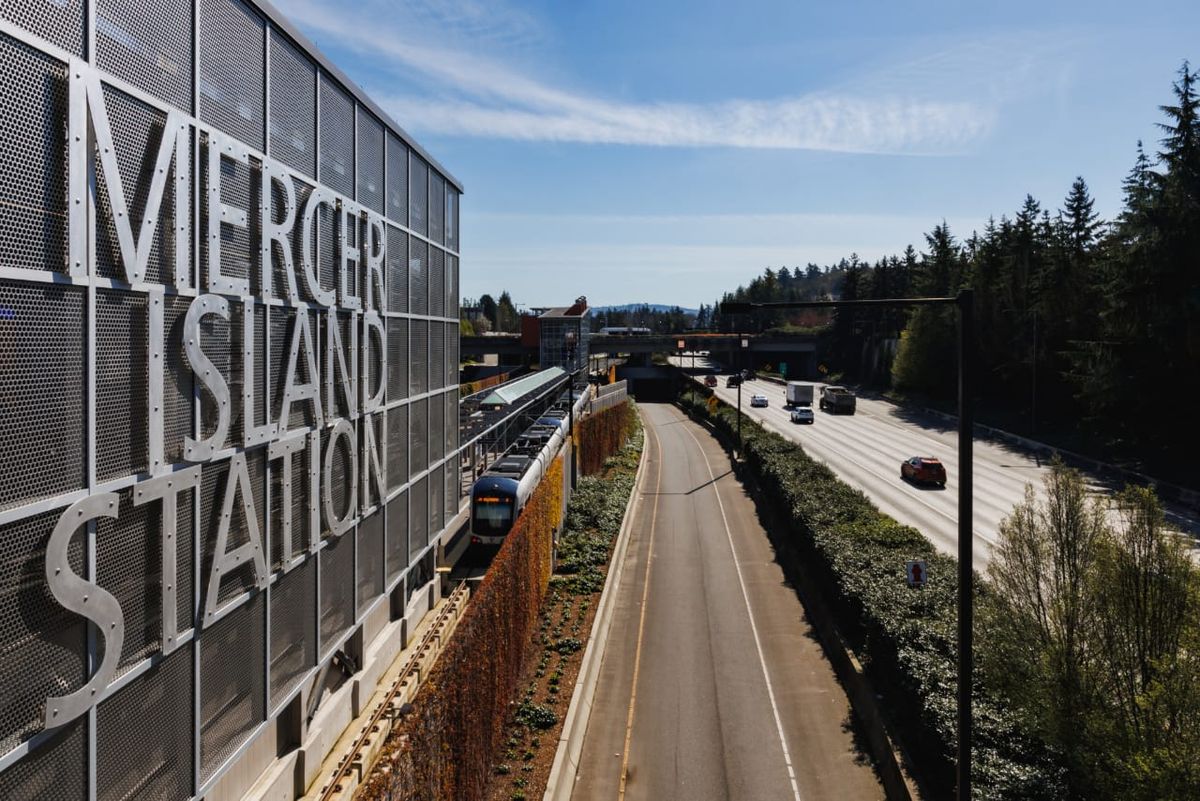
 Ryan Packer